


 Home
HomeGoogle harnesses historical news data and AI to forecast flash floods
Flash floods rank as some of the planet's most lethal weather phenomena, claiming over 5,000 lives annually. They are also notoriously challenging to forecast. Google, however, believes it has found a novel solution to this problem: by analyzing news reports.
While humanity has amassed vast amounts of meteorological data, flash floods are too brief and localized to be systematically measured, unlike temperature or river flow trends tracked over time. This data deficiency hinders deep learning models, even as they grow more adept at general weather prediction, from accurately forecasting flash floods.
To bridge this gap, Google researchers employed Gemini—the company's large language model—to sift through 5 million global news articles. The process identified reports of 2.6 million distinct flood events, converting them into a geotagged timeline named "Groundsource." According to Gila Loike, a Google Research product manager, this marks the company's first use of language models for such a purpose. The research and data set were made public on Thursday morning.
Using Groundsource as a real-world benchmark, the team trained a model based on a Long Short-Term Memory (LSTM) neural network. This model processes global weather forecasts to generate probability estimates for flash floods in specific locations.
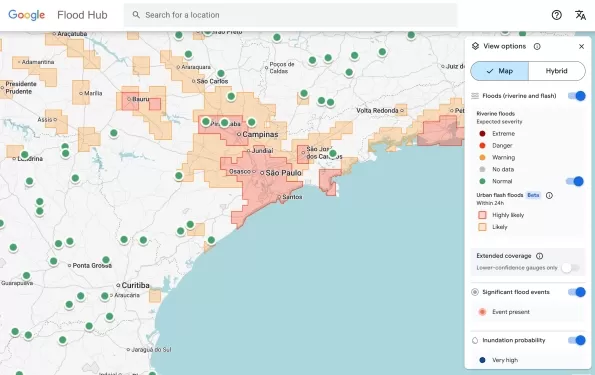
Google's flash flood forecasting model now identifies risks for urban areas across 150 countries on its Flood Hub platform and shares this data with emergency response agencies worldwide. António José Beleza, an emergency response official with the Southern African Development Community who participated in a trial of the model, stated it significantly improved his organization's response speed to flood events.
The model does have current limitations. Its resolution is relatively broad, assessing risk across 20-square-kilometer zones. It is also less precise than systems like the US National Weather Service's flood alerts, partly because it does not integrate local radar data for real-time precipitation tracking.
A key objective of the project, however, was to create a solution for regions where local governments lack the resources for costly weather-sensing infrastructure or detailed historical meteorological records.
"By aggregating millions of reports, the Groundsource data set helps rebalance the global map," explained Juliet Rothenberg, a program manager on Google's Resilience team. "It allows us to extrapolate insights to other regions with far less available information."
Rothenberg added that the team hopes this methodology—using LLMs to create quantitative data sets from qualitative, written sources—can be applied to other ephemeral but critical forecasting challenges, such as heat waves and mudslides.
Marshall Moutenot, CEO of Upstream Tech, a firm using similar deep learning for river flow forecasts for clients like hydropower companies, views Google's work as part of a broader push to compile data for AI-driven weather models. Moutenot also co-founded dynamical.org, a group curating machine learning-ready weather data for researchers and startups.
"Data scarcity remains one of the toughest hurdles in geophysics," Moutenot noted. "Paradoxically, there's an overabundance of Earth data, yet a shortage of validated ground truth for evaluation. This was a highly creative approach to acquiring that essential data."
Related article
 Stripe to Acquire OpenRouter as AI Model Routing Gains Momentum
Stripe has agreed to acquire OpenRouter, an AI model-routing platform that gives developers access to hundreds of models through a single interface. The deal adds model selection and routing to Stripe’s existing work around AI usage and token-based b
Former OpenAI Researcher Barrett Zoph Returns to Google to Support Gemini Development
Barret Zoph, who previously abruptly left and joined OpenAI due to a disagreement with Thinking Machines Lab CEO Miriam Mularati, has once again changed employers. Alphabet's Google announced that Zoph will return as Vice President of Research, bring
How Recursive Intelligence Raised $335M at $4B Valuation in 4 Months
The co-founders of startup Ricursive Intelligence seemed destined to be co-founders.Anna Goldie, CEO, and Azalia Mirhoseini, CTO, are so well-known in the AI community that they were among those AI engineers who “got those weird emails from Zuckerber
Related Special Topic Recommendations
Design & Art
Stripe to Acquire OpenRouter as AI Model Routing Gains Momentum
Stripe has agreed to acquire OpenRouter, an AI model-routing platform that gives developers access to hundreds of models through a single interface. The deal adds model selection and routing to Stripe’s existing work around AI usage and token-based b
Former OpenAI Researcher Barrett Zoph Returns to Google to Support Gemini Development
Barret Zoph, who previously abruptly left and joined OpenAI due to a disagreement with Thinking Machines Lab CEO Miriam Mularati, has once again changed employers. Alphabet's Google announced that Zoph will return as Vice President of Research, bring
How Recursive Intelligence Raised $335M at $4B Valuation in 4 Months
The co-founders of startup Ricursive Intelligence seemed destined to be co-founders.Anna Goldie, CEO, and Azalia Mirhoseini, CTO, are so well-known in the AI community that they were among those AI engineers who “got those weird emails from Zuckerber
Related Special Topic Recommendations
Design & Art
 Top AI Illustration Tools: Create Editorial Scenes and Cover Art Faster
2026 Latest Top-rated AI Illustration Tools: Our curated list features the best powerfully designed tools for creating stunning editorial scenes and eye-catching cover art quickly. Each option has gone through rigorous real-world tests, offering a free vs paid comparison to help you find the perfect match for your workflow. Try these must-try solutions today to unlock your AI edge and boost your creative productivity. Explore now at XIX.AI.
 10 tools
 xix.ai
Education and Learning
Top AI Tutors for Exam Prep: Practice Math, Science, and English
xix.ai
Education and Learning
Top AI Tutors for Exam Prep: Practice Math, Science, and English
2026 Latest Top-Rated Best AI Tutors for Exam Prep are here on XIX.AI! Our curated list features powerful game-changing tools that offer free vs paid comparison, real-world tests, and weekly updated rankings. They help boost your writing efficiency, simplify complex topic learning, and unlock your academic potential. Explore now to Discover your perfect exam prep tool and Start creating today to Unlock your AI edge!
10 tools
xix.ai
Finance
AI Budget Planning Tools for Personal Money Management
2026 Latest Best Top-Rated AI Budget Planning Tools for Personal Money Management are here on XIX.AI! This curated collection features powerful, game-changing solutions that help you conduct real-world tests, understand spending habits, and create personalized plans to boost productivity. Enjoy a free vs paid comparison along with detailed rankings. Must-try tools designed to simplify money management and unlock your AI edge. Explore now!
11 tools
xix.ai
Health & Wellness
AI Sleep Tracking Assistants: Improve Recovery with Better Bedtime Habits
2026 Latest Best Top-Rated AI Sleep Tracking Assistants curated for ultimate recovery. This fully updated weekly guide features powerful tools that deliver real-world tests, free vs paid comparison, and detailed rankings to help you find the must-try solution that boosts sleep quality and supports better bedtime habits. Explore now at XIX.AI to Unlock your AI edge.
10 tools
xix.ai
Data Analysis
AI SQL Copilots for Product and Revenue Analytics
2026 Latest Best Top-Rated AI SQL Copilots for Product and Revenue Analytics! XIX.AI has curated a powerful, game-changing collection of must-try tools that undergo real-world tests through weekly updated rankings. These tools help users boost productivity significantly by accelerating data analysis, streamlining complex queries, and generating accurate insights to drive smarter business decisions. Explore now to Discover your perfect tool for unlocking your AI edge!
14 tools
xix.ai
Education and Learning
Best AI Homework Helpers That Teach: Learn Concepts, Not Just Answers
2026 Latest Best Top-Rated AI Homework Helpers That Teach Core Concepts Not Just Answers Powerful Tools for Students Must-Try Curated List Weekly Updated Free vs Paid Comparison Real-World Tests Accurate Rankings to Help You Unlock Your Full Learning Potential Explore now to Discover your perfect tool for smarter studying.
10 tools
xix.ai

 Comments (2)
0/500
Comments (2)
0/500
![JosephScott]()
So Google's basically using old news articles to predict floods? That's wild. I mean, if it works, it could save thousands of lives, but I wonder how much historical data is actually reliable when weather patterns are changing so fast. 🌊🤔
![RalphJohnson]()
ニュース記事をAIで分析して洪水を予測するなんて、Googleらしい発想だね。でも、データの偏りやプライバシーは大丈夫?特に途上国のニュース網が不十分な地域では、精度に影響が出そう。それに、この技術が有料サービス化されたら、災害予測にお金がかかる世の中になるのかな…ちょっと怖いかも😅
Flash floods rank as some of the planet's most lethal weather phenomena, claiming over 5,000 lives annually. They are also notoriously challenging to forecast. Google, however, believes it has found a novel solution to this problem: by analyzing news reports.
While humanity has amassed vast amounts of meteorological data, flash floods are too brief and localized to be systematically measured, unlike temperature or river flow trends tracked over time. This data deficiency hinders deep learning models, even as they grow more adept at general weather prediction, from accurately forecasting flash floods.
To bridge this gap, Google researchers employed Gemini—the company's large language model—to sift through 5 million global news articles. The process identified reports of 2.6 million distinct flood events, converting them into a geotagged timeline named "Groundsource." According to Gila Loike, a Google Research product manager, this marks the company's first use of language models for such a purpose. The research and data set were made public on Thursday morning.
Using Groundsource as a real-world benchmark, the team trained a model based on a Long Short-Term Memory (LSTM) neural network. This model processes global weather forecasts to generate probability estimates for flash floods in specific locations.
Google's flash flood forecasting model now identifies risks for urban areas across 150 countries on its Flood Hub platform and shares this data with emergency response agencies worldwide. António José Beleza, an emergency response official with the Southern African Development Community who participated in a trial of the model, stated it significantly improved his organization's response speed to flood events.
The model does have current limitations. Its resolution is relatively broad, assessing risk across 20-square-kilometer zones. It is also less precise than systems like the US National Weather Service's flood alerts, partly because it does not integrate local radar data for real-time precipitation tracking.
A key objective of the project, however, was to create a solution for regions where local governments lack the resources for costly weather-sensing infrastructure or detailed historical meteorological records.
"By aggregating millions of reports, the Groundsource data set helps rebalance the global map," explained Juliet Rothenberg, a program manager on Google's Resilience team. "It allows us to extrapolate insights to other regions with far less available information."
Rothenberg added that the team hopes this methodology—using LLMs to create quantitative data sets from qualitative, written sources—can be applied to other ephemeral but critical forecasting challenges, such as heat waves and mudslides.
Marshall Moutenot, CEO of Upstream Tech, a firm using similar deep learning for river flow forecasts for clients like hydropower companies, views Google's work as part of a broader push to compile data for AI-driven weather models. Moutenot also co-founded dynamical.org, a group curating machine learning-ready weather data for researchers and startups.
"Data scarcity remains one of the toughest hurdles in geophysics," Moutenot noted. "Paradoxically, there's an overabundance of Earth data, yet a shortage of validated ground truth for evaluation. This was a highly creative approach to acquiring that essential data."








 Stripe to Acquire OpenRouter as AI Model Routing Gains Momentum
Stripe has agreed to acquire OpenRouter, an AI model-routing platform that gives developers access to hundreds of models through a single interface. The deal adds model selection and routing to Stripe’s existing work around AI usage and token-based b
Stripe to Acquire OpenRouter as AI Model Routing Gains Momentum
Stripe has agreed to acquire OpenRouter, an AI model-routing platform that gives developers access to hundreds of models through a single interface. The deal adds model selection and routing to Stripe’s existing work around AI usage and token-based b
 Former OpenAI Researcher Barrett Zoph Returns to Google to Support Gemini Development
Barret Zoph, who previously abruptly left and joined OpenAI due to a disagreement with Thinking Machines Lab CEO Miriam Mularati, has once again changed employers. Alphabet's Google announced that Zoph will return as Vice President of Research, bring
Former OpenAI Researcher Barrett Zoph Returns to Google to Support Gemini Development
Barret Zoph, who previously abruptly left and joined OpenAI due to a disagreement with Thinking Machines Lab CEO Miriam Mularati, has once again changed employers. Alphabet's Google announced that Zoph will return as Vice President of Research, bring
 How Recursive Intelligence Raised $335M at $4B Valuation in 4 Months
The co-founders of startup Ricursive Intelligence seemed destined to be co-founders.Anna Goldie, CEO, and Azalia Mirhoseini, CTO, are so well-known in the AI community that they were among those AI engineers who “got those weird emails from Zuckerber
How Recursive Intelligence Raised $335M at $4B Valuation in 4 Months
The co-founders of startup Ricursive Intelligence seemed destined to be co-founders.Anna Goldie, CEO, and Azalia Mirhoseini, CTO, are so well-known in the AI community that they were among those AI engineers who “got those weird emails from Zuckerber

2026 Latest Top-rated AI Illustration Tools: Our curated list features the best powerfully designed tools for creating stunning editorial scenes and eye-catching cover art quickly. Each option has gone through rigorous real-world tests, offering a free vs paid comparison to help you find the perfect match for your workflow. Try these must-try solutions today to unlock your AI edge and boost your creative productivity. Explore now at XIX.AI.
10 tools
xix.ai

2026 Latest Top-Rated Best AI Tutors for Exam Prep are here on XIX.AI! Our curated list features powerful game-changing tools that offer free vs paid comparison, real-world tests, and weekly updated rankings. They help boost your writing efficiency, simplify complex topic learning, and unlock your academic potential. Explore now to Discover your perfect exam prep tool and Start creating today to Unlock your AI edge!
10 tools
xix.ai

2026 Latest Best Top-Rated AI Budget Planning Tools for Personal Money Management are here on XIX.AI! This curated collection features powerful, game-changing solutions that help you conduct real-world tests, understand spending habits, and create personalized plans to boost productivity. Enjoy a free vs paid comparison along with detailed rankings. Must-try tools designed to simplify money management and unlock your AI edge. Explore now!
11 tools
xix.ai

2026 Latest Best Top-Rated AI Sleep Tracking Assistants curated for ultimate recovery. This fully updated weekly guide features powerful tools that deliver real-world tests, free vs paid comparison, and detailed rankings to help you find the must-try solution that boosts sleep quality and supports better bedtime habits. Explore now at XIX.AI to Unlock your AI edge.
10 tools
xix.ai

2026 Latest Best Top-Rated AI SQL Copilots for Product and Revenue Analytics! XIX.AI has curated a powerful, game-changing collection of must-try tools that undergo real-world tests through weekly updated rankings. These tools help users boost productivity significantly by accelerating data analysis, streamlining complex queries, and generating accurate insights to drive smarter business decisions. Explore now to Discover your perfect tool for unlocking your AI edge!
14 tools
xix.ai

2026 Latest Best Top-Rated AI Homework Helpers That Teach Core Concepts Not Just Answers Powerful Tools for Students Must-Try Curated List Weekly Updated Free vs Paid Comparison Real-World Tests Accurate Rankings to Help You Unlock Your Full Learning Potential Explore now to Discover your perfect tool for smarter studying.
10 tools
xix.ai

So Google's basically using old news articles to predict floods? That's wild. I mean, if it works, it could save thousands of lives, but I wonder how much historical data is actually reliable when weather patterns are changing so fast. 🌊🤔
ニュース記事をAIで分析して洪水を予測するなんて、Googleらしい発想だね。でも、データの偏りやプライバシーは大丈夫?特に途上国のニュース網が不十分な地域では、精度に影響が出そう。それに、この技術が有料サービス化されたら、災害予測にお金がかかる世の中になるのかな…ちょっと怖いかも😅












