


 Home
HomeGoogle Gemini Launches Memory Import for One-Click AI Migration Across Platforms
For heavy AI users, one of the most frustrating parts of switching platforms is having to retrain the assistant's "personality." Now, Google is working to break through this barrier with a new feature.
On March 27, Google's AI assistant Gemini officially launched the "Memory Import" feature. Users can quickly transfer their conversation history and personal preferences from other AI assistants, completely removing the hassle of retraining AI habits when switching platforms.
Two Pathways: From "Summary Sync" to "Large File Transfer"
To meet different migration needs, Gemini has introduced two core solutions in this update:
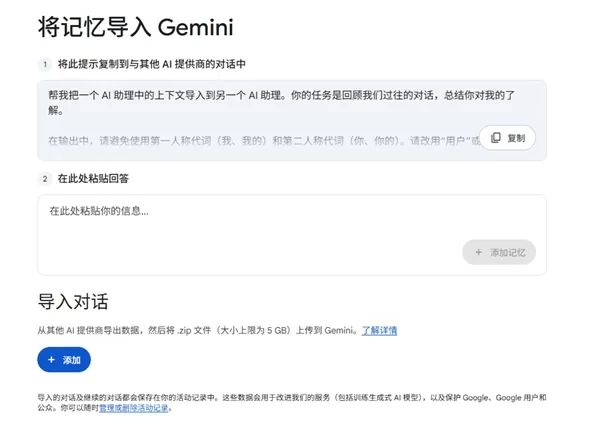
Keyword Copy Migration: This is a lightweight "mental sync." Users simply run specific keywords in the original AI chat window to have it summarize its understanding of them—such as communication style, career background, and common preferences—then paste the generated summary into Gemini to complete the initial profile.
Batch Import of Chat Data: For users who want to retain complete interaction history, Gemini supports exporting chat data from other providers and uploading it. This feature supports zip files up to 5GB, preserving long-term interaction details so the new assistant can quickly adapt to the user's style.
Addressing Pain Points: Giving AI "Continuity"
The memory import feature solves the core pain point for users switching AI platforms. Previously, every time they switched tools, users had to re-explain their work requirements, schedule habits, and even creative styles, resulting in significant efficiency losses.
With this feature, Gemini can quickly take over users' previous creative projects and even continue specific language habits, truly achieving seamless integration of AI services.
Privacy and Control: Users Maintain Oversight of Their Data
While enhancing convenience, data security remains a priority:
Data Usage: Google clearly states that imported conversations and subsequent interactions will be stored in activity records, used to optimize services and train models.
Management Control: Users have full control, able to view, manage, or delete these activity records at any time, ensuring their personal information stays secure.
Conclusion: AI Competition Enters the "User Retention" Era
As Gemini first opens the "memory transfer" channel, competition among AI assistants is evolving from simple feature comparisons to user experience continuity. When the cost of switching platforms is minimized, what truly retains users is that "personalized memory" that understands them best.
Related article
 DeepMind CEO Hassabis: I sleep six hours a day, usually feel energetic around 1 a.m.
Fortune recently featured an interview with Demis Hassabis, CEO of Google DeepMind, revealing his unconventional approach to rest and productivity. Hassabis disclosed that he sleeps very little, structuring his waking hours into two distinct work blo
OpenAI, Anthropic Vie for Market Share Despite Revenue Shortfalls
Despite recent reports suggesting OpenAI missed revenue targets, creating pressure on tech stocks this Tuesday, private AI lab investors remain resilient. Seasoned backers have confirmed they will not reduce investment despite negative media coverage
California AV Compliance: A New Era of Tickets, Geofences, and 1M Miles
Guident operates an AuveTech shuttle in South Florida, managing a four-mile route in West Palm Beach and a one-mile route in Boca Raton using its remote monitoring technology. | Credit: GuidentCalifornia is redefining the regulatory landscape for dri
Related Special Topic Recommendations
Music composition
DeepMind CEO Hassabis: I sleep six hours a day, usually feel energetic around 1 a.m.
Fortune recently featured an interview with Demis Hassabis, CEO of Google DeepMind, revealing his unconventional approach to rest and productivity. Hassabis disclosed that he sleeps very little, structuring his waking hours into two distinct work blo
OpenAI, Anthropic Vie for Market Share Despite Revenue Shortfalls
Despite recent reports suggesting OpenAI missed revenue targets, creating pressure on tech stocks this Tuesday, private AI lab investors remain resilient. Seasoned backers have confirmed they will not reduce investment despite negative media coverage
California AV Compliance: A New Era of Tickets, Geofences, and 1M Miles
Guident operates an AuveTech shuttle in South Florida, managing a four-mile route in West Palm Beach and a one-mile route in Boca Raton using its remote monitoring technology. | Credit: GuidentCalifornia is redefining the regulatory landscape for dri
Related Special Topic Recommendations
Music composition
 AI Stem Separation Tools for Remix Production, Sampling Prep, and Karaoke Masters
2026 Latest Best Top-rated AI Stem Separation Tools Curated for Remix Production, Sampling Prep, and Karaoke Masters. These powerful game-changing tools offer real-world tests to deliver precise audio isolation, boosting productivity significantly. XIX.AI provides a weekly updated free vs paid comparison guide to help you find the must-try solution that suits your needs. Explore now to unlock your AI edge.
 8 tools
 xix.ai
Data Analysis
AI SQL Copilots for Revenue Dashboards, Funnel Analysis, and Product Metrics
xix.ai
Data Analysis
AI SQL Copilots for Revenue Dashboards, Funnel Analysis, and Product Metrics
2026 Latest Best AI SQL Copilots Ranked Top-Rated! XIX.AI curates a powerful game-changing collection for weekly updated real-world tests. These must-try tools help you generate accurate revenue dashboards, analyze sales funnels, and track product metrics swiftly, boosting productivity massively. Explore now to Discover your perfect tool for data-driven decision making! 238 characters
9 tools
xix.ai
Music composition
Best AI Melody Writing Tools for Song Drafts
2026 Latest Best Top-Rated AI Melody Writing Tools for Song Drafts! XIX.AI has curated a highly powerful game-changing collection that goes through rigorous real-world tests to deliver the best writing experience. You can find detailed free vs paid comparisons, accurate rankings, and must-try options designed to help you create stunning song drafts effortlessly and boost your creative productivity significantly. Explore now to discover your perfect tool!
8 tools
xix.ai
chatbot
Best AI Conversation Trainer Tools for Interview Practice
2026 Latest Best Top-rated AI Conversation Trainer Tools for Interview Practice are here on XIX.AI! This curated collection features powerful, game-changing tools that go through rigorous real-world tests to deliver accurate feedback. You’ll find a free vs paid comparison and detailed rankings to help you choose the must-try option that boosts your confidence and skills. Explore now to Discover your perfect tool for interview success!
12 tools
xix.ai
Design & Art
Best AI Style Transfer Tools for Creative Experiments
2026 Latest Best Top-rated AI Style Transfer Tools for Creative Experiments! XIX.AI has curated a powerful, game-changing collection of must-try tools that deliver exceptional results through real-world tests and rigorous rankings. These top solutions help creatives boost productivity significantly by accelerating content creation and unlocking endless creative possibilities. Explore now to discover your perfect tool and start creating today!
9 tools
xix.ai
Comic Creation
Best AI Dialogue Bubble Tools for Visual Storytelling
2026 Latest Best Top-Rated AI Dialogue Bubble Tools for Visual Storytelling are here on XIX.AI! This curated collection features powerful, game-changing tools that help creators boost productivity and overcome creative bottlenecks. Get a free vs paid comparison, see real-world tests, and check the latest rankings to find the must-try solutions perfect for crafting engaging visual narratives. Explore now to discover your ideal tool!
10 tools
xix.ai

 Comments (0)
0/500
Comments (0)
0/500
For heavy AI users, one of the most frustrating parts of switching platforms is having to retrain the assistant's "personality." Now, Google is working to break through this barrier with a new feature.
On March 27, Google's AI assistant Gemini officially launched the "Memory Import" feature. Users can quickly transfer their conversation history and personal preferences from other AI assistants, completely removing the hassle of retraining AI habits when switching platforms.
Two Pathways: From "Summary Sync" to "Large File Transfer"
To meet different migration needs, Gemini has introduced two core solutions in this update:
Keyword Copy Migration: This is a lightweight "mental sync." Users simply run specific keywords in the original AI chat window to have it summarize its understanding of them—such as communication style, career background, and common preferences—then paste the generated summary into Gemini to complete the initial profile.
Batch Import of Chat Data: For users who want to retain complete interaction history, Gemini supports exporting chat data from other providers and uploading it. This feature supports zip files up to 5GB, preserving long-term interaction details so the new assistant can quickly adapt to the user's style.
Addressing Pain Points: Giving AI "Continuity"
The memory import feature solves the core pain point for users switching AI platforms. Previously, every time they switched tools, users had to re-explain their work requirements, schedule habits, and even creative styles, resulting in significant efficiency losses.
With this feature, Gemini can quickly take over users' previous creative projects and even continue specific language habits, truly achieving seamless integration of AI services.
Privacy and Control: Users Maintain Oversight of Their Data
While enhancing convenience, data security remains a priority:
Data Usage: Google clearly states that imported conversations and subsequent interactions will be stored in activity records, used to optimize services and train models.
Management Control: Users have full control, able to view, manage, or delete these activity records at any time, ensuring their personal information stays secure.
Conclusion: AI Competition Enters the "User Retention" Era
As Gemini first opens the "memory transfer" channel, competition among AI assistants is evolving from simple feature comparisons to user experience continuity. When the cost of switching platforms is minimized, what truly retains users is that "personalized memory" that understands them best.








 DeepMind CEO Hassabis: I sleep six hours a day, usually feel energetic around 1 a.m.
Fortune recently featured an interview with Demis Hassabis, CEO of Google DeepMind, revealing his unconventional approach to rest and productivity. Hassabis disclosed that he sleeps very little, structuring his waking hours into two distinct work blo
DeepMind CEO Hassabis: I sleep six hours a day, usually feel energetic around 1 a.m.
Fortune recently featured an interview with Demis Hassabis, CEO of Google DeepMind, revealing his unconventional approach to rest and productivity. Hassabis disclosed that he sleeps very little, structuring his waking hours into two distinct work blo
 OpenAI, Anthropic Vie for Market Share Despite Revenue Shortfalls
Despite recent reports suggesting OpenAI missed revenue targets, creating pressure on tech stocks this Tuesday, private AI lab investors remain resilient. Seasoned backers have confirmed they will not reduce investment despite negative media coverage
California AV Compliance: A New Era of Tickets, Geofences, and 1M Miles
Guident operates an AuveTech shuttle in South Florida, managing a four-mile route in West Palm Beach and a one-mile route in Boca Raton using its remote monitoring technology. | Credit: GuidentCalifornia is redefining the regulatory landscape for dri
OpenAI, Anthropic Vie for Market Share Despite Revenue Shortfalls
Despite recent reports suggesting OpenAI missed revenue targets, creating pressure on tech stocks this Tuesday, private AI lab investors remain resilient. Seasoned backers have confirmed they will not reduce investment despite negative media coverage
California AV Compliance: A New Era of Tickets, Geofences, and 1M Miles
Guident operates an AuveTech shuttle in South Florida, managing a four-mile route in West Palm Beach and a one-mile route in Boca Raton using its remote monitoring technology. | Credit: GuidentCalifornia is redefining the regulatory landscape for dri
2026 Latest Best Top-rated AI Stem Separation Tools Curated for Remix Production, Sampling Prep, and Karaoke Masters. These powerful game-changing tools offer real-world tests to deliver precise audio isolation, boosting productivity significantly. XIX.AI provides a weekly updated free vs paid comparison guide to help you find the must-try solution that suits your needs. Explore now to unlock your AI edge.
8 tools
xix.ai

2026 Latest Best AI SQL Copilots Ranked Top-Rated! XIX.AI curates a powerful game-changing collection for weekly updated real-world tests. These must-try tools help you generate accurate revenue dashboards, analyze sales funnels, and track product metrics swiftly, boosting productivity massively. Explore now to Discover your perfect tool for data-driven decision making! 238 characters
9 tools
xix.ai

2026 Latest Best Top-Rated AI Melody Writing Tools for Song Drafts! XIX.AI has curated a highly powerful game-changing collection that goes through rigorous real-world tests to deliver the best writing experience. You can find detailed free vs paid comparisons, accurate rankings, and must-try options designed to help you create stunning song drafts effortlessly and boost your creative productivity significantly. Explore now to discover your perfect tool!
8 tools
xix.ai

2026 Latest Best Top-rated AI Conversation Trainer Tools for Interview Practice are here on XIX.AI! This curated collection features powerful, game-changing tools that go through rigorous real-world tests to deliver accurate feedback. You’ll find a free vs paid comparison and detailed rankings to help you choose the must-try option that boosts your confidence and skills. Explore now to Discover your perfect tool for interview success!
12 tools
xix.ai

2026 Latest Best Top-rated AI Style Transfer Tools for Creative Experiments! XIX.AI has curated a powerful, game-changing collection of must-try tools that deliver exceptional results through real-world tests and rigorous rankings. These top solutions help creatives boost productivity significantly by accelerating content creation and unlocking endless creative possibilities. Explore now to discover your perfect tool and start creating today!
9 tools
xix.ai

2026 Latest Best Top-Rated AI Dialogue Bubble Tools for Visual Storytelling are here on XIX.AI! This curated collection features powerful, game-changing tools that help creators boost productivity and overcome creative bottlenecks. Get a free vs paid comparison, see real-world tests, and check the latest rankings to find the must-try solutions perfect for crafting engaging visual narratives. Explore now to discover your ideal tool!
10 tools
xix.ai












