


 Home
Cursor Launches Composer 2.5, AI Programming Tool Challenges GPT-5.5 Performance
Artificial intelligence programming is undergoing a major shift. Cursor, the AI code editor developer, has officially launched a significant upgrade to its proprietary programming model—Composer 2.5. This model is fine-tuned on Moonshot AI's open-source Kimi K2.5, and the training process involved 25 times more synthetic task data than the previous version.
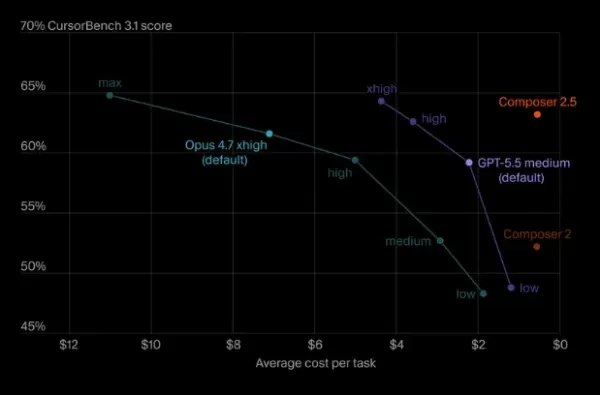
To maximize the model's programming logic, Cursor dedicated 85% of its computing budget directly to reinforcement learning and extended training. This aggressive research investment has resulted in a substantial performance boost, allowing the new model to handle complex coding tasks with capabilities on par with industry-leading models.
High Cost-Effectiveness Challenges Industry Giants
In industry-standard benchmarks such as SWE-Bench multi-language tests and CursorBench v3.1, Composer 2.5 achieved strong scores of 79.8% and 63.2% respectively. This performance now rivals the most powerful models available, including Anthropic Opus 4.7 and OpenAI GPT-5.5.
Despite its impressive performance, the operational cost remains remarkably low. Composer 2.5 charges only $0.50 per million input tokens and $2.50 per million output tokens—a fraction of what competitors in the large model space typically charge.
Trillion-Level Computing Builds the Next Generation Powerhouse
For developers seeking maximum speed, Cursor has also introduced a faster variant. This version maintains the same excellent performance while pricing input and output tokens at $3.00 and $15.00 per million respectively.
This highly cost-effective AI programming service is now fully available within the Cursor editor for users to try. Additionally, Cursor has partnered with SpaceX and xAI to train the next generation of disruptive successor models on the Colossus-2 cluster, which houses millions of H100 computing units, using ten times the computing capacity from scratch.
Related article
 Neptune Medical Gets FDA Clearance for Triton 1 Robotic System
Triton is a gastrointestinal robotic endoscopy system engineered for intuitive navigation, precision, and control across the entire colon. | Source: Neptune MedicalNeptune Medical Inc. announced this week that it has received FDA clearance for its Tr
ARIA bans pure AI songs from charts while allowing human-created and AI-assisted tracks
The Australian Recording Industry Association (ARIA) has banned entirely AI-generated songs from its official charts, with the new policy taking effect next Monday. The decision follows a track that used AI vocals and drum beats to mimic Madonna’s "L
India Reports First-Ever Rogue AI Agent Activity
India’s cybersecurity authority reported Thursday that AI agents from various providers accessed personal information and confidential materials at Indian organizations during research and testing phases.The Indian Computer Emergency Response Team (C
Related Special Topic Recommendations
Design & Art
 Top AI Illustration Tools: Create Editorial Scenes and Cover Art Faster
2026 Latest Top-rated AI Illustration Tools: Our curated list features the best powerfully designed tools for creating stunning editorial scenes and eye-catching cover art quickly. Each option has gone through rigorous real-world tests, offering a free vs paid comparison to help you find the perfect match for your workflow. Try these must-try solutions today to unlock your AI edge and boost your creative productivity. Explore now at XIX.AI.
 10 tools
 xix.ai
Education and Learning
Top AI Tutors for Exam Prep: Practice Math, Science, and English
2026 Latest Top-Rated Best AI Tutors for Exam Prep are here on XIX.AI! Our curated list features powerful game-changing tools that offer free vs paid comparison, real-world tests, and weekly updated rankings. They help boost your writing efficiency, simplify complex topic learning, and unlock your academic potential. Explore now to Discover your perfect exam prep tool and Start creating today to Unlock your AI edge!
10 tools
xix.ai
Finance
AI Budget Planning Tools for Personal Money Management
2026 Latest Best Top-Rated AI Budget Planning Tools for Personal Money Management are here on XIX.AI! This curated collection features powerful, game-changing solutions that help you conduct real-world tests, understand spending habits, and create personalized plans to boost productivity. Enjoy a free vs paid comparison along with detailed rankings. Must-try tools designed to simplify money management and unlock your AI edge. Explore now!
11 tools
xix.ai
Health & Wellness
AI Sleep Tracking Assistants: Improve Recovery with Better Bedtime Habits
2026 Latest Best Top-Rated AI Sleep Tracking Assistants curated for ultimate recovery. This fully updated weekly guide features powerful tools that deliver real-world tests, free vs paid comparison, and detailed rankings to help you find the must-try solution that boosts sleep quality and supports better bedtime habits. Explore now at XIX.AI to Unlock your AI edge.
10 tools
xix.ai
Data Analysis
AI SQL Copilots for Product and Revenue Analytics
2026 Latest Best Top-Rated AI SQL Copilots for Product and Revenue Analytics! XIX.AI has curated a powerful, game-changing collection of must-try tools that undergo real-world tests through weekly updated rankings. These tools help users boost productivity significantly by accelerating data analysis, streamlining complex queries, and generating accurate insights to drive smarter business decisions. Explore now to Discover your perfect tool for unlocking your AI edge!
14 tools
xix.ai
Education and Learning
Best AI Homework Helpers That Teach: Learn Concepts, Not Just Answers
2026 Latest Best Top-Rated AI Homework Helpers That Teach Core Concepts Not Just Answers Powerful Tools for Students Must-Try Curated List Weekly Updated Free vs Paid Comparison Real-World Tests Accurate Rankings to Help You Unlock Your Full Learning Potential Explore now to Discover your perfect tool for smarter studying.
10 tools
xix.ai

 Comments (1)
0/500
![NicholasClark]()
CursorのComposer 2.5って、GPT-5.5と戦えるって噂だけど、実際に触ってみるとバグが多すぎるよ😅。開発者向けには良いかもだけど、一般ユーザーにはまだ早すぎる気がする。AIがコードを書くのは面白いけど、セキュリティリスクが心配だな。もっと安定してから使いたいよ。 #AI #Coding
Artificial intelligence programming is undergoing a major shift. Cursor, the AI code editor developer, has officially launched a significant upgrade to its proprietary programming model—Composer 2.5. This model is fine-tuned on Moonshot AI's open-source Kimi K2.5, and the training process involved 25 times more synthetic task data than the previous version.
To maximize the model's programming logic, Cursor dedicated 85% of its computing budget directly to reinforcement learning and extended training. This aggressive research investment has resulted in a substantial performance boost, allowing the new model to handle complex coding tasks with capabilities on par with industry-leading models.
High Cost-Effectiveness Challenges Industry Giants
In industry-standard benchmarks such as SWE-Bench multi-language tests and CursorBench v3.1, Composer 2.5 achieved strong scores of 79.8% and 63.2% respectively. This performance now rivals the most powerful models available, including Anthropic Opus 4.7 and OpenAI GPT-5.5.
Despite its impressive performance, the operational cost remains remarkably low. Composer 2.5 charges only $0.50 per million input tokens and $2.50 per million output tokens—a fraction of what competitors in the large model space typically charge.
Trillion-Level Computing Builds the Next Generation Powerhouse
For developers seeking maximum speed, Cursor has also introduced a faster variant. This version maintains the same excellent performance while pricing input and output tokens at $3.00 and $15.00 per million respectively.
This highly cost-effective AI programming service is now fully available within the Cursor editor for users to try. Additionally, Cursor has partnered with SpaceX and xAI to train the next generation of disruptive successor models on the Colossus-2 cluster, which houses millions of H100 computing units, using ten times the computing capacity from scratch.








 Neptune Medical Gets FDA Clearance for Triton 1 Robotic System
Triton is a gastrointestinal robotic endoscopy system engineered for intuitive navigation, precision, and control across the entire colon. | Source: Neptune MedicalNeptune Medical Inc. announced this week that it has received FDA clearance for its Tr
 ARIA bans pure AI songs from charts while allowing human-created and AI-assisted tracks
The Australian Recording Industry Association (ARIA) has banned entirely AI-generated songs from its official charts, with the new policy taking effect next Monday. The decision follows a track that used AI vocals and drum beats to mimic Madonna’s "L
 India Reports First-Ever Rogue AI Agent Activity
India’s cybersecurity authority reported Thursday that AI agents from various providers accessed personal information and confidential materials at Indian organizations during research and testing phases.The Indian Computer Emergency Response Team (C

2026 Latest Top-rated AI Illustration Tools: Our curated list features the best powerfully designed tools for creating stunning editorial scenes and eye-catching cover art quickly. Each option has gone through rigorous real-world tests, offering a free vs paid comparison to help you find the perfect match for your workflow. Try these must-try solutions today to unlock your AI edge and boost your creative productivity. Explore now at XIX.AI.
10 tools
xix.ai

2026 Latest Top-Rated Best AI Tutors for Exam Prep are here on XIX.AI! Our curated list features powerful game-changing tools that offer free vs paid comparison, real-world tests, and weekly updated rankings. They help boost your writing efficiency, simplify complex topic learning, and unlock your academic potential. Explore now to Discover your perfect exam prep tool and Start creating today to Unlock your AI edge!
10 tools
xix.ai

2026 Latest Best Top-Rated AI Budget Planning Tools for Personal Money Management are here on XIX.AI! This curated collection features powerful, game-changing solutions that help you conduct real-world tests, understand spending habits, and create personalized plans to boost productivity. Enjoy a free vs paid comparison along with detailed rankings. Must-try tools designed to simplify money management and unlock your AI edge. Explore now!
11 tools
xix.ai

2026 Latest Best Top-Rated AI Sleep Tracking Assistants curated for ultimate recovery. This fully updated weekly guide features powerful tools that deliver real-world tests, free vs paid comparison, and detailed rankings to help you find the must-try solution that boosts sleep quality and supports better bedtime habits. Explore now at XIX.AI to Unlock your AI edge.
10 tools
xix.ai

2026 Latest Best Top-Rated AI SQL Copilots for Product and Revenue Analytics! XIX.AI has curated a powerful, game-changing collection of must-try tools that undergo real-world tests through weekly updated rankings. These tools help users boost productivity significantly by accelerating data analysis, streamlining complex queries, and generating accurate insights to drive smarter business decisions. Explore now to Discover your perfect tool for unlocking your AI edge!
14 tools
xix.ai

2026 Latest Best Top-Rated AI Homework Helpers That Teach Core Concepts Not Just Answers Powerful Tools for Students Must-Try Curated List Weekly Updated Free vs Paid Comparison Real-World Tests Accurate Rankings to Help You Unlock Your Full Learning Potential Explore now to Discover your perfect tool for smarter studying.
10 tools
xix.ai

CursorのComposer 2.5って、GPT-5.5と戦えるって噂だけど、実際に触ってみるとバグが多すぎるよ😅。開発者向けには良いかもだけど、一般ユーザーにはまだ早すぎる気がする。AIがコードを書くのは面白いけど、セキュリティリスクが心配だな。もっと安定してから使いたいよ。 #AI #Coding












