


 Home
HomeDiagnostic AI Revolutionizes Healthcare with Conversational Technology
The fusion of artificial intelligence and healthcare continues to accelerate, with conversational AI standing out as a revolutionary advancement. Envision healthcare interactions where AI systems conduct natural, medically-informed conversations with patients, collecting vital health histories while supporting clinicians in reaching precise diagnoses. This breakthrough technology represents the forefront of medical AI research, promising to transform patient care delivery. Our examination reveals how conversational diagnostic AI could reshape healthcare by enhancing accessibility, standardizing quality, and supporting clinical decision-making. Through analyzing the architecture of AMIE (Articulate Medical Intelligence Explorer), we'll demonstrate how AI can enrich doctor-patient interactions while maintaining empathy and clinical rigor - potentially creating more sustainable healthcare ecosystems.
Key Points
- The physician-patient conversation remains fundamental to high-quality medical care.
- Conversational AI promises greater healthcare access and consistency.
- AMIE represents an innovative AI system specialized in diagnostic dialogues.
- Simulation environments prove essential for AI training and assessment.
- Evaluating AI empathy and communication effectiveness presents ongoing challenges.
- Incorporating real-world clinical data is vital for medical AI viability.
- Diagnostic precision serves as a critical benchmark for conversational AI.
- Chain-of-reasoning techniques enhance AI response refinement.
- AI technology could democratize elite-level medical expertise globally.
- LLM-based clinical history and diagnostic systems show remarkable potential.
The Foundation of Medical Practice: Conversational AI
The Importance of Physician-Patient Dialogue
Medical practice fundamentally revolves around the therapeutic conversation between clinicians and patients. Expert clinical history-taking enables accurate diagnoses, effective treatment plans, and lasting patient-provider relationships. These dialogues establish critical understanding of symptoms, medical backgrounds, and lifestyle factors - without which diagnostic accuracy significantly declines.
Emerging AI applications aim to augment rather than replace these essential human interactions. The physician-patient dynamic remains foundational to quality healthcare delivery.
Effective clinical history-taking facilitates:
- Precise Diagnoses: Capturing symptom nuances and medical timelines
- Personalized Treatment: Developing tailored therapeutic approaches
- Relationship Building: Establishing trust through empathetic communication
AI's role complements these human-centered aspects of care, ultimately enhancing clinical capabilities.
Towards Conversational Diagnostic AI
Conversational diagnostic AI represents healthcare's future - combining natural language processing, machine learning, and medical expertise to create systems capable of clinically-relevant dialogues. These sophisticated tools simulate doctor-patient interactions, gathering diagnostic clues while supporting clinical decision-making.
Key components include:
- Natural Language Understanding: Interpreting patient communication meaning
- Medical Knowledge Integration: Accessing comprehensive clinical data
- Clinical Inference Capabilities: Synthesizing diagnostic possibilities
- Dialogue Management: Maintaining coherent, relevant conversations
AMIE: A Leading Example of Diagnostic AI
Articulate Medical Intelligence Explorer (AMIE)
AMIE exemplifies cutting-edge conversational diagnostic AI, developed collaboratively by Google Research and DeepMind. This system enhances medical dialogues through innovative self-play simulations with automated feedback mechanisms, enabling comprehensive learning across diverse medical scenarios.
AMIE's objectives include:
- Matching experienced clinicians' diagnostic acumen
- Optimizing Large Language Models (LLMs) for medical conversations
- Incorporating extensive real-world and simulated clinical data
- Addressing varied patient inquiries and clinical situations
AMIE System Architecture
AMIE's sophisticated framework integrates multiple specialized components:
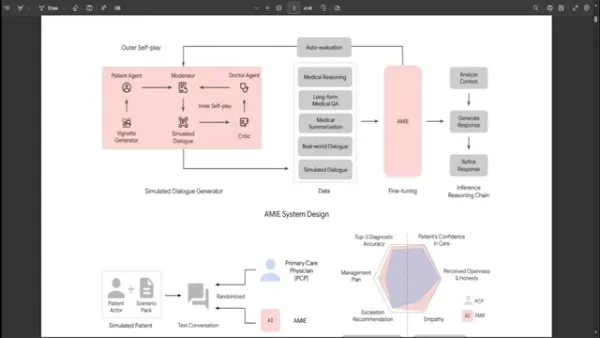
- Simulated Dialogue Generator: Facilitates doctor-patient interactions
- Comprehensive Data Integration: Medical reasoning, Q&A datasets, clinical summaries
- Precision Fine-Tuning: Ensures clinically accurate responses
- Inference Reasoning Chain: Enhances diagnostic reliability
Implementing AMIE in Clinical Settings
AMIE Evaluation Methodology
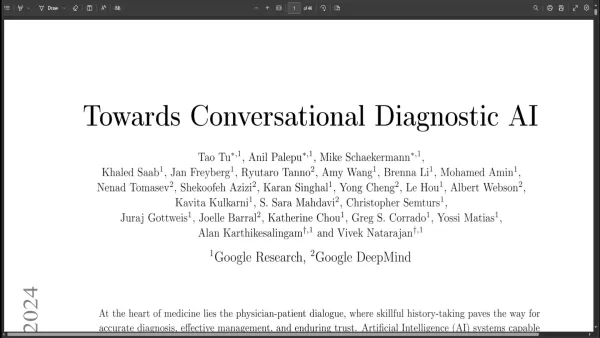
Researchers assess AMIE through blinded comparative studies involving primary care physicians conducting virtual OSCE exams with standardized patients via synchronous text chats. Post-encounter evaluations by both patients and specialists provide comprehensive performance metrics.
Clinical Implementation Process
- Text-based consultation with standardized patient
- Post-encounter feedback collection
- Specialist physician evaluation
Advantages and Challenges of Conversational Diagnostic AI
Benefits
- Expands healthcare accessibility, particularly underserved regions
- Standardizes diagnostic approaches
- Reduces clinical documentation errors
- Continuously integrates current medical knowledge
- Delivers personalized patient interactions
Challenges
- Replicating human physician empathy remains difficult
- Potential algorithmic bias requires mitigation
- Data security and privacy concerns must be addressed
- Risk of clinical over-reliance necessitates safeguards
- Complex ethical situations demand human oversight
Frequently Asked Questions
What is AMIE's potential impact?
AMIE could democratize access to elite medical expertise while establishing foundations for scalable healthcare delivery that maintains empathic communication and clinical trust.
What exactly is AMIE?
Articulate Medical Intelligence Explorer represents Google Research and DeepMind's advanced conversational AI system designed to achieve physician-level diagnostic capabilities while making world-class healthcare universally accessible.
Related Questions
What hurdles exist in developing diagnostic AI?
Creating effective conversational diagnostic AI involves overcoming significant technical and ethical challenges. Foremost is accurately simulating human clinicians' empathy and nuanced communication - critical elements for establishing patient trust and therapeutic relationships. Additionally, developers must vigilantly address potential algorithmic biases to ensure equitable care across diverse patient populations while implementing rigorous data security protocols for sensitive health information.
Related article
 DeepMind CEO Hassabis: I sleep six hours a day, usually feel energetic around 1 a.m.
Fortune recently featured an interview with Demis Hassabis, CEO of Google DeepMind, revealing his unconventional approach to rest and productivity. Hassabis disclosed that he sleeps very little, structuring his waking hours into two distinct work blo
OpenAI, Anthropic Vie for Market Share Despite Revenue Shortfalls
Despite recent reports suggesting OpenAI missed revenue targets, creating pressure on tech stocks this Tuesday, private AI lab investors remain resilient. Seasoned backers have confirmed they will not reduce investment despite negative media coverage
California AV Compliance: A New Era of Tickets, Geofences, and 1M Miles
Guident operates an AuveTech shuttle in South Florida, managing a four-mile route in West Palm Beach and a one-mile route in Boca Raton using its remote monitoring technology. | Credit: GuidentCalifornia is redefining the regulatory landscape for dri
Related Special Topic Recommendations
Video creation
DeepMind CEO Hassabis: I sleep six hours a day, usually feel energetic around 1 a.m.
Fortune recently featured an interview with Demis Hassabis, CEO of Google DeepMind, revealing his unconventional approach to rest and productivity. Hassabis disclosed that he sleeps very little, structuring his waking hours into two distinct work blo
OpenAI, Anthropic Vie for Market Share Despite Revenue Shortfalls
Despite recent reports suggesting OpenAI missed revenue targets, creating pressure on tech stocks this Tuesday, private AI lab investors remain resilient. Seasoned backers have confirmed they will not reduce investment despite negative media coverage
California AV Compliance: A New Era of Tickets, Geofences, and 1M Miles
Guident operates an AuveTech shuttle in South Florida, managing a four-mile route in West Palm Beach and a one-mile route in Boca Raton using its remote monitoring technology. | Credit: GuidentCalifornia is redefining the regulatory landscape for dri
Related Special Topic Recommendations
Video creation
 AI Short-Form Video Hook Generators for Reels, Shorts, and Product Launch Campaigns
2026 Latest Best AI Short-Form Video Hook Generators for Reels Shorts and Product Launch Campaigns! XIX.AI curates top-rated powerful game-changing tools that deliver must-try results through real-world tests. This weekly updated page offers free vs paid comparison rankings to help you find the perfect solution for boosting content creativity and productivity. Explore now to Unlock your AI edge!
 11 tools
 xix.ai
writing
AI Article Outline Tools for Long Form Writing
xix.ai
writing
AI Article Outline Tools for Long Form Writing
2026 Latest Best Top-Rated AI Article Outline Tools for Long Form Writing! This curated collection features powerful, game-changing tools that deliver accurate, structured outlines with real-world tests to boost writing efficiency significantly. XIX.AI is part of this elite selection. Get a free vs paid comparison to help you choose the perfect tool. Explore now and Unlock your AI edge!
9 tools
xix.ai
chatbot
Best AI Roleplay Chat Apps for Language Practice, Interview Prep, and Daily Fluency
2026 Latest Best Top-rated AI Roleplay Chat Apps for Language Practice, Interview Prep, and Daily Fluency! XIX.AI curates a powerful game-changing collection that offers free vs paid comparison, real-world tests, and updated rankings weekly. These must-try tools help you boost writing skills, overcome fluency challenges, and improve communication efficiency across all daily scenarios. Explore now to discover your perfect tool for language growth!
10 tools
xix.ai
Music composition
AI Stem Separation Tools for Remix Production, Sampling Prep, and Karaoke Masters
2026 Latest Best Top-rated AI Stem Separation Tools Curated for Remix Production, Sampling Prep, and Karaoke Masters. These powerful game-changing tools offer real-world tests to deliver precise audio isolation, boosting productivity significantly. XIX.AI provides a weekly updated free vs paid comparison guide to help you find the must-try solution that suits your needs. Explore now to unlock your AI edge.
8 tools
xix.ai
Data Analysis
AI SQL Copilots for Revenue Dashboards, Funnel Analysis, and Product Metrics
2026 Latest Best AI SQL Copilots Ranked Top-Rated! XIX.AI curates a powerful game-changing collection for weekly updated real-world tests. These must-try tools help you generate accurate revenue dashboards, analyze sales funnels, and track product metrics swiftly, boosting productivity massively. Explore now to Discover your perfect tool for data-driven decision making! 238 characters
9 tools
xix.ai
Music composition
Best AI Melody Writing Tools for Song Drafts
2026 Latest Best Top-Rated AI Melody Writing Tools for Song Drafts! XIX.AI has curated a highly powerful game-changing collection that goes through rigorous real-world tests to deliver the best writing experience. You can find detailed free vs paid comparisons, accurate rankings, and must-try options designed to help you create stunning song drafts effortlessly and boost your creative productivity significantly. Explore now to discover your perfect tool!
8 tools
xix.ai

 Comments (1)
0/500
Comments (1)
0/500
![JonathanDavis]()
Conversational AI in healthcare sounds both thrilling and slightly eerie. I love the idea of AI that can actually hold a nuanced medical conversation, but does it mean my doctor is replaced by a chatbot? 🤖 Also, privacy concerns with voice data? Let's see how it plays out in real clinics. #HealthTech
The fusion of artificial intelligence and healthcare continues to accelerate, with conversational AI standing out as a revolutionary advancement. Envision healthcare interactions where AI systems conduct natural, medically-informed conversations with patients, collecting vital health histories while supporting clinicians in reaching precise diagnoses. This breakthrough technology represents the forefront of medical AI research, promising to transform patient care delivery. Our examination reveals how conversational diagnostic AI could reshape healthcare by enhancing accessibility, standardizing quality, and supporting clinical decision-making. Through analyzing the architecture of AMIE (Articulate Medical Intelligence Explorer), we'll demonstrate how AI can enrich doctor-patient interactions while maintaining empathy and clinical rigor - potentially creating more sustainable healthcare ecosystems.
Key Points
- The physician-patient conversation remains fundamental to high-quality medical care.
- Conversational AI promises greater healthcare access and consistency.
- AMIE represents an innovative AI system specialized in diagnostic dialogues.
- Simulation environments prove essential for AI training and assessment.
- Evaluating AI empathy and communication effectiveness presents ongoing challenges.
- Incorporating real-world clinical data is vital for medical AI viability.
- Diagnostic precision serves as a critical benchmark for conversational AI.
- Chain-of-reasoning techniques enhance AI response refinement.
- AI technology could democratize elite-level medical expertise globally.
- LLM-based clinical history and diagnostic systems show remarkable potential.
The Foundation of Medical Practice: Conversational AI
The Importance of Physician-Patient Dialogue
Medical practice fundamentally revolves around the therapeutic conversation between clinicians and patients. Expert clinical history-taking enables accurate diagnoses, effective treatment plans, and lasting patient-provider relationships. These dialogues establish critical understanding of symptoms, medical backgrounds, and lifestyle factors - without which diagnostic accuracy significantly declines.
Emerging AI applications aim to augment rather than replace these essential human interactions. The physician-patient dynamic remains foundational to quality healthcare delivery.
Effective clinical history-taking facilitates:
- Precise Diagnoses: Capturing symptom nuances and medical timelines
- Personalized Treatment: Developing tailored therapeutic approaches
- Relationship Building: Establishing trust through empathetic communication
AI's role complements these human-centered aspects of care, ultimately enhancing clinical capabilities.
Towards Conversational Diagnostic AI
Conversational diagnostic AI represents healthcare's future - combining natural language processing, machine learning, and medical expertise to create systems capable of clinically-relevant dialogues. These sophisticated tools simulate doctor-patient interactions, gathering diagnostic clues while supporting clinical decision-making.
Key components include:
- Natural Language Understanding: Interpreting patient communication meaning
- Medical Knowledge Integration: Accessing comprehensive clinical data
- Clinical Inference Capabilities: Synthesizing diagnostic possibilities
- Dialogue Management: Maintaining coherent, relevant conversations
AMIE: A Leading Example of Diagnostic AI
Articulate Medical Intelligence Explorer (AMIE)
AMIE exemplifies cutting-edge conversational diagnostic AI, developed collaboratively by Google Research and DeepMind. This system enhances medical dialogues through innovative self-play simulations with automated feedback mechanisms, enabling comprehensive learning across diverse medical scenarios.
AMIE's objectives include:
- Matching experienced clinicians' diagnostic acumen
- Optimizing Large Language Models (LLMs) for medical conversations
- Incorporating extensive real-world and simulated clinical data
- Addressing varied patient inquiries and clinical situations
AMIE System Architecture
AMIE's sophisticated framework integrates multiple specialized components:
- Simulated Dialogue Generator: Facilitates doctor-patient interactions
- Comprehensive Data Integration: Medical reasoning, Q&A datasets, clinical summaries
- Precision Fine-Tuning: Ensures clinically accurate responses
- Inference Reasoning Chain: Enhances diagnostic reliability
Implementing AMIE in Clinical Settings
AMIE Evaluation Methodology
Researchers assess AMIE through blinded comparative studies involving primary care physicians conducting virtual OSCE exams with standardized patients via synchronous text chats. Post-encounter evaluations by both patients and specialists provide comprehensive performance metrics.
Clinical Implementation Process
- Text-based consultation with standardized patient
- Post-encounter feedback collection
- Specialist physician evaluation
Advantages and Challenges of Conversational Diagnostic AI
Benefits
- Expands healthcare accessibility, particularly underserved regions
- Standardizes diagnostic approaches
- Reduces clinical documentation errors
- Continuously integrates current medical knowledge
- Delivers personalized patient interactions
Challenges
- Replicating human physician empathy remains difficult
- Potential algorithmic bias requires mitigation
- Data security and privacy concerns must be addressed
- Risk of clinical over-reliance necessitates safeguards
- Complex ethical situations demand human oversight
Frequently Asked Questions
What is AMIE's potential impact?
AMIE could democratize access to elite medical expertise while establishing foundations for scalable healthcare delivery that maintains empathic communication and clinical trust.
What exactly is AMIE?
Articulate Medical Intelligence Explorer represents Google Research and DeepMind's advanced conversational AI system designed to achieve physician-level diagnostic capabilities while making world-class healthcare universally accessible.
Related Questions
What hurdles exist in developing diagnostic AI?
Creating effective conversational diagnostic AI involves overcoming significant technical and ethical challenges. Foremost is accurately simulating human clinicians' empathy and nuanced communication - critical elements for establishing patient trust and therapeutic relationships. Additionally, developers must vigilantly address potential algorithmic biases to ensure equitable care across diverse patient populations while implementing rigorous data security protocols for sensitive health information.








 DeepMind CEO Hassabis: I sleep six hours a day, usually feel energetic around 1 a.m.
Fortune recently featured an interview with Demis Hassabis, CEO of Google DeepMind, revealing his unconventional approach to rest and productivity. Hassabis disclosed that he sleeps very little, structuring his waking hours into two distinct work blo
DeepMind CEO Hassabis: I sleep six hours a day, usually feel energetic around 1 a.m.
Fortune recently featured an interview with Demis Hassabis, CEO of Google DeepMind, revealing his unconventional approach to rest and productivity. Hassabis disclosed that he sleeps very little, structuring his waking hours into two distinct work blo
 OpenAI, Anthropic Vie for Market Share Despite Revenue Shortfalls
Despite recent reports suggesting OpenAI missed revenue targets, creating pressure on tech stocks this Tuesday, private AI lab investors remain resilient. Seasoned backers have confirmed they will not reduce investment despite negative media coverage
California AV Compliance: A New Era of Tickets, Geofences, and 1M Miles
Guident operates an AuveTech shuttle in South Florida, managing a four-mile route in West Palm Beach and a one-mile route in Boca Raton using its remote monitoring technology. | Credit: GuidentCalifornia is redefining the regulatory landscape for dri
OpenAI, Anthropic Vie for Market Share Despite Revenue Shortfalls
Despite recent reports suggesting OpenAI missed revenue targets, creating pressure on tech stocks this Tuesday, private AI lab investors remain resilient. Seasoned backers have confirmed they will not reduce investment despite negative media coverage
California AV Compliance: A New Era of Tickets, Geofences, and 1M Miles
Guident operates an AuveTech shuttle in South Florida, managing a four-mile route in West Palm Beach and a one-mile route in Boca Raton using its remote monitoring technology. | Credit: GuidentCalifornia is redefining the regulatory landscape for dri

2026 Latest Best AI Short-Form Video Hook Generators for Reels Shorts and Product Launch Campaigns! XIX.AI curates top-rated powerful game-changing tools that deliver must-try results through real-world tests. This weekly updated page offers free vs paid comparison rankings to help you find the perfect solution for boosting content creativity and productivity. Explore now to Unlock your AI edge!
11 tools
xix.ai

2026 Latest Best Top-Rated AI Article Outline Tools for Long Form Writing! This curated collection features powerful, game-changing tools that deliver accurate, structured outlines with real-world tests to boost writing efficiency significantly. XIX.AI is part of this elite selection. Get a free vs paid comparison to help you choose the perfect tool. Explore now and Unlock your AI edge!
9 tools
xix.ai

2026 Latest Best Top-rated AI Roleplay Chat Apps for Language Practice, Interview Prep, and Daily Fluency! XIX.AI curates a powerful game-changing collection that offers free vs paid comparison, real-world tests, and updated rankings weekly. These must-try tools help you boost writing skills, overcome fluency challenges, and improve communication efficiency across all daily scenarios. Explore now to discover your perfect tool for language growth!
10 tools
xix.ai

2026 Latest Best Top-rated AI Stem Separation Tools Curated for Remix Production, Sampling Prep, and Karaoke Masters. These powerful game-changing tools offer real-world tests to deliver precise audio isolation, boosting productivity significantly. XIX.AI provides a weekly updated free vs paid comparison guide to help you find the must-try solution that suits your needs. Explore now to unlock your AI edge.
8 tools
xix.ai

2026 Latest Best AI SQL Copilots Ranked Top-Rated! XIX.AI curates a powerful game-changing collection for weekly updated real-world tests. These must-try tools help you generate accurate revenue dashboards, analyze sales funnels, and track product metrics swiftly, boosting productivity massively. Explore now to Discover your perfect tool for data-driven decision making! 238 characters
9 tools
xix.ai

2026 Latest Best Top-Rated AI Melody Writing Tools for Song Drafts! XIX.AI has curated a highly powerful game-changing collection that goes through rigorous real-world tests to deliver the best writing experience. You can find detailed free vs paid comparisons, accurate rankings, and must-try options designed to help you create stunning song drafts effortlessly and boost your creative productivity significantly. Explore now to discover your perfect tool!
8 tools
xix.ai

Conversational AI in healthcare sounds both thrilling and slightly eerie. I love the idea of AI that can actually hold a nuanced medical conversation, but does it mean my doctor is replaced by a chatbot? 🤖 Also, privacy concerns with voice data? Let's see how it plays out in real clinics. #HealthTech












