


 Home
HomeWhat is Fraunhofer's vision for the future of conversational AI in 2025?
Artificial intelligence is advancing at an unprecedented pace, with conversational AI leading the charge. This article explores the groundbreaking research conducted by Fraunhofer, Europe's premier application-focused research organization. We'll examine their unique vision for conversational AI, their unwavering commitment to digital sovereignty, and the suite of technologies they're developing to redefine human-computer interaction. Covering everything from core audio enhancement to sophisticated sequential question-answering, this overview provides a deep dive into the SPEAKER platform and its transformative potential across numerous sectors.
Key Points
Fraunhofer is a pivotal force in conversational AI research and development.
Ensuring digital sovereignty is a foundational principle of their AI work.
Enhancing voice quality and refining speech recognition are central to their technological stack.
Knowledge graphs are indispensable for building truly intelligent and contextual dialogue systems.
The SPEAKER platform seeks to integrate diverse conversational AI technologies and accelerate innovation.
Understanding Conversational AI at Fraunhofer
What is Conversational AI?
Conversational AI refers to technologies that allow machines to comprehend, process, and respond to human language in a natural, dialogue-like manner. This field powers everything from basic chatbots to sophisticated voice assistants and smart devices.
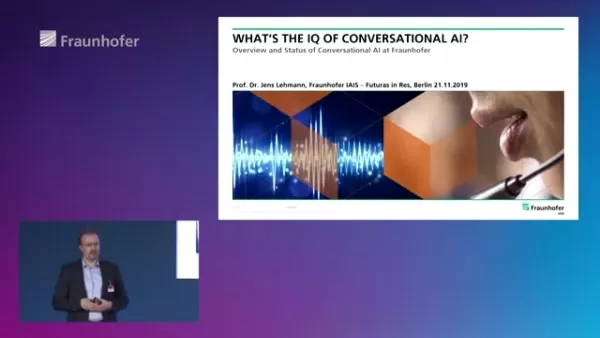
Fraunhofer, acknowledging the strategic significance of this domain, dedicates substantial resources to its advancement. Their goal is to engineer solutions that are not only intelligent but also secure, private, and fully aligned with European regulatory standards.
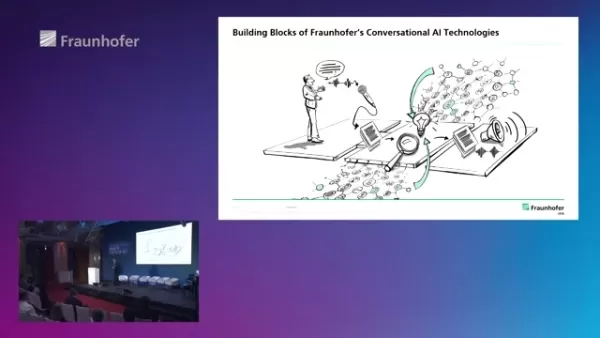
The effectiveness of any conversational AI hinges on three core abilities:
- Understand Natural Language: Accurately interpreting human language, with all its subtleties and contextual clues, is fundamental.
- Generate Relevant Responses: Crafting replies or initiating actions that are meaningful and appropriate to the conversation's flow.
- Maintain Context: Retaining information from earlier in the dialogue to ensure coherence and relevance in ongoing exchanges.
These capabilities are essential for creating AI that can interact with people naturally in diverse scenarios.
Key technologies driving conversational AI include:
- Natural Language Processing (NLP): The suite of algorithms that enables machines to parse and generate human language.
- Machine Learning (ML): Models that learn from data to continuously improve their understanding and performance.
- Knowledge Graphs: Structured networks of information that allow AI systems to access, connect, and reason with vast amounts of knowledge.
Fraunhofer's Approach to Conversational AI Development
Fraunhofer's strategy in conversational AI is defined by a triad of principles: a steadfast commitment to digital sovereignty, a design philosophy centered on modular and adaptable systems, and a sharp focus on practical, real-world applicability.
Their research is motivated by the critical need to develop AI that operates independently of large, external cloud ecosystems, thereby safeguarding data security and user privacy.
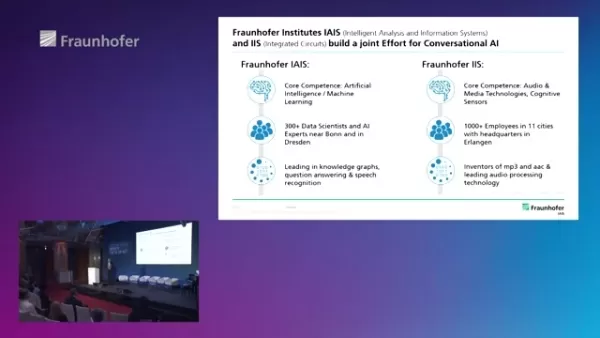
Fraunhofer's conversational AI efforts are spearheaded by collaboration between two of its leading institutes:
- Fraunhofer IAIS (Institute for Intelligent Analysis and Information Systems): A center of excellence in artificial intelligence, machine learning, and knowledge graph technology, with a team of over 300 data science and AI specialists.
- Fraunhofer IIS (Institute for Integrated Circuits): A world leader in audio, media, and sensor technologies, employing more than 1,000 experts in audio processing and cognitive systems.
By combining the algorithmic prowess of IAIS with the audio engineering expertise of IIS, Fraunhofer creates a powerful, unified front in conversational AI development.
Building Blocks of Fraunhofer's Conversational AI Technologies
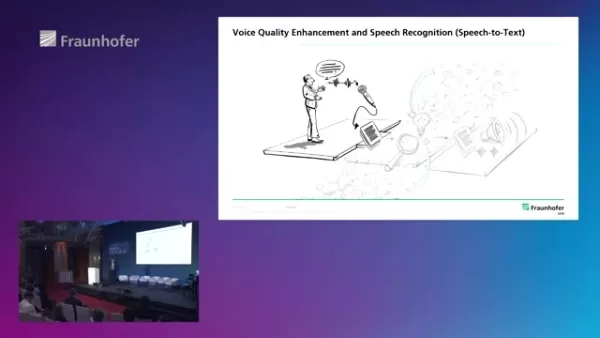
Voice Quality Enhancement and Speech Recognition
The journey of a spoken command begins with capturing clear audio. This is a significant challenge in noisy real-world environments.

To solve this, Fraunhofer IIS created the UpHear Voice Quality Enhancement technology. This system is engineered to:
- Reduce Noise: Actively suppress background sounds to isolate the speaker's voice.
- Cancel Acoustic Echoes: Remove feedback and echo that can distort audio and confuse speech recognition engines.
- Extract Voice Signals: Cleanly separate the primary voice from other audio sources in the environment.
This robust audio preprocessing is vital for building speech recognition systems that perform reliably anywhere, from a busy office to a moving car.
Notable Products Utilizing UpHear Technology:
- Yandex Station Smart Speaker
- LG XBoom Smart Speaker
- Kandao Meeting 360 Conferencing System
Once the audio is pristine, it must be converted into text. Fraunhofer IAIS develops high-accuracy, domain-adaptable speech recognition models to complete this crucial step.
Sequential Question Answering and Knowledge Graphs
Moving beyond single-command interactions, sequential question answering enables genuine, multi-turn dialogues where users can ask follow-up questions based on previous answers.
This advanced capability is powered by:
- Knowledge Graphs: The structured knowledge base that serves as the AI's long-term memory and reasoning engine.
- Contextual Understanding: The system's ability to track the conversation history and use it to interpret the intent behind each new query.
- Inference Capabilities: The skill to logically connect disparate facts within the knowledge graph to deduce new information.
Together, these elements allow the AI to deliver nuanced, informative, and context-aware responses.
How Knowledge Graphs Power Conversational AI:
By organizing information as interconnected entities, knowledge graphs empower AI systems to:
- Access Relevant Information: Instantly retrieve data points and facts related to the user's question.
- Reason About Relationships: Understand and traverse the links between different concepts (e.g., a person, their creations, and their birthplace).
- Generate Contextually Appropriate Responses: Formulate answers that are directly relevant to the user's immediate query and the broader dialogue context.
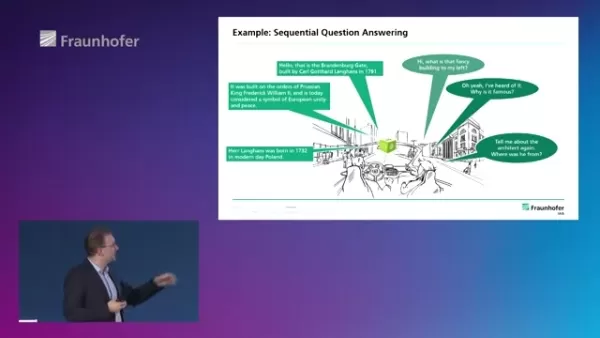
For instance, a user might ask, "What is the Brandenburg Gate?" The system queries its knowledge graph to identify it as a Berlin landmark and provide historical details. The graph also stores the relationship linking the gate to its architect, Carl Gotthard Langhans.
Multiple Hops Example: If the user then asks, “Where was he from?” the system performs a 'double hop' query. It first finds the entity for Langhans, then follows the relationship to his birthplace, Poland, delivering a precise and connected answer.
Speech Synthesis (Text-to-Speech)
The conversation loop closes with the AI responding aloud. This requires converting text responses into natural, human-like speech.
Fraunhofer IIS's advanced Text-to-Speech technologies excel at:
- Producing High-Quality Audio: Generating speech that is clear, fluid, and pleasant to listen to.
- Adapting to Different Voices and Accents: Creating a range of vocal personas to suit various applications or user preferences.
- Controlling Prosody and Intonation: Adjusting rhythm, emphasis, and pitch to convey correct meaning, emotion, and nuance.
These features are key to making interactions with AI not just functional, but engaging and natural.
Text-to-Speech technology enables dynamic responses such as:
- “The Museum is subdivided into the…”
- “Technical University Berlin…”
- “Yes, ask me about this city…”
- “Nordwind und Sonne”
- “It depends on my job, but I really…”
- “En behertzet Kölle Allaaaf…”
How to Use Conversational AI Platform
How to improve data security by using their platform?
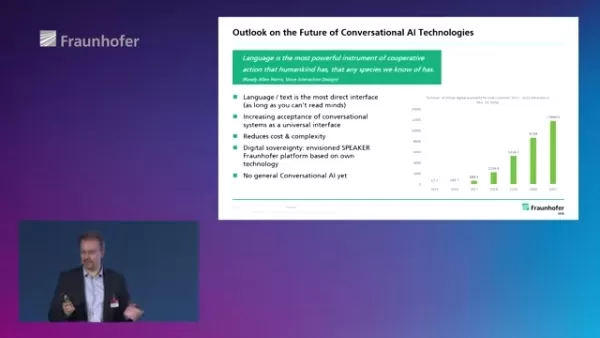
Platforms built on the principle of digital sovereignty put you in full command of your data.
- Data remains secured and is processed directly on the user's device or within their controlled infrastructure.
- Eliminates dependence on external, third-party cloud services for core processing.
- All data handling is designed to be fully compliant with GDPR and other privacy regulations.
SPEAKER Platform Pricing
Pricing of SPEAKER Platform
While Fraunhofer is developing the innovative SPEAKER platform, specific information regarding pricing models, payment structures, or associated costs has not yet been publicly released. Interested users should monitor the official Fraunhofer website for the latest updates and detailed pricing plans as they become available. Final costs are expected to vary based on the specific use case and deployment scope of the conversational AI technology.
SPEAKER Platform Pros and Cons
Pros
Uncompromising focus on digital sovereignty and robust data security.
Modular architecture facilitates customization and easy integration into existing systems.
Offers a collaborative ecosystem designed to spur innovation and partnership.
Cons
The platform is still in active development, with its full real-world efficacy yet to be comprehensively validated.
Integrating and orchestrating various independent modules may present a technical learning curve.
Use Cases for Conversational AI Technologies
Test Conversational AI in cars
Integrating conversational AI into vehicles can significantly enhance the driving experience. It allows drivers to access navigation help, local information, or entertainment through natural speech, reducing distractions. For example, a driver could inquire about nearby restaurants or engage the AI in casual conversation during a long trip.
FAQ
What is Fraunhofer's approach to conversational AI?
Fraunhofer's approach is built on three pillars: prioritizing digital sovereignty for data control, developing modular and flexible solutions, and ensuring all technologies are grounded in practical, real-world applications that respect user privacy.
What are the key components of Fraunhofer's conversational AI technologies?
The core technological components are voice quality enhancement (UpHear), advanced speech recognition, sequential question answering powered by knowledge graphs, and high-fidelity speech synthesis (Text-to-Speech).
What is the SPEAKER platform?
The SPEAKER platform is an upcoming Fraunhofer initiative aiming to unify their conversational AI technologies into a cohesive offering for businesses. It focuses on providing sovereign speech assistant modules, with plans for a testable release anticipated around 2026.
Related Questions
How does Fraunhofer ensure data security and privacy in its conversational AI solutions?
Fraunhofer embeds data security through its digital sovereignty framework. This ensures user data stays within their control, avoids external cloud dependencies, and guarantees adherence to strict regulations like GDPR. This approach is designed to keep customer data protected and private by default.
Related article
 DeepMind CEO Hassabis: I sleep six hours a day, usually feel energetic around 1 a.m.
Fortune recently featured an interview with Demis Hassabis, CEO of Google DeepMind, revealing his unconventional approach to rest and productivity. Hassabis disclosed that he sleeps very little, structuring his waking hours into two distinct work blo
OpenAI, Anthropic Vie for Market Share Despite Revenue Shortfalls
Despite recent reports suggesting OpenAI missed revenue targets, creating pressure on tech stocks this Tuesday, private AI lab investors remain resilient. Seasoned backers have confirmed they will not reduce investment despite negative media coverage
California AV Compliance: A New Era of Tickets, Geofences, and 1M Miles
Guident operates an AuveTech shuttle in South Florida, managing a four-mile route in West Palm Beach and a one-mile route in Boca Raton using its remote monitoring technology. | Credit: GuidentCalifornia is redefining the regulatory landscape for dri
Related Special Topic Recommendations
chatbot
DeepMind CEO Hassabis: I sleep six hours a day, usually feel energetic around 1 a.m.
Fortune recently featured an interview with Demis Hassabis, CEO of Google DeepMind, revealing his unconventional approach to rest and productivity. Hassabis disclosed that he sleeps very little, structuring his waking hours into two distinct work blo
OpenAI, Anthropic Vie for Market Share Despite Revenue Shortfalls
Despite recent reports suggesting OpenAI missed revenue targets, creating pressure on tech stocks this Tuesday, private AI lab investors remain resilient. Seasoned backers have confirmed they will not reduce investment despite negative media coverage
California AV Compliance: A New Era of Tickets, Geofences, and 1M Miles
Guident operates an AuveTech shuttle in South Florida, managing a four-mile route in West Palm Beach and a one-mile route in Boca Raton using its remote monitoring technology. | Credit: GuidentCalifornia is redefining the regulatory landscape for dri
Related Special Topic Recommendations
chatbot
 Best AI Roleplay Chat Apps for Language Practice, Interview Prep, and Daily Fluency
2026 Latest Best Top-rated AI Roleplay Chat Apps for Language Practice, Interview Prep, and Daily Fluency! XIX.AI curates a powerful game-changing collection that offers free vs paid comparison, real-world tests, and updated rankings weekly. These must-try tools help you boost writing skills, overcome fluency challenges, and improve communication efficiency across all daily scenarios. Explore now to discover your perfect tool for language growth!
 10 tools
 xix.ai
Music composition
AI Stem Separation Tools for Remix Production, Sampling Prep, and Karaoke Masters
xix.ai
Music composition
AI Stem Separation Tools for Remix Production, Sampling Prep, and Karaoke Masters
2026 Latest Best Top-rated AI Stem Separation Tools Curated for Remix Production, Sampling Prep, and Karaoke Masters. These powerful game-changing tools offer real-world tests to deliver precise audio isolation, boosting productivity significantly. XIX.AI provides a weekly updated free vs paid comparison guide to help you find the must-try solution that suits your needs. Explore now to unlock your AI edge.
8 tools
xix.ai
Data Analysis
AI SQL Copilots for Revenue Dashboards, Funnel Analysis, and Product Metrics
2026 Latest Best AI SQL Copilots Ranked Top-Rated! XIX.AI curates a powerful game-changing collection for weekly updated real-world tests. These must-try tools help you generate accurate revenue dashboards, analyze sales funnels, and track product metrics swiftly, boosting productivity massively. Explore now to Discover your perfect tool for data-driven decision making! 238 characters
9 tools
xix.ai
Music composition
Best AI Melody Writing Tools for Song Drafts
2026 Latest Best Top-Rated AI Melody Writing Tools for Song Drafts! XIX.AI has curated a highly powerful game-changing collection that goes through rigorous real-world tests to deliver the best writing experience. You can find detailed free vs paid comparisons, accurate rankings, and must-try options designed to help you create stunning song drafts effortlessly and boost your creative productivity significantly. Explore now to discover your perfect tool!
8 tools
xix.ai
chatbot
Best AI Conversation Trainer Tools for Interview Practice
2026 Latest Best Top-rated AI Conversation Trainer Tools for Interview Practice are here on XIX.AI! This curated collection features powerful, game-changing tools that go through rigorous real-world tests to deliver accurate feedback. You’ll find a free vs paid comparison and detailed rankings to help you choose the must-try option that boosts your confidence and skills. Explore now to Discover your perfect tool for interview success!
12 tools
xix.ai
Design & Art
Best AI Style Transfer Tools for Creative Experiments
2026 Latest Best Top-rated AI Style Transfer Tools for Creative Experiments! XIX.AI has curated a powerful, game-changing collection of must-try tools that deliver exceptional results through real-world tests and rigorous rankings. These top solutions help creatives boost productivity significantly by accelerating content creation and unlocking endless creative possibilities. Explore now to discover your perfect tool and start creating today!
9 tools
xix.ai

 Comments (0)
0/500
Comments (0)
0/500
Artificial intelligence is advancing at an unprecedented pace, with conversational AI leading the charge. This article explores the groundbreaking research conducted by Fraunhofer, Europe's premier application-focused research organization. We'll examine their unique vision for conversational AI, their unwavering commitment to digital sovereignty, and the suite of technologies they're developing to redefine human-computer interaction. Covering everything from core audio enhancement to sophisticated sequential question-answering, this overview provides a deep dive into the SPEAKER platform and its transformative potential across numerous sectors.
Key Points
Fraunhofer is a pivotal force in conversational AI research and development.
Ensuring digital sovereignty is a foundational principle of their AI work.
Enhancing voice quality and refining speech recognition are central to their technological stack.
Knowledge graphs are indispensable for building truly intelligent and contextual dialogue systems.
The SPEAKER platform seeks to integrate diverse conversational AI technologies and accelerate innovation.
Understanding Conversational AI at Fraunhofer
What is Conversational AI?
Conversational AI refers to technologies that allow machines to comprehend, process, and respond to human language in a natural, dialogue-like manner. This field powers everything from basic chatbots to sophisticated voice assistants and smart devices.
Fraunhofer, acknowledging the strategic significance of this domain, dedicates substantial resources to its advancement. Their goal is to engineer solutions that are not only intelligent but also secure, private, and fully aligned with European regulatory standards.
The effectiveness of any conversational AI hinges on three core abilities:
- Understand Natural Language: Accurately interpreting human language, with all its subtleties and contextual clues, is fundamental.
- Generate Relevant Responses: Crafting replies or initiating actions that are meaningful and appropriate to the conversation's flow.
- Maintain Context: Retaining information from earlier in the dialogue to ensure coherence and relevance in ongoing exchanges.
These capabilities are essential for creating AI that can interact with people naturally in diverse scenarios.
Key technologies driving conversational AI include:
- Natural Language Processing (NLP): The suite of algorithms that enables machines to parse and generate human language.
- Machine Learning (ML): Models that learn from data to continuously improve their understanding and performance.
- Knowledge Graphs: Structured networks of information that allow AI systems to access, connect, and reason with vast amounts of knowledge.
Fraunhofer's Approach to Conversational AI Development
Fraunhofer's strategy in conversational AI is defined by a triad of principles: a steadfast commitment to digital sovereignty, a design philosophy centered on modular and adaptable systems, and a sharp focus on practical, real-world applicability.
Their research is motivated by the critical need to develop AI that operates independently of large, external cloud ecosystems, thereby safeguarding data security and user privacy.
Fraunhofer's conversational AI efforts are spearheaded by collaboration between two of its leading institutes:
- Fraunhofer IAIS (Institute for Intelligent Analysis and Information Systems): A center of excellence in artificial intelligence, machine learning, and knowledge graph technology, with a team of over 300 data science and AI specialists.
- Fraunhofer IIS (Institute for Integrated Circuits): A world leader in audio, media, and sensor technologies, employing more than 1,000 experts in audio processing and cognitive systems.
By combining the algorithmic prowess of IAIS with the audio engineering expertise of IIS, Fraunhofer creates a powerful, unified front in conversational AI development.
Building Blocks of Fraunhofer's Conversational AI Technologies
Voice Quality Enhancement and Speech Recognition
The journey of a spoken command begins with capturing clear audio. This is a significant challenge in noisy real-world environments.
To solve this, Fraunhofer IIS created the UpHear Voice Quality Enhancement technology. This system is engineered to:
- Reduce Noise: Actively suppress background sounds to isolate the speaker's voice.
- Cancel Acoustic Echoes: Remove feedback and echo that can distort audio and confuse speech recognition engines.
- Extract Voice Signals: Cleanly separate the primary voice from other audio sources in the environment.
This robust audio preprocessing is vital for building speech recognition systems that perform reliably anywhere, from a busy office to a moving car.
Notable Products Utilizing UpHear Technology:
- Yandex Station Smart Speaker
- LG XBoom Smart Speaker
- Kandao Meeting 360 Conferencing System
Once the audio is pristine, it must be converted into text. Fraunhofer IAIS develops high-accuracy, domain-adaptable speech recognition models to complete this crucial step.
Sequential Question Answering and Knowledge Graphs
Moving beyond single-command interactions, sequential question answering enables genuine, multi-turn dialogues where users can ask follow-up questions based on previous answers.
This advanced capability is powered by:
- Knowledge Graphs: The structured knowledge base that serves as the AI's long-term memory and reasoning engine.
- Contextual Understanding: The system's ability to track the conversation history and use it to interpret the intent behind each new query.
- Inference Capabilities: The skill to logically connect disparate facts within the knowledge graph to deduce new information.
Together, these elements allow the AI to deliver nuanced, informative, and context-aware responses.
How Knowledge Graphs Power Conversational AI:
By organizing information as interconnected entities, knowledge graphs empower AI systems to:
- Access Relevant Information: Instantly retrieve data points and facts related to the user's question.
- Reason About Relationships: Understand and traverse the links between different concepts (e.g., a person, their creations, and their birthplace).
- Generate Contextually Appropriate Responses: Formulate answers that are directly relevant to the user's immediate query and the broader dialogue context.
For instance, a user might ask, "What is the Brandenburg Gate?" The system queries its knowledge graph to identify it as a Berlin landmark and provide historical details. The graph also stores the relationship linking the gate to its architect, Carl Gotthard Langhans.
Multiple Hops Example: If the user then asks, “Where was he from?” the system performs a 'double hop' query. It first finds the entity for Langhans, then follows the relationship to his birthplace, Poland, delivering a precise and connected answer.
Speech Synthesis (Text-to-Speech)
The conversation loop closes with the AI responding aloud. This requires converting text responses into natural, human-like speech.
Fraunhofer IIS's advanced Text-to-Speech technologies excel at:
- Producing High-Quality Audio: Generating speech that is clear, fluid, and pleasant to listen to.
- Adapting to Different Voices and Accents: Creating a range of vocal personas to suit various applications or user preferences.
- Controlling Prosody and Intonation: Adjusting rhythm, emphasis, and pitch to convey correct meaning, emotion, and nuance.
These features are key to making interactions with AI not just functional, but engaging and natural.
Text-to-Speech technology enables dynamic responses such as:
- “The Museum is subdivided into the…”
- “Technical University Berlin…”
- “Yes, ask me about this city…”
- “Nordwind und Sonne”
- “It depends on my job, but I really…”
- “En behertzet Kölle Allaaaf…”
How to Use Conversational AI Platform
How to improve data security by using their platform?
Platforms built on the principle of digital sovereignty put you in full command of your data.
- Data remains secured and is processed directly on the user's device or within their controlled infrastructure.
- Eliminates dependence on external, third-party cloud services for core processing.
- All data handling is designed to be fully compliant with GDPR and other privacy regulations.
SPEAKER Platform Pricing
Pricing of SPEAKER Platform
While Fraunhofer is developing the innovative SPEAKER platform, specific information regarding pricing models, payment structures, or associated costs has not yet been publicly released. Interested users should monitor the official Fraunhofer website for the latest updates and detailed pricing plans as they become available. Final costs are expected to vary based on the specific use case and deployment scope of the conversational AI technology.
SPEAKER Platform Pros and Cons
Pros
Uncompromising focus on digital sovereignty and robust data security.
Modular architecture facilitates customization and easy integration into existing systems.
Offers a collaborative ecosystem designed to spur innovation and partnership.
Cons
The platform is still in active development, with its full real-world efficacy yet to be comprehensively validated.
Integrating and orchestrating various independent modules may present a technical learning curve.
Use Cases for Conversational AI Technologies
Test Conversational AI in cars
Integrating conversational AI into vehicles can significantly enhance the driving experience. It allows drivers to access navigation help, local information, or entertainment through natural speech, reducing distractions. For example, a driver could inquire about nearby restaurants or engage the AI in casual conversation during a long trip.
FAQ
What is Fraunhofer's approach to conversational AI?
Fraunhofer's approach is built on three pillars: prioritizing digital sovereignty for data control, developing modular and flexible solutions, and ensuring all technologies are grounded in practical, real-world applications that respect user privacy.
What are the key components of Fraunhofer's conversational AI technologies?
The core technological components are voice quality enhancement (UpHear), advanced speech recognition, sequential question answering powered by knowledge graphs, and high-fidelity speech synthesis (Text-to-Speech).
What is the SPEAKER platform?
The SPEAKER platform is an upcoming Fraunhofer initiative aiming to unify their conversational AI technologies into a cohesive offering for businesses. It focuses on providing sovereign speech assistant modules, with plans for a testable release anticipated around 2026.
Related Questions
How does Fraunhofer ensure data security and privacy in its conversational AI solutions?
Fraunhofer embeds data security through its digital sovereignty framework. This ensures user data stays within their control, avoids external cloud dependencies, and guarantees adherence to strict regulations like GDPR. This approach is designed to keep customer data protected and private by default.








 DeepMind CEO Hassabis: I sleep six hours a day, usually feel energetic around 1 a.m.
Fortune recently featured an interview with Demis Hassabis, CEO of Google DeepMind, revealing his unconventional approach to rest and productivity. Hassabis disclosed that he sleeps very little, structuring his waking hours into two distinct work blo
DeepMind CEO Hassabis: I sleep six hours a day, usually feel energetic around 1 a.m.
Fortune recently featured an interview with Demis Hassabis, CEO of Google DeepMind, revealing his unconventional approach to rest and productivity. Hassabis disclosed that he sleeps very little, structuring his waking hours into two distinct work blo
 OpenAI, Anthropic Vie for Market Share Despite Revenue Shortfalls
Despite recent reports suggesting OpenAI missed revenue targets, creating pressure on tech stocks this Tuesday, private AI lab investors remain resilient. Seasoned backers have confirmed they will not reduce investment despite negative media coverage
California AV Compliance: A New Era of Tickets, Geofences, and 1M Miles
Guident operates an AuveTech shuttle in South Florida, managing a four-mile route in West Palm Beach and a one-mile route in Boca Raton using its remote monitoring technology. | Credit: GuidentCalifornia is redefining the regulatory landscape for dri
OpenAI, Anthropic Vie for Market Share Despite Revenue Shortfalls
Despite recent reports suggesting OpenAI missed revenue targets, creating pressure on tech stocks this Tuesday, private AI lab investors remain resilient. Seasoned backers have confirmed they will not reduce investment despite negative media coverage
California AV Compliance: A New Era of Tickets, Geofences, and 1M Miles
Guident operates an AuveTech shuttle in South Florida, managing a four-mile route in West Palm Beach and a one-mile route in Boca Raton using its remote monitoring technology. | Credit: GuidentCalifornia is redefining the regulatory landscape for dri

2026 Latest Best Top-rated AI Roleplay Chat Apps for Language Practice, Interview Prep, and Daily Fluency! XIX.AI curates a powerful game-changing collection that offers free vs paid comparison, real-world tests, and updated rankings weekly. These must-try tools help you boost writing skills, overcome fluency challenges, and improve communication efficiency across all daily scenarios. Explore now to discover your perfect tool for language growth!
10 tools
xix.ai
2026 Latest Best Top-rated AI Stem Separation Tools Curated for Remix Production, Sampling Prep, and Karaoke Masters. These powerful game-changing tools offer real-world tests to deliver precise audio isolation, boosting productivity significantly. XIX.AI provides a weekly updated free vs paid comparison guide to help you find the must-try solution that suits your needs. Explore now to unlock your AI edge.
8 tools
xix.ai

2026 Latest Best AI SQL Copilots Ranked Top-Rated! XIX.AI curates a powerful game-changing collection for weekly updated real-world tests. These must-try tools help you generate accurate revenue dashboards, analyze sales funnels, and track product metrics swiftly, boosting productivity massively. Explore now to Discover your perfect tool for data-driven decision making! 238 characters
9 tools
xix.ai

2026 Latest Best Top-Rated AI Melody Writing Tools for Song Drafts! XIX.AI has curated a highly powerful game-changing collection that goes through rigorous real-world tests to deliver the best writing experience. You can find detailed free vs paid comparisons, accurate rankings, and must-try options designed to help you create stunning song drafts effortlessly and boost your creative productivity significantly. Explore now to discover your perfect tool!
8 tools
xix.ai
2026 Latest Best Top-rated AI Conversation Trainer Tools for Interview Practice are here on XIX.AI! This curated collection features powerful, game-changing tools that go through rigorous real-world tests to deliver accurate feedback. You’ll find a free vs paid comparison and detailed rankings to help you choose the must-try option that boosts your confidence and skills. Explore now to Discover your perfect tool for interview success!
12 tools
xix.ai

2026 Latest Best Top-rated AI Style Transfer Tools for Creative Experiments! XIX.AI has curated a powerful, game-changing collection of must-try tools that deliver exceptional results through real-world tests and rigorous rankings. These top solutions help creatives boost productivity significantly by accelerating content creation and unlocking endless creative possibilities. Explore now to discover your perfect tool and start creating today!
9 tools
xix.ai












