


 Home
HomeConverge Bio secures $25M in funding from Bessemer and tech leaders
Artificial intelligence is rapidly advancing in drug discovery as pharmaceutical and biotech firms seek to shorten R&D timelines by years and improve success rates amid rising costs. Over 200 startups are now competing to integrate AI directly into research workflows, drawing increased investor attention. Converge Bio is the latest company capitalizing on this trend, securing fresh funding as competition intensifies in the AI-driven drug discovery sector.
The Boston- and Tel Aviv–based startup, which helps pharmaceutical and biotech companies accelerate drug development using generative AI trained on molecular data, has raised a $25 million oversubscribed Series A round led by Bessemer Venture Partners. TLV Partners and Vintage Investment Partners also participated, along with additional support from unnamed executives at Meta, OpenAI, and Wiz.
In practice, Converge trains generative models on DNA, RNA, and protein sequences, then integrates them into pharmaceutical and biotech workflows to expedite drug development.
“The drug-development lifecycle has distinct stages—from target identification and discovery to manufacturing, clinical trials, and beyond—and within each, there are experiments we can support,” Converge Bio CEO and co-founder Dov Gertz shared in an exclusive interview with TechCrunch. “Our platform continues to expand across these stages, helping bring new drugs to market more quickly.”
So far, Converge has launched customer-facing systems. The startup has already introduced three distinct AI systems: one for antibody design, one for protein yield optimization, and one for biomarker and target discovery.
“Consider our antibody design system as an example. It’s not just a single model. It consists of three integrated components. First, a generative model creates novel antibodies. Next, predictive models filter these antibodies based on their molecular properties. Finally, a docking system, which uses a physics-based model, simulates the three-dimensional interactions between the antibody and its target,” Gertz continued. The value lies in the system as a whole, not in any single model, according to the CEO. “Our customers don’t need to assemble models themselves. They receive ready-to-use systems that integrate directly into their workflows.”
The new funding arrives about a year and a half after the company raised a $5.5 million seed round in 2024.
Techcrunch event Join the Disrupt 2026 Waitlist
Add yourself to the Disrupt 2026 waitlist to be first in line when Early Bird tickets become available. Past Disrupt events have featured Google Cloud, Netflix, Microsoft, Box, Phia, a16z, ElevenLabs, Wayve, Hugging Face, Elad Gil, and Vinod Khosla on stage—part of over 250 industry leaders driving 200+ sessions designed to fuel your growth and sharpen your competitive edge. Plus, connect with hundreds of startups innovating across every sector.
Join the Disrupt 2026 Waitlist
Add yourself to the Disrupt 2026 waitlist to be first in line when Early Bird tickets become available. Past Disrupt events have featured Google Cloud, Netflix, Microsoft, Box, Phia, a16z, ElevenLabs, Wayve, Hugging Face, Elad Gil, and Vinod Khosla on stage—part of over 250 industry leaders driving 200+ sessions designed to fuel your growth and sharpen your competitive edge. Plus, connect with hundreds of startups innovating across every sector.
San Francisco | October 13-15, 2026 WAITLIST NOW Since then, the two-year-old startup has scaled rapidly. Converge has formed 40 partnerships with pharmaceutical and biotech companies and is currently managing about 40 programs on its platform, Gertz said. It collaborates with customers across the U.S., Canada, Europe, and Israel and is now expanding into Asia.
The team has also grown quickly, increasing from just nine employees in November 2024 to 34. Along the way, Converge has started publishing public case studies. In one, the startup helped a partner increase protein yield by 4 to 4.5 times in a single computational iteration. In another, the platform generated antibodies with exceptionally high binding affinity, reaching the single-nanomolar range, Gertz noted.
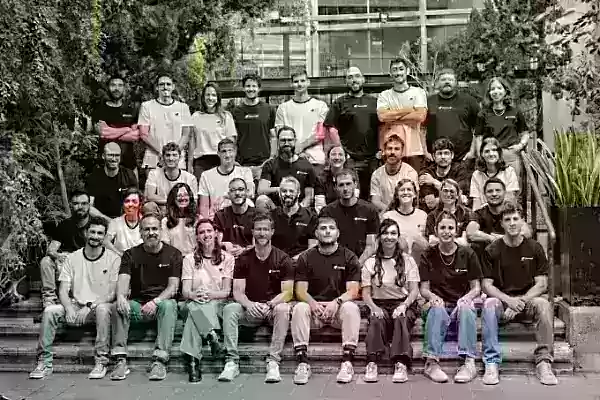
image credits: converge bio AI-driven drug discovery is gaining significant momentum. Last year, Eli Lilly partnered with Nvidia to build what the companies described as the pharmaceutical industry’s most powerful supercomputer for drug discovery. And in October 2024, the developers behind Google DeepMind’s AlphaFold project won a Nobel Prize in Chemistry for creating AlphaFold, the AI system capable of predicting protein structures.
When asked about this momentum and how it is influencing Converge Bio’s growth, Gertz said the company is witnessing the largest financial opportunity in the history of life sciences, with the industry shifting from “trial-and-error” methods to data-driven molecular design.
“We feel the momentum strongly, especially in our inboxes. A year and a half ago, when we founded the company, there was considerable skepticism,” Gertz told TechCrunch. That skepticism has disappeared remarkably quickly, thanks to successful case studies from companies like Converge and from academia, he added.
Large language models are attracting attention in drug discovery for their ability to analyze biological sequences and propose new molecules, but challenges like hallucinations and accuracy persist. “In text, hallucinations are usually easy to spot,” the CEO said. “In molecules, validating a novel compound can take weeks, so the cost is much higher.” To address this, Converge combines generative models with predictive ones, filtering new molecules to reduce risk and enhance outcomes for its partners. “This filtration isn’t perfect, but it significantly lowers risk and delivers better results for our customers,” Gertz added.
TechCrunch also inquired about experts like Yann LeCun, who remain skeptical about using LLMs. “I’m a huge fan of Yann LeCun, and I completely agree with him. We don’t rely on text-based models for core scientific understanding. To truly grasp biology, models must be trained on DNA, RNA, proteins, and small molecules,” Gertz explained.
Text-based LLMs are used only as auxiliary tools, for instance, to help customers navigate literature on generated molecules. “They’re not our core technology,” Gertz said. “We’re not tied to a single architecture. We use LLMs, diffusion models, traditional machine learning, and statistical methods when appropriate.”
“Our vision is for every life-science organization to use Converge Bio as its generative AI lab. Wet labs will always exist, but they’ll be complemented by generative labs that create hypotheses and molecules computationally. We aim to be that generative lab for the entire industry,” Gertz said.
Related article
 Stripe to Acquire OpenRouter as AI Model Routing Gains Momentum
Stripe has agreed to acquire OpenRouter, an AI model-routing platform that gives developers access to hundreds of models through a single interface. The deal adds model selection and routing to Stripe’s existing work around AI usage and token-based b
Former OpenAI Researcher Barrett Zoph Returns to Google to Support Gemini Development
Barret Zoph, who previously abruptly left and joined OpenAI due to a disagreement with Thinking Machines Lab CEO Miriam Mularati, has once again changed employers. Alphabet's Google announced that Zoph will return as Vice President of Research, bring
How Recursive Intelligence Raised $335M at $4B Valuation in 4 Months
The co-founders of startup Ricursive Intelligence seemed destined to be co-founders.Anna Goldie, CEO, and Azalia Mirhoseini, CTO, are so well-known in the AI community that they were among those AI engineers who “got those weird emails from Zuckerber
Related Special Topic Recommendations
Design & Art
Stripe to Acquire OpenRouter as AI Model Routing Gains Momentum
Stripe has agreed to acquire OpenRouter, an AI model-routing platform that gives developers access to hundreds of models through a single interface. The deal adds model selection and routing to Stripe’s existing work around AI usage and token-based b
Former OpenAI Researcher Barrett Zoph Returns to Google to Support Gemini Development
Barret Zoph, who previously abruptly left and joined OpenAI due to a disagreement with Thinking Machines Lab CEO Miriam Mularati, has once again changed employers. Alphabet's Google announced that Zoph will return as Vice President of Research, bring
How Recursive Intelligence Raised $335M at $4B Valuation in 4 Months
The co-founders of startup Ricursive Intelligence seemed destined to be co-founders.Anna Goldie, CEO, and Azalia Mirhoseini, CTO, are so well-known in the AI community that they were among those AI engineers who “got those weird emails from Zuckerber
Related Special Topic Recommendations
Design & Art
 Top AI Illustration Tools: Create Editorial Scenes and Cover Art Faster
2026 Latest Top-rated AI Illustration Tools: Our curated list features the best powerfully designed tools for creating stunning editorial scenes and eye-catching cover art quickly. Each option has gone through rigorous real-world tests, offering a free vs paid comparison to help you find the perfect match for your workflow. Try these must-try solutions today to unlock your AI edge and boost your creative productivity. Explore now at XIX.AI.
 10 tools
 xix.ai
Education and Learning
Top AI Tutors for Exam Prep: Practice Math, Science, and English
xix.ai
Education and Learning
Top AI Tutors for Exam Prep: Practice Math, Science, and English
2026 Latest Top-Rated Best AI Tutors for Exam Prep are here on XIX.AI! Our curated list features powerful game-changing tools that offer free vs paid comparison, real-world tests, and weekly updated rankings. They help boost your writing efficiency, simplify complex topic learning, and unlock your academic potential. Explore now to Discover your perfect exam prep tool and Start creating today to Unlock your AI edge!
10 tools
xix.ai
Finance
AI Budget Planning Tools for Personal Money Management
2026 Latest Best Top-Rated AI Budget Planning Tools for Personal Money Management are here on XIX.AI! This curated collection features powerful, game-changing solutions that help you conduct real-world tests, understand spending habits, and create personalized plans to boost productivity. Enjoy a free vs paid comparison along with detailed rankings. Must-try tools designed to simplify money management and unlock your AI edge. Explore now!
11 tools
xix.ai
Health & Wellness
AI Sleep Tracking Assistants: Improve Recovery with Better Bedtime Habits
2026 Latest Best Top-Rated AI Sleep Tracking Assistants curated for ultimate recovery. This fully updated weekly guide features powerful tools that deliver real-world tests, free vs paid comparison, and detailed rankings to help you find the must-try solution that boosts sleep quality and supports better bedtime habits. Explore now at XIX.AI to Unlock your AI edge.
10 tools
xix.ai
Data Analysis
AI SQL Copilots for Product and Revenue Analytics
2026 Latest Best Top-Rated AI SQL Copilots for Product and Revenue Analytics! XIX.AI has curated a powerful, game-changing collection of must-try tools that undergo real-world tests through weekly updated rankings. These tools help users boost productivity significantly by accelerating data analysis, streamlining complex queries, and generating accurate insights to drive smarter business decisions. Explore now to Discover your perfect tool for unlocking your AI edge!
14 tools
xix.ai
Education and Learning
Best AI Homework Helpers That Teach: Learn Concepts, Not Just Answers
2026 Latest Best Top-Rated AI Homework Helpers That Teach Core Concepts Not Just Answers Powerful Tools for Students Must-Try Curated List Weekly Updated Free vs Paid Comparison Real-World Tests Accurate Rankings to Help You Unlock Your Full Learning Potential Explore now to Discover your perfect tool for smarter studying.
10 tools
xix.ai

 Comments (2)
0/500
Comments (2)
0/500
![EdwardSmith]()
Finally, some real money flowing into AI drug discovery. But with 200 startups, how many will actually deliver? 🤔
![WilliamYoung]()
25 Millionen für AI in der Medikamentenentwicklung? Das Feld wird ja immer voller. Bessemer ist natürlich ein großer Name, aber bei über 200 Startups frage ich mich, wie viele in 5 Jahren noch übrig sind. Die Kosten im Pharmabereich sind wirklich explodiert, also klar, dass man nach effizienteren Wegen sucht. Hoffentlich führt das nicht nur zu schnelleren, sondern auch zu besseren und sichereren Therapien. Die ethischen Fragen bei AI-gestützter Forschung sollte man dabei aber nicht aus den Augen verlieren. Spannende Zeiten! 🤔
Artificial intelligence is rapidly advancing in drug discovery as pharmaceutical and biotech firms seek to shorten R&D timelines by years and improve success rates amid rising costs. Over 200 startups are now competing to integrate AI directly into research workflows, drawing increased investor attention. Converge Bio is the latest company capitalizing on this trend, securing fresh funding as competition intensifies in the AI-driven drug discovery sector.
The Boston- and Tel Aviv–based startup, which helps pharmaceutical and biotech companies accelerate drug development using generative AI trained on molecular data, has raised a $25 million oversubscribed Series A round led by Bessemer Venture Partners. TLV Partners and Vintage Investment Partners also participated, along with additional support from unnamed executives at Meta, OpenAI, and Wiz.
In practice, Converge trains generative models on DNA, RNA, and protein sequences, then integrates them into pharmaceutical and biotech workflows to expedite drug development.
“The drug-development lifecycle has distinct stages—from target identification and discovery to manufacturing, clinical trials, and beyond—and within each, there are experiments we can support,” Converge Bio CEO and co-founder Dov Gertz shared in an exclusive interview with TechCrunch. “Our platform continues to expand across these stages, helping bring new drugs to market more quickly.”
So far, Converge has launched customer-facing systems. The startup has already introduced three distinct AI systems: one for antibody design, one for protein yield optimization, and one for biomarker and target discovery.
“Consider our antibody design system as an example. It’s not just a single model. It consists of three integrated components. First, a generative model creates novel antibodies. Next, predictive models filter these antibodies based on their molecular properties. Finally, a docking system, which uses a physics-based model, simulates the three-dimensional interactions between the antibody and its target,” Gertz continued. The value lies in the system as a whole, not in any single model, according to the CEO. “Our customers don’t need to assemble models themselves. They receive ready-to-use systems that integrate directly into their workflows.”
The new funding arrives about a year and a half after the company raised a $5.5 million seed round in 2024.
Techcrunch eventJoin the Disrupt 2026 Waitlist
Add yourself to the Disrupt 2026 waitlist to be first in line when Early Bird tickets become available. Past Disrupt events have featured Google Cloud, Netflix, Microsoft, Box, Phia, a16z, ElevenLabs, Wayve, Hugging Face, Elad Gil, and Vinod Khosla on stage—part of over 250 industry leaders driving 200+ sessions designed to fuel your growth and sharpen your competitive edge. Plus, connect with hundreds of startups innovating across every sector.
Join the Disrupt 2026 Waitlist
Add yourself to the Disrupt 2026 waitlist to be first in line when Early Bird tickets become available. Past Disrupt events have featured Google Cloud, Netflix, Microsoft, Box, Phia, a16z, ElevenLabs, Wayve, Hugging Face, Elad Gil, and Vinod Khosla on stage—part of over 250 industry leaders driving 200+ sessions designed to fuel your growth and sharpen your competitive edge. Plus, connect with hundreds of startups innovating across every sector.
San Francisco | October 13-15, 2026 WAITLIST NOWSince then, the two-year-old startup has scaled rapidly. Converge has formed 40 partnerships with pharmaceutical and biotech companies and is currently managing about 40 programs on its platform, Gertz said. It collaborates with customers across the U.S., Canada, Europe, and Israel and is now expanding into Asia.
The team has also grown quickly, increasing from just nine employees in November 2024 to 34. Along the way, Converge has started publishing public case studies. In one, the startup helped a partner increase protein yield by 4 to 4.5 times in a single computational iteration. In another, the platform generated antibodies with exceptionally high binding affinity, reaching the single-nanomolar range, Gertz noted.
AI-driven drug discovery is gaining significant momentum. Last year, Eli Lilly partnered with Nvidia to build what the companies described as the pharmaceutical industry’s most powerful supercomputer for drug discovery. And in October 2024, the developers behind Google DeepMind’s AlphaFold project won a Nobel Prize in Chemistry for creating AlphaFold, the AI system capable of predicting protein structures.
When asked about this momentum and how it is influencing Converge Bio’s growth, Gertz said the company is witnessing the largest financial opportunity in the history of life sciences, with the industry shifting from “trial-and-error” methods to data-driven molecular design.
“We feel the momentum strongly, especially in our inboxes. A year and a half ago, when we founded the company, there was considerable skepticism,” Gertz told TechCrunch. That skepticism has disappeared remarkably quickly, thanks to successful case studies from companies like Converge and from academia, he added.
Large language models are attracting attention in drug discovery for their ability to analyze biological sequences and propose new molecules, but challenges like hallucinations and accuracy persist. “In text, hallucinations are usually easy to spot,” the CEO said. “In molecules, validating a novel compound can take weeks, so the cost is much higher.” To address this, Converge combines generative models with predictive ones, filtering new molecules to reduce risk and enhance outcomes for its partners. “This filtration isn’t perfect, but it significantly lowers risk and delivers better results for our customers,” Gertz added.
TechCrunch also inquired about experts like Yann LeCun, who remain skeptical about using LLMs. “I’m a huge fan of Yann LeCun, and I completely agree with him. We don’t rely on text-based models for core scientific understanding. To truly grasp biology, models must be trained on DNA, RNA, proteins, and small molecules,” Gertz explained.
Text-based LLMs are used only as auxiliary tools, for instance, to help customers navigate literature on generated molecules. “They’re not our core technology,” Gertz said. “We’re not tied to a single architecture. We use LLMs, diffusion models, traditional machine learning, and statistical methods when appropriate.”
“Our vision is for every life-science organization to use Converge Bio as its generative AI lab. Wet labs will always exist, but they’ll be complemented by generative labs that create hypotheses and molecules computationally. We aim to be that generative lab for the entire industry,” Gertz said.








 Stripe to Acquire OpenRouter as AI Model Routing Gains Momentum
Stripe has agreed to acquire OpenRouter, an AI model-routing platform that gives developers access to hundreds of models through a single interface. The deal adds model selection and routing to Stripe’s existing work around AI usage and token-based b
Stripe to Acquire OpenRouter as AI Model Routing Gains Momentum
Stripe has agreed to acquire OpenRouter, an AI model-routing platform that gives developers access to hundreds of models through a single interface. The deal adds model selection and routing to Stripe’s existing work around AI usage and token-based b
 Former OpenAI Researcher Barrett Zoph Returns to Google to Support Gemini Development
Barret Zoph, who previously abruptly left and joined OpenAI due to a disagreement with Thinking Machines Lab CEO Miriam Mularati, has once again changed employers. Alphabet's Google announced that Zoph will return as Vice President of Research, bring
Former OpenAI Researcher Barrett Zoph Returns to Google to Support Gemini Development
Barret Zoph, who previously abruptly left and joined OpenAI due to a disagreement with Thinking Machines Lab CEO Miriam Mularati, has once again changed employers. Alphabet's Google announced that Zoph will return as Vice President of Research, bring
 How Recursive Intelligence Raised $335M at $4B Valuation in 4 Months
The co-founders of startup Ricursive Intelligence seemed destined to be co-founders.Anna Goldie, CEO, and Azalia Mirhoseini, CTO, are so well-known in the AI community that they were among those AI engineers who “got those weird emails from Zuckerber
How Recursive Intelligence Raised $335M at $4B Valuation in 4 Months
The co-founders of startup Ricursive Intelligence seemed destined to be co-founders.Anna Goldie, CEO, and Azalia Mirhoseini, CTO, are so well-known in the AI community that they were among those AI engineers who “got those weird emails from Zuckerber

2026 Latest Top-rated AI Illustration Tools: Our curated list features the best powerfully designed tools for creating stunning editorial scenes and eye-catching cover art quickly. Each option has gone through rigorous real-world tests, offering a free vs paid comparison to help you find the perfect match for your workflow. Try these must-try solutions today to unlock your AI edge and boost your creative productivity. Explore now at XIX.AI.
10 tools
xix.ai

2026 Latest Top-Rated Best AI Tutors for Exam Prep are here on XIX.AI! Our curated list features powerful game-changing tools that offer free vs paid comparison, real-world tests, and weekly updated rankings. They help boost your writing efficiency, simplify complex topic learning, and unlock your academic potential. Explore now to Discover your perfect exam prep tool and Start creating today to Unlock your AI edge!
10 tools
xix.ai

2026 Latest Best Top-Rated AI Budget Planning Tools for Personal Money Management are here on XIX.AI! This curated collection features powerful, game-changing solutions that help you conduct real-world tests, understand spending habits, and create personalized plans to boost productivity. Enjoy a free vs paid comparison along with detailed rankings. Must-try tools designed to simplify money management and unlock your AI edge. Explore now!
11 tools
xix.ai

2026 Latest Best Top-Rated AI Sleep Tracking Assistants curated for ultimate recovery. This fully updated weekly guide features powerful tools that deliver real-world tests, free vs paid comparison, and detailed rankings to help you find the must-try solution that boosts sleep quality and supports better bedtime habits. Explore now at XIX.AI to Unlock your AI edge.
10 tools
xix.ai

2026 Latest Best Top-Rated AI SQL Copilots for Product and Revenue Analytics! XIX.AI has curated a powerful, game-changing collection of must-try tools that undergo real-world tests through weekly updated rankings. These tools help users boost productivity significantly by accelerating data analysis, streamlining complex queries, and generating accurate insights to drive smarter business decisions. Explore now to Discover your perfect tool for unlocking your AI edge!
14 tools
xix.ai

2026 Latest Best Top-Rated AI Homework Helpers That Teach Core Concepts Not Just Answers Powerful Tools for Students Must-Try Curated List Weekly Updated Free vs Paid Comparison Real-World Tests Accurate Rankings to Help You Unlock Your Full Learning Potential Explore now to Discover your perfect tool for smarter studying.
10 tools
xix.ai

Finally, some real money flowing into AI drug discovery. But with 200 startups, how many will actually deliver? 🤔
25 Millionen für AI in der Medikamentenentwicklung? Das Feld wird ja immer voller. Bessemer ist natürlich ein großer Name, aber bei über 200 Startups frage ich mich, wie viele in 5 Jahren noch übrig sind. Die Kosten im Pharmabereich sind wirklich explodiert, also klar, dass man nach effizienteren Wegen sucht. Hoffentlich führt das nicht nur zu schnelleren, sondern auch zu besseren und sichereren Therapien. Die ethischen Fragen bei AI-gestützter Forschung sollte man dabei aber nicht aus den Augen verlieren. Spannende Zeiten! 🤔












