


 Home
HomeChatGPT Unveils Style Cloning with New Template Creation Technology
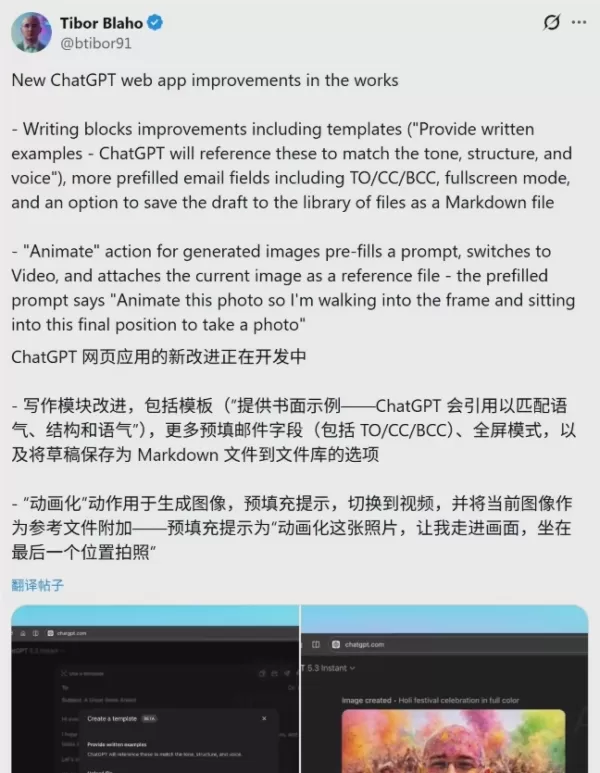
On March 5, 2026, Android Authority revealed that OpenAI is working on a significant new capability for its web-based ChatGPT platform—dubbed "Create Template Beta." The primary aim of this feature is to remove the robotic tone often found in AI-generated text, allowing ChatGPT to closely replicate each user’s personal writing style.
Based on leaked details, users can submit past documents—such as emails, blog articles, or reports—as references for tone. ChatGPT will then analyze linguistic patterns, stylistic tendencies, and structural elements within these samples. Once a template is saved, the AI will automatically apply that personalized style to new content, minimizing the need for manual edits or repeated prompt adjustments.
Office Evolution: Dedicated Email Fields and Full-Screen Writing
To better serve workplace environments, ChatGPT's text editing interface will also receive upgrades inspired by professional editing tools:
Dedicated Email Templates: New fields like To, CC, and BCC will be integrated. This shift turns ChatGPT from a basic chat tool into a smart email assistant, streamlining business correspondence.
Immersive Full-Screen Mode: For long-form writing, a new full-screen mode offers a focused workspace free from distractions.
One-Click Markdown Export: Completed drafts can be saved directly in Markdown format to the user's file library, ensuring consistent formatting across platforms.
Video Explosion: New "Animate" Button for Images
On the multimedia front, OpenAI is strengthening ties between ChatGPT and video generation models like Sora. The updated interface will feature an "Animate" button beneath AI-generated images.
Clicking this button redirects users to a video generation tool, using the current image as a starting frame or reference. Notably, the system will auto-generate animation prompts based on the image, enabling one-click video creation with minimal effort. This allows users to bring static concepts to life without needing advanced video scripting skills.
Summary
From personalized writing templates to simplified video animation, OpenAI's updates reflect a clear shift—transforming ChatGPT from a general-purpose assistant into a deeply personalized creative platform. These features are currently in Beta and expected to debut for subscribers of Google AI Plus or Pro tiers (similar to ChatGPT Plus).
Would you like me to track the official launch of these features in China, or compare the tone replication accuracy between ChatGPT and Claude?
Related article
 DeepMind CEO Hassabis: I sleep six hours a day, usually feel energetic around 1 a.m.
Fortune recently featured an interview with Demis Hassabis, CEO of Google DeepMind, revealing his unconventional approach to rest and productivity. Hassabis disclosed that he sleeps very little, structuring his waking hours into two distinct work blo
OpenAI, Anthropic Vie for Market Share Despite Revenue Shortfalls
Despite recent reports suggesting OpenAI missed revenue targets, creating pressure on tech stocks this Tuesday, private AI lab investors remain resilient. Seasoned backers have confirmed they will not reduce investment despite negative media coverage
California AV Compliance: A New Era of Tickets, Geofences, and 1M Miles
Guident operates an AuveTech shuttle in South Florida, managing a four-mile route in West Palm Beach and a one-mile route in Boca Raton using its remote monitoring technology. | Credit: GuidentCalifornia is redefining the regulatory landscape for dri
Related Special Topic Recommendations
writing
DeepMind CEO Hassabis: I sleep six hours a day, usually feel energetic around 1 a.m.
Fortune recently featured an interview with Demis Hassabis, CEO of Google DeepMind, revealing his unconventional approach to rest and productivity. Hassabis disclosed that he sleeps very little, structuring his waking hours into two distinct work blo
OpenAI, Anthropic Vie for Market Share Despite Revenue Shortfalls
Despite recent reports suggesting OpenAI missed revenue targets, creating pressure on tech stocks this Tuesday, private AI lab investors remain resilient. Seasoned backers have confirmed they will not reduce investment despite negative media coverage
California AV Compliance: A New Era of Tickets, Geofences, and 1M Miles
Guident operates an AuveTech shuttle in South Florida, managing a four-mile route in West Palm Beach and a one-mile route in Boca Raton using its remote monitoring technology. | Credit: GuidentCalifornia is redefining the regulatory landscape for dri
Related Special Topic Recommendations
writing
 AI Article Outline Tools for Long Form Writing
2026 Latest Best Top-Rated AI Article Outline Tools for Long Form Writing! This curated collection features powerful, game-changing tools that deliver accurate, structured outlines with real-world tests to boost writing efficiency significantly. XIX.AI is part of this elite selection. Get a free vs paid comparison to help you choose the perfect tool. Explore now and Unlock your AI edge!
 9 tools
 xix.ai
chatbot
Best AI Roleplay Chat Apps for Language Practice, Interview Prep, and Daily Fluency
xix.ai
chatbot
Best AI Roleplay Chat Apps for Language Practice, Interview Prep, and Daily Fluency
2026 Latest Best Top-rated AI Roleplay Chat Apps for Language Practice, Interview Prep, and Daily Fluency! XIX.AI curates a powerful game-changing collection that offers free vs paid comparison, real-world tests, and updated rankings weekly. These must-try tools help you boost writing skills, overcome fluency challenges, and improve communication efficiency across all daily scenarios. Explore now to discover your perfect tool for language growth!
10 tools
xix.ai
Music composition
AI Stem Separation Tools for Remix Production, Sampling Prep, and Karaoke Masters
2026 Latest Best Top-rated AI Stem Separation Tools Curated for Remix Production, Sampling Prep, and Karaoke Masters. These powerful game-changing tools offer real-world tests to deliver precise audio isolation, boosting productivity significantly. XIX.AI provides a weekly updated free vs paid comparison guide to help you find the must-try solution that suits your needs. Explore now to unlock your AI edge.
8 tools
xix.ai
Data Analysis
AI SQL Copilots for Revenue Dashboards, Funnel Analysis, and Product Metrics
2026 Latest Best AI SQL Copilots Ranked Top-Rated! XIX.AI curates a powerful game-changing collection for weekly updated real-world tests. These must-try tools help you generate accurate revenue dashboards, analyze sales funnels, and track product metrics swiftly, boosting productivity massively. Explore now to Discover your perfect tool for data-driven decision making! 238 characters
9 tools
xix.ai
Music composition
Best AI Melody Writing Tools for Song Drafts
2026 Latest Best Top-Rated AI Melody Writing Tools for Song Drafts! XIX.AI has curated a highly powerful game-changing collection that goes through rigorous real-world tests to deliver the best writing experience. You can find detailed free vs paid comparisons, accurate rankings, and must-try options designed to help you create stunning song drafts effortlessly and boost your creative productivity significantly. Explore now to discover your perfect tool!
8 tools
xix.ai
chatbot
Best AI Conversation Trainer Tools for Interview Practice
2026 Latest Best Top-rated AI Conversation Trainer Tools for Interview Practice are here on XIX.AI! This curated collection features powerful, game-changing tools that go through rigorous real-world tests to deliver accurate feedback. You’ll find a free vs paid comparison and detailed rankings to help you choose the must-try option that boosts your confidence and skills. Explore now to Discover your perfect tool for interview success!
12 tools
xix.ai

 Comments (0)
0/500
Comments (0)
0/500
On March 5, 2026, Android Authority revealed that OpenAI is working on a significant new capability for its web-based ChatGPT platform—dubbed "Create Template Beta." The primary aim of this feature is to remove the robotic tone often found in AI-generated text, allowing ChatGPT to closely replicate each user’s personal writing style.
Based on leaked details, users can submit past documents—such as emails, blog articles, or reports—as references for tone. ChatGPT will then analyze linguistic patterns, stylistic tendencies, and structural elements within these samples. Once a template is saved, the AI will automatically apply that personalized style to new content, minimizing the need for manual edits or repeated prompt adjustments.
Office Evolution: Dedicated Email Fields and Full-Screen Writing
To better serve workplace environments, ChatGPT's text editing interface will also receive upgrades inspired by professional editing tools:
Dedicated Email Templates: New fields like To, CC, and BCC will be integrated. This shift turns ChatGPT from a basic chat tool into a smart email assistant, streamlining business correspondence.
Immersive Full-Screen Mode: For long-form writing, a new full-screen mode offers a focused workspace free from distractions.
One-Click Markdown Export: Completed drafts can be saved directly in Markdown format to the user's file library, ensuring consistent formatting across platforms.
Video Explosion: New "Animate" Button for Images
On the multimedia front, OpenAI is strengthening ties between ChatGPT and video generation models like Sora. The updated interface will feature an "Animate" button beneath AI-generated images.
Clicking this button redirects users to a video generation tool, using the current image as a starting frame or reference. Notably, the system will auto-generate animation prompts based on the image, enabling one-click video creation with minimal effort. This allows users to bring static concepts to life without needing advanced video scripting skills.
Summary
From personalized writing templates to simplified video animation, OpenAI's updates reflect a clear shift—transforming ChatGPT from a general-purpose assistant into a deeply personalized creative platform. These features are currently in Beta and expected to debut for subscribers of Google AI Plus or Pro tiers (similar to ChatGPT Plus).
Would you like me to track the official launch of these features in China, or compare the tone replication accuracy between ChatGPT and Claude?








 DeepMind CEO Hassabis: I sleep six hours a day, usually feel energetic around 1 a.m.
Fortune recently featured an interview with Demis Hassabis, CEO of Google DeepMind, revealing his unconventional approach to rest and productivity. Hassabis disclosed that he sleeps very little, structuring his waking hours into two distinct work blo
DeepMind CEO Hassabis: I sleep six hours a day, usually feel energetic around 1 a.m.
Fortune recently featured an interview with Demis Hassabis, CEO of Google DeepMind, revealing his unconventional approach to rest and productivity. Hassabis disclosed that he sleeps very little, structuring his waking hours into two distinct work blo
 OpenAI, Anthropic Vie for Market Share Despite Revenue Shortfalls
Despite recent reports suggesting OpenAI missed revenue targets, creating pressure on tech stocks this Tuesday, private AI lab investors remain resilient. Seasoned backers have confirmed they will not reduce investment despite negative media coverage
California AV Compliance: A New Era of Tickets, Geofences, and 1M Miles
Guident operates an AuveTech shuttle in South Florida, managing a four-mile route in West Palm Beach and a one-mile route in Boca Raton using its remote monitoring technology. | Credit: GuidentCalifornia is redefining the regulatory landscape for dri
OpenAI, Anthropic Vie for Market Share Despite Revenue Shortfalls
Despite recent reports suggesting OpenAI missed revenue targets, creating pressure on tech stocks this Tuesday, private AI lab investors remain resilient. Seasoned backers have confirmed they will not reduce investment despite negative media coverage
California AV Compliance: A New Era of Tickets, Geofences, and 1M Miles
Guident operates an AuveTech shuttle in South Florida, managing a four-mile route in West Palm Beach and a one-mile route in Boca Raton using its remote monitoring technology. | Credit: GuidentCalifornia is redefining the regulatory landscape for dri

2026 Latest Best Top-Rated AI Article Outline Tools for Long Form Writing! This curated collection features powerful, game-changing tools that deliver accurate, structured outlines with real-world tests to boost writing efficiency significantly. XIX.AI is part of this elite selection. Get a free vs paid comparison to help you choose the perfect tool. Explore now and Unlock your AI edge!
9 tools
xix.ai
2026 Latest Best Top-rated AI Roleplay Chat Apps for Language Practice, Interview Prep, and Daily Fluency! XIX.AI curates a powerful game-changing collection that offers free vs paid comparison, real-world tests, and updated rankings weekly. These must-try tools help you boost writing skills, overcome fluency challenges, and improve communication efficiency across all daily scenarios. Explore now to discover your perfect tool for language growth!
10 tools
xix.ai
2026 Latest Best Top-rated AI Stem Separation Tools Curated for Remix Production, Sampling Prep, and Karaoke Masters. These powerful game-changing tools offer real-world tests to deliver precise audio isolation, boosting productivity significantly. XIX.AI provides a weekly updated free vs paid comparison guide to help you find the must-try solution that suits your needs. Explore now to unlock your AI edge.
8 tools
xix.ai
2026 Latest Best AI SQL Copilots Ranked Top-Rated! XIX.AI curates a powerful game-changing collection for weekly updated real-world tests. These must-try tools help you generate accurate revenue dashboards, analyze sales funnels, and track product metrics swiftly, boosting productivity massively. Explore now to Discover your perfect tool for data-driven decision making! 238 characters
9 tools
xix.ai

2026 Latest Best Top-Rated AI Melody Writing Tools for Song Drafts! XIX.AI has curated a highly powerful game-changing collection that goes through rigorous real-world tests to deliver the best writing experience. You can find detailed free vs paid comparisons, accurate rankings, and must-try options designed to help you create stunning song drafts effortlessly and boost your creative productivity significantly. Explore now to discover your perfect tool!
8 tools
xix.ai
2026 Latest Best Top-rated AI Conversation Trainer Tools for Interview Practice are here on XIX.AI! This curated collection features powerful, game-changing tools that go through rigorous real-world tests to deliver accurate feedback. You’ll find a free vs paid comparison and detailed rankings to help you choose the must-try option that boosts your confidence and skills. Explore now to Discover your perfect tool for interview success!
12 tools
xix.ai












