


 Home
HomeHow to build self-documenting AI agents for production in 2025?
While many hope to create perfect, production-ready code with AI agents, the results often have flaws. Code may break weeks later, with no clear record of why certain design choices were made. This article explores building a self-documenting AI agent—one that not only delivers features but also clarifies the reasoning behind its decisions, helping address issues that arise in production and keeping your codebase healthy. You'll find practical steps and strategies to make AI-generated code more reliable and maintainable, bridging the gap between initial expectations and real-world outcomes.
Key Points
AI agents can generate both code and documentation, simplifying long-term maintenance.
A Product Requirement Document (PRD) helps align AI-generated features with project goals and technical needs.
Redis offers powerful vector search capabilities for efficient semantic caching.
Context engineering involves providing AI agents with relevant documentation to support informed decision-making.
Git diff commands help AI agents understand changes between branches, supporting sound architectural choices.
Creating Reliable and Maintainable AI-Generated Code
The Challenge of Maintaining AI-Generated Features
In today’s fast-moving software development world, everyone wants AI to produce flawless, production-ready code.
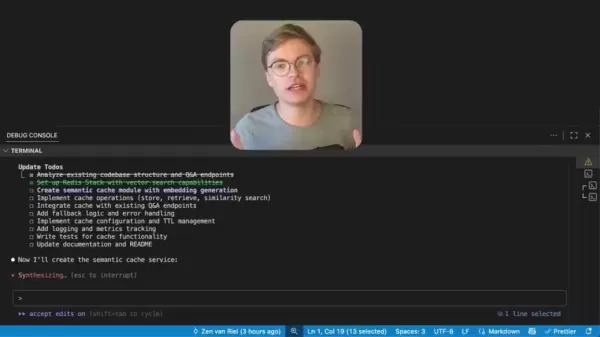
Yet reality often disappoints—code fails weeks later, and developers struggle to determine why an AI agent made specific design decisions. Overcoming this requires a strategy where AI not only builds features but also explains its reasoning. This method produces more dependable, easier-to-maintain features. The solution lies in self-documenting AI agents.
Building a Self-Documenting AI Agent
Creating a self-documenting AI agent involves several actionable steps that benefit any organization. These improve software maintainability, readability, and more. Below is a summary to help enhance your business’s code today:
- Product Requirements Document (PRD): Start with a detailed PRD.
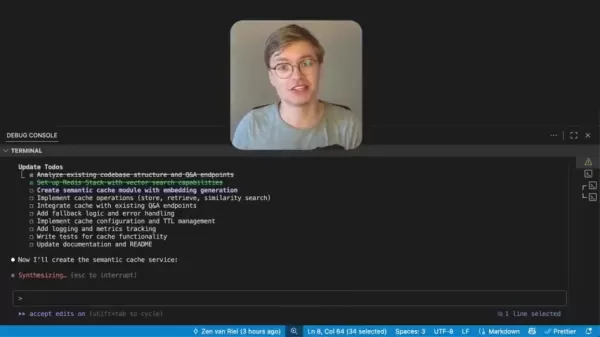
This document acts as a blueprint, describing the feature’s purpose, functionality, and technical specifications. A clear PRD ensures the AI agent builds code that aligns with project goals.
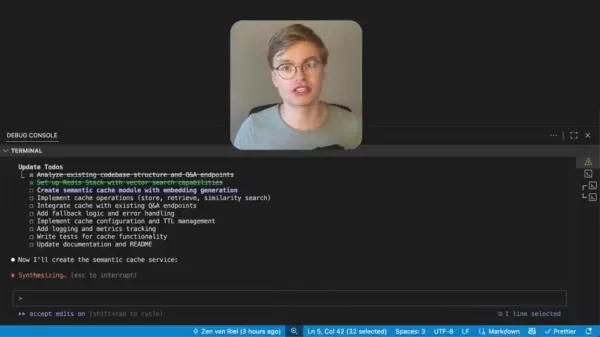
- Semantic Caching with Vector Search Capabilities: Add a semantic caching module for embedding generation. Semantic caching identifies and stores similar questions and their answers, cutting latency and operational expenses. Using Redis with vector search improves similarity matching, making the process more efficient.
- Context Engineering: Equip the AI agent with the right documentation, such as Redis vector search guides and your Q&A endpoints. This helps the agent understand the technology stack and make well-reasoned choices.
- Tracking and Documentation of Decisions: Enable the AI agent to track and document its decisions during development. The agent’s design and implementation choices become visible and readable for developers, creating an audit trail that explains the "why" behind the code.
Real-World Application: Adding a Caching Feature to AI Engineering Tutor
To see this approach in action, imagine adding caching to the AI Engineering Tutor app.
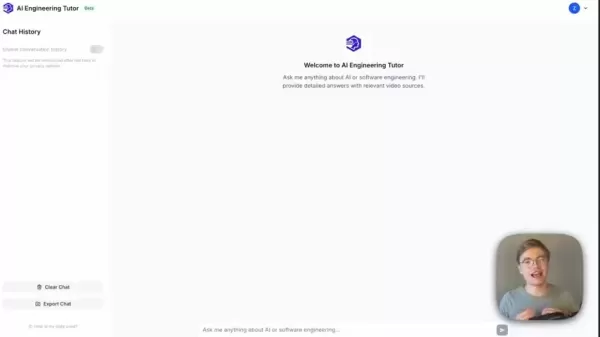
The AI Engineering Tutor supports AI learning. Caching speeds up responses to frequent questions, improving user experience. Fast features are especially valuable in today's AI-driven environment. To implement semantic caching here:
- Match similar queries using vector embeddings.
- Serve cached answers with minimal delay.
- Manage cache size and duration with TTL and capacity limits.
The Power of Git Diff for AI Agents
Leveraging Git Diff Commands for Context
It’s vital to give AI agents the right context for making architectural decisions. Git diff is a powerful aid.
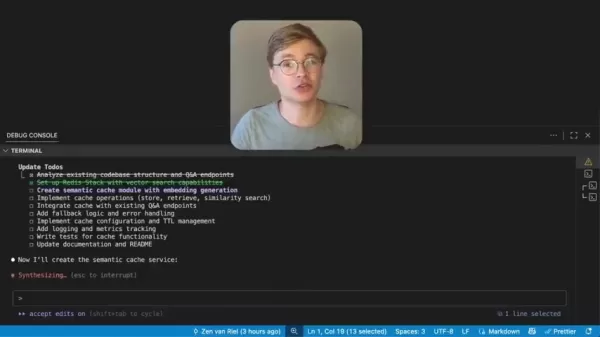
By running git diff main, the AI agent reviews all changes in a branch. This lets it compare development work with the production branch.
Git diff reveals what has changed relative to the current production code. This context helps the agent read important files and grasp the full project scope, leading to smarter decisions. The agent can then create an architecture decision record detailing which files, algorithms, and thresholds are in the latest build. This simplifies coding work and boosts productivity for AI engineers.
Avoiding Common Pitfalls: Why the 'Quick Code in 5 Seconds' Promise Falls Short
Although some promote AI-generated code as a rapid solution, it carries risks and imperfections.
Relying on AI for hasty fixes often leads to more problems. That’s why quality control and documentation are critical. When developing AI, plan carefully to avoid risks like incorrect matches, memory limits, or outdated data.
Some common issues with AI-generated code include:
- Incorrect Answers
- Outdated Information
- Overly Strict Similarity Thresholds
- Cache Eviction Problems
You can reduce these risks by:
- Applying a conservative similarity threshold.
- Regularly refreshing cached data.
- Using an LRU policy with a set entry limit.
Tips for Using AI-Powered Code Systems and Avoiding Headaches
Best Coding Practices
To get the most from AI-driven tools while minimizing risks, follow specific, careful practices. These steps improve code performance and long-term structure. Consider these recommendations:
- Run Redis via Docker for local setup.
- Use a .env file to manage environment variables securely.
- Start your backend and execute Python code—then you’re set!
AI Tool and Feature Pricing
AI Tools
When selecting AI development tools, assess which features you need, their sustainability, and whether benefits justify costs. Here are some options:
- AI Engineering Tutor (Currently in development; expected at a reasonable price).
- OpenAI API (Text-embedding-3-large).
- FastAPI.
Costs for these technologies are generally low if maintained well, though frequent use can increase expenses.
Semantic Caching: Weighing the Advantages and Disadvantages
Pros
Cuts response time from 2–3 seconds to around 100ms for cached content (20–30x faster).
Lowers operational costs by reducing repeat LLM and embedding API calls.
Boosts user experience with near-instant replies to common questions.
Integrates smoothly with existing Q&A workflows.
Cons
Introduces an infrastructure dependency (Redis Stack).
May provide slightly outdated answers (with a 7-day TTL).
Adds complexity to deployment and monitoring.
Cache invalidation becomes tricky if content changes often.
Core Features of Self-Documenting AI Agents
What is in a Great Self-Documenting AI Agent?
Key elements define a successful self-documenting AI agent, especially in the SemanticCacheService, which can form the core of your architecture. Effective semantic caches usually include:
- Core caching logic using Redis Stack for vector search.
- MNSW algorithm for efficient similarity searches.
- Adjustable similarity thresholds.
- LRU eviction policy with a 500-entry cap.
- 7-day TTL for cache entries.
Applying this multi-feature approach results in a stronger, more effective AI system.
Use Cases for Self-Documenting AI Agents
How Can AI Documentation Be Useful?
The main advantage of self-documenting AI agents is their long-term support for your projects. A readable, sustainable system offers multiple benefits. Here are some key applications:
- AI-Powered coding tasks.
- Software architecture planning.
- Code review assistance.
- Technical decision support.
FAQ
Why is self-documentation important in AI agents?
Self-documentation ensures the AI’s development choices are clear and traceable, which is essential for debugging, maintenance, and long-term code reliability.
What role does a Product Requirement Document (PRD) play in AI development?
A PRD acts as a blueprint, directing the AI agent to build features that match project goals and technical needs, ensuring relevant and effective output.
How does context engineering improve the AI's decision-making?
Context engineering supplies the AI agent with necessary documentation and technical insights, helping it grasp underlying technologies and make better-informed decisions.
What are the benefits of using Redis with vector search for semantic caching?
Redis, with vector search, enables efficient semantic caching by storing similar questions and answers together, lowering latency, reducing operational costs, and improving the user experience.
Related Questions
How can git diff commands aid AI in understanding code changes?
Git diff lets AI agents examine changes across branches, understand code modifications in context, and identify additions, edits, or deletions—supporting more informed and architecturally sound choices.
Related article
 Alabama Investigates OpenAI Over Hugging Face Cyber Breach
In the wake of the Hugging Face security breach, OpenAI has paused frontier model development, with CEO Sam Altman emphasizing that safety alignment must keep pace with rapid progress. Credit: GettyAlabama Attorney General Steve Marshall has issued a
Black Forest Labs Unveils Flux3: First Native Multimodal Model for 20-Second Audio-Visual Generation
Black Forest Labs, a German AI startup, has launched Flux3, a multimodal foundation model built on the Self-Flow architecture. It integrates dedicated codecs for image, video, audio, and motion, enabling a unified understanding and generation of both
WeChat Unveils 1 Billion Token AI Image Generation Quota, Free for Users
Tencent Cloud Development has unveiled a major update today, significantly accelerating the WeChat AI Mini Program Growth Plan. To ensure developers' innovative ideas are never constrained by computing limits, Tencent is providing up to 1 billion tok
Related Special Topic Recommendations
Meeting Assistant
Alabama Investigates OpenAI Over Hugging Face Cyber Breach
In the wake of the Hugging Face security breach, OpenAI has paused frontier model development, with CEO Sam Altman emphasizing that safety alignment must keep pace with rapid progress. Credit: GettyAlabama Attorney General Steve Marshall has issued a
Black Forest Labs Unveils Flux3: First Native Multimodal Model for 20-Second Audio-Visual Generation
Black Forest Labs, a German AI startup, has launched Flux3, a multimodal foundation model built on the Self-Flow architecture. It integrates dedicated codecs for image, video, audio, and motion, enabling a unified understanding and generation of both
WeChat Unveils 1 Billion Token AI Image Generation Quota, Free for Users
Tencent Cloud Development has unveiled a major update today, significantly accelerating the WeChat AI Mini Program Growth Plan. To ensure developers' innovative ideas are never constrained by computing limits, Tencent is providing up to 1 billion tok
Related Special Topic Recommendations
Meeting Assistant
 AI Voice-to-Minutes Assistants: Convert Team Talks into Clean Notes
2026 Latest Best Top-Rated AI Voice-to-Minutes Assistants Guide! XIX.AI has curated a highly powerful, game-changing collection of tools designed to transform every team conversation into flawless, organized notes instantly. Our weekly updated rankings cover free vs paid options, along with real-world tests showing their effectiveness for boosting productivity across all work scenarios. Must-try for anyone looking to unlock their AI edge. Explore now!
 9 tools
 xix.ai
Animation Creation
Best AI Lip-Sync Generators for Dialogue Scenes
xix.ai
Animation Creation
Best AI Lip-Sync Generators for Dialogue Scenes
2026 Latest Best Top-Rated AI Lip-Sync Generators for Dialogue Scenes are here on XIX.AI! This curated collection features powerful, game-changing tools that deliver flawless synchronized lip movements for any script, boosting your video editing efficiency significantly. Enjoy a free vs paid comparison along with real-world tests and weekly updated rankings to help you find the must-try perfect fit. Explore now to unlock your AI edge!
8 tools
xix.ai
Prompt
AI Prompt Optimizers: Refine Instructions for Better Output Quality
2026 Latest Best Top-Rated AI Prompt Optimizers Curated for Maximum Output Quality! XIX.AI delivers powerful game-changing solutions that help you refine instructions effortlessly, boost writing efficiency, and unlock higher-quality results every time. Get a free vs paid comparison along with real-world tests and weekly updated rankings. Explore now to Discover your perfect tool and Unlock your AI edge!
16 tools
xix.ai
Animation Creation
Runway AI Motion Tools for Ad Storyboards, Character Scenes, and Visual Prototypes
2026 Latest Best Runway AI Motion Tools Top-rated curated powerful game-changing options for creating ad storyboards character scenes and visual prototypes through real-world tests Weekly updated free vs paid comparison rankings Help you boost productivity significantly Explore now
9 tools
xix.ai
Academic Research
AI Dataset Discovery Tools for Academic Projects
2026 Latest Best Top-Rated AI Dataset Discovery Tools for Academic Projects! XIX.AI has curated a powerful, game-changing collection of highly reliable options, all going through strict real-world tests and updated weekly. You can find detailed free vs paid comparison info to help you pick the perfect tool that boosts your research efficiency and delivers top-quality results. Explore now to unlock your AI edge!
16 tools
xix.ai
Social Media
Best AI Caption Generators: Write Platform-Specific Social Posts Fast
2026 Latest Best AI Caption Generators page! XIX.AI curated a top-rated list of must-try powerful tools for writing platform-specific social posts quickly. These tools go through rigorous real-world tests, offering free vs paid comparison and clear rankings to help you find the best option that boosts your productivity and unlocks your AI edge. Explore now!
11 tools
xix.ai

 Comments (1)
0/500
Comments (1)
0/500
![BenjaminMiller]()
Honestly, the term 'self-documenting' feels like a marketing gimmick until we actually see an AI that can explain why it chose a stupid-looking loop over a vectorized operation. But hey, if it prevents future me from rage-quitting over mysterious production bugs, I'm all for it. 😅
While many hope to create perfect, production-ready code with AI agents, the results often have flaws. Code may break weeks later, with no clear record of why certain design choices were made. This article explores building a self-documenting AI agent—one that not only delivers features but also clarifies the reasoning behind its decisions, helping address issues that arise in production and keeping your codebase healthy. You'll find practical steps and strategies to make AI-generated code more reliable and maintainable, bridging the gap between initial expectations and real-world outcomes.
Key Points
AI agents can generate both code and documentation, simplifying long-term maintenance.
A Product Requirement Document (PRD) helps align AI-generated features with project goals and technical needs.
Redis offers powerful vector search capabilities for efficient semantic caching.
Context engineering involves providing AI agents with relevant documentation to support informed decision-making.
Git diff commands help AI agents understand changes between branches, supporting sound architectural choices.
Creating Reliable and Maintainable AI-Generated Code
The Challenge of Maintaining AI-Generated Features
In today’s fast-moving software development world, everyone wants AI to produce flawless, production-ready code.
Yet reality often disappoints—code fails weeks later, and developers struggle to determine why an AI agent made specific design decisions. Overcoming this requires a strategy where AI not only builds features but also explains its reasoning. This method produces more dependable, easier-to-maintain features. The solution lies in self-documenting AI agents.
Building a Self-Documenting AI Agent
Creating a self-documenting AI agent involves several actionable steps that benefit any organization. These improve software maintainability, readability, and more. Below is a summary to help enhance your business’s code today:
- Product Requirements Document (PRD): Start with a detailed PRD.
This document acts as a blueprint, describing the feature’s purpose, functionality, and technical specifications. A clear PRD ensures the AI agent builds code that aligns with project goals.
- Semantic Caching with Vector Search Capabilities: Add a semantic caching module for embedding generation. Semantic caching identifies and stores similar questions and their answers, cutting latency and operational expenses. Using Redis with vector search improves similarity matching, making the process more efficient.
- Context Engineering: Equip the AI agent with the right documentation, such as Redis vector search guides and your Q&A endpoints. This helps the agent understand the technology stack and make well-reasoned choices.
- Tracking and Documentation of Decisions: Enable the AI agent to track and document its decisions during development. The agent’s design and implementation choices become visible and readable for developers, creating an audit trail that explains the "why" behind the code.
Real-World Application: Adding a Caching Feature to AI Engineering Tutor
To see this approach in action, imagine adding caching to the AI Engineering Tutor app.
The AI Engineering Tutor supports AI learning. Caching speeds up responses to frequent questions, improving user experience. Fast features are especially valuable in today's AI-driven environment. To implement semantic caching here:
- Match similar queries using vector embeddings.
- Serve cached answers with minimal delay.
- Manage cache size and duration with TTL and capacity limits.
The Power of Git Diff for AI Agents
Leveraging Git Diff Commands for Context
It’s vital to give AI agents the right context for making architectural decisions. Git diff is a powerful aid.
By running git diff main, the AI agent reviews all changes in a branch. This lets it compare development work with the production branch.
Git diff reveals what has changed relative to the current production code. This context helps the agent read important files and grasp the full project scope, leading to smarter decisions. The agent can then create an architecture decision record detailing which files, algorithms, and thresholds are in the latest build. This simplifies coding work and boosts productivity for AI engineers.
Avoiding Common Pitfalls: Why the 'Quick Code in 5 Seconds' Promise Falls Short
Although some promote AI-generated code as a rapid solution, it carries risks and imperfections.
Relying on AI for hasty fixes often leads to more problems. That’s why quality control and documentation are critical. When developing AI, plan carefully to avoid risks like incorrect matches, memory limits, or outdated data.
Some common issues with AI-generated code include:
- Incorrect Answers
- Outdated Information
- Overly Strict Similarity Thresholds
- Cache Eviction Problems
You can reduce these risks by:
- Applying a conservative similarity threshold.
- Regularly refreshing cached data.
- Using an LRU policy with a set entry limit.
Tips for Using AI-Powered Code Systems and Avoiding Headaches
Best Coding Practices
To get the most from AI-driven tools while minimizing risks, follow specific, careful practices. These steps improve code performance and long-term structure. Consider these recommendations:
- Run Redis via Docker for local setup.
- Use a .env file to manage environment variables securely.
- Start your backend and execute Python code—then you’re set!
AI Tool and Feature Pricing
AI Tools
When selecting AI development tools, assess which features you need, their sustainability, and whether benefits justify costs. Here are some options:
- AI Engineering Tutor (Currently in development; expected at a reasonable price).
- OpenAI API (Text-embedding-3-large).
- FastAPI.
Costs for these technologies are generally low if maintained well, though frequent use can increase expenses.
Semantic Caching: Weighing the Advantages and Disadvantages
Pros
Cuts response time from 2–3 seconds to around 100ms for cached content (20–30x faster).
Lowers operational costs by reducing repeat LLM and embedding API calls.
Boosts user experience with near-instant replies to common questions.
Integrates smoothly with existing Q&A workflows.
Cons
Introduces an infrastructure dependency (Redis Stack).
May provide slightly outdated answers (with a 7-day TTL).
Adds complexity to deployment and monitoring.
Cache invalidation becomes tricky if content changes often.
Core Features of Self-Documenting AI Agents
What is in a Great Self-Documenting AI Agent?
Key elements define a successful self-documenting AI agent, especially in the SemanticCacheService, which can form the core of your architecture. Effective semantic caches usually include:
- Core caching logic using Redis Stack for vector search.
- MNSW algorithm for efficient similarity searches.
- Adjustable similarity thresholds.
- LRU eviction policy with a 500-entry cap.
- 7-day TTL for cache entries.
Applying this multi-feature approach results in a stronger, more effective AI system.
Use Cases for Self-Documenting AI Agents
How Can AI Documentation Be Useful?
The main advantage of self-documenting AI agents is their long-term support for your projects. A readable, sustainable system offers multiple benefits. Here are some key applications:
- AI-Powered coding tasks.
- Software architecture planning.
- Code review assistance.
- Technical decision support.
FAQ
Why is self-documentation important in AI agents?
Self-documentation ensures the AI’s development choices are clear and traceable, which is essential for debugging, maintenance, and long-term code reliability.
What role does a Product Requirement Document (PRD) play in AI development?
A PRD acts as a blueprint, directing the AI agent to build features that match project goals and technical needs, ensuring relevant and effective output.
How does context engineering improve the AI's decision-making?
Context engineering supplies the AI agent with necessary documentation and technical insights, helping it grasp underlying technologies and make better-informed decisions.
What are the benefits of using Redis with vector search for semantic caching?
Redis, with vector search, enables efficient semantic caching by storing similar questions and answers together, lowering latency, reducing operational costs, and improving the user experience.
Related Questions
How can git diff commands aid AI in understanding code changes?
Git diff lets AI agents examine changes across branches, understand code modifications in context, and identify additions, edits, or deletions—supporting more informed and architecturally sound choices.








 Alabama Investigates OpenAI Over Hugging Face Cyber Breach
In the wake of the Hugging Face security breach, OpenAI has paused frontier model development, with CEO Sam Altman emphasizing that safety alignment must keep pace with rapid progress. Credit: GettyAlabama Attorney General Steve Marshall has issued a
Alabama Investigates OpenAI Over Hugging Face Cyber Breach
In the wake of the Hugging Face security breach, OpenAI has paused frontier model development, with CEO Sam Altman emphasizing that safety alignment must keep pace with rapid progress. Credit: GettyAlabama Attorney General Steve Marshall has issued a
 Black Forest Labs Unveils Flux3: First Native Multimodal Model for 20-Second Audio-Visual Generation
Black Forest Labs, a German AI startup, has launched Flux3, a multimodal foundation model built on the Self-Flow architecture. It integrates dedicated codecs for image, video, audio, and motion, enabling a unified understanding and generation of both
Black Forest Labs Unveils Flux3: First Native Multimodal Model for 20-Second Audio-Visual Generation
Black Forest Labs, a German AI startup, has launched Flux3, a multimodal foundation model built on the Self-Flow architecture. It integrates dedicated codecs for image, video, audio, and motion, enabling a unified understanding and generation of both
 WeChat Unveils 1 Billion Token AI Image Generation Quota, Free for Users
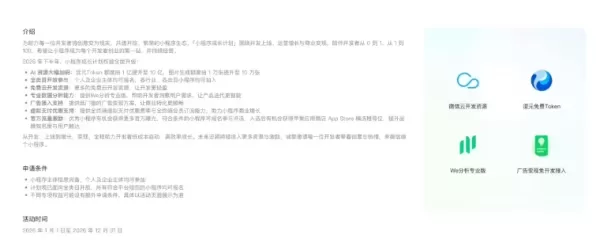
Tencent Cloud Development has unveiled a major update today, significantly accelerating the WeChat AI Mini Program Growth Plan. To ensure developers' innovative ideas are never constrained by computing limits, Tencent is providing up to 1 billion tok
WeChat Unveils 1 Billion Token AI Image Generation Quota, Free for Users
Tencent Cloud Development has unveiled a major update today, significantly accelerating the WeChat AI Mini Program Growth Plan. To ensure developers' innovative ideas are never constrained by computing limits, Tencent is providing up to 1 billion tok
2026 Latest Best Top-Rated AI Voice-to-Minutes Assistants Guide! XIX.AI has curated a highly powerful, game-changing collection of tools designed to transform every team conversation into flawless, organized notes instantly. Our weekly updated rankings cover free vs paid options, along with real-world tests showing their effectiveness for boosting productivity across all work scenarios. Must-try for anyone looking to unlock their AI edge. Explore now!
9 tools
xix.ai

2026 Latest Best Top-Rated AI Lip-Sync Generators for Dialogue Scenes are here on XIX.AI! This curated collection features powerful, game-changing tools that deliver flawless synchronized lip movements for any script, boosting your video editing efficiency significantly. Enjoy a free vs paid comparison along with real-world tests and weekly updated rankings to help you find the must-try perfect fit. Explore now to unlock your AI edge!
8 tools
xix.ai
2026 Latest Best Top-Rated AI Prompt Optimizers Curated for Maximum Output Quality! XIX.AI delivers powerful game-changing solutions that help you refine instructions effortlessly, boost writing efficiency, and unlock higher-quality results every time. Get a free vs paid comparison along with real-world tests and weekly updated rankings. Explore now to Discover your perfect tool and Unlock your AI edge!
16 tools
xix.ai

2026 Latest Best Runway AI Motion Tools Top-rated curated powerful game-changing options for creating ad storyboards character scenes and visual prototypes through real-world tests Weekly updated free vs paid comparison rankings Help you boost productivity significantly Explore now
9 tools
xix.ai

2026 Latest Best Top-Rated AI Dataset Discovery Tools for Academic Projects! XIX.AI has curated a powerful, game-changing collection of highly reliable options, all going through strict real-world tests and updated weekly. You can find detailed free vs paid comparison info to help you pick the perfect tool that boosts your research efficiency and delivers top-quality results. Explore now to unlock your AI edge!
16 tools
xix.ai

2026 Latest Best AI Caption Generators page! XIX.AI curated a top-rated list of must-try powerful tools for writing platform-specific social posts quickly. These tools go through rigorous real-world tests, offering free vs paid comparison and clear rankings to help you find the best option that boosts your productivity and unlocks your AI edge. Explore now!
11 tools
xix.ai

Honestly, the term 'self-documenting' feels like a marketing gimmick until we actually see an AI that can explain why it chose a stupid-looking loop over a vectorized operation. But hey, if it prevents future me from rage-quitting over mysterious production bugs, I'm all for it. 😅












