


 Home
HomeAnthropic’s Mythos redefines Firefox’s cybersecurity approach
When Anthropic introduced its Mythos model in April, the company also issued a strong caution to software developers. The model proved so adept at identifying software vulnerabilities, the lab claimed, that it uncovered thousands of high-severity bugs that needed patching before the model could be released publicly.
Now, security researchers working on Mozilla’s Firefox browser are offering a detailed look at how that process has played out in practice and what Mythos’ capabilities mean for software security more broadly.
In a post published Thursday, Mozilla stated that Mythos has revealed a large number of high-severity flaws, including some that had remained hidden in the code for over a decade.
That marks a major leap forward from what AI security tools could achieve just six months earlier. Until recently, AI-powered bug-finding tools came with serious limitations, often overwhelming security teams with low-quality reports and false alarms. However, Mozilla’s researchers say the latest generation of tools has reached a turning point, especially now that agentic systems can evaluate their own work and filter out poor results.
“It is difficult to overstate how much this dynamic changed for us over a few short months,” the researchers wrote. “First, the models got a lot more capable. Second, we dramatically improved our techniques for harnessing these models.”
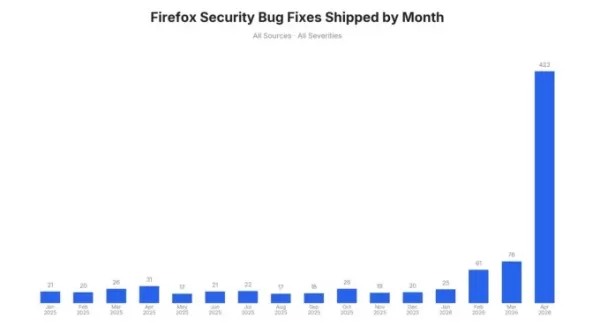
Image Credits:Firefox
The results are striking: In April 2026, Firefox shipped 423 bug fixes, compared to just 31 in the same month a year earlier. The researchers have also shared details on 12 of those bugs, ranging from two unusual sandbox vulnerabilities to a 15-year-old error in how the browser parses an HTML element.
“These things are actually just suddenly very good,” Brian Grinstead, a distinguished engineer at Mozilla, told TechCrunch. “We see that on our own internal scanning, we see that on external bug reports, and we see that in all sorts of signals across the industry.”
The fact that the system helped uncover vulnerabilities in Firefox’s “sandbox” system is especially noteworthy, given the complexity required for an exploit targeting it. To find sandbox vulnerabilities, the model must craft a compromised patch for the browser, then attack the most secure part of the software with the new code in place. Finding and demonstrating the bug is a delicate, multi-step process that demands both creativity and precision.
To put this into perspective, Mozilla’s bug bounty program offers researchers up to $20,000 for discovering a bug in Firefox’s sandbox — the highest reward available. Despite that top-dollar bounty, Grinstead says Mythos is finding more sandbox issues than human researchers ever did. “We do get them,” he told TechCrunch, “but not at the volume that we are able to find with this technique.”
Notably, the Firefox team still isn’t using AI to fix the bugs, despite well-documented progress in AI coding tools. The team does ask AI to write patches for each bug, but the resulting code usually can’t be deployed directly and instead serves as a reference for a human engineer.
“For the bugs we’re talking about in this post, every single one is one engineer writing a patch and one engineer reviewing it,” Grinstead says. “We have not found it to be automatable.”
It remains unclear how AI’s emerging capabilities will reshape the broader cybersecurity landscape. One month after Mythos was previewed, most of the bugs it discovered likely haven’t been patched yet, making it hard to gauge their full impact. Anthropic has been meticulous about following responsible disclosure norms, but it’s probable that malicious actors are using similar techniques behind the scenes, even if the models they employ are less advanced.
Speaking at a recent event, Anthropic CEO Dario Amodei expressed optimism that the new tools would ultimately favor defenders. “If we handle this right, we could be in a better position than we started, because we fixed all these bugs. There are only so many bugs to find,” Amodei said. “So I think there’s a better world on the other side of this.”
Having dealt with the practical realities, Grinstead offers a more tempered view: “It’s useful for both attackers and defenders, but having the tool available shifts the advantage a little bit to defense. Realistically, nobody knows the answer to this yet.”
Related article
 Fortinet’s Virtue AI Deal Bolsters Agentic AI Security
Ken Xie, Founder and CEO of Fortinet | Credit: FortinetFortinet acquires Virtue AI to strengthen runtime protection and automated validation for AI systems as enterprises scale deployment of agents and modelsFortinet has acquired Virtue AI, a company
Anthropic CEO Outlines Plan To Pace The Frontier
AI researchers have issued increasingly urgent warnings about artificial intelligence risks, with OpenAI CEO Sam Altman suggesting it may be time to “pace” development. But what would that actually entail?In a recent blog post, Anthropic CEO Dario Am
Anthropic Unveils Opus 4.6, a Controversial Content Generator
Anthropic’s universal usage standards for Claude prohibit the model from generating sexually explicit content, including depicting or requesting sexual intercourse or sex acts, generating content related to sexual fetishes or fantasies, or engaging i
Related Special Topic Recommendations
Design & Art
Fortinet’s Virtue AI Deal Bolsters Agentic AI Security
Ken Xie, Founder and CEO of Fortinet | Credit: FortinetFortinet acquires Virtue AI to strengthen runtime protection and automated validation for AI systems as enterprises scale deployment of agents and modelsFortinet has acquired Virtue AI, a company
Anthropic CEO Outlines Plan To Pace The Frontier
AI researchers have issued increasingly urgent warnings about artificial intelligence risks, with OpenAI CEO Sam Altman suggesting it may be time to “pace” development. But what would that actually entail?In a recent blog post, Anthropic CEO Dario Am
Anthropic Unveils Opus 4.6, a Controversial Content Generator
Anthropic’s universal usage standards for Claude prohibit the model from generating sexually explicit content, including depicting or requesting sexual intercourse or sex acts, generating content related to sexual fetishes or fantasies, or engaging i
Related Special Topic Recommendations
Design & Art
 Top AI Illustration Tools: Create Editorial Scenes and Cover Art Faster
2026 Latest Top-rated AI Illustration Tools: Our curated list features the best powerfully designed tools for creating stunning editorial scenes and eye-catching cover art quickly. Each option has gone through rigorous real-world tests, offering a free vs paid comparison to help you find the perfect match for your workflow. Try these must-try solutions today to unlock your AI edge and boost your creative productivity. Explore now at XIX.AI.
 10 tools
 xix.ai
Education and Learning
Top AI Tutors for Exam Prep: Practice Math, Science, and English
xix.ai
Education and Learning
Top AI Tutors for Exam Prep: Practice Math, Science, and English
2026 Latest Top-Rated Best AI Tutors for Exam Prep are here on XIX.AI! Our curated list features powerful game-changing tools that offer free vs paid comparison, real-world tests, and weekly updated rankings. They help boost your writing efficiency, simplify complex topic learning, and unlock your academic potential. Explore now to Discover your perfect exam prep tool and Start creating today to Unlock your AI edge!
10 tools
xix.ai
Finance
AI Budget Planning Tools for Personal Money Management
2026 Latest Best Top-Rated AI Budget Planning Tools for Personal Money Management are here on XIX.AI! This curated collection features powerful, game-changing solutions that help you conduct real-world tests, understand spending habits, and create personalized plans to boost productivity. Enjoy a free vs paid comparison along with detailed rankings. Must-try tools designed to simplify money management and unlock your AI edge. Explore now!
11 tools
xix.ai
Health & Wellness
AI Sleep Tracking Assistants: Improve Recovery with Better Bedtime Habits
2026 Latest Best Top-Rated AI Sleep Tracking Assistants curated for ultimate recovery. This fully updated weekly guide features powerful tools that deliver real-world tests, free vs paid comparison, and detailed rankings to help you find the must-try solution that boosts sleep quality and supports better bedtime habits. Explore now at XIX.AI to Unlock your AI edge.
10 tools
xix.ai
Data Analysis
AI SQL Copilots for Product and Revenue Analytics
2026 Latest Best Top-Rated AI SQL Copilots for Product and Revenue Analytics! XIX.AI has curated a powerful, game-changing collection of must-try tools that undergo real-world tests through weekly updated rankings. These tools help users boost productivity significantly by accelerating data analysis, streamlining complex queries, and generating accurate insights to drive smarter business decisions. Explore now to Discover your perfect tool for unlocking your AI edge!
14 tools
xix.ai
Education and Learning
Best AI Homework Helpers That Teach: Learn Concepts, Not Just Answers
2026 Latest Best Top-Rated AI Homework Helpers That Teach Core Concepts Not Just Answers Powerful Tools for Students Must-Try Curated List Weekly Updated Free vs Paid Comparison Real-World Tests Accurate Rankings to Help You Unlock Your Full Learning Potential Explore now to Discover your perfect tool for smarter studying.
10 tools
xix.ai

 Comments (0)
0/500
Comments (0)
0/500
When Anthropic introduced its Mythos model in April, the company also issued a strong caution to software developers. The model proved so adept at identifying software vulnerabilities, the lab claimed, that it uncovered thousands of high-severity bugs that needed patching before the model could be released publicly.
Now, security researchers working on Mozilla’s Firefox browser are offering a detailed look at how that process has played out in practice and what Mythos’ capabilities mean for software security more broadly.
In a post published Thursday, Mozilla stated that Mythos has revealed a large number of high-severity flaws, including some that had remained hidden in the code for over a decade.
That marks a major leap forward from what AI security tools could achieve just six months earlier. Until recently, AI-powered bug-finding tools came with serious limitations, often overwhelming security teams with low-quality reports and false alarms. However, Mozilla’s researchers say the latest generation of tools has reached a turning point, especially now that agentic systems can evaluate their own work and filter out poor results.
“It is difficult to overstate how much this dynamic changed for us over a few short months,” the researchers wrote. “First, the models got a lot more capable. Second, we dramatically improved our techniques for harnessing these models.”
Image Credits:Firefox
The results are striking: In April 2026, Firefox shipped 423 bug fixes, compared to just 31 in the same month a year earlier. The researchers have also shared details on 12 of those bugs, ranging from two unusual sandbox vulnerabilities to a 15-year-old error in how the browser parses an HTML element.
“These things are actually just suddenly very good,” Brian Grinstead, a distinguished engineer at Mozilla, told TechCrunch. “We see that on our own internal scanning, we see that on external bug reports, and we see that in all sorts of signals across the industry.”
The fact that the system helped uncover vulnerabilities in Firefox’s “sandbox” system is especially noteworthy, given the complexity required for an exploit targeting it. To find sandbox vulnerabilities, the model must craft a compromised patch for the browser, then attack the most secure part of the software with the new code in place. Finding and demonstrating the bug is a delicate, multi-step process that demands both creativity and precision.
To put this into perspective, Mozilla’s bug bounty program offers researchers up to $20,000 for discovering a bug in Firefox’s sandbox — the highest reward available. Despite that top-dollar bounty, Grinstead says Mythos is finding more sandbox issues than human researchers ever did. “We do get them,” he told TechCrunch, “but not at the volume that we are able to find with this technique.”
Notably, the Firefox team still isn’t using AI to fix the bugs, despite well-documented progress in AI coding tools. The team does ask AI to write patches for each bug, but the resulting code usually can’t be deployed directly and instead serves as a reference for a human engineer.
“For the bugs we’re talking about in this post, every single one is one engineer writing a patch and one engineer reviewing it,” Grinstead says. “We have not found it to be automatable.”
It remains unclear how AI’s emerging capabilities will reshape the broader cybersecurity landscape. One month after Mythos was previewed, most of the bugs it discovered likely haven’t been patched yet, making it hard to gauge their full impact. Anthropic has been meticulous about following responsible disclosure norms, but it’s probable that malicious actors are using similar techniques behind the scenes, even if the models they employ are less advanced.
Speaking at a recent event, Anthropic CEO Dario Amodei expressed optimism that the new tools would ultimately favor defenders. “If we handle this right, we could be in a better position than we started, because we fixed all these bugs. There are only so many bugs to find,” Amodei said. “So I think there’s a better world on the other side of this.”
Having dealt with the practical realities, Grinstead offers a more tempered view: “It’s useful for both attackers and defenders, but having the tool available shifts the advantage a little bit to defense. Realistically, nobody knows the answer to this yet.”








 Fortinet’s Virtue AI Deal Bolsters Agentic AI Security
Ken Xie, Founder and CEO of Fortinet | Credit: FortinetFortinet acquires Virtue AI to strengthen runtime protection and automated validation for AI systems as enterprises scale deployment of agents and modelsFortinet has acquired Virtue AI, a company
Fortinet’s Virtue AI Deal Bolsters Agentic AI Security
Ken Xie, Founder and CEO of Fortinet | Credit: FortinetFortinet acquires Virtue AI to strengthen runtime protection and automated validation for AI systems as enterprises scale deployment of agents and modelsFortinet has acquired Virtue AI, a company
 Anthropic CEO Outlines Plan To Pace The Frontier
AI researchers have issued increasingly urgent warnings about artificial intelligence risks, with OpenAI CEO Sam Altman suggesting it may be time to “pace” development. But what would that actually entail?In a recent blog post, Anthropic CEO Dario Am
Anthropic CEO Outlines Plan To Pace The Frontier
AI researchers have issued increasingly urgent warnings about artificial intelligence risks, with OpenAI CEO Sam Altman suggesting it may be time to “pace” development. But what would that actually entail?In a recent blog post, Anthropic CEO Dario Am
 Anthropic Unveils Opus 4.6, a Controversial Content Generator
Anthropic’s universal usage standards for Claude prohibit the model from generating sexually explicit content, including depicting or requesting sexual intercourse or sex acts, generating content related to sexual fetishes or fantasies, or engaging i
Anthropic Unveils Opus 4.6, a Controversial Content Generator
Anthropic’s universal usage standards for Claude prohibit the model from generating sexually explicit content, including depicting or requesting sexual intercourse or sex acts, generating content related to sexual fetishes or fantasies, or engaging i

2026 Latest Top-rated AI Illustration Tools: Our curated list features the best powerfully designed tools for creating stunning editorial scenes and eye-catching cover art quickly. Each option has gone through rigorous real-world tests, offering a free vs paid comparison to help you find the perfect match for your workflow. Try these must-try solutions today to unlock your AI edge and boost your creative productivity. Explore now at XIX.AI.
10 tools
xix.ai

2026 Latest Top-Rated Best AI Tutors for Exam Prep are here on XIX.AI! Our curated list features powerful game-changing tools that offer free vs paid comparison, real-world tests, and weekly updated rankings. They help boost your writing efficiency, simplify complex topic learning, and unlock your academic potential. Explore now to Discover your perfect exam prep tool and Start creating today to Unlock your AI edge!
10 tools
xix.ai

2026 Latest Best Top-Rated AI Budget Planning Tools for Personal Money Management are here on XIX.AI! This curated collection features powerful, game-changing solutions that help you conduct real-world tests, understand spending habits, and create personalized plans to boost productivity. Enjoy a free vs paid comparison along with detailed rankings. Must-try tools designed to simplify money management and unlock your AI edge. Explore now!
11 tools
xix.ai

2026 Latest Best Top-Rated AI Sleep Tracking Assistants curated for ultimate recovery. This fully updated weekly guide features powerful tools that deliver real-world tests, free vs paid comparison, and detailed rankings to help you find the must-try solution that boosts sleep quality and supports better bedtime habits. Explore now at XIX.AI to Unlock your AI edge.
10 tools
xix.ai

2026 Latest Best Top-Rated AI SQL Copilots for Product and Revenue Analytics! XIX.AI has curated a powerful, game-changing collection of must-try tools that undergo real-world tests through weekly updated rankings. These tools help users boost productivity significantly by accelerating data analysis, streamlining complex queries, and generating accurate insights to drive smarter business decisions. Explore now to Discover your perfect tool for unlocking your AI edge!
14 tools
xix.ai

2026 Latest Best Top-Rated AI Homework Helpers That Teach Core Concepts Not Just Answers Powerful Tools for Students Must-Try Curated List Weekly Updated Free vs Paid Comparison Real-World Tests Accurate Rankings to Help You Unlock Your Full Learning Potential Explore now to Discover your perfect tool for smarter studying.
10 tools
xix.ai












