


 Home
HomeAmazon's AI Wearable Bee: First Look at New Hands-On Experience
During initial tests with a Bee review unit, we found the device itself straightforward to operate. Turning recording on or off requires just a single button press. Within the companion app, you can configure a double-press to either bookmark a conversation segment, process the current audio, or do both. You can also set a press-and-hold gesture to leave a voice note or converse with the AI assistant. (The Bee app currently prompts you to enable voice notes, which we did.)
Similar to many other AI offerings such as Plaud, Granola, Fathom, Fireflies, and Otter, Bee can listen to, record, and transcribe audio conversations. Its key differentiator is that instead of presenting just an overview or a raw transcript, it intelligently segments the audio and provides a summary for each part. For example, an interview might be broken down into sections covering the introduction, detailed product specifications, industry trends, and other discussed topics.
Each section is highlighted with a distinct background color for easy visual distinction while scrolling. Tapping on any section reveals the full, exact transcription.
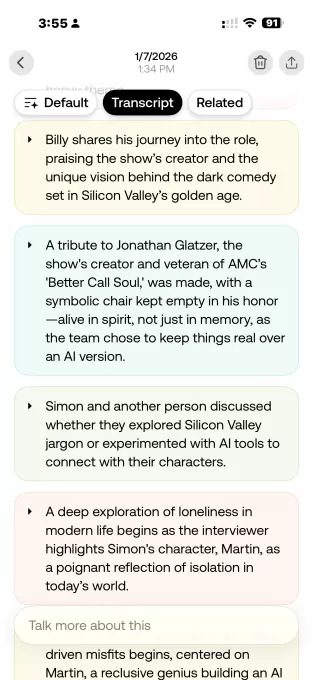
Image Credits: Bee Screenshot Initially, it wasn't clear how to label different speakers in the app. We discovered you could tap on a conversation segment to confirm if you were the speaker, but this functionality is more limited compared to professional AI transcription services that allow labeling each participant. Additionally, Bee deletes the audio file after transcribing it, which makes it unsuitable for situations where you need to replay the original recording to verify accuracy.
However, Bee isn't necessarily intended as a professional work tool. Amazon envisions it as a personal AI companion that integrates into your daily life. By connecting with Google services, Bee can link a recorded conversation to an actionable task. For instance, after meeting someone at a conference, it might suggest connecting with them on LinkedIn or researching their product.
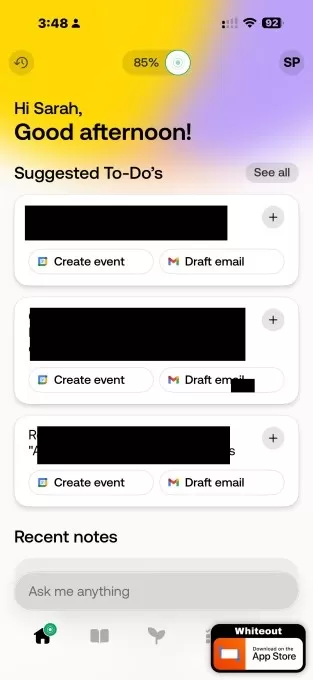
Image Credits: Bee Screenshot with Redacted Personal Data You can also use it to leave voice notes for yourself, serving as a convenient alternative to typing reminders in a notes app.
Another feature in the Bee app lets you review memories from past days, while a "Grow" section provides personalized insights as the AI learns more about you. You can also confirm and add information to a personal "facts" section, similar to other AI chatbots' ability to remember details from your conversations.
Amazon has announced that more features for Bee will be rolled out over the coming year.
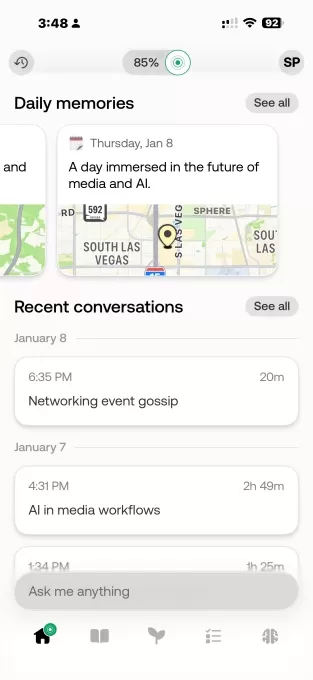
Image Credits: Bee Screenshot 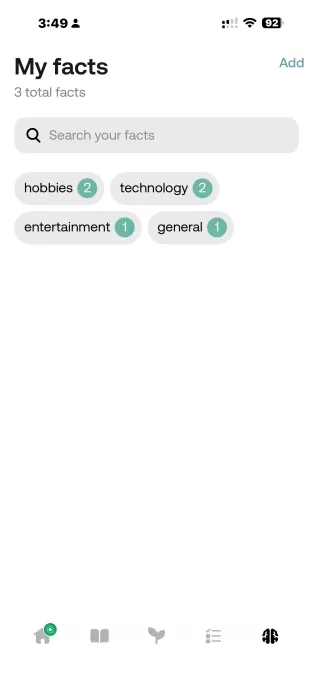
Image Credits: Bee Screenshot Bee is not always listening by default—a design choice that contrasts with rival wearables like the AI Pin, which faced criticism for potential privacy issues. The intended use is to ask for permission before recording a conversation, unless you're at a public event where recording is generally expected.
When recording is active, a green light turns on to clearly signal to others that the device is in use.
We found Bee's sports band to be somewhat flimsy. It detached twice during wear, even during sedentary activities like riding in a taxi with minimal hand movement. We haven't tested the clip-on pin accessory yet, but it appears more sturdy.
Overall, Bee's mobile app design is significantly more polished and user-friendly than Amazon's in-house efforts like the Alexa mobile experience. However, the core premise—that we need a dedicated AI device to record and learn from our conversations—remains largely unproven. Is there a genuine use case for such devices among consumers outside of professional settings like meetings and interviews?
Furthermore, if AI listening devices become mainstream, it will likely necessitate a cultural shift regarding what is considered appropriate. Today, casually video-recording strangers in public, while often legal, is generally frowned upon. Similarly, recording audio with an AI device without prior consent may be viewed as intrusive or in poor taste.
Not everyone will adhere to such social norms, of course, potentially leading people to censor their speech in public spaces.
A telling moment occurred at CES. While chatting with a representative at a booth, they jokingly said, 'Say that louder into my microphone,' pointing to a discreet AI recording device on their shirt after I made a comment about a competitor's product. It was a stark reminder that in the near future, any casual conversation could become "on the record," regardless of consent.
Bee's market acceptance—or lack thereof—will ultimately help Amazon gauge whether this is a future consumers are truly ready to embrace.
Related article
 Stripe to Acquire OpenRouter as AI Model Routing Gains Momentum
Stripe has agreed to acquire OpenRouter, an AI model-routing platform that gives developers access to hundreds of models through a single interface. The deal adds model selection and routing to Stripe’s existing work around AI usage and token-based b
Former OpenAI Researcher Barrett Zoph Returns to Google to Support Gemini Development
Barret Zoph, who previously abruptly left and joined OpenAI due to a disagreement with Thinking Machines Lab CEO Miriam Mularati, has once again changed employers. Alphabet's Google announced that Zoph will return as Vice President of Research, bring
How Recursive Intelligence Raised $335M at $4B Valuation in 4 Months
The co-founders of startup Ricursive Intelligence seemed destined to be co-founders.Anna Goldie, CEO, and Azalia Mirhoseini, CTO, are so well-known in the AI community that they were among those AI engineers who “got those weird emails from Zuckerber
Related Special Topic Recommendations
Design & Art
Stripe to Acquire OpenRouter as AI Model Routing Gains Momentum
Stripe has agreed to acquire OpenRouter, an AI model-routing platform that gives developers access to hundreds of models through a single interface. The deal adds model selection and routing to Stripe’s existing work around AI usage and token-based b
Former OpenAI Researcher Barrett Zoph Returns to Google to Support Gemini Development
Barret Zoph, who previously abruptly left and joined OpenAI due to a disagreement with Thinking Machines Lab CEO Miriam Mularati, has once again changed employers. Alphabet's Google announced that Zoph will return as Vice President of Research, bring
How Recursive Intelligence Raised $335M at $4B Valuation in 4 Months
The co-founders of startup Ricursive Intelligence seemed destined to be co-founders.Anna Goldie, CEO, and Azalia Mirhoseini, CTO, are so well-known in the AI community that they were among those AI engineers who “got those weird emails from Zuckerber
Related Special Topic Recommendations
Design & Art
 Top AI Illustration Tools: Create Editorial Scenes and Cover Art Faster
2026 Latest Top-rated AI Illustration Tools: Our curated list features the best powerfully designed tools for creating stunning editorial scenes and eye-catching cover art quickly. Each option has gone through rigorous real-world tests, offering a free vs paid comparison to help you find the perfect match for your workflow. Try these must-try solutions today to unlock your AI edge and boost your creative productivity. Explore now at XIX.AI.
 10 tools
 xix.ai
Education and Learning
Top AI Tutors for Exam Prep: Practice Math, Science, and English
xix.ai
Education and Learning
Top AI Tutors for Exam Prep: Practice Math, Science, and English
2026 Latest Top-Rated Best AI Tutors for Exam Prep are here on XIX.AI! Our curated list features powerful game-changing tools that offer free vs paid comparison, real-world tests, and weekly updated rankings. They help boost your writing efficiency, simplify complex topic learning, and unlock your academic potential. Explore now to Discover your perfect exam prep tool and Start creating today to Unlock your AI edge!
10 tools
xix.ai
Finance
AI Budget Planning Tools for Personal Money Management
2026 Latest Best Top-Rated AI Budget Planning Tools for Personal Money Management are here on XIX.AI! This curated collection features powerful, game-changing solutions that help you conduct real-world tests, understand spending habits, and create personalized plans to boost productivity. Enjoy a free vs paid comparison along with detailed rankings. Must-try tools designed to simplify money management and unlock your AI edge. Explore now!
11 tools
xix.ai
Health & Wellness
AI Sleep Tracking Assistants: Improve Recovery with Better Bedtime Habits
2026 Latest Best Top-Rated AI Sleep Tracking Assistants curated for ultimate recovery. This fully updated weekly guide features powerful tools that deliver real-world tests, free vs paid comparison, and detailed rankings to help you find the must-try solution that boosts sleep quality and supports better bedtime habits. Explore now at XIX.AI to Unlock your AI edge.
10 tools
xix.ai
Data Analysis
AI SQL Copilots for Product and Revenue Analytics
2026 Latest Best Top-Rated AI SQL Copilots for Product and Revenue Analytics! XIX.AI has curated a powerful, game-changing collection of must-try tools that undergo real-world tests through weekly updated rankings. These tools help users boost productivity significantly by accelerating data analysis, streamlining complex queries, and generating accurate insights to drive smarter business decisions. Explore now to Discover your perfect tool for unlocking your AI edge!
14 tools
xix.ai
Education and Learning
Best AI Homework Helpers That Teach: Learn Concepts, Not Just Answers
2026 Latest Best Top-Rated AI Homework Helpers That Teach Core Concepts Not Just Answers Powerful Tools for Students Must-Try Curated List Weekly Updated Free vs Paid Comparison Real-World Tests Accurate Rankings to Help You Unlock Your Full Learning Potential Explore now to Discover your perfect tool for smarter studying.
10 tools
xix.ai

 Comments (0)
0/500
Comments (0)
0/500
During initial tests with a Bee review unit, we found the device itself straightforward to operate. Turning recording on or off requires just a single button press. Within the companion app, you can configure a double-press to either bookmark a conversation segment, process the current audio, or do both. You can also set a press-and-hold gesture to leave a voice note or converse with the AI assistant. (The Bee app currently prompts you to enable voice notes, which we did.)
Similar to many other AI offerings such as Plaud, Granola, Fathom, Fireflies, and Otter, Bee can listen to, record, and transcribe audio conversations. Its key differentiator is that instead of presenting just an overview or a raw transcript, it intelligently segments the audio and provides a summary for each part. For example, an interview might be broken down into sections covering the introduction, detailed product specifications, industry trends, and other discussed topics.
Each section is highlighted with a distinct background color for easy visual distinction while scrolling. Tapping on any section reveals the full, exact transcription.
Initially, it wasn't clear how to label different speakers in the app. We discovered you could tap on a conversation segment to confirm if you were the speaker, but this functionality is more limited compared to professional AI transcription services that allow labeling each participant. Additionally, Bee deletes the audio file after transcribing it, which makes it unsuitable for situations where you need to replay the original recording to verify accuracy.
However, Bee isn't necessarily intended as a professional work tool. Amazon envisions it as a personal AI companion that integrates into your daily life. By connecting with Google services, Bee can link a recorded conversation to an actionable task. For instance, after meeting someone at a conference, it might suggest connecting with them on LinkedIn or researching their product.
You can also use it to leave voice notes for yourself, serving as a convenient alternative to typing reminders in a notes app.
Another feature in the Bee app lets you review memories from past days, while a "Grow" section provides personalized insights as the AI learns more about you. You can also confirm and add information to a personal "facts" section, similar to other AI chatbots' ability to remember details from your conversations.
Amazon has announced that more features for Bee will be rolled out over the coming year.
Bee is not always listening by default—a design choice that contrasts with rival wearables like the AI Pin, which faced criticism for potential privacy issues. The intended use is to ask for permission before recording a conversation, unless you're at a public event where recording is generally expected.
When recording is active, a green light turns on to clearly signal to others that the device is in use.
We found Bee's sports band to be somewhat flimsy. It detached twice during wear, even during sedentary activities like riding in a taxi with minimal hand movement. We haven't tested the clip-on pin accessory yet, but it appears more sturdy.
Overall, Bee's mobile app design is significantly more polished and user-friendly than Amazon's in-house efforts like the Alexa mobile experience. However, the core premise—that we need a dedicated AI device to record and learn from our conversations—remains largely unproven. Is there a genuine use case for such devices among consumers outside of professional settings like meetings and interviews?
Furthermore, if AI listening devices become mainstream, it will likely necessitate a cultural shift regarding what is considered appropriate. Today, casually video-recording strangers in public, while often legal, is generally frowned upon. Similarly, recording audio with an AI device without prior consent may be viewed as intrusive or in poor taste.
Not everyone will adhere to such social norms, of course, potentially leading people to censor their speech in public spaces.
A telling moment occurred at CES. While chatting with a representative at a booth, they jokingly said, 'Say that louder into my microphone,' pointing to a discreet AI recording device on their shirt after I made a comment about a competitor's product. It was a stark reminder that in the near future, any casual conversation could become "on the record," regardless of consent.
Bee's market acceptance—or lack thereof—will ultimately help Amazon gauge whether this is a future consumers are truly ready to embrace.








 Stripe to Acquire OpenRouter as AI Model Routing Gains Momentum
Stripe has agreed to acquire OpenRouter, an AI model-routing platform that gives developers access to hundreds of models through a single interface. The deal adds model selection and routing to Stripe’s existing work around AI usage and token-based b
Stripe to Acquire OpenRouter as AI Model Routing Gains Momentum
Stripe has agreed to acquire OpenRouter, an AI model-routing platform that gives developers access to hundreds of models through a single interface. The deal adds model selection and routing to Stripe’s existing work around AI usage and token-based b
 Former OpenAI Researcher Barrett Zoph Returns to Google to Support Gemini Development
Barret Zoph, who previously abruptly left and joined OpenAI due to a disagreement with Thinking Machines Lab CEO Miriam Mularati, has once again changed employers. Alphabet's Google announced that Zoph will return as Vice President of Research, bring
Former OpenAI Researcher Barrett Zoph Returns to Google to Support Gemini Development
Barret Zoph, who previously abruptly left and joined OpenAI due to a disagreement with Thinking Machines Lab CEO Miriam Mularati, has once again changed employers. Alphabet's Google announced that Zoph will return as Vice President of Research, bring
 How Recursive Intelligence Raised $335M at $4B Valuation in 4 Months
The co-founders of startup Ricursive Intelligence seemed destined to be co-founders.Anna Goldie, CEO, and Azalia Mirhoseini, CTO, are so well-known in the AI community that they were among those AI engineers who “got those weird emails from Zuckerber
How Recursive Intelligence Raised $335M at $4B Valuation in 4 Months
The co-founders of startup Ricursive Intelligence seemed destined to be co-founders.Anna Goldie, CEO, and Azalia Mirhoseini, CTO, are so well-known in the AI community that they were among those AI engineers who “got those weird emails from Zuckerber

2026 Latest Top-rated AI Illustration Tools: Our curated list features the best powerfully designed tools for creating stunning editorial scenes and eye-catching cover art quickly. Each option has gone through rigorous real-world tests, offering a free vs paid comparison to help you find the perfect match for your workflow. Try these must-try solutions today to unlock your AI edge and boost your creative productivity. Explore now at XIX.AI.
10 tools
xix.ai

2026 Latest Top-Rated Best AI Tutors for Exam Prep are here on XIX.AI! Our curated list features powerful game-changing tools that offer free vs paid comparison, real-world tests, and weekly updated rankings. They help boost your writing efficiency, simplify complex topic learning, and unlock your academic potential. Explore now to Discover your perfect exam prep tool and Start creating today to Unlock your AI edge!
10 tools
xix.ai

2026 Latest Best Top-Rated AI Budget Planning Tools for Personal Money Management are here on XIX.AI! This curated collection features powerful, game-changing solutions that help you conduct real-world tests, understand spending habits, and create personalized plans to boost productivity. Enjoy a free vs paid comparison along with detailed rankings. Must-try tools designed to simplify money management and unlock your AI edge. Explore now!
11 tools
xix.ai

2026 Latest Best Top-Rated AI Sleep Tracking Assistants curated for ultimate recovery. This fully updated weekly guide features powerful tools that deliver real-world tests, free vs paid comparison, and detailed rankings to help you find the must-try solution that boosts sleep quality and supports better bedtime habits. Explore now at XIX.AI to Unlock your AI edge.
10 tools
xix.ai

2026 Latest Best Top-Rated AI SQL Copilots for Product and Revenue Analytics! XIX.AI has curated a powerful, game-changing collection of must-try tools that undergo real-world tests through weekly updated rankings. These tools help users boost productivity significantly by accelerating data analysis, streamlining complex queries, and generating accurate insights to drive smarter business decisions. Explore now to Discover your perfect tool for unlocking your AI edge!
14 tools
xix.ai

2026 Latest Best Top-Rated AI Homework Helpers That Teach Core Concepts Not Just Answers Powerful Tools for Students Must-Try Curated List Weekly Updated Free vs Paid Comparison Real-World Tests Accurate Rankings to Help You Unlock Your Full Learning Potential Explore now to Discover your perfect tool for smarter studying.
10 tools
xix.ai












