


 Home
HomeShopify Dropshipping: Build a Profitable E-Commerce Store Fast
AI can streamline the process of building a Shopify dropshipping store. This article explains how artificial intelligence cuts down the time and effort needed to establish a profitable online business. We'll present examples of AI-generated stores earning remarkable revenue and show you how to use these tools for your own e-commerce success. Creating a dropshipping store with AI is a highly efficient approach, saving time while boosting earnings.
Key Points
AI can fully automate the creation of a Shopify dropshipping store.
AI-built stores often deliver high conversion rates and substantial revenue.
AI tools dramatically reduce the time and effort required to launch an online store.
Using AI gives you a competitive edge in the e-commerce market.
We will demonstrate successful AI-driven Shopify stores.
Launching a profitable dropshipping store requires the right set of tools.
AI enables you to automate core dropshipping functions.
The Power of AI in Shopify Dropshipping
AI-Powered Shopify Store Creation
The rise of artificial intelligence has transformed countless industries, and e-commerce is a prime example. Today, AI can build a complete Shopify dropshipping store, handling tasks that previously required significant time and specialized knowledge. From choosing winning products to designing the storefront and crafting product descriptions, AI covers every step. The great advantage of dropshipping is its low barrier to entry.
This automation frees up entrepreneurs to focus on other essential business areas like marketing and customer support. With AI managing the groundwork, starting a dropshipping business becomes faster, more efficient, and more accessible, even for those with limited technical experience.
Additionally, AI systems are built to maximize conversion rates. They assess market data, customer activity, and product performance to refine the store’s design, product positioning, and overall user journey, boosting the chances of making a sale.
Adopting AI for Shopify store setup is quickly gaining traction.
Real-World Examples of AI-Built Stores
To demonstrate AI's potential in Shopify dropshipping, let's look at some actual stores built using artificial intelligence. These are not just theoretical models but live businesses generating significant revenue and achieving impressive conversion rates.
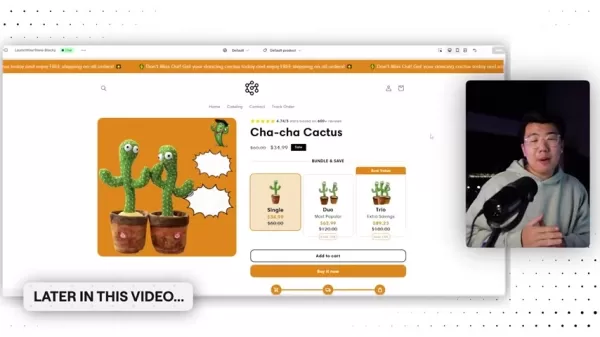
The dancing cactus toy website serves as an excellent example of a well-executed dropshipping product page. It presents single, duo, and trio cactus bundle options.
One store, fully created by AI, brought in roughly $2,274 in revenue with only about $500 spent on ads. This strong return on investment illustrates the profit potential when AI is applied strategically to store development. Another store has reported comparable results, confirming the repeatability of success with AI.
These cases prove that AI is more than an innovative gadget; it’s a practical resource that delivers measurable financial outcomes in the competitive e-commerce landscape. Understanding the fundamentals of dropshipping is key to unlocking its full potential.
Revenue and ROI Metrics
Now, let's examine the key performance indicators from an AI-generated Shopify store. Analyzing these metrics provides a clear picture of the store’s operational success and profit capacity.
Key Metrics:
- Total Revenue: One AI-created store earned $2,274 in a short timeframe.
- Ad Spend: This revenue was accomplished with an advertising budget of approximately $500.
- Return on Ad Spend (ROAS): The store achieved a ROAS of 4.01, signifying a powerful return on investment. A ROAS of 4.01 means every dollar spent on ads generated $4.01 in revenue.
- Profit Margin: The business maintained a 60% profit margin, reflecting effective cost control and pricing.
These figures highlight how AI can fuel profitability in Shopify dropshipping. By improving conversion rates and reducing advertising expenses, AI helps business owners secure significant returns. AI represents the next generation of dropshipping store development.
Understanding Dropshipping and AI Integration
What is Dropshipping?
Dropshipping is an order fulfillment model where the retailer does not stock the products it sells. Instead, when a customer buys a product, the store purchases the item from a third-party supplier, who ships it directly to the customer. This means the seller never physically handles the merchandise. Key benefits are:
- Low Startup Costs: No need for major investment in inventory.
- Broad Product Selection: You can offer numerous products without managing stock levels.
- Operational Flexibility: You can manage the business from any location with internet access.
However, the model also has some drawbacks:
- Lower Profit Margins: Fierce competition often leads to price reductions.
- Inventory Management: Keeping track of supplier stock can be difficult.
- Shipping Complications: Dealing with multiple suppliers may create complex shipping scenarios.
AI technology helps address many of these inherent dropshipping challenges.
How AI Enhances Dropshipping
AI introduces several key improvements to the dropshipping framework, increasing both efficiency and profitability:
- Product Selection: AI evaluates market trends and consumer behavior to pinpoint high-demand products.
- Store Design: AI applications can produce attractive, conversion-focused store layouts.
- Product Descriptions: AI writes compelling and search-engine-optimized product descriptions.
- Inventory Management: AI forecasts demand and helps coordinate stock levels with suppliers.
- Customer Service: AI-driven chatbots can manage customer questions and provide assistance.
- Advertising: AI systems can fine-tune ad campaigns for the best possible return.
Integrating AI into dropshipping modernizes the conventional model, turning it into a more streamlined and lucrative operation.
Launching Your Shopify Store with AI
Steps to Build an AI-Powered Shopify Store
You can quickly and effectively launch a Shopify store using AI assistance. Follow this step-by-step process:
Step 1: Choose an AI-Powered Shopify App
Pick an AI tool that matches your e-commerce objectives. Look for capabilities such as automated store design, product curation, and content generation. Since different services specialize in various areas, do your research to select the best match.
Step 2: Connect the App to Your Shopify Account
After selecting an app, integrate it with your Shopify account. This usually means giving the app specific permissions to access and adjust your store's configuration.
Step 3: Define Your Product Niche
Specify the product category you want to target. The AI will use this input to choose products and tailor your store's design to that niche.
Step 4: Customize Your Store Design
Even though the AI will produce a store design, you should further personalize it. Modify colors, fonts, and page structures to align with your brand identity.
Step 5: Review and Edit AI-Generated Content
Scrutinize all product descriptions, titles, and other content produced by the AI. Make edits to ensure it’s both accurate and appealing to customers.
Step 6: Launch Your Store and Start Marketing
Once your store meets your standards, go live and initiate your marketing efforts. Use social media platforms, email campaigns, and other channels to attract visitors. Make sure your marketing approach resonates with your intended audience.
Advantages and Disadvantages of AI in Shopify Dropshipping
Pros
Speeds up store setup
Lowers overall workload
Boosts conversion rates
Enables data-driven decision making
Reduces advertising expenses
Simplifies getting started with dropshipping
AI assists with professional store design
Cons
Creates reliance on AI tools
May result in somewhat generic store designs
Requires human monitoring and review
Involves subscription costs for AI software
Some constraints on deep customization
Frequently Asked Questions
Can AI really build a Shopify dropshipping store from scratch?
Yes, current AI tools can automate major parts of store setup, including product research, design, and content generation. This allows you to build a fully operational store with very little hands-on work.
How much does it cost to use AI to build a Shopify store?
Costs depend on the specific AI tool selected. Some providers offer free trials or entry-level plans, while others have monthly fees for premium features. Compare different tools to find one that suits your financial plan.
Is it necessary to have technical skills to use AI-powered store builders?
No, the majority of AI-powered store builders are developed for ease of use and demand very little technical knowledge. They generally feature simple drag-and-drop interfaces and user-friendly controls.
How can I ensure that my AI-built store stands out from the competition?
While AI automates many creation steps, incorporating your unique brand identity and customization is vital. Prioritize outstanding customer support and develop engaging marketing initiatives to set your store apart.
What kind of ROAS can I expect from an AI-built dropshipping store?
ROAS will vary, but high-performing AI-built stores have achieved figures as high as 4.01. To sustain profitability, you should continuously refine your advertising and store performance.
Related Questions
What are the best Shopify apps for dropshipping?
Several Shopify apps are built to support dropshipping operations. Popular choices include Oberlo, DSers, Spocket, and AliDropship. These apps connect you to suppliers, automate order processing, and simplify importing products.
How do I find profitable products for dropshipping?
Finding profitable products requires thorough market research. Leverage resources like Google Trends, SaleHoo, and Niche Scraper to find trending items with strong demand and manageable competition. AI-powered product research tools can also automate this task.
What are the legal considerations for running a dropshipping business?
Operating a dropshipping business requires adherence to all relevant laws and regulations. This covers obtaining necessary business permits, following consumer protection standards, and respecting copyright and trademark laws. It's wise to seek advice from a legal expert.
How important is customer service in dropshipping?
Customer service is extremely important in dropshipping, since you are accountable for resolving any customer problems or inquiries. Deliver quick and effective support, manage returns and refunds smoothly, and aim to build a positive customer relationship. Great service encourages repeat purchases and favorable reviews.
What are some strategies for scaling a dropshipping business?
Expanding a dropshipping business involves increasing your product range, expanding your marketing methods, and improving operational efficiency. Think about using automation software for routine tasks, outsourcing certain jobs to freelancers or assistants, and investing in paid ads to grow your audience. Regularly track key performance metrics and adapt your tactics accordingly.
Related article
 DeepMind CEO Hassabis: I sleep six hours a day, usually feel energetic around 1 a.m.
Fortune recently featured an interview with Demis Hassabis, CEO of Google DeepMind, revealing his unconventional approach to rest and productivity. Hassabis disclosed that he sleeps very little, structuring his waking hours into two distinct work blo
OpenAI, Anthropic Vie for Market Share Despite Revenue Shortfalls
Despite recent reports suggesting OpenAI missed revenue targets, creating pressure on tech stocks this Tuesday, private AI lab investors remain resilient. Seasoned backers have confirmed they will not reduce investment despite negative media coverage
California AV Compliance: A New Era of Tickets, Geofences, and 1M Miles
Guident operates an AuveTech shuttle in South Florida, managing a four-mile route in West Palm Beach and a one-mile route in Boca Raton using its remote monitoring technology. | Credit: GuidentCalifornia is redefining the regulatory landscape for dri
Related Special Topic Recommendations
Music composition
DeepMind CEO Hassabis: I sleep six hours a day, usually feel energetic around 1 a.m.
Fortune recently featured an interview with Demis Hassabis, CEO of Google DeepMind, revealing his unconventional approach to rest and productivity. Hassabis disclosed that he sleeps very little, structuring his waking hours into two distinct work blo
OpenAI, Anthropic Vie for Market Share Despite Revenue Shortfalls
Despite recent reports suggesting OpenAI missed revenue targets, creating pressure on tech stocks this Tuesday, private AI lab investors remain resilient. Seasoned backers have confirmed they will not reduce investment despite negative media coverage
California AV Compliance: A New Era of Tickets, Geofences, and 1M Miles
Guident operates an AuveTech shuttle in South Florida, managing a four-mile route in West Palm Beach and a one-mile route in Boca Raton using its remote monitoring technology. | Credit: GuidentCalifornia is redefining the regulatory landscape for dri
Related Special Topic Recommendations
Music composition
 AI Stem Separation Tools for Remix Production, Sampling Prep, and Karaoke Masters
2026 Latest Best Top-rated AI Stem Separation Tools Curated for Remix Production, Sampling Prep, and Karaoke Masters. These powerful game-changing tools offer real-world tests to deliver precise audio isolation, boosting productivity significantly. XIX.AI provides a weekly updated free vs paid comparison guide to help you find the must-try solution that suits your needs. Explore now to unlock your AI edge.
 8 tools
 xix.ai
Data Analysis
AI SQL Copilots for Revenue Dashboards, Funnel Analysis, and Product Metrics
xix.ai
Data Analysis
AI SQL Copilots for Revenue Dashboards, Funnel Analysis, and Product Metrics
2026 Latest Best AI SQL Copilots Ranked Top-Rated! XIX.AI curates a powerful game-changing collection for weekly updated real-world tests. These must-try tools help you generate accurate revenue dashboards, analyze sales funnels, and track product metrics swiftly, boosting productivity massively. Explore now to Discover your perfect tool for data-driven decision making! 238 characters
9 tools
xix.ai
Music composition
Best AI Melody Writing Tools for Song Drafts
2026 Latest Best Top-Rated AI Melody Writing Tools for Song Drafts! XIX.AI has curated a highly powerful game-changing collection that goes through rigorous real-world tests to deliver the best writing experience. You can find detailed free vs paid comparisons, accurate rankings, and must-try options designed to help you create stunning song drafts effortlessly and boost your creative productivity significantly. Explore now to discover your perfect tool!
8 tools
xix.ai
chatbot
Best AI Conversation Trainer Tools for Interview Practice
2026 Latest Best Top-rated AI Conversation Trainer Tools for Interview Practice are here on XIX.AI! This curated collection features powerful, game-changing tools that go through rigorous real-world tests to deliver accurate feedback. You’ll find a free vs paid comparison and detailed rankings to help you choose the must-try option that boosts your confidence and skills. Explore now to Discover your perfect tool for interview success!
12 tools
xix.ai
Design & Art
Best AI Style Transfer Tools for Creative Experiments
2026 Latest Best Top-rated AI Style Transfer Tools for Creative Experiments! XIX.AI has curated a powerful, game-changing collection of must-try tools that deliver exceptional results through real-world tests and rigorous rankings. These top solutions help creatives boost productivity significantly by accelerating content creation and unlocking endless creative possibilities. Explore now to discover your perfect tool and start creating today!
9 tools
xix.ai
Comic Creation
Best AI Dialogue Bubble Tools for Visual Storytelling
2026 Latest Best Top-Rated AI Dialogue Bubble Tools for Visual Storytelling are here on XIX.AI! This curated collection features powerful, game-changing tools that help creators boost productivity and overcome creative bottlenecks. Get a free vs paid comparison, see real-world tests, and check the latest rankings to find the must-try solutions perfect for crafting engaging visual narratives. Explore now to discover your ideal tool!
10 tools
xix.ai

 Comments (0)
0/500
Comments (0)
0/500
AI can streamline the process of building a Shopify dropshipping store. This article explains how artificial intelligence cuts down the time and effort needed to establish a profitable online business. We'll present examples of AI-generated stores earning remarkable revenue and show you how to use these tools for your own e-commerce success. Creating a dropshipping store with AI is a highly efficient approach, saving time while boosting earnings.
Key Points
AI can fully automate the creation of a Shopify dropshipping store.
AI-built stores often deliver high conversion rates and substantial revenue.
AI tools dramatically reduce the time and effort required to launch an online store.
Using AI gives you a competitive edge in the e-commerce market.
We will demonstrate successful AI-driven Shopify stores.
Launching a profitable dropshipping store requires the right set of tools.
AI enables you to automate core dropshipping functions.
The Power of AI in Shopify Dropshipping
AI-Powered Shopify Store Creation
The rise of artificial intelligence has transformed countless industries, and e-commerce is a prime example. Today, AI can build a complete Shopify dropshipping store, handling tasks that previously required significant time and specialized knowledge. From choosing winning products to designing the storefront and crafting product descriptions, AI covers every step. The great advantage of dropshipping is its low barrier to entry.
This automation frees up entrepreneurs to focus on other essential business areas like marketing and customer support. With AI managing the groundwork, starting a dropshipping business becomes faster, more efficient, and more accessible, even for those with limited technical experience.
Additionally, AI systems are built to maximize conversion rates. They assess market data, customer activity, and product performance to refine the store’s design, product positioning, and overall user journey, boosting the chances of making a sale.
Adopting AI for Shopify store setup is quickly gaining traction.
Real-World Examples of AI-Built Stores
To demonstrate AI's potential in Shopify dropshipping, let's look at some actual stores built using artificial intelligence. These are not just theoretical models but live businesses generating significant revenue and achieving impressive conversion rates.
The dancing cactus toy website serves as an excellent example of a well-executed dropshipping product page. It presents single, duo, and trio cactus bundle options.
One store, fully created by AI, brought in roughly $2,274 in revenue with only about $500 spent on ads. This strong return on investment illustrates the profit potential when AI is applied strategically to store development. Another store has reported comparable results, confirming the repeatability of success with AI.
These cases prove that AI is more than an innovative gadget; it’s a practical resource that delivers measurable financial outcomes in the competitive e-commerce landscape. Understanding the fundamentals of dropshipping is key to unlocking its full potential.
Revenue and ROI Metrics
Now, let's examine the key performance indicators from an AI-generated Shopify store. Analyzing these metrics provides a clear picture of the store’s operational success and profit capacity.
Key Metrics:
- Total Revenue: One AI-created store earned $2,274 in a short timeframe.
- Ad Spend: This revenue was accomplished with an advertising budget of approximately $500.
- Return on Ad Spend (ROAS): The store achieved a ROAS of 4.01, signifying a powerful return on investment. A ROAS of 4.01 means every dollar spent on ads generated $4.01 in revenue.
- Profit Margin: The business maintained a 60% profit margin, reflecting effective cost control and pricing.
These figures highlight how AI can fuel profitability in Shopify dropshipping. By improving conversion rates and reducing advertising expenses, AI helps business owners secure significant returns. AI represents the next generation of dropshipping store development.
Understanding Dropshipping and AI Integration
What is Dropshipping?
Dropshipping is an order fulfillment model where the retailer does not stock the products it sells. Instead, when a customer buys a product, the store purchases the item from a third-party supplier, who ships it directly to the customer. This means the seller never physically handles the merchandise. Key benefits are:
- Low Startup Costs: No need for major investment in inventory.
- Broad Product Selection: You can offer numerous products without managing stock levels.
- Operational Flexibility: You can manage the business from any location with internet access.
However, the model also has some drawbacks:
- Lower Profit Margins: Fierce competition often leads to price reductions.
- Inventory Management: Keeping track of supplier stock can be difficult.
- Shipping Complications: Dealing with multiple suppliers may create complex shipping scenarios.
AI technology helps address many of these inherent dropshipping challenges.
How AI Enhances Dropshipping
AI introduces several key improvements to the dropshipping framework, increasing both efficiency and profitability:
- Product Selection: AI evaluates market trends and consumer behavior to pinpoint high-demand products.
- Store Design: AI applications can produce attractive, conversion-focused store layouts.
- Product Descriptions: AI writes compelling and search-engine-optimized product descriptions.
- Inventory Management: AI forecasts demand and helps coordinate stock levels with suppliers.
- Customer Service: AI-driven chatbots can manage customer questions and provide assistance.
- Advertising: AI systems can fine-tune ad campaigns for the best possible return.
Integrating AI into dropshipping modernizes the conventional model, turning it into a more streamlined and lucrative operation.
Launching Your Shopify Store with AI
Steps to Build an AI-Powered Shopify Store
You can quickly and effectively launch a Shopify store using AI assistance. Follow this step-by-step process:
Step 1: Choose an AI-Powered Shopify App
Pick an AI tool that matches your e-commerce objectives. Look for capabilities such as automated store design, product curation, and content generation. Since different services specialize in various areas, do your research to select the best match.
Step 2: Connect the App to Your Shopify Account
After selecting an app, integrate it with your Shopify account. This usually means giving the app specific permissions to access and adjust your store's configuration.
Step 3: Define Your Product Niche
Specify the product category you want to target. The AI will use this input to choose products and tailor your store's design to that niche.
Step 4: Customize Your Store Design
Even though the AI will produce a store design, you should further personalize it. Modify colors, fonts, and page structures to align with your brand identity.
Step 5: Review and Edit AI-Generated Content
Scrutinize all product descriptions, titles, and other content produced by the AI. Make edits to ensure it’s both accurate and appealing to customers.
Step 6: Launch Your Store and Start Marketing
Once your store meets your standards, go live and initiate your marketing efforts. Use social media platforms, email campaigns, and other channels to attract visitors. Make sure your marketing approach resonates with your intended audience.
Advantages and Disadvantages of AI in Shopify Dropshipping
Pros
Speeds up store setup
Lowers overall workload
Boosts conversion rates
Enables data-driven decision making
Reduces advertising expenses
Simplifies getting started with dropshipping
AI assists with professional store design
Cons
Creates reliance on AI tools
May result in somewhat generic store designs
Requires human monitoring and review
Involves subscription costs for AI software
Some constraints on deep customization
Frequently Asked Questions
Can AI really build a Shopify dropshipping store from scratch?
Yes, current AI tools can automate major parts of store setup, including product research, design, and content generation. This allows you to build a fully operational store with very little hands-on work.
How much does it cost to use AI to build a Shopify store?
Costs depend on the specific AI tool selected. Some providers offer free trials or entry-level plans, while others have monthly fees for premium features. Compare different tools to find one that suits your financial plan.
Is it necessary to have technical skills to use AI-powered store builders?
No, the majority of AI-powered store builders are developed for ease of use and demand very little technical knowledge. They generally feature simple drag-and-drop interfaces and user-friendly controls.
How can I ensure that my AI-built store stands out from the competition?
While AI automates many creation steps, incorporating your unique brand identity and customization is vital. Prioritize outstanding customer support and develop engaging marketing initiatives to set your store apart.
What kind of ROAS can I expect from an AI-built dropshipping store?
ROAS will vary, but high-performing AI-built stores have achieved figures as high as 4.01. To sustain profitability, you should continuously refine your advertising and store performance.
Related Questions
What are the best Shopify apps for dropshipping?
Several Shopify apps are built to support dropshipping operations. Popular choices include Oberlo, DSers, Spocket, and AliDropship. These apps connect you to suppliers, automate order processing, and simplify importing products.
How do I find profitable products for dropshipping?
Finding profitable products requires thorough market research. Leverage resources like Google Trends, SaleHoo, and Niche Scraper to find trending items with strong demand and manageable competition. AI-powered product research tools can also automate this task.
What are the legal considerations for running a dropshipping business?
Operating a dropshipping business requires adherence to all relevant laws and regulations. This covers obtaining necessary business permits, following consumer protection standards, and respecting copyright and trademark laws. It's wise to seek advice from a legal expert.
How important is customer service in dropshipping?
Customer service is extremely important in dropshipping, since you are accountable for resolving any customer problems or inquiries. Deliver quick and effective support, manage returns and refunds smoothly, and aim to build a positive customer relationship. Great service encourages repeat purchases and favorable reviews.
What are some strategies for scaling a dropshipping business?
Expanding a dropshipping business involves increasing your product range, expanding your marketing methods, and improving operational efficiency. Think about using automation software for routine tasks, outsourcing certain jobs to freelancers or assistants, and investing in paid ads to grow your audience. Regularly track key performance metrics and adapt your tactics accordingly.








 DeepMind CEO Hassabis: I sleep six hours a day, usually feel energetic around 1 a.m.
Fortune recently featured an interview with Demis Hassabis, CEO of Google DeepMind, revealing his unconventional approach to rest and productivity. Hassabis disclosed that he sleeps very little, structuring his waking hours into two distinct work blo
DeepMind CEO Hassabis: I sleep six hours a day, usually feel energetic around 1 a.m.
Fortune recently featured an interview with Demis Hassabis, CEO of Google DeepMind, revealing his unconventional approach to rest and productivity. Hassabis disclosed that he sleeps very little, structuring his waking hours into two distinct work blo
 OpenAI, Anthropic Vie for Market Share Despite Revenue Shortfalls
Despite recent reports suggesting OpenAI missed revenue targets, creating pressure on tech stocks this Tuesday, private AI lab investors remain resilient. Seasoned backers have confirmed they will not reduce investment despite negative media coverage
California AV Compliance: A New Era of Tickets, Geofences, and 1M Miles
Guident operates an AuveTech shuttle in South Florida, managing a four-mile route in West Palm Beach and a one-mile route in Boca Raton using its remote monitoring technology. | Credit: GuidentCalifornia is redefining the regulatory landscape for dri
OpenAI, Anthropic Vie for Market Share Despite Revenue Shortfalls
Despite recent reports suggesting OpenAI missed revenue targets, creating pressure on tech stocks this Tuesday, private AI lab investors remain resilient. Seasoned backers have confirmed they will not reduce investment despite negative media coverage
California AV Compliance: A New Era of Tickets, Geofences, and 1M Miles
Guident operates an AuveTech shuttle in South Florida, managing a four-mile route in West Palm Beach and a one-mile route in Boca Raton using its remote monitoring technology. | Credit: GuidentCalifornia is redefining the regulatory landscape for dri

2026 Latest Best Top-rated AI Stem Separation Tools Curated for Remix Production, Sampling Prep, and Karaoke Masters. These powerful game-changing tools offer real-world tests to deliver precise audio isolation, boosting productivity significantly. XIX.AI provides a weekly updated free vs paid comparison guide to help you find the must-try solution that suits your needs. Explore now to unlock your AI edge.
8 tools
xix.ai

2026 Latest Best AI SQL Copilots Ranked Top-Rated! XIX.AI curates a powerful game-changing collection for weekly updated real-world tests. These must-try tools help you generate accurate revenue dashboards, analyze sales funnels, and track product metrics swiftly, boosting productivity massively. Explore now to Discover your perfect tool for data-driven decision making! 238 characters
9 tools
xix.ai

2026 Latest Best Top-Rated AI Melody Writing Tools for Song Drafts! XIX.AI has curated a highly powerful game-changing collection that goes through rigorous real-world tests to deliver the best writing experience. You can find detailed free vs paid comparisons, accurate rankings, and must-try options designed to help you create stunning song drafts effortlessly and boost your creative productivity significantly. Explore now to discover your perfect tool!
8 tools
xix.ai

2026 Latest Best Top-rated AI Conversation Trainer Tools for Interview Practice are here on XIX.AI! This curated collection features powerful, game-changing tools that go through rigorous real-world tests to deliver accurate feedback. You’ll find a free vs paid comparison and detailed rankings to help you choose the must-try option that boosts your confidence and skills. Explore now to Discover your perfect tool for interview success!
12 tools
xix.ai

2026 Latest Best Top-rated AI Style Transfer Tools for Creative Experiments! XIX.AI has curated a powerful, game-changing collection of must-try tools that deliver exceptional results through real-world tests and rigorous rankings. These top solutions help creatives boost productivity significantly by accelerating content creation and unlocking endless creative possibilities. Explore now to discover your perfect tool and start creating today!
9 tools
xix.ai

2026 Latest Best Top-Rated AI Dialogue Bubble Tools for Visual Storytelling are here on XIX.AI! This curated collection features powerful, game-changing tools that help creators boost productivity and overcome creative bottlenecks. Get a free vs paid comparison, see real-world tests, and check the latest rankings to find the must-try solutions perfect for crafting engaging visual narratives. Explore now to discover your ideal tool!
10 tools
xix.ai












