


 Home
HomeHow will AI change nursing careers in 2025? Future of healthcare jobs explained.
The healthcare sector is undergoing rapid transformation, with Artificial Intelligence (AI) leading the charge. As we progress through 2025, understanding AI's influence on healthcare roles, especially nursing, is more important than ever. This article examines AI's impact on nursing careers, assesses job security amidst automation, and identifies the key skills for success in a technology-enhanced healthcare setting. Whether you're an experienced nurse or exploring a healthcare career, this guide offers essential insights for the future of the profession. Is nursing still a viable career choice?
Key Points
AI is reshaping healthcare, but nursing continues to offer a stable and secure career.
While AI is unlikely to replace nurses, it will significantly transform their daily responsibilities.
Proficiency with digital health tools and AI concepts is becoming fundamental for nursing professionals.
Certain nursing specializations, such as telehealth, may experience more pronounced shifts due to AI.
Hospitals are adopting AI for tasks like staff scheduling, resource allocation, and remote patient monitoring.
Nurses should cultivate skills that AI cannot easily replicate, including complex problem-solving and empathy.
The rise of wearable health technology presents both new opportunities and challenges for nursing practice.
Adaptability is the cornerstone for nurses to excel within an AI-augmented healthcare system.
Electronic health records (EHRs) will become increasingly sophisticated through AI integration.
The Evolution of Nursing and the Rise of AI
AI's Late Entrance to the Nursing Profession
For a long time, the notion that Artificial Intelligence (AI) could significantly impact healthcare seemed far-fetched. Many professionals viewed AI merely as a tool for automating routine, mundane tasks. Today, however, most healthcare workers recognize AI as a valuable asset that can streamline a wide array of processes.

The nursing field, once considered insulated from AI, is now navigating a period of significant change. Discussions about automation in nursing, automated data analysis, and machine-assisted treatment plans are now commonplace. For veteran nurses, AI was not a consideration early in their careers. It is only in the last three to four years that nurses have begun to seriously contemplate the long-term security of their profession. For aspiring nurses, the central question remains: is nursing still the right path for me?
The Shifting Landscape: AI's Integration into Healthcare
Historically, healthcare operated on traditional foundations: paper records, manual data handling, and in-person consultations were standard. The industry's digital transformation, marked by the adoption of electronic health records (EHRs), telemedicine, and advanced diagnostics, has fundamentally changed patient care. However, integrating AI into nursing faced several initial barriers. Data Security and Privacy: Deploying AI systems demanded stringent security protocols to safeguard sensitive patient data, ensuring strict compliance with healthcare regulations.Regulatory Approval: Gaining FDA clearance for specific healthcare applications was a critical step for AI adoption.Interoperability: Seamless data exchange between different hospital and software systems was essential to realize the full potential of AI.

User Adoption: Successful AI integration depended on comprehensive training for healthcare staff to utilize these new tools effectively.
Why Nursing Remains Relatively Safe from AI Replacement
A 2025 analysis classified healthcare roles into three categories: those replaceable by AI, those where AI can handle substantial portions of the work, and those where AI serves as a supportive tool without replacing the human professional. Registered nurses firmly belong to the last group. Nursing is regarded as one of the most secure healthcare careers because AI's role is to augment, not usurp, the nurse's job. It aims to enhance speed, accuracy, and reduce fatigue. The key differentiator will be adaptability: nurses who master these tools will work more efficiently, with greater precision, and unlock more career opportunities, while those who resist may find themselves at a disadvantage.

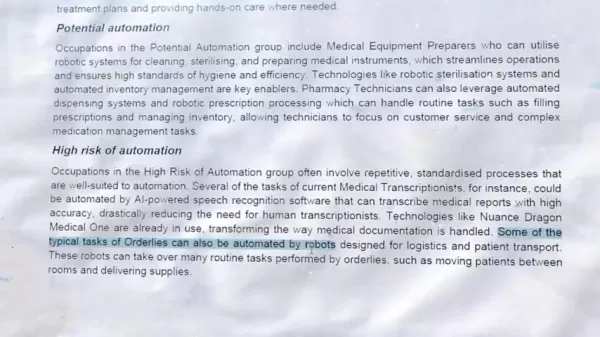
The OECD's 2025 report on Digital and AI Skills in Health Occupations confirms nursing as one of the professions least susceptible to AI replacement. In stark contrast, roles like medical transcriptionist are high-risk, as AI can perform their core tasks almost instantaneously.
Data-Driven Insights: The Future of Nursing
The Current Landscape: Nursing Statistics and Projections
Nursing is the largest healthcare profession in the United States, with approximately 3.17 million actively licensed Registered Nurses currently practicing. This represents nearly 20% of the total healthcare workforce, solidifying its status as a major national profession.
The Bureau of Labor Statistics projects a 6% growth in employment for registered nurses from 2022 to 2032, matching the average growth rate for all occupations. An estimated 193,100 job openings for RNs are expected each year over this period, driven primarily by an aging population and rising demand for healthcare services.
OECD Report Findings: AI’s Role in Health Occupations
The OECD’s 2025 report identifies nursing as one of the professions safest from AI-driven job displacement.
- The 40 occupations most exposed to AI typically involve repetitive, desk-based tasks.
- The 40 least affected roles require hands-on, practical work and nuanced judgment—a description that fits nursing perfectly.
The same report highlights the opposite end of the risk spectrum.

Key findings include:
- Medical transcriptionists are at high risk, as their primary duty—transcribing audio recordings—is a task AI can complete in seconds.
- Orderlies also fall into a high-risk category, as many of their physical support functions could potentially be managed by robotics.
Microsoft's Analysis: AI's Impact on Job Security
Microsoft's independent analysis of AI's impact across industries also produced two lists: the 40 jobs most and least affected by AI. Notably, nursing did not appear on either list. The roles most susceptible were those characterized by repetitive or predominantly desk-bound work.
Harnessing AI: Practical Tips for Nurses
Embrace Technology: Adapting to New Tools and Platforms
Adopting new technological tools is crucial for modern nursing practice. Key areas for AI application include: Electronic Health Records (EHRs), Telehealth Platforms, Wearable Health Trackers, and Automated Patient Monitoring Systems. As central figures in patient care, nurses must develop competence and confidence in using these AI-enhanced systems.

Focus on Essential Skills: Critical Thinking, Compassion, and Adaptability
Despite AI's advancements, these systems lack the core human skills essential to nursing. Certain abilities remain inherently human and second nature to skilled nurses, such as:
- Applying critical thinking in high-pressure, clinical situations.
- Delivering care with genuine compassion and empathy.
- Conducting nuanced patient assessments and making swift, informed decisions.
AI Integration: Investment and Cost-Effectiveness
Cost of Implementation
Implementing AI tools requires upfront investment but can yield significant long-term cost savings and operational benefits in nursing. Potential advantages include:
- Reduced Administrative Overheads
- Improved Clinical Outcomes
- Enhanced Operational Efficiency
- Cost Savings from Enhanced Preventive Care
Related article
 Ultraman’s College Critique Sparks Debate on Redefining Growth and Careers in the AI Era
In an era defined by rapid AI advancement, traditional education and career planning face unprecedented challenges. OpenAI CEO Sam Altman recently delivered a provocative address at the Internapalooza tech intern event, arguing that a four-year colle
Ctrip Business Travel Unveils AI Ecosystem with 7 Industry Agents and 17 Core Capabilities
Ctrip Business Travel has officially unveiled the "Ctrip Business Travel AI Ecosystem," leveraging large language models to fundamentally restructure corporate travel management. This comprehensive ecosystem addresses four core scenarios: travel arra
Stripe to Acquire OpenRouter as AI Model Routing Gains Momentum
Stripe has agreed to acquire OpenRouter, an AI model-routing platform that gives developers access to hundreds of models through a single interface. The deal adds model selection and routing to Stripe’s existing work around AI usage and token-based b
Related Special Topic Recommendations
Design & Art
Ultraman’s College Critique Sparks Debate on Redefining Growth and Careers in the AI Era
In an era defined by rapid AI advancement, traditional education and career planning face unprecedented challenges. OpenAI CEO Sam Altman recently delivered a provocative address at the Internapalooza tech intern event, arguing that a four-year colle
Ctrip Business Travel Unveils AI Ecosystem with 7 Industry Agents and 17 Core Capabilities
Ctrip Business Travel has officially unveiled the "Ctrip Business Travel AI Ecosystem," leveraging large language models to fundamentally restructure corporate travel management. This comprehensive ecosystem addresses four core scenarios: travel arra
Stripe to Acquire OpenRouter as AI Model Routing Gains Momentum
Stripe has agreed to acquire OpenRouter, an AI model-routing platform that gives developers access to hundreds of models through a single interface. The deal adds model selection and routing to Stripe’s existing work around AI usage and token-based b
Related Special Topic Recommendations
Design & Art
 Top AI Illustration Tools: Create Editorial Scenes and Cover Art Faster
2026 Latest Top-rated AI Illustration Tools: Our curated list features the best powerfully designed tools for creating stunning editorial scenes and eye-catching cover art quickly. Each option has gone through rigorous real-world tests, offering a free vs paid comparison to help you find the perfect match for your workflow. Try these must-try solutions today to unlock your AI edge and boost your creative productivity. Explore now at XIX.AI.
 10 tools
 xix.ai
Education and Learning
Top AI Tutors for Exam Prep: Practice Math, Science, and English
xix.ai
Education and Learning
Top AI Tutors for Exam Prep: Practice Math, Science, and English
2026 Latest Top-Rated Best AI Tutors for Exam Prep are here on XIX.AI! Our curated list features powerful game-changing tools that offer free vs paid comparison, real-world tests, and weekly updated rankings. They help boost your writing efficiency, simplify complex topic learning, and unlock your academic potential. Explore now to Discover your perfect exam prep tool and Start creating today to Unlock your AI edge!
10 tools
xix.ai
Finance
AI Budget Planning Tools for Personal Money Management
2026 Latest Best Top-Rated AI Budget Planning Tools for Personal Money Management are here on XIX.AI! This curated collection features powerful, game-changing solutions that help you conduct real-world tests, understand spending habits, and create personalized plans to boost productivity. Enjoy a free vs paid comparison along with detailed rankings. Must-try tools designed to simplify money management and unlock your AI edge. Explore now!
11 tools
xix.ai
Health & Wellness
AI Sleep Tracking Assistants: Improve Recovery with Better Bedtime Habits
2026 Latest Best Top-Rated AI Sleep Tracking Assistants curated for ultimate recovery. This fully updated weekly guide features powerful tools that deliver real-world tests, free vs paid comparison, and detailed rankings to help you find the must-try solution that boosts sleep quality and supports better bedtime habits. Explore now at XIX.AI to Unlock your AI edge.
10 tools
xix.ai
Data Analysis
AI SQL Copilots for Product and Revenue Analytics
2026 Latest Best Top-Rated AI SQL Copilots for Product and Revenue Analytics! XIX.AI has curated a powerful, game-changing collection of must-try tools that undergo real-world tests through weekly updated rankings. These tools help users boost productivity significantly by accelerating data analysis, streamlining complex queries, and generating accurate insights to drive smarter business decisions. Explore now to Discover your perfect tool for unlocking your AI edge!
14 tools
xix.ai
Education and Learning
Best AI Homework Helpers That Teach: Learn Concepts, Not Just Answers
2026 Latest Best Top-Rated AI Homework Helpers That Teach Core Concepts Not Just Answers Powerful Tools for Students Must-Try Curated List Weekly Updated Free vs Paid Comparison Real-World Tests Accurate Rankings to Help You Unlock Your Full Learning Potential Explore now to Discover your perfect tool for smarter studying.
10 tools
xix.ai

 Comments (1)
0/500
Comments (1)
0/500
![WillieRodriguez]()
L'article parle de l'IA en santé. Franchement, ça fait un peu peur pour les infirmiers, non ? 😅 Est-ce que les robots vont vraiment nous remplacer pour le côté humain ? J'espère que ça va plutôt aider à gérer les tâches administratives pénibles.
The healthcare sector is undergoing rapid transformation, with Artificial Intelligence (AI) leading the charge. As we progress through 2025, understanding AI's influence on healthcare roles, especially nursing, is more important than ever. This article examines AI's impact on nursing careers, assesses job security amidst automation, and identifies the key skills for success in a technology-enhanced healthcare setting. Whether you're an experienced nurse or exploring a healthcare career, this guide offers essential insights for the future of the profession. Is nursing still a viable career choice?
Key Points
AI is reshaping healthcare, but nursing continues to offer a stable and secure career.
While AI is unlikely to replace nurses, it will significantly transform their daily responsibilities.
Proficiency with digital health tools and AI concepts is becoming fundamental for nursing professionals.
Certain nursing specializations, such as telehealth, may experience more pronounced shifts due to AI.
Hospitals are adopting AI for tasks like staff scheduling, resource allocation, and remote patient monitoring.
Nurses should cultivate skills that AI cannot easily replicate, including complex problem-solving and empathy.
The rise of wearable health technology presents both new opportunities and challenges for nursing practice.
Adaptability is the cornerstone for nurses to excel within an AI-augmented healthcare system.
Electronic health records (EHRs) will become increasingly sophisticated through AI integration.
The Evolution of Nursing and the Rise of AI
AI's Late Entrance to the Nursing Profession
For a long time, the notion that Artificial Intelligence (AI) could significantly impact healthcare seemed far-fetched. Many professionals viewed AI merely as a tool for automating routine, mundane tasks. Today, however, most healthcare workers recognize AI as a valuable asset that can streamline a wide array of processes.
The nursing field, once considered insulated from AI, is now navigating a period of significant change. Discussions about automation in nursing, automated data analysis, and machine-assisted treatment plans are now commonplace. For veteran nurses, AI was not a consideration early in their careers. It is only in the last three to four years that nurses have begun to seriously contemplate the long-term security of their profession. For aspiring nurses, the central question remains: is nursing still the right path for me?
The Shifting Landscape: AI's Integration into Healthcare
Historically, healthcare operated on traditional foundations: paper records, manual data handling, and in-person consultations were standard. The industry's digital transformation, marked by the adoption of electronic health records (EHRs), telemedicine, and advanced diagnostics, has fundamentally changed patient care. However, integrating AI into nursing faced several initial barriers. Data Security and Privacy: Deploying AI systems demanded stringent security protocols to safeguard sensitive patient data, ensuring strict compliance with healthcare regulations.Regulatory Approval: Gaining FDA clearance for specific healthcare applications was a critical step for AI adoption.Interoperability: Seamless data exchange between different hospital and software systems was essential to realize the full potential of AI.
User Adoption: Successful AI integration depended on comprehensive training for healthcare staff to utilize these new tools effectively.
Why Nursing Remains Relatively Safe from AI Replacement
A 2025 analysis classified healthcare roles into three categories: those replaceable by AI, those where AI can handle substantial portions of the work, and those where AI serves as a supportive tool without replacing the human professional. Registered nurses firmly belong to the last group. Nursing is regarded as one of the most secure healthcare careers because AI's role is to augment, not usurp, the nurse's job. It aims to enhance speed, accuracy, and reduce fatigue. The key differentiator will be adaptability: nurses who master these tools will work more efficiently, with greater precision, and unlock more career opportunities, while those who resist may find themselves at a disadvantage.
The OECD's 2025 report on Digital and AI Skills in Health Occupations confirms nursing as one of the professions least susceptible to AI replacement. In stark contrast, roles like medical transcriptionist are high-risk, as AI can perform their core tasks almost instantaneously.
Data-Driven Insights: The Future of Nursing
The Current Landscape: Nursing Statistics and Projections
Nursing is the largest healthcare profession in the United States, with approximately 3.17 million actively licensed Registered Nurses currently practicing. This represents nearly 20% of the total healthcare workforce, solidifying its status as a major national profession.
The Bureau of Labor Statistics projects a 6% growth in employment for registered nurses from 2022 to 2032, matching the average growth rate for all occupations. An estimated 193,100 job openings for RNs are expected each year over this period, driven primarily by an aging population and rising demand for healthcare services.
OECD Report Findings: AI’s Role in Health Occupations
The OECD’s 2025 report identifies nursing as one of the professions safest from AI-driven job displacement.
- The 40 occupations most exposed to AI typically involve repetitive, desk-based tasks.
- The 40 least affected roles require hands-on, practical work and nuanced judgment—a description that fits nursing perfectly.
The same report highlights the opposite end of the risk spectrum.
Key findings include:
- Medical transcriptionists are at high risk, as their primary duty—transcribing audio recordings—is a task AI can complete in seconds.
- Orderlies also fall into a high-risk category, as many of their physical support functions could potentially be managed by robotics.
Microsoft's Analysis: AI's Impact on Job Security
Microsoft's independent analysis of AI's impact across industries also produced two lists: the 40 jobs most and least affected by AI. Notably, nursing did not appear on either list. The roles most susceptible were those characterized by repetitive or predominantly desk-bound work.
Harnessing AI: Practical Tips for Nurses
Embrace Technology: Adapting to New Tools and Platforms
Adopting new technological tools is crucial for modern nursing practice. Key areas for AI application include: Electronic Health Records (EHRs), Telehealth Platforms, Wearable Health Trackers, and Automated Patient Monitoring Systems. As central figures in patient care, nurses must develop competence and confidence in using these AI-enhanced systems.
Focus on Essential Skills: Critical Thinking, Compassion, and Adaptability
Despite AI's advancements, these systems lack the core human skills essential to nursing. Certain abilities remain inherently human and second nature to skilled nurses, such as:
- Applying critical thinking in high-pressure, clinical situations.
- Delivering care with genuine compassion and empathy.
- Conducting nuanced patient assessments and making swift, informed decisions.
AI Integration: Investment and Cost-Effectiveness
Cost of Implementation
Implementing AI tools requires upfront investment but can yield significant long-term cost savings and operational benefits in nursing. Potential advantages include:
- Reduced Administrative Overheads
- Improved Clinical Outcomes
- Enhanced Operational Efficiency
- Cost Savings from Enhanced Preventive Care








 Ultraman’s College Critique Sparks Debate on Redefining Growth and Careers in the AI Era
In an era defined by rapid AI advancement, traditional education and career planning face unprecedented challenges. OpenAI CEO Sam Altman recently delivered a provocative address at the Internapalooza tech intern event, arguing that a four-year colle
Ultraman’s College Critique Sparks Debate on Redefining Growth and Careers in the AI Era
In an era defined by rapid AI advancement, traditional education and career planning face unprecedented challenges. OpenAI CEO Sam Altman recently delivered a provocative address at the Internapalooza tech intern event, arguing that a four-year colle
 Ctrip Business Travel Unveils AI Ecosystem with 7 Industry Agents and 17 Core Capabilities
Ctrip Business Travel has officially unveiled the "Ctrip Business Travel AI Ecosystem," leveraging large language models to fundamentally restructure corporate travel management. This comprehensive ecosystem addresses four core scenarios: travel arra
Ctrip Business Travel Unveils AI Ecosystem with 7 Industry Agents and 17 Core Capabilities
Ctrip Business Travel has officially unveiled the "Ctrip Business Travel AI Ecosystem," leveraging large language models to fundamentally restructure corporate travel management. This comprehensive ecosystem addresses four core scenarios: travel arra
 Stripe to Acquire OpenRouter as AI Model Routing Gains Momentum
Stripe has agreed to acquire OpenRouter, an AI model-routing platform that gives developers access to hundreds of models through a single interface. The deal adds model selection and routing to Stripe’s existing work around AI usage and token-based b
Stripe to Acquire OpenRouter as AI Model Routing Gains Momentum
Stripe has agreed to acquire OpenRouter, an AI model-routing platform that gives developers access to hundreds of models through a single interface. The deal adds model selection and routing to Stripe’s existing work around AI usage and token-based b

2026 Latest Top-rated AI Illustration Tools: Our curated list features the best powerfully designed tools for creating stunning editorial scenes and eye-catching cover art quickly. Each option has gone through rigorous real-world tests, offering a free vs paid comparison to help you find the perfect match for your workflow. Try these must-try solutions today to unlock your AI edge and boost your creative productivity. Explore now at XIX.AI.
10 tools
xix.ai

2026 Latest Top-Rated Best AI Tutors for Exam Prep are here on XIX.AI! Our curated list features powerful game-changing tools that offer free vs paid comparison, real-world tests, and weekly updated rankings. They help boost your writing efficiency, simplify complex topic learning, and unlock your academic potential. Explore now to Discover your perfect exam prep tool and Start creating today to Unlock your AI edge!
10 tools
xix.ai

2026 Latest Best Top-Rated AI Budget Planning Tools for Personal Money Management are here on XIX.AI! This curated collection features powerful, game-changing solutions that help you conduct real-world tests, understand spending habits, and create personalized plans to boost productivity. Enjoy a free vs paid comparison along with detailed rankings. Must-try tools designed to simplify money management and unlock your AI edge. Explore now!
11 tools
xix.ai

2026 Latest Best Top-Rated AI Sleep Tracking Assistants curated for ultimate recovery. This fully updated weekly guide features powerful tools that deliver real-world tests, free vs paid comparison, and detailed rankings to help you find the must-try solution that boosts sleep quality and supports better bedtime habits. Explore now at XIX.AI to Unlock your AI edge.
10 tools
xix.ai

2026 Latest Best Top-Rated AI SQL Copilots for Product and Revenue Analytics! XIX.AI has curated a powerful, game-changing collection of must-try tools that undergo real-world tests through weekly updated rankings. These tools help users boost productivity significantly by accelerating data analysis, streamlining complex queries, and generating accurate insights to drive smarter business decisions. Explore now to Discover your perfect tool for unlocking your AI edge!
14 tools
xix.ai

2026 Latest Best Top-Rated AI Homework Helpers That Teach Core Concepts Not Just Answers Powerful Tools for Students Must-Try Curated List Weekly Updated Free vs Paid Comparison Real-World Tests Accurate Rankings to Help You Unlock Your Full Learning Potential Explore now to Discover your perfect tool for smarter studying.
10 tools
xix.ai

L'article parle de l'IA en santé. Franchement, ça fait un peu peur pour les infirmiers, non ? 😅 Est-ce que les robots vont vraiment nous remplacer pour le côté humain ? J'espère que ça va plutôt aider à gérer les tâches administratives pénibles.












