


 Home
HomeAI Image Generation: Expert Prompt Techniques for Superior Visuals
Artificial intelligence is rapidly transforming creative fields, with AI image generation becoming an essential tool for visual content creation. By leveraging advanced AI models, users can now produce stunning, original images directly from text descriptions. This groundbreaking technology is reshaping industries by providing new creative avenues for artists, designers, marketers, and anyone looking to visualize their ideas. This guide explores the craft of prompt engineering for AI image generation, sharing actionable techniques to help you create compelling visuals. We'll examine the core elements of powerful prompts, discuss various approaches to achieve your desired outcomes, and share practical advice to streamline your creative process.
Key Points
AI image generation creates visuals directly from text prompts.
Crafting effective prompts is essential for achieving quality results.
Images can be created using straightforward English descriptions.
Iterative testing and refinement are fundamental to mastering AI image generation.
Modern AI image generation platforms are intuitive and accessible.
Understanding AI Image Generation and Prompts
The Basics of AI Image Generation
AI image generation involves creating visuals using sophisticated artificial intelligence algorithms. These deep learning systems analyze enormous datasets containing images and their descriptions. When users provide text instructions, the AI interprets these prompts and generates corresponding images. Recent technological advances now enable the creation of photorealistic scenes, artistic compositions, and abstract imagery with impressive detail and precision. The generation process involves inputting a text description into an AI model, which then progressively enhances the image until it matches the prompt. Different AI platforms have unique characteristics that influence output style and quality, making experimentation crucial for finding your ideal tool. Beyond basic image creation, these systems offer editing capabilities, style adaptation, and resolution enhancement, expanding their utility across numerous applications.
The effectiveness of AI image generation hinges on the prompt – the text instruction that directs the AI model. A well-constructed prompt directly influences both the relevance and quality of the generated image, making prompt crafting a vital skill for success.
Crafting Effective Prompts: The Building Blocks
Creating powerful prompts combines creative vision with strategic communication. You need a clear concept of your desired outcome and the ability to articulate that vision effectively to the AI. Consider these fundamental elements:
- Clarity and Specificity: Precise, unambiguous language helps the AI understand your requirements. Use descriptive adjectives and concrete nouns to create vivid mental imagery for the AI system.
- Keywords and Concepts: Identify essential elements for your image and incorporate precise keywords. For a sunset ocean scene, use terms like "golden hour," "ocean waves," and "vibrant sunset colors."
- Style and Composition: Define your preferred aesthetic and layout. Specify whether you want photorealistic results, artistic interpretations, or abstract designs using terms like "photo-realistic," "impressionist style," "surreal composition," or "geometric patterns."
- Context and Details: Add environmental context, lighting conditions, color schemes, and mood indicators. For example, "futuristic urban landscape at night illuminated by neon lights with aerial vehicles."
By skillfully combining these elements, you can develop prompts that guide AI models to produce images closely aligned with your vision. Remember that prompt engineering involves continuous improvement through testing and refinement.
Real-World Examples and Practical Applications
Generating a College Building Image with AI
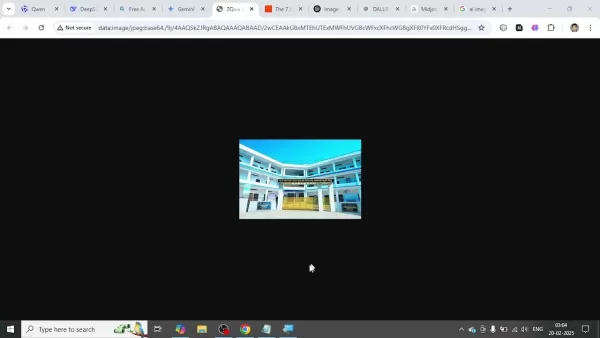
Let's examine a practical application by creating an AI-generated image of a college building. We'll begin with a basic prompt and progressively enhance it for greater detail and accuracy.
Initial Prompt: "College building"
This simple instruction will produce a generic educational structure. To create more specific and visually engaging results, we can add descriptive elements.
Enhanced Prompt: "Image featuring an imposing entrance gate to an institutional building. The architecture suggests a governmental structure with two distinct floors, each featuring balconies. A flagpole stands prominently in the foreground flying the Indian flag. The entrance is framed by two substantial pillars supporting an arched structure bearing the inscription 'Dr. G Shankar Government Womens First Grade College and PG Study Centre.' The scene is set under a clear blue sky with sandy ground coverage, captured during daylight hours."
This detailed prompt provides comprehensive architectural specifications, contextual elements, and environmental details. When processed by an AI image generator, this detailed description yields images that closely match the specified college building. This demonstrates how thorough descriptions produce more accurate and visually appealing results.
Benefits of AI Image Generation:
- Efficiency: AI image generation dramatically reduces the time and resources needed to create complex visual scenes.
- Cost-Effective: Provides an affordable alternative to professional photography or design services, particularly for budget-conscious projects.
- Creative Discovery: Enables rapid exploration of diverse creative concepts and artistic styles, encouraging innovation and experimentation.
- Universal Access: AI image generation tools are widely available online, making professional-quality visual content creation accessible to everyone.
Applications in Various Industries:
- Marketing and Advertising: AI-generated visuals enhance advertising campaigns, social media content, and website graphics.
- Education: Supports learning through customized educational materials, illustrations, and visual teaching aids.
- Art and Design: Facilitates the creation of unique artwork, graphic designs, and visual prototypes.
- Gaming and Entertainment: Generates game assets, visual effects, and concept art for film and television productions.
Tips and Tricks for Optimizing Your Prompts
Mastering AI image generation requires dedicated practice and systematic experimentation. These optimization strategies will help you achieve superior results:
- Diversify Your Vocabulary: Experiment with synonyms and related terms rather than repeating the same keywords.
- Specify Camera Techniques: Include preferred camera angles and perspectives like "close-up detail," "panoramic view," or "overhead shot."
- Control Lighting Conditions: Use specific terminology to manage illumination and shadow effects, such as "soft ambient lighting," "defined shadows," or "silhouette against backlight."
- Incorporate Emotional Tone: Convey specific moods or feelings through descriptive terms like "joyful atmosphere," "melancholic scene," "mysterious ambiance," or "dramatic tension."
- Reference Artistic Influences: Mention specific artists, movements, or styles to guide the AI's creative direction, like "Van Gogh-inspired," "Art Deco aesthetic," or "Impressionist influence."
Use this reference table to refine your prompt crafting:
Aspect Description Example Clarity Employ unambiguous, specific language to prevent misinterpretation. "A majestic mountain range at sunset" (more effective than "Mountains") Detail Include specific characteristics to direct the AI's output. "A snow-capped mountain range at sunset with a clear blue sky" (provides additional context) Style Define the artistic approach you want the AI to follow. "A snow-capped mountain range at sunset in the style of Bob Ross" (specifies artistic influence) Emotion Include terms that convey specific feelings or atmosphere. "A serene snow-capped mountain range at sunset with a clear blue sky" (establishes mood) Perspective Specify the viewing angle or photographic approach. "A wide-angle view of a snow-capped mountain range at sunset" (defines visual perspective)
Implementing these techniques will help you maximize the potential of AI image generation and develop a distinctive visual style.
Step-by-Step Guide to AI Image Generation
Choosing the Right AI Image Generator
Selecting an appropriate AI image generator is your first crucial step. Multiple platforms offer varying capabilities and specializations. Consider these established options:
- DALL-E: OpenAI's solution renowned for generating highly imaginative and creative images from textual descriptions.
- Midjourney: A popular platform celebrated for producing artistically sophisticated and visually striking images, accessible through Discord.
- DeepAI: Provides comprehensive AI solutions including a versatile text-to-image generator.
- Bing Image Creator: A user-friendly option integrated directly into the Bing search ecosystem, balancing accessibility with quality output.
Evaluate platforms based on usability, pricing structure, output quality, and creative flexibility. Many services provide free introductory access or trial periods, allowing you to assess their suitability before subscription.
Crafting Your First Prompt
After selecting your platform, begin with straightforward prompts describing your desired image. Start with "a cat resting on a windowsill." If initial results need refinement, enhance your description: "a fluffy ginger cat perched on a rustic wooden windowsill with warm sunlight filtering through the glass." Remember that specificity directly correlates with the AI's comprehension and output quality.
Generating and Refining Your Image
Once you submit your prompt, the AI processes your request and generates corresponding imagery. Processing times vary based on prompt complexity and platform capabilities. Carefully evaluate each generated image against your original vision. If adjustments are needed, modify your prompt and regenerate. This cyclical process of creation and refinement is fundamental to achieving optimal results. Embrace experimentation with different phrasing and parameters until you achieve satisfaction.
Frequently Asked Questions about AI Image Generation
What is AI image generation?
AI image generation involves creating visual content using artificial intelligence systems. These algorithms learn from extensive image-text datasets, enabling them to produce new images that interpret text prompts.
How do I craft effective prompts?
Successful prompts feature clarity, specificity, and comprehensive detail. Use descriptive language, concrete references, and relevant terminology to direct the AI's creative process. Test different stylistic approaches, compositional elements, and contextual details to perfect your outcomes.
What are some popular AI image generators?
Leading AI image generation platforms include DALL-E, Midjourney, DeepAI, and Bing Image Creator. Each system has distinct advantages and limitations, so selecting the right tool depends on your specific creative requirements.
Is AI image generation free?
Many AI image generators provide complimentary access or limited free usage tiers. Advanced functionality and higher-resolution outputs typically require premium subscriptions.
What are the ethical considerations of AI image generation?
Ethical considerations encompass copyright compliance, potential misuse scenarios like deepfake creation, and the technology's impact on creative professions. Responsible and ethical application of AI image generation is paramount.
Related Questions on AI Image Generation
How can AI image generation be used in marketing?
AI image generation presents significant opportunities for marketing applications. It enables the creation of attention-grabbing advertisements, social media content, website visuals, and product representations. AI-generated imagery can be customized to align with brand standards and target demographic preferences, amplifying campaign effectiveness. Additionally, the technology supports personalized content creation for individual customers, boosting engagement and conversion metrics. By harnessing AI capabilities, marketing teams can produce premium visuals efficiently and economically. The capacity to generate unique and compelling content provides a competitive advantage in today's dynamic marketing environment.
Related article
 DeepMind CEO Hassabis: I sleep six hours a day, usually feel energetic around 1 a.m.
Fortune recently featured an interview with Demis Hassabis, CEO of Google DeepMind, revealing his unconventional approach to rest and productivity. Hassabis disclosed that he sleeps very little, structuring his waking hours into two distinct work blo
OpenAI, Anthropic Vie for Market Share Despite Revenue Shortfalls
Despite recent reports suggesting OpenAI missed revenue targets, creating pressure on tech stocks this Tuesday, private AI lab investors remain resilient. Seasoned backers have confirmed they will not reduce investment despite negative media coverage
California AV Compliance: A New Era of Tickets, Geofences, and 1M Miles
Guident operates an AuveTech shuttle in South Florida, managing a four-mile route in West Palm Beach and a one-mile route in Boca Raton using its remote monitoring technology. | Credit: GuidentCalifornia is redefining the regulatory landscape for dri
Related Special Topic Recommendations
chatbot
DeepMind CEO Hassabis: I sleep six hours a day, usually feel energetic around 1 a.m.
Fortune recently featured an interview with Demis Hassabis, CEO of Google DeepMind, revealing his unconventional approach to rest and productivity. Hassabis disclosed that he sleeps very little, structuring his waking hours into two distinct work blo
OpenAI, Anthropic Vie for Market Share Despite Revenue Shortfalls
Despite recent reports suggesting OpenAI missed revenue targets, creating pressure on tech stocks this Tuesday, private AI lab investors remain resilient. Seasoned backers have confirmed they will not reduce investment despite negative media coverage
California AV Compliance: A New Era of Tickets, Geofences, and 1M Miles
Guident operates an AuveTech shuttle in South Florida, managing a four-mile route in West Palm Beach and a one-mile route in Boca Raton using its remote monitoring technology. | Credit: GuidentCalifornia is redefining the regulatory landscape for dri
Related Special Topic Recommendations
chatbot
 Best AI Roleplay Chat Apps for Language Practice, Interview Prep, and Daily Fluency
2026 Latest Best Top-rated AI Roleplay Chat Apps for Language Practice, Interview Prep, and Daily Fluency! XIX.AI curates a powerful game-changing collection that offers free vs paid comparison, real-world tests, and updated rankings weekly. These must-try tools help you boost writing skills, overcome fluency challenges, and improve communication efficiency across all daily scenarios. Explore now to discover your perfect tool for language growth!
 10 tools
 xix.ai
Music composition
AI Stem Separation Tools for Remix Production, Sampling Prep, and Karaoke Masters
xix.ai
Music composition
AI Stem Separation Tools for Remix Production, Sampling Prep, and Karaoke Masters
2026 Latest Best Top-rated AI Stem Separation Tools Curated for Remix Production, Sampling Prep, and Karaoke Masters. These powerful game-changing tools offer real-world tests to deliver precise audio isolation, boosting productivity significantly. XIX.AI provides a weekly updated free vs paid comparison guide to help you find the must-try solution that suits your needs. Explore now to unlock your AI edge.
8 tools
xix.ai
Data Analysis
AI SQL Copilots for Revenue Dashboards, Funnel Analysis, and Product Metrics
2026 Latest Best AI SQL Copilots Ranked Top-Rated! XIX.AI curates a powerful game-changing collection for weekly updated real-world tests. These must-try tools help you generate accurate revenue dashboards, analyze sales funnels, and track product metrics swiftly, boosting productivity massively. Explore now to Discover your perfect tool for data-driven decision making! 238 characters
9 tools
xix.ai
Music composition
Best AI Melody Writing Tools for Song Drafts
2026 Latest Best Top-Rated AI Melody Writing Tools for Song Drafts! XIX.AI has curated a highly powerful game-changing collection that goes through rigorous real-world tests to deliver the best writing experience. You can find detailed free vs paid comparisons, accurate rankings, and must-try options designed to help you create stunning song drafts effortlessly and boost your creative productivity significantly. Explore now to discover your perfect tool!
8 tools
xix.ai
chatbot
Best AI Conversation Trainer Tools for Interview Practice
2026 Latest Best Top-rated AI Conversation Trainer Tools for Interview Practice are here on XIX.AI! This curated collection features powerful, game-changing tools that go through rigorous real-world tests to deliver accurate feedback. You’ll find a free vs paid comparison and detailed rankings to help you choose the must-try option that boosts your confidence and skills. Explore now to Discover your perfect tool for interview success!
12 tools
xix.ai
Design & Art
Best AI Style Transfer Tools for Creative Experiments
2026 Latest Best Top-rated AI Style Transfer Tools for Creative Experiments! XIX.AI has curated a powerful, game-changing collection of must-try tools that deliver exceptional results through real-world tests and rigorous rankings. These top solutions help creatives boost productivity significantly by accelerating content creation and unlocking endless creative possibilities. Explore now to discover your perfect tool and start creating today!
9 tools
xix.ai

 Comments (1)
0/500
Comments (1)
0/500
![BenJackson]()
Ich habe das Gefühl, dass die ‚Experten-Prompts‘ oft überschätzt werden. Letztendlich bestimmt das Trainingsmaterial des KI-Modells die Grenzen viel mehr als ein paar ausgeklügelte Wörter. Wir sollten vielleicht mehr über die ethischen Implikationen dieser Trainingsdaten und die Verdrängung von Grafikern sprechen. Der kreative Prozess wird so irgendwie entmystifiziert – faszinierend, aber auch ein bisschen unheimlich. 😅
Artificial intelligence is rapidly transforming creative fields, with AI image generation becoming an essential tool for visual content creation. By leveraging advanced AI models, users can now produce stunning, original images directly from text descriptions. This groundbreaking technology is reshaping industries by providing new creative avenues for artists, designers, marketers, and anyone looking to visualize their ideas. This guide explores the craft of prompt engineering for AI image generation, sharing actionable techniques to help you create compelling visuals. We'll examine the core elements of powerful prompts, discuss various approaches to achieve your desired outcomes, and share practical advice to streamline your creative process.
Key Points
AI image generation creates visuals directly from text prompts.
Crafting effective prompts is essential for achieving quality results.
Images can be created using straightforward English descriptions.
Iterative testing and refinement are fundamental to mastering AI image generation.
Modern AI image generation platforms are intuitive and accessible.
Understanding AI Image Generation and Prompts
The Basics of AI Image Generation
AI image generation involves creating visuals using sophisticated artificial intelligence algorithms. These deep learning systems analyze enormous datasets containing images and their descriptions. When users provide text instructions, the AI interprets these prompts and generates corresponding images. Recent technological advances now enable the creation of photorealistic scenes, artistic compositions, and abstract imagery with impressive detail and precision. The generation process involves inputting a text description into an AI model, which then progressively enhances the image until it matches the prompt. Different AI platforms have unique characteristics that influence output style and quality, making experimentation crucial for finding your ideal tool. Beyond basic image creation, these systems offer editing capabilities, style adaptation, and resolution enhancement, expanding their utility across numerous applications.
The effectiveness of AI image generation hinges on the prompt – the text instruction that directs the AI model. A well-constructed prompt directly influences both the relevance and quality of the generated image, making prompt crafting a vital skill for success.
Crafting Effective Prompts: The Building Blocks
Creating powerful prompts combines creative vision with strategic communication. You need a clear concept of your desired outcome and the ability to articulate that vision effectively to the AI. Consider these fundamental elements:
- Clarity and Specificity: Precise, unambiguous language helps the AI understand your requirements. Use descriptive adjectives and concrete nouns to create vivid mental imagery for the AI system.
- Keywords and Concepts: Identify essential elements for your image and incorporate precise keywords. For a sunset ocean scene, use terms like "golden hour," "ocean waves," and "vibrant sunset colors."
- Style and Composition: Define your preferred aesthetic and layout. Specify whether you want photorealistic results, artistic interpretations, or abstract designs using terms like "photo-realistic," "impressionist style," "surreal composition," or "geometric patterns."
- Context and Details: Add environmental context, lighting conditions, color schemes, and mood indicators. For example, "futuristic urban landscape at night illuminated by neon lights with aerial vehicles."
By skillfully combining these elements, you can develop prompts that guide AI models to produce images closely aligned with your vision. Remember that prompt engineering involves continuous improvement through testing and refinement.
Real-World Examples and Practical Applications
Generating a College Building Image with AI
Let's examine a practical application by creating an AI-generated image of a college building. We'll begin with a basic prompt and progressively enhance it for greater detail and accuracy.
Initial Prompt: "College building"
This simple instruction will produce a generic educational structure. To create more specific and visually engaging results, we can add descriptive elements.
Enhanced Prompt: "Image featuring an imposing entrance gate to an institutional building. The architecture suggests a governmental structure with two distinct floors, each featuring balconies. A flagpole stands prominently in the foreground flying the Indian flag. The entrance is framed by two substantial pillars supporting an arched structure bearing the inscription 'Dr. G Shankar Government Womens First Grade College and PG Study Centre.' The scene is set under a clear blue sky with sandy ground coverage, captured during daylight hours."
This detailed prompt provides comprehensive architectural specifications, contextual elements, and environmental details. When processed by an AI image generator, this detailed description yields images that closely match the specified college building. This demonstrates how thorough descriptions produce more accurate and visually appealing results.
Benefits of AI Image Generation:
- Efficiency: AI image generation dramatically reduces the time and resources needed to create complex visual scenes.
- Cost-Effective: Provides an affordable alternative to professional photography or design services, particularly for budget-conscious projects.
- Creative Discovery: Enables rapid exploration of diverse creative concepts and artistic styles, encouraging innovation and experimentation.
- Universal Access: AI image generation tools are widely available online, making professional-quality visual content creation accessible to everyone.
Applications in Various Industries:
- Marketing and Advertising: AI-generated visuals enhance advertising campaigns, social media content, and website graphics.
- Education: Supports learning through customized educational materials, illustrations, and visual teaching aids.
- Art and Design: Facilitates the creation of unique artwork, graphic designs, and visual prototypes.
- Gaming and Entertainment: Generates game assets, visual effects, and concept art for film and television productions.
Tips and Tricks for Optimizing Your Prompts
Mastering AI image generation requires dedicated practice and systematic experimentation. These optimization strategies will help you achieve superior results:
- Diversify Your Vocabulary: Experiment with synonyms and related terms rather than repeating the same keywords.
- Specify Camera Techniques: Include preferred camera angles and perspectives like "close-up detail," "panoramic view," or "overhead shot."
- Control Lighting Conditions: Use specific terminology to manage illumination and shadow effects, such as "soft ambient lighting," "defined shadows," or "silhouette against backlight."
- Incorporate Emotional Tone: Convey specific moods or feelings through descriptive terms like "joyful atmosphere," "melancholic scene," "mysterious ambiance," or "dramatic tension."
- Reference Artistic Influences: Mention specific artists, movements, or styles to guide the AI's creative direction, like "Van Gogh-inspired," "Art Deco aesthetic," or "Impressionist influence."
Use this reference table to refine your prompt crafting:
| Aspect | Description | Example |
|---|---|---|
| Clarity | Employ unambiguous, specific language to prevent misinterpretation. | "A majestic mountain range at sunset" (more effective than "Mountains") |
| Detail | Include specific characteristics to direct the AI's output. | "A snow-capped mountain range at sunset with a clear blue sky" (provides additional context) |
| Style | Define the artistic approach you want the AI to follow. | "A snow-capped mountain range at sunset in the style of Bob Ross" (specifies artistic influence) |
| Emotion | Include terms that convey specific feelings or atmosphere. | "A serene snow-capped mountain range at sunset with a clear blue sky" (establishes mood) |
| Perspective | Specify the viewing angle or photographic approach. | "A wide-angle view of a snow-capped mountain range at sunset" (defines visual perspective) |
Implementing these techniques will help you maximize the potential of AI image generation and develop a distinctive visual style.
Step-by-Step Guide to AI Image Generation
Choosing the Right AI Image Generator
Selecting an appropriate AI image generator is your first crucial step. Multiple platforms offer varying capabilities and specializations. Consider these established options:
- DALL-E: OpenAI's solution renowned for generating highly imaginative and creative images from textual descriptions.
- Midjourney: A popular platform celebrated for producing artistically sophisticated and visually striking images, accessible through Discord.
- DeepAI: Provides comprehensive AI solutions including a versatile text-to-image generator.
- Bing Image Creator: A user-friendly option integrated directly into the Bing search ecosystem, balancing accessibility with quality output.
Evaluate platforms based on usability, pricing structure, output quality, and creative flexibility. Many services provide free introductory access or trial periods, allowing you to assess their suitability before subscription.
Crafting Your First Prompt
After selecting your platform, begin with straightforward prompts describing your desired image. Start with "a cat resting on a windowsill." If initial results need refinement, enhance your description: "a fluffy ginger cat perched on a rustic wooden windowsill with warm sunlight filtering through the glass." Remember that specificity directly correlates with the AI's comprehension and output quality.
Generating and Refining Your Image
Once you submit your prompt, the AI processes your request and generates corresponding imagery. Processing times vary based on prompt complexity and platform capabilities. Carefully evaluate each generated image against your original vision. If adjustments are needed, modify your prompt and regenerate. This cyclical process of creation and refinement is fundamental to achieving optimal results. Embrace experimentation with different phrasing and parameters until you achieve satisfaction.
Frequently Asked Questions about AI Image Generation
What is AI image generation?
AI image generation involves creating visual content using artificial intelligence systems. These algorithms learn from extensive image-text datasets, enabling them to produce new images that interpret text prompts.
How do I craft effective prompts?
Successful prompts feature clarity, specificity, and comprehensive detail. Use descriptive language, concrete references, and relevant terminology to direct the AI's creative process. Test different stylistic approaches, compositional elements, and contextual details to perfect your outcomes.
What are some popular AI image generators?
Leading AI image generation platforms include DALL-E, Midjourney, DeepAI, and Bing Image Creator. Each system has distinct advantages and limitations, so selecting the right tool depends on your specific creative requirements.
Is AI image generation free?
Many AI image generators provide complimentary access or limited free usage tiers. Advanced functionality and higher-resolution outputs typically require premium subscriptions.
What are the ethical considerations of AI image generation?
Ethical considerations encompass copyright compliance, potential misuse scenarios like deepfake creation, and the technology's impact on creative professions. Responsible and ethical application of AI image generation is paramount.
Related Questions on AI Image Generation
How can AI image generation be used in marketing?
AI image generation presents significant opportunities for marketing applications. It enables the creation of attention-grabbing advertisements, social media content, website visuals, and product representations. AI-generated imagery can be customized to align with brand standards and target demographic preferences, amplifying campaign effectiveness. Additionally, the technology supports personalized content creation for individual customers, boosting engagement and conversion metrics. By harnessing AI capabilities, marketing teams can produce premium visuals efficiently and economically. The capacity to generate unique and compelling content provides a competitive advantage in today's dynamic marketing environment.








 DeepMind CEO Hassabis: I sleep six hours a day, usually feel energetic around 1 a.m.
Fortune recently featured an interview with Demis Hassabis, CEO of Google DeepMind, revealing his unconventional approach to rest and productivity. Hassabis disclosed that he sleeps very little, structuring his waking hours into two distinct work blo
DeepMind CEO Hassabis: I sleep six hours a day, usually feel energetic around 1 a.m.
Fortune recently featured an interview with Demis Hassabis, CEO of Google DeepMind, revealing his unconventional approach to rest and productivity. Hassabis disclosed that he sleeps very little, structuring his waking hours into two distinct work blo
 OpenAI, Anthropic Vie for Market Share Despite Revenue Shortfalls
Despite recent reports suggesting OpenAI missed revenue targets, creating pressure on tech stocks this Tuesday, private AI lab investors remain resilient. Seasoned backers have confirmed they will not reduce investment despite negative media coverage
California AV Compliance: A New Era of Tickets, Geofences, and 1M Miles
Guident operates an AuveTech shuttle in South Florida, managing a four-mile route in West Palm Beach and a one-mile route in Boca Raton using its remote monitoring technology. | Credit: GuidentCalifornia is redefining the regulatory landscape for dri
OpenAI, Anthropic Vie for Market Share Despite Revenue Shortfalls
Despite recent reports suggesting OpenAI missed revenue targets, creating pressure on tech stocks this Tuesday, private AI lab investors remain resilient. Seasoned backers have confirmed they will not reduce investment despite negative media coverage
California AV Compliance: A New Era of Tickets, Geofences, and 1M Miles
Guident operates an AuveTech shuttle in South Florida, managing a four-mile route in West Palm Beach and a one-mile route in Boca Raton using its remote monitoring technology. | Credit: GuidentCalifornia is redefining the regulatory landscape for dri

2026 Latest Best Top-rated AI Roleplay Chat Apps for Language Practice, Interview Prep, and Daily Fluency! XIX.AI curates a powerful game-changing collection that offers free vs paid comparison, real-world tests, and updated rankings weekly. These must-try tools help you boost writing skills, overcome fluency challenges, and improve communication efficiency across all daily scenarios. Explore now to discover your perfect tool for language growth!
10 tools
xix.ai

2026 Latest Best Top-rated AI Stem Separation Tools Curated for Remix Production, Sampling Prep, and Karaoke Masters. These powerful game-changing tools offer real-world tests to deliver precise audio isolation, boosting productivity significantly. XIX.AI provides a weekly updated free vs paid comparison guide to help you find the must-try solution that suits your needs. Explore now to unlock your AI edge.
8 tools
xix.ai

2026 Latest Best AI SQL Copilots Ranked Top-Rated! XIX.AI curates a powerful game-changing collection for weekly updated real-world tests. These must-try tools help you generate accurate revenue dashboards, analyze sales funnels, and track product metrics swiftly, boosting productivity massively. Explore now to Discover your perfect tool for data-driven decision making! 238 characters
9 tools
xix.ai

2026 Latest Best Top-Rated AI Melody Writing Tools for Song Drafts! XIX.AI has curated a highly powerful game-changing collection that goes through rigorous real-world tests to deliver the best writing experience. You can find detailed free vs paid comparisons, accurate rankings, and must-try options designed to help you create stunning song drafts effortlessly and boost your creative productivity significantly. Explore now to discover your perfect tool!
8 tools
xix.ai

2026 Latest Best Top-rated AI Conversation Trainer Tools for Interview Practice are here on XIX.AI! This curated collection features powerful, game-changing tools that go through rigorous real-world tests to deliver accurate feedback. You’ll find a free vs paid comparison and detailed rankings to help you choose the must-try option that boosts your confidence and skills. Explore now to Discover your perfect tool for interview success!
12 tools
xix.ai

2026 Latest Best Top-rated AI Style Transfer Tools for Creative Experiments! XIX.AI has curated a powerful, game-changing collection of must-try tools that deliver exceptional results through real-world tests and rigorous rankings. These top solutions help creatives boost productivity significantly by accelerating content creation and unlocking endless creative possibilities. Explore now to discover your perfect tool and start creating today!
9 tools
xix.ai

Ich habe das Gefühl, dass die ‚Experten-Prompts‘ oft überschätzt werden. Letztendlich bestimmt das Trainingsmaterial des KI-Modells die Grenzen viel mehr als ein paar ausgeklügelte Wörter. Wir sollten vielleicht mehr über die ethischen Implikationen dieser Trainingsdaten und die Verdrängung von Grafikern sprechen. Der kreative Prozess wird so irgendwie entmystifiziert – faszinierend, aber auch ein bisschen unheimlich. 😅












