


 Home
AI Fails to Win Public Over Despite Promises
Despite rapid technological advancements, AI’s public image is deteriorating. Axios reported on Wednesday that the National Republican Senatorial Committee issued a memo to major AI firms, warning that U.S. data center expansions are jeopardizing the party’s prospects in a crucial Ohio election. Concurrently, a Pew Research study revealed growing American apprehension toward AI: 52% of respondents expressed being “more concerned than excited” about its increasing role in daily life, a significant rise from 37% in 2021.
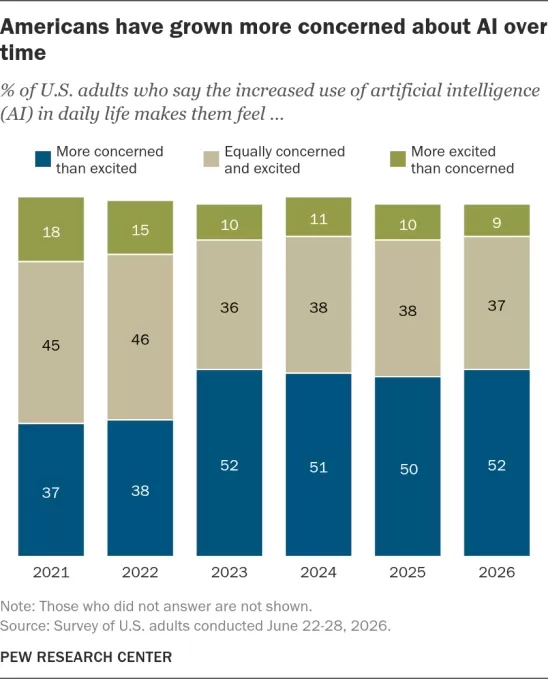
Image Credits:Pew Research
A recent CNBC poll targeting 18- to 34-year-olds showed that when presented with the names of nine leading AI figures, a majority of respondents stated they do not trust these individuals to “act responsibly” regarding AI development. A May Economist/YouGov poll indicated that over 70% ofAmericans believe AI is advancing too rapidly. This trend continues to grow.
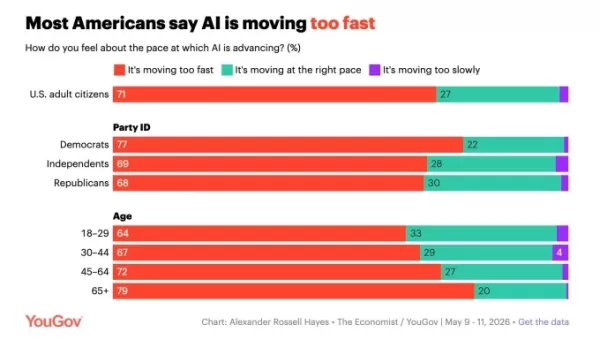
Image Credits:YouGov
This widespread discontent is now impacting financial performance. The Wall Street Journal reported this week that tech companies are facing a public relations crisis due to their plans to construct AI data centers across the U.S., prompting them to enhance their offers with job guarantees, clean water investments, and other local incentives. (In one instance, this included $50,000 bonuses for teachers in a Louisiana parish.)
The common thread across these reports is that consumers do not perceive AI as improving their lives, yet they are expected to bear the associated costs. For an industry that has raised hundreds of billions of dollars based on the inevitability of AI, this shifting public sentiment has evolved from a mere PR issue into a significant business challenge, one that industry leaders are beginning to acknowledge.
Today, many consumers view AI through a limited lens, such as AI chatbots or AI-enhanced search experiences (like the recently AI-integrated Google). They observe AI features being integrated into everyday products, from email services to televisions, often without their consent. They see AI as a tool facilitating academic dishonesty among students, including at the college level, which raises questions about the value of degrees. They also hear about AI models trained on vast amounts of intellectual property to generate art, videos, music, and writing—outputs traditionally produced by humans.
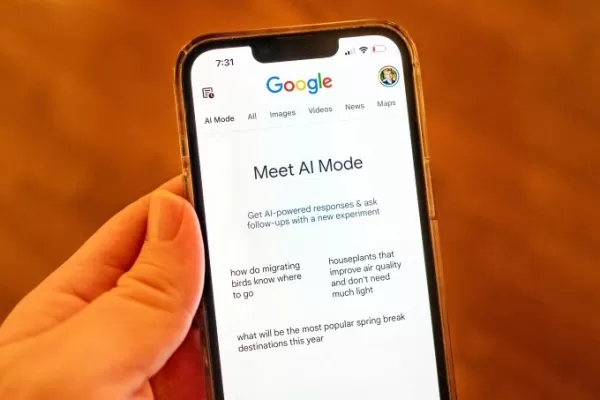
Image Credits:Smith Collection/Gado / Getty Images
It is hardly surprising that AI is encountering more consumer resistance than other transformative technologies, such as the iPhone, personal computers, or even the internet, did at comparable stages of adoption.
Yet, some industry figures remain surprised by this reaction. They assumed that widespread AI adoption would lead to acceptance, and its ubiquity would eventually foster positive sentiment as it became embedded in the majority of tech products and services.
Instead, consumer trends are moving in the opposite direction. Young people, in particular, are showing renewed interest in retro technology, ranging from basic phones to point-and-shoot cameras, tape decks, and CD players. AI-free, algorithm-free classic iPods are commanding premium prices on eBay. So-called “grandma hobbies” like quilting, knitting, jigsaw puzzles, card games, and Mahjong are suddenly ubiquitous. In-person activities, such as run clubs, are gaining popularity over online dating.

Vibrant cassette tapes in yellow, pink, green, blue, and orange, stacked together creating a nostalgic retro backgroundImage Credits:Javier Zayas Photography / Getty Images
Some in Silicon Valley may attribute this to a messaging failure: perhaps executives need to explain AI’s benefits more clearly to consumers.
The reality, however, may be that consumers understand AI sufficiently but do not believe the trade-offs are justified. When the potential upside involves job displacement rather than increased pay and reduced workweeks, paired with AI features that consumers find unimpressive—such as summarized web pages or overly chatty televisions—that skepticism intensifies.
There are industry insiders beginning to recognize this shift.
On a recent podcast, Airbnb CEO Brian Chesky acknowledged that the AI backlash is real and largely stems from the industry’s failure to deliver products that “regular people” desire.
“I think part of it’s a narrative issue that we’re not talking about AI correctly,” Chesky said. “But part of it is we need to actually be developing more products that just regular people can use and say, ‘I love AI because AI allows me to have a doctor on demand and I can’t have that. I can’t afford that.’ And so I think we need more regular things.”
2/2 Second, on the messaging around AI. I do not agree that my messaging has been disproportionately negative. In fact it has been about equally balanced between risks and benefits: I’ve written one major essay about each, and even in interviews where I discuss the risks, I…
— Dario Amodei (@DarioAmodei) August 15, 2026
Even Anthropic CEO Dario Amodei, one of the industry’s most prominent figures, admitted in a post on X this week that negative public perception of AI is a “big problem” and fundamentally a “crisis of trust.” He stated that people distrust companies, governments, and the tech industry because they “suspect that we are cooking up some new way to screw them over.”
He argued that the solution lies in delivering on AI’s promises—for instance, by curing cancer.
“I think by far the most accurate criticism of AI companies, including Anthropic, is that we haven’t yet delivered on our big promises to benefit the world. That is totally on us,” he noted.
Related article
 AI Fails to Win Public Over Despite Promises
Despite rapid technological advancements, AI’s public image is deteriorating. Axios reported on Wednesday that the National Republican Senatorial Committee issued a memo to major AI firms, warning that U.S. data center expansions are jeopardizing the
Doppel Partners With San Francisco 49ers to Bring AI Into Sports
Doppel's AI-native platform is designed to protect against threats. Credit: GettyThe San Francisco 49ers name Doppel their official Social Engineering Defense Partner, deploying frontier AI to combat deepfakes, phishing and cyber riskThe San Francisc
Andreessen-backed Vals Targets AI Benchmarking Leadership
Benchmarking has become the industry standard for how AI companies validate their models’ capabilities, leverage favorable metrics to differentiate from competitors, and market their superiority. In short, strong benchmark results almost always trans
Related Special Topic Recommendations
Design & Art
 Top AI Illustration Tools: Create Editorial Scenes and Cover Art Faster
2026 Latest Top-rated AI Illustration Tools: Our curated list features the best powerfully designed tools for creating stunning editorial scenes and eye-catching cover art quickly. Each option has gone through rigorous real-world tests, offering a free vs paid comparison to help you find the perfect match for your workflow. Try these must-try solutions today to unlock your AI edge and boost your creative productivity. Explore now at XIX.AI.
 10 tools
 xix.ai
Education and Learning
Top AI Tutors for Exam Prep: Practice Math, Science, and English
2026 Latest Top-Rated Best AI Tutors for Exam Prep are here on XIX.AI! Our curated list features powerful game-changing tools that offer free vs paid comparison, real-world tests, and weekly updated rankings. They help boost your writing efficiency, simplify complex topic learning, and unlock your academic potential. Explore now to Discover your perfect exam prep tool and Start creating today to Unlock your AI edge!
10 tools
xix.ai
Finance
AI Budget Planning Tools for Personal Money Management
2026 Latest Best Top-Rated AI Budget Planning Tools for Personal Money Management are here on XIX.AI! This curated collection features powerful, game-changing solutions that help you conduct real-world tests, understand spending habits, and create personalized plans to boost productivity. Enjoy a free vs paid comparison along with detailed rankings. Must-try tools designed to simplify money management and unlock your AI edge. Explore now!
11 tools
xix.ai
Health & Wellness
AI Sleep Tracking Assistants: Improve Recovery with Better Bedtime Habits
2026 Latest Best Top-Rated AI Sleep Tracking Assistants curated for ultimate recovery. This fully updated weekly guide features powerful tools that deliver real-world tests, free vs paid comparison, and detailed rankings to help you find the must-try solution that boosts sleep quality and supports better bedtime habits. Explore now at XIX.AI to Unlock your AI edge.
10 tools
xix.ai
Data Analysis
AI SQL Copilots for Product and Revenue Analytics
2026 Latest Best Top-Rated AI SQL Copilots for Product and Revenue Analytics! XIX.AI has curated a powerful, game-changing collection of must-try tools that undergo real-world tests through weekly updated rankings. These tools help users boost productivity significantly by accelerating data analysis, streamlining complex queries, and generating accurate insights to drive smarter business decisions. Explore now to Discover your perfect tool for unlocking your AI edge!
14 tools
xix.ai
Education and Learning
Best AI Homework Helpers That Teach: Learn Concepts, Not Just Answers
2026 Latest Best Top-Rated AI Homework Helpers That Teach Core Concepts Not Just Answers Powerful Tools for Students Must-Try Curated List Weekly Updated Free vs Paid Comparison Real-World Tests Accurate Rankings to Help You Unlock Your Full Learning Potential Explore now to Discover your perfect tool for smarter studying.
10 tools
xix.ai

 Comments (0)
0/500
Despite rapid technological advancements, AI’s public image is deteriorating. Axios reported on Wednesday that the National Republican Senatorial Committee issued a memo to major AI firms, warning that U.S. data center expansions are jeopardizing the party’s prospects in a crucial Ohio election. Concurrently, a Pew Research study revealed growing American apprehension toward AI: 52% of respondents expressed being “more concerned than excited” about its increasing role in daily life, a significant rise from 37% in 2021.
Image Credits:Pew Research
A recent CNBC poll targeting 18- to 34-year-olds showed that when presented with the names of nine leading AI figures, a majority of respondents stated they do not trust these individuals to “act responsibly” regarding AI development. A May Economist/YouGov poll indicated that over 70% ofAmericans believe AI is advancing too rapidly. This trend continues to grow.
Image Credits:YouGov
This widespread discontent is now impacting financial performance. The Wall Street Journal reported this week that tech companies are facing a public relations crisis due to their plans to construct AI data centers across the U.S., prompting them to enhance their offers with job guarantees, clean water investments, and other local incentives. (In one instance, this included $50,000 bonuses for teachers in a Louisiana parish.)
The common thread across these reports is that consumers do not perceive AI as improving their lives, yet they are expected to bear the associated costs. For an industry that has raised hundreds of billions of dollars based on the inevitability of AI, this shifting public sentiment has evolved from a mere PR issue into a significant business challenge, one that industry leaders are beginning to acknowledge.
Today, many consumers view AI through a limited lens, such as AI chatbots or AI-enhanced search experiences (like the recently AI-integrated Google). They observe AI features being integrated into everyday products, from email services to televisions, often without their consent. They see AI as a tool facilitating academic dishonesty among students, including at the college level, which raises questions about the value of degrees. They also hear about AI models trained on vast amounts of intellectual property to generate art, videos, music, and writing—outputs traditionally produced by humans.
Image Credits:Smith Collection/Gado / Getty Images
It is hardly surprising that AI is encountering more consumer resistance than other transformative technologies, such as the iPhone, personal computers, or even the internet, did at comparable stages of adoption.
Yet, some industry figures remain surprised by this reaction. They assumed that widespread AI adoption would lead to acceptance, and its ubiquity would eventually foster positive sentiment as it became embedded in the majority of tech products and services.
Instead, consumer trends are moving in the opposite direction. Young people, in particular, are showing renewed interest in retro technology, ranging from basic phones to point-and-shoot cameras, tape decks, and CD players. AI-free, algorithm-free classic iPods are commanding premium prices on eBay. So-called “grandma hobbies” like quilting, knitting, jigsaw puzzles, card games, and Mahjong are suddenly ubiquitous. In-person activities, such as run clubs, are gaining popularity over online dating.
Vibrant cassette tapes in yellow, pink, green, blue, and orange, stacked together creating a nostalgic retro backgroundImage Credits:Javier Zayas Photography / Getty Images
Some in Silicon Valley may attribute this to a messaging failure: perhaps executives need to explain AI’s benefits more clearly to consumers.
The reality, however, may be that consumers understand AI sufficiently but do not believe the trade-offs are justified. When the potential upside involves job displacement rather than increased pay and reduced workweeks, paired with AI features that consumers find unimpressive—such as summarized web pages or overly chatty televisions—that skepticism intensifies.
There are industry insiders beginning to recognize this shift.
On a recent podcast, Airbnb CEO Brian Chesky acknowledged that the AI backlash is real and largely stems from the industry’s failure to deliver products that “regular people” desire.
“I think part of it’s a narrative issue that we’re not talking about AI correctly,” Chesky said. “But part of it is we need to actually be developing more products that just regular people can use and say, ‘I love AI because AI allows me to have a doctor on demand and I can’t have that. I can’t afford that.’ And so I think we need more regular things.”
2/2 Second, on the messaging around AI. I do not agree that my messaging has been disproportionately negative. In fact it has been about equally balanced between risks and benefits: I’ve written one major essay about each, and even in interviews where I discuss the risks, I…
— Dario Amodei (@DarioAmodei) August 15, 2026
Even Anthropic CEO Dario Amodei, one of the industry’s most prominent figures, admitted in a post on X this week that negative public perception of AI is a “big problem” and fundamentally a “crisis of trust.” He stated that people distrust companies, governments, and the tech industry because they “suspect that we are cooking up some new way to screw them over.”
He argued that the solution lies in delivering on AI’s promises—for instance, by curing cancer.
“I think by far the most accurate criticism of AI companies, including Anthropic, is that we haven’t yet delivered on our big promises to benefit the world. That is totally on us,” he noted.








 AI Fails to Win Public Over Despite Promises
Despite rapid technological advancements, AI’s public image is deteriorating. Axios reported on Wednesday that the National Republican Senatorial Committee issued a memo to major AI firms, warning that U.S. data center expansions are jeopardizing the
 Doppel Partners With San Francisco 49ers to Bring AI Into Sports
Doppel's AI-native platform is designed to protect against threats. Credit: GettyThe San Francisco 49ers name Doppel their official Social Engineering Defense Partner, deploying frontier AI to combat deepfakes, phishing and cyber riskThe San Francisc
 Andreessen-backed Vals Targets AI Benchmarking Leadership
Benchmarking has become the industry standard for how AI companies validate their models’ capabilities, leverage favorable metrics to differentiate from competitors, and market their superiority. In short, strong benchmark results almost always trans

2026 Latest Top-rated AI Illustration Tools: Our curated list features the best powerfully designed tools for creating stunning editorial scenes and eye-catching cover art quickly. Each option has gone through rigorous real-world tests, offering a free vs paid comparison to help you find the perfect match for your workflow. Try these must-try solutions today to unlock your AI edge and boost your creative productivity. Explore now at XIX.AI.
10 tools
xix.ai

2026 Latest Top-Rated Best AI Tutors for Exam Prep are here on XIX.AI! Our curated list features powerful game-changing tools that offer free vs paid comparison, real-world tests, and weekly updated rankings. They help boost your writing efficiency, simplify complex topic learning, and unlock your academic potential. Explore now to Discover your perfect exam prep tool and Start creating today to Unlock your AI edge!
10 tools
xix.ai

2026 Latest Best Top-Rated AI Budget Planning Tools for Personal Money Management are here on XIX.AI! This curated collection features powerful, game-changing solutions that help you conduct real-world tests, understand spending habits, and create personalized plans to boost productivity. Enjoy a free vs paid comparison along with detailed rankings. Must-try tools designed to simplify money management and unlock your AI edge. Explore now!
11 tools
xix.ai

2026 Latest Best Top-Rated AI Sleep Tracking Assistants curated for ultimate recovery. This fully updated weekly guide features powerful tools that deliver real-world tests, free vs paid comparison, and detailed rankings to help you find the must-try solution that boosts sleep quality and supports better bedtime habits. Explore now at XIX.AI to Unlock your AI edge.
10 tools
xix.ai

2026 Latest Best Top-Rated AI SQL Copilots for Product and Revenue Analytics! XIX.AI has curated a powerful, game-changing collection of must-try tools that undergo real-world tests through weekly updated rankings. These tools help users boost productivity significantly by accelerating data analysis, streamlining complex queries, and generating accurate insights to drive smarter business decisions. Explore now to Discover your perfect tool for unlocking your AI edge!
14 tools
xix.ai

2026 Latest Best Top-Rated AI Homework Helpers That Teach Core Concepts Not Just Answers Powerful Tools for Students Must-Try Curated List Weekly Updated Free vs Paid Comparison Real-World Tests Accurate Rankings to Help You Unlock Your Full Learning Potential Explore now to Discover your perfect tool for smarter studying.
10 tools
xix.ai












