


 Home
HomeWhat are the top AI research tools and hacks for 2025? A complete guide.
In today's fast-paced academic environment, researchers are constantly exploring methods to boost their productivity and efficiency. Artificial intelligence (AI) provides powerful capabilities that can transform the research workflow. From uncovering research gaps to drafting compelling manuscripts, AI offers substantial support for publishing in Q1 journals, as long as it is applied ethically. This guide delves into practical AI research strategies that help academics excel in their disciplines while maintaining high standards of ethical, original writing.
Key Points
While AI can dramatically speed up the research process, it must always be used with ethical considerations and responsibility.
Tools such as SciSpace and Consensus AI are invaluable for identifying research gaps and gathering related information.
A crucial factor for academic success involves locating high-quality sources during the literature review stage.
Overcome language barriers by using AI to instantly translate interviews and other research materials into English.
AI can streamline various tasks, including creating outlines, writing abstracts, and even recommending suitable journals for submission.
Rigorous verification and critical analysis remain essential to ensure the research is ethically sound and free of plagiarism.
Unlocking Academic Success: The Best AI Research Hacks
Finding Research Gaps Quickly With AI
Identifying research gaps is a critical initial step in any research project. Traditional approaches often require countless hours of manually reviewing numerous papers. AI-powered tools can significantly reduce this time investment, providing researchers with a distinct advantage.
One prominent software solution in this domain is SciSpace. It assists researchers in identifying gaps in the literature more efficiently and rapidly.
SciSpace: Your AI Research Assistant
SciSpace acts as an intelligent research assistant, allowing you to upload papers, interact with them through conversation, identify research gaps, and swiftly extract key insights. Begin by uploading relevant research papers to the platform. Once uploaded, you can pose specific questions to the AI, such as:
- "What future research directions or unanswered questions do these papers suggest?"
- "In which countries or regions were these studies conducted?"
- "Are there specific countries or regions where little to no research on this topic has been performed?"
- "Which populations or subjects have been the primary focus of previous research?"
- "What are the main topics these studies have concentrated on?"
- "Are there any closely related topics that these studies have not explored in depth?"
By inputting these questions into the SciSpace chat interface, the AI analyzes the documents to provide answers. This approach eliminates the need for manual reading of each paper, saving a considerable amount of time. Instead of poring over PDFs yourself, you can let SciSpace handle the reading.
This method allows you to leverage AI to quickly pinpoint under-explored research areas, paving the way for original and significant contributions. It enables researchers to save time and focus their efforts on other critical aspects of their work.
Finding Lack of Research Consensus With AI
In many academic disciplines, conflicting research findings can create uncertainty and reveal opportunities for further investigation. Identifying areas where experts disagree can be a fruitful source of new research topics. However, manually detecting such disagreements is often time-consuming. AI can efficiently assist with this task.
Consensus AI: Identify Disagreement
Consensus AI is specifically designed to help researchers quickly identify areas of disagreement within the scientific literature.
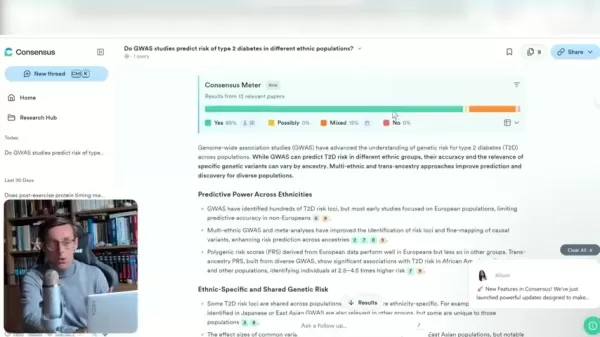
This AI tool enhances the accuracy of topic analysis. Simply enter a yes-or-no question into the Consensus AI search bar. At the top of the results, you will see a consensus meter indicating the proportion of studies that support or contradict the premise of your question.
Rather than conducting extensive research manually, the AI provides data that helps guide the direction of your paper.
Pinpointing Weaknesses of Previous Studies Using AI
AI can significantly accelerate the process of identifying limitations in previous studies, which often leads to strong new research topics. SciSpace is an excellent tool for this type of analysis.
How To Use SciSpace to Spot Weaknesses
To identify limitations using SciSpace, upload your relevant PDFs to the platform. Then, ask targeted questions such as:
- What notable weaknesses or drawbacks exist in the methodologies used in these papers?
- How many participants were involved in the studies?
- What was the sample size for each study?
- Did these studies utilize a control group?
- Was a placebo used in these studies?
- Did the studies adequately control for potential confounding variables?
Using AI in this way allows you to rapidly identify promising avenues for future research that could help validate or challenge existing theories.
Gaining New Research Insights From Other Fields
Researchers often concentrate deeply on a narrow field. However, exploring research from adjacent or unrelated disciplines can spark innovative ideas. For instance, if you are investigating non-native speakers in the teaching profession, there may be unexplored angles. Looking beyond your immediate field can provide substantial assistance.
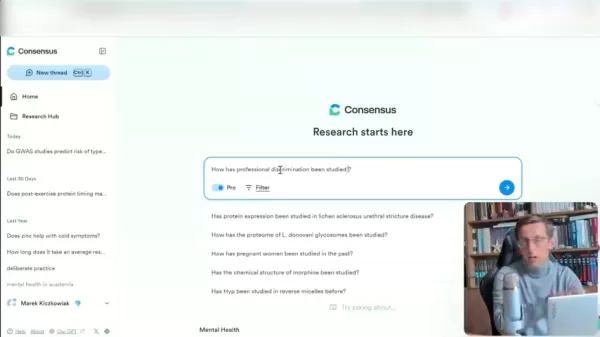
Consensus AI can be particularly useful here. Pose a question such as, “How has [an adjacent topic] been studied in [an adjacent field]?” This framework allows you to see how related concepts have been explored elsewhere, potentially revealing new research pathways.
Generating Novel Research Ideas to Study
Another effective strategy for developing groundbreaking research is to generate novel ideas. If you're seeking ways to accelerate idea generation, AI can provide significant support.
SciSpace is a valuable resource for this. Follow these steps to use the 'Find Topics' module:
- Locate the “Find Topics” feature.
- Enter your primary research topic.
- Review the suggestions generated by SciSpace.
The platform will propose specific topics to explore and help you refine your thesis for targeting Q1 journals. It provides various combinations of abstracts and results, enabling you to determine which Q1 journal would be the best fit for your research.
Finding the Right Keywords to Increase Visibility
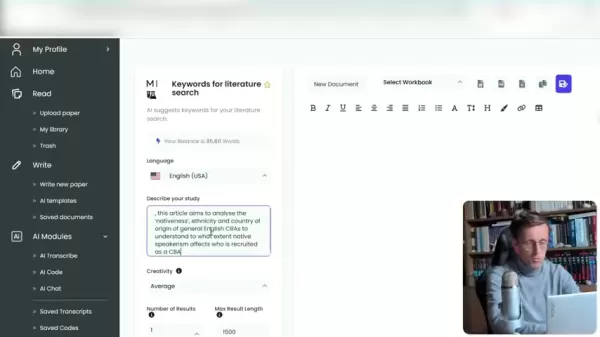
Selecting appropriate keywords is essential for enhancing the visibility of your research. When conducting literature searches, using the correct search terms is crucial for finding relevant papers. Avidnote is an excellent AI tool for keyword generation. The process is straightforward:
- Navigate to the AI template section.
- Select the option for literature search keywords.
- Provide a description of your study.
- Generate the keyword suggestions.
The AI will supply individual keywords as well as optimized search strings to help you locate the right sources efficiently. The capabilities of AI in this area continue to advance impressively.
Get an Effective Title to Capture Attention
Formulating a compelling title is often one of the most challenging aspects of paper writing. How can you create an attention-grabbing title amid the other demands of research? Paperpal offers AI assistance specifically for this task.
Crafting the right wording and optimizing for SEO are critical; otherwise, your paper may go unnoticed. To achieve this, consider asking the AI questions like:
- What is the significance of [my main topic]?
- Why is it important to study [my main topic]?
- How does [my main topic] impact society or the world at large?
- What is the relevance of [my main topic] within [my field]?
- Is there a significant problem associated with [my main topic]?
Paperpal analyzes the degree of consensus among researchers on these questions and presents the literature in a color-coded format for easy interpretation.
Reading Research Papers Faster than Ever
Once you have selected your papers and prepared your research questions, it's time to analyze the findings and begin writing. Here are some simple steps to accelerate this process using AI.
First, open Avidnote. Second, upload a paper and use the chat function to interact with it. The platform offers a range of helpful general prompts to aid your analysis.
As emphasized, AI can assist with numerous aspects of the research and writing process. However, it is crucial to remember that AI tools should not be used to conduct the research or write the text itself. They should serve as a starting point to enhance your own work.
Structure the Paper Effectively
Researchers can easily diverge into tangential directions while writing. Establishing a clear, logical structure is essential for maintaining focus. AI can be highly effective in helping to create this framework.
In Avidnote, go to AI templates, select 'Publish', and then 'Plan my study'. Input your research information to enable the AI to generate relevant content. It will produce valuable material to ensure your paper progresses in the right direction. Starting with a solid plan is key, and a robust AI tool can provide that foundation.
Proofread for a Q1 Journal
Ensuring your manuscript is polished and error-free is paramount for submission to a Q1 journal. This is another area where AI proves beneficial. Paperpal is an excellent AI tool that integrates as a plugin for Microsoft Word. It checks your text for spelling, grammatical tense, syntax, and other language issues, helping you prepare a clean and professional submission.
Top Tools for Academic Writing in 2025
Avidnote
This AI-powered software is designed to optimize the research and writing process for academics. Its core features include:
- Literature review assistance: Quickly summarize and analyze research papers.
- Reference management: Automatically format citations and bibliographies.
- Writing tools: Improve the quality and clarity of your writing.
- Team collaboration: Enable seamless teamwork on research projects.
SciSpace
This AI platform specializes in literature discovery and analysis. Key features include:
- Research gap identification: Discover underexplored areas within a field.
- Paper summarization: Quickly grasp the essential points of academic papers.
- Concept mapping: Visualize relationships between different research ideas.
- Citation analysis: Track the impact and influence of specific papers.
Consensus AI
This tool is tailored to analyze levels of agreement and contradiction in scientific research. Its main features are:
- Yes/No Question Answering: Determine if a specific idea is supported by existing research.
- Consensus Meter: Gauge the degree of scientific consensus on a particular topic.
Jenni AI
Jenni AI serves as a comprehensive writing assistant for academic authors. The platform analyzes your text and provides support with:
- Outlining
- Abstract Writing
- Finding Relevant Papers
Paperpal
Paperpal performs its functions swiftly and efficiently. We highly recommend this AI website for its core features:
- Offers text improvement suggestions and rewrites problematic sections.
- Provides feedback on language usage and style.
Using AI in Academic Research: Benefits and Challenges
Pros
Increased Efficiency: AI tools automate repetitive tasks, freeing up researchers' time for more complex work.
Improved Writing Quality: AI assists with grammar, style, and clarity, enhancing the overall quality of manuscripts.
Enhanced Research Discovery: AI helps identify relevant sources and research gaps more effectively than manual searches.
Ethical Considerations: Researchers are reminded to avoid plagiarism and critically evaluate all AI-generated content.
Cons
Risk of Plagiarism: Over-dependence on AI can inadvertently lead to plagiarism if content is not properly original and cited.
Bias and Accuracy: AI models are trained on existing data, which may contain inherent biases that can affect output.
Dependence: Heavy reliance on AI might impede the development of a researcher's own critical thinking and analytical skills.
Cost: Access to many advanced AI-powered tools often requires a paid subscription.
Use Cases
Using the right prompts
To maximize the effectiveness of tools like Jenni AI and Paperpal, consider using prompts such as:
- What is the most critical element for writing a title that will attract readers?
- Can you provide a strong example that illustrates [this concept]?
- What questions would a domain expert likely ask to evaluate this research?
FAQ
Are these tools intended to write the entire paper for me?
No, they are not. The ethical use of AI in academia is paramount. These tools are designed to assist and streamline the writing process, helping researchers refine their ideas and improve their work. They should not be used to generate complete manuscripts.
How important is to make your paper unique in research papers?
Extremely important. Originality is fundamental to making a meaningful contribution to your field and achieving recognition within the academic community.
Is the writing ability of the researcher still a factor in the end result?
Yes, absolutely. AI serves as an aid to enhance your output, but it cannot replace the researcher's own expertise, critical judgment, and writing skill. It is essential to use these tools responsibly and adhere to ethical guidelines.
Related Questions
What does Q1 mean?
In academic publishing, journals are categorized into quartiles based on their impact factor. Q1 denotes the top 25% of journals in a specific field, representing the most prestigious and influential publications. Publishing in a Q1 journal significantly boosts a researcher's profile and the reach of their work.
How does AI ensure ethical and plagiarism-free research?
AI tools can support ethical research by assisting with paraphrasing, citation management, and plagiarism checks. However, the researcher bears the ultimate responsibility for ensuring originality. This involves critically reviewing all AI-generated content, properly attributing sources, and conducting thorough plagiarism checks.
Are there any free tools out there to help improve efficiency?
While many advanced AI research and writing tools operate on a subscription model, their cost is often comparable to routine expenses. Researchers must evaluate the return on investment, but many find the productivity gains justify the cost. Consensus AI, SciSpace, Jenni AI, and Paperpal are all leading options in this category.
Related article
 DeepMind CEO Hassabis: I sleep six hours a day, usually feel energetic around 1 a.m.
Fortune recently featured an interview with Demis Hassabis, CEO of Google DeepMind, revealing his unconventional approach to rest and productivity. Hassabis disclosed that he sleeps very little, structuring his waking hours into two distinct work blo
OpenAI, Anthropic Vie for Market Share Despite Revenue Shortfalls
Despite recent reports suggesting OpenAI missed revenue targets, creating pressure on tech stocks this Tuesday, private AI lab investors remain resilient. Seasoned backers have confirmed they will not reduce investment despite negative media coverage
California AV Compliance: A New Era of Tickets, Geofences, and 1M Miles
Guident operates an AuveTech shuttle in South Florida, managing a four-mile route in West Palm Beach and a one-mile route in Boca Raton using its remote monitoring technology. | Credit: GuidentCalifornia is redefining the regulatory landscape for dri
Related Special Topic Recommendations
Music composition
DeepMind CEO Hassabis: I sleep six hours a day, usually feel energetic around 1 a.m.
Fortune recently featured an interview with Demis Hassabis, CEO of Google DeepMind, revealing his unconventional approach to rest and productivity. Hassabis disclosed that he sleeps very little, structuring his waking hours into two distinct work blo
OpenAI, Anthropic Vie for Market Share Despite Revenue Shortfalls
Despite recent reports suggesting OpenAI missed revenue targets, creating pressure on tech stocks this Tuesday, private AI lab investors remain resilient. Seasoned backers have confirmed they will not reduce investment despite negative media coverage
California AV Compliance: A New Era of Tickets, Geofences, and 1M Miles
Guident operates an AuveTech shuttle in South Florida, managing a four-mile route in West Palm Beach and a one-mile route in Boca Raton using its remote monitoring technology. | Credit: GuidentCalifornia is redefining the regulatory landscape for dri
Related Special Topic Recommendations
Music composition
 AI Stem Separation Tools for Remix Production, Sampling Prep, and Karaoke Masters
2026 Latest Best Top-rated AI Stem Separation Tools Curated for Remix Production, Sampling Prep, and Karaoke Masters. These powerful game-changing tools offer real-world tests to deliver precise audio isolation, boosting productivity significantly. XIX.AI provides a weekly updated free vs paid comparison guide to help you find the must-try solution that suits your needs. Explore now to unlock your AI edge.
 8 tools
 xix.ai
Data Analysis
AI SQL Copilots for Revenue Dashboards, Funnel Analysis, and Product Metrics
xix.ai
Data Analysis
AI SQL Copilots for Revenue Dashboards, Funnel Analysis, and Product Metrics
2026 Latest Best AI SQL Copilots Ranked Top-Rated! XIX.AI curates a powerful game-changing collection for weekly updated real-world tests. These must-try tools help you generate accurate revenue dashboards, analyze sales funnels, and track product metrics swiftly, boosting productivity massively. Explore now to Discover your perfect tool for data-driven decision making! 238 characters
9 tools
xix.ai
Music composition
Best AI Melody Writing Tools for Song Drafts
2026 Latest Best Top-Rated AI Melody Writing Tools for Song Drafts! XIX.AI has curated a highly powerful game-changing collection that goes through rigorous real-world tests to deliver the best writing experience. You can find detailed free vs paid comparisons, accurate rankings, and must-try options designed to help you create stunning song drafts effortlessly and boost your creative productivity significantly. Explore now to discover your perfect tool!
8 tools
xix.ai
chatbot
Best AI Conversation Trainer Tools for Interview Practice
2026 Latest Best Top-rated AI Conversation Trainer Tools for Interview Practice are here on XIX.AI! This curated collection features powerful, game-changing tools that go through rigorous real-world tests to deliver accurate feedback. You’ll find a free vs paid comparison and detailed rankings to help you choose the must-try option that boosts your confidence and skills. Explore now to Discover your perfect tool for interview success!
12 tools
xix.ai
Design & Art
Best AI Style Transfer Tools for Creative Experiments
2026 Latest Best Top-rated AI Style Transfer Tools for Creative Experiments! XIX.AI has curated a powerful, game-changing collection of must-try tools that deliver exceptional results through real-world tests and rigorous rankings. These top solutions help creatives boost productivity significantly by accelerating content creation and unlocking endless creative possibilities. Explore now to discover your perfect tool and start creating today!
9 tools
xix.ai
Comic Creation
Best AI Dialogue Bubble Tools for Visual Storytelling
2026 Latest Best Top-Rated AI Dialogue Bubble Tools for Visual Storytelling are here on XIX.AI! This curated collection features powerful, game-changing tools that help creators boost productivity and overcome creative bottlenecks. Get a free vs paid comparison, see real-world tests, and check the latest rankings to find the must-try solutions perfect for crafting engaging visual narratives. Explore now to discover your ideal tool!
10 tools
xix.ai

 Comments (1)
0/500
Comments (1)
0/500
![JasonHarris]()
This guide is super helpful! I've been struggling to keep up with all the new AI tools for my literature review. The section on automated citation analysis sounds like a game-changer. Can anyone recommend a specific tool for that? Also, a bit worried about over-reliance on AI for hypothesis generation... feels like we might miss out on serendipitous discoveries. 🤔
In today's fast-paced academic environment, researchers are constantly exploring methods to boost their productivity and efficiency. Artificial intelligence (AI) provides powerful capabilities that can transform the research workflow. From uncovering research gaps to drafting compelling manuscripts, AI offers substantial support for publishing in Q1 journals, as long as it is applied ethically. This guide delves into practical AI research strategies that help academics excel in their disciplines while maintaining high standards of ethical, original writing.
Key Points
While AI can dramatically speed up the research process, it must always be used with ethical considerations and responsibility.
Tools such as SciSpace and Consensus AI are invaluable for identifying research gaps and gathering related information.
A crucial factor for academic success involves locating high-quality sources during the literature review stage.
Overcome language barriers by using AI to instantly translate interviews and other research materials into English.
AI can streamline various tasks, including creating outlines, writing abstracts, and even recommending suitable journals for submission.
Rigorous verification and critical analysis remain essential to ensure the research is ethically sound and free of plagiarism.
Unlocking Academic Success: The Best AI Research Hacks
Finding Research Gaps Quickly With AI
Identifying research gaps is a critical initial step in any research project. Traditional approaches often require countless hours of manually reviewing numerous papers. AI-powered tools can significantly reduce this time investment, providing researchers with a distinct advantage.
One prominent software solution in this domain is SciSpace. It assists researchers in identifying gaps in the literature more efficiently and rapidly.
SciSpace: Your AI Research Assistant
SciSpace acts as an intelligent research assistant, allowing you to upload papers, interact with them through conversation, identify research gaps, and swiftly extract key insights. Begin by uploading relevant research papers to the platform. Once uploaded, you can pose specific questions to the AI, such as:
- "What future research directions or unanswered questions do these papers suggest?"
- "In which countries or regions were these studies conducted?"
- "Are there specific countries or regions where little to no research on this topic has been performed?"
- "Which populations or subjects have been the primary focus of previous research?"
- "What are the main topics these studies have concentrated on?"
- "Are there any closely related topics that these studies have not explored in depth?"
By inputting these questions into the SciSpace chat interface, the AI analyzes the documents to provide answers. This approach eliminates the need for manual reading of each paper, saving a considerable amount of time. Instead of poring over PDFs yourself, you can let SciSpace handle the reading.
This method allows you to leverage AI to quickly pinpoint under-explored research areas, paving the way for original and significant contributions. It enables researchers to save time and focus their efforts on other critical aspects of their work.
Finding Lack of Research Consensus With AI
In many academic disciplines, conflicting research findings can create uncertainty and reveal opportunities for further investigation. Identifying areas where experts disagree can be a fruitful source of new research topics. However, manually detecting such disagreements is often time-consuming. AI can efficiently assist with this task.
Consensus AI: Identify Disagreement
Consensus AI is specifically designed to help researchers quickly identify areas of disagreement within the scientific literature.
This AI tool enhances the accuracy of topic analysis. Simply enter a yes-or-no question into the Consensus AI search bar. At the top of the results, you will see a consensus meter indicating the proportion of studies that support or contradict the premise of your question.
Rather than conducting extensive research manually, the AI provides data that helps guide the direction of your paper.
Pinpointing Weaknesses of Previous Studies Using AI
AI can significantly accelerate the process of identifying limitations in previous studies, which often leads to strong new research topics. SciSpace is an excellent tool for this type of analysis.
How To Use SciSpace to Spot Weaknesses
To identify limitations using SciSpace, upload your relevant PDFs to the platform. Then, ask targeted questions such as:
- What notable weaknesses or drawbacks exist in the methodologies used in these papers?
- How many participants were involved in the studies?
- What was the sample size for each study?
- Did these studies utilize a control group?
- Was a placebo used in these studies?
- Did the studies adequately control for potential confounding variables?
Using AI in this way allows you to rapidly identify promising avenues for future research that could help validate or challenge existing theories.
Gaining New Research Insights From Other Fields
Researchers often concentrate deeply on a narrow field. However, exploring research from adjacent or unrelated disciplines can spark innovative ideas. For instance, if you are investigating non-native speakers in the teaching profession, there may be unexplored angles. Looking beyond your immediate field can provide substantial assistance.
Consensus AI can be particularly useful here. Pose a question such as, “How has [an adjacent topic] been studied in [an adjacent field]?” This framework allows you to see how related concepts have been explored elsewhere, potentially revealing new research pathways.
Generating Novel Research Ideas to Study
Another effective strategy for developing groundbreaking research is to generate novel ideas. If you're seeking ways to accelerate idea generation, AI can provide significant support.
SciSpace is a valuable resource for this. Follow these steps to use the 'Find Topics' module:
- Locate the “Find Topics” feature.
- Enter your primary research topic.
- Review the suggestions generated by SciSpace.
The platform will propose specific topics to explore and help you refine your thesis for targeting Q1 journals. It provides various combinations of abstracts and results, enabling you to determine which Q1 journal would be the best fit for your research.
Finding the Right Keywords to Increase Visibility
Selecting appropriate keywords is essential for enhancing the visibility of your research. When conducting literature searches, using the correct search terms is crucial for finding relevant papers. Avidnote is an excellent AI tool for keyword generation. The process is straightforward:
- Navigate to the AI template section.
- Select the option for literature search keywords.
- Provide a description of your study.
- Generate the keyword suggestions.
The AI will supply individual keywords as well as optimized search strings to help you locate the right sources efficiently. The capabilities of AI in this area continue to advance impressively.
Get an Effective Title to Capture Attention
Formulating a compelling title is often one of the most challenging aspects of paper writing. How can you create an attention-grabbing title amid the other demands of research? Paperpal offers AI assistance specifically for this task.
Crafting the right wording and optimizing for SEO are critical; otherwise, your paper may go unnoticed. To achieve this, consider asking the AI questions like:
- What is the significance of [my main topic]?
- Why is it important to study [my main topic]?
- How does [my main topic] impact society or the world at large?
- What is the relevance of [my main topic] within [my field]?
- Is there a significant problem associated with [my main topic]?
Paperpal analyzes the degree of consensus among researchers on these questions and presents the literature in a color-coded format for easy interpretation.
Reading Research Papers Faster than Ever
Once you have selected your papers and prepared your research questions, it's time to analyze the findings and begin writing. Here are some simple steps to accelerate this process using AI.
First, open Avidnote. Second, upload a paper and use the chat function to interact with it. The platform offers a range of helpful general prompts to aid your analysis.
As emphasized, AI can assist with numerous aspects of the research and writing process. However, it is crucial to remember that AI tools should not be used to conduct the research or write the text itself. They should serve as a starting point to enhance your own work.
Structure the Paper Effectively
Researchers can easily diverge into tangential directions while writing. Establishing a clear, logical structure is essential for maintaining focus. AI can be highly effective in helping to create this framework.
In Avidnote, go to AI templates, select 'Publish', and then 'Plan my study'. Input your research information to enable the AI to generate relevant content. It will produce valuable material to ensure your paper progresses in the right direction. Starting with a solid plan is key, and a robust AI tool can provide that foundation.
Proofread for a Q1 Journal
Ensuring your manuscript is polished and error-free is paramount for submission to a Q1 journal. This is another area where AI proves beneficial. Paperpal is an excellent AI tool that integrates as a plugin for Microsoft Word. It checks your text for spelling, grammatical tense, syntax, and other language issues, helping you prepare a clean and professional submission.
Top Tools for Academic Writing in 2025
Avidnote
This AI-powered software is designed to optimize the research and writing process for academics. Its core features include:
- Literature review assistance: Quickly summarize and analyze research papers.
- Reference management: Automatically format citations and bibliographies.
- Writing tools: Improve the quality and clarity of your writing.
- Team collaboration: Enable seamless teamwork on research projects.
SciSpace
This AI platform specializes in literature discovery and analysis. Key features include:
- Research gap identification: Discover underexplored areas within a field.
- Paper summarization: Quickly grasp the essential points of academic papers.
- Concept mapping: Visualize relationships between different research ideas.
- Citation analysis: Track the impact and influence of specific papers.
Consensus AI
This tool is tailored to analyze levels of agreement and contradiction in scientific research. Its main features are:
- Yes/No Question Answering: Determine if a specific idea is supported by existing research.
- Consensus Meter: Gauge the degree of scientific consensus on a particular topic.
Jenni AI
Jenni AI serves as a comprehensive writing assistant for academic authors. The platform analyzes your text and provides support with:
- Outlining
- Abstract Writing
- Finding Relevant Papers
Paperpal
Paperpal performs its functions swiftly and efficiently. We highly recommend this AI website for its core features:
- Offers text improvement suggestions and rewrites problematic sections.
- Provides feedback on language usage and style.
Using AI in Academic Research: Benefits and Challenges
Pros
Increased Efficiency: AI tools automate repetitive tasks, freeing up researchers' time for more complex work.
Improved Writing Quality: AI assists with grammar, style, and clarity, enhancing the overall quality of manuscripts.
Enhanced Research Discovery: AI helps identify relevant sources and research gaps more effectively than manual searches.
Ethical Considerations: Researchers are reminded to avoid plagiarism and critically evaluate all AI-generated content.
Cons
Risk of Plagiarism: Over-dependence on AI can inadvertently lead to plagiarism if content is not properly original and cited.
Bias and Accuracy: AI models are trained on existing data, which may contain inherent biases that can affect output.
Dependence: Heavy reliance on AI might impede the development of a researcher's own critical thinking and analytical skills.
Cost: Access to many advanced AI-powered tools often requires a paid subscription.
Use Cases
Using the right prompts
To maximize the effectiveness of tools like Jenni AI and Paperpal, consider using prompts such as:
- What is the most critical element for writing a title that will attract readers?
- Can you provide a strong example that illustrates [this concept]?
- What questions would a domain expert likely ask to evaluate this research?
FAQ
Are these tools intended to write the entire paper for me?
No, they are not. The ethical use of AI in academia is paramount. These tools are designed to assist and streamline the writing process, helping researchers refine their ideas and improve their work. They should not be used to generate complete manuscripts.
How important is to make your paper unique in research papers?
Extremely important. Originality is fundamental to making a meaningful contribution to your field and achieving recognition within the academic community.
Is the writing ability of the researcher still a factor in the end result?
Yes, absolutely. AI serves as an aid to enhance your output, but it cannot replace the researcher's own expertise, critical judgment, and writing skill. It is essential to use these tools responsibly and adhere to ethical guidelines.
Related Questions
What does Q1 mean?
In academic publishing, journals are categorized into quartiles based on their impact factor. Q1 denotes the top 25% of journals in a specific field, representing the most prestigious and influential publications. Publishing in a Q1 journal significantly boosts a researcher's profile and the reach of their work.
How does AI ensure ethical and plagiarism-free research?
AI tools can support ethical research by assisting with paraphrasing, citation management, and plagiarism checks. However, the researcher bears the ultimate responsibility for ensuring originality. This involves critically reviewing all AI-generated content, properly attributing sources, and conducting thorough plagiarism checks.
Are there any free tools out there to help improve efficiency?
While many advanced AI research and writing tools operate on a subscription model, their cost is often comparable to routine expenses. Researchers must evaluate the return on investment, but many find the productivity gains justify the cost. Consensus AI, SciSpace, Jenni AI, and Paperpal are all leading options in this category.








 DeepMind CEO Hassabis: I sleep six hours a day, usually feel energetic around 1 a.m.
Fortune recently featured an interview with Demis Hassabis, CEO of Google DeepMind, revealing his unconventional approach to rest and productivity. Hassabis disclosed that he sleeps very little, structuring his waking hours into two distinct work blo
DeepMind CEO Hassabis: I sleep six hours a day, usually feel energetic around 1 a.m.
Fortune recently featured an interview with Demis Hassabis, CEO of Google DeepMind, revealing his unconventional approach to rest and productivity. Hassabis disclosed that he sleeps very little, structuring his waking hours into two distinct work blo
 OpenAI, Anthropic Vie for Market Share Despite Revenue Shortfalls
Despite recent reports suggesting OpenAI missed revenue targets, creating pressure on tech stocks this Tuesday, private AI lab investors remain resilient. Seasoned backers have confirmed they will not reduce investment despite negative media coverage
California AV Compliance: A New Era of Tickets, Geofences, and 1M Miles
Guident operates an AuveTech shuttle in South Florida, managing a four-mile route in West Palm Beach and a one-mile route in Boca Raton using its remote monitoring technology. | Credit: GuidentCalifornia is redefining the regulatory landscape for dri
OpenAI, Anthropic Vie for Market Share Despite Revenue Shortfalls
Despite recent reports suggesting OpenAI missed revenue targets, creating pressure on tech stocks this Tuesday, private AI lab investors remain resilient. Seasoned backers have confirmed they will not reduce investment despite negative media coverage
California AV Compliance: A New Era of Tickets, Geofences, and 1M Miles
Guident operates an AuveTech shuttle in South Florida, managing a four-mile route in West Palm Beach and a one-mile route in Boca Raton using its remote monitoring technology. | Credit: GuidentCalifornia is redefining the regulatory landscape for dri

2026 Latest Best Top-rated AI Stem Separation Tools Curated for Remix Production, Sampling Prep, and Karaoke Masters. These powerful game-changing tools offer real-world tests to deliver precise audio isolation, boosting productivity significantly. XIX.AI provides a weekly updated free vs paid comparison guide to help you find the must-try solution that suits your needs. Explore now to unlock your AI edge.
8 tools
xix.ai

2026 Latest Best AI SQL Copilots Ranked Top-Rated! XIX.AI curates a powerful game-changing collection for weekly updated real-world tests. These must-try tools help you generate accurate revenue dashboards, analyze sales funnels, and track product metrics swiftly, boosting productivity massively. Explore now to Discover your perfect tool for data-driven decision making! 238 characters
9 tools
xix.ai

2026 Latest Best Top-Rated AI Melody Writing Tools for Song Drafts! XIX.AI has curated a highly powerful game-changing collection that goes through rigorous real-world tests to deliver the best writing experience. You can find detailed free vs paid comparisons, accurate rankings, and must-try options designed to help you create stunning song drafts effortlessly and boost your creative productivity significantly. Explore now to discover your perfect tool!
8 tools
xix.ai

2026 Latest Best Top-rated AI Conversation Trainer Tools for Interview Practice are here on XIX.AI! This curated collection features powerful, game-changing tools that go through rigorous real-world tests to deliver accurate feedback. You’ll find a free vs paid comparison and detailed rankings to help you choose the must-try option that boosts your confidence and skills. Explore now to Discover your perfect tool for interview success!
12 tools
xix.ai

2026 Latest Best Top-rated AI Style Transfer Tools for Creative Experiments! XIX.AI has curated a powerful, game-changing collection of must-try tools that deliver exceptional results through real-world tests and rigorous rankings. These top solutions help creatives boost productivity significantly by accelerating content creation and unlocking endless creative possibilities. Explore now to discover your perfect tool and start creating today!
9 tools
xix.ai

2026 Latest Best Top-Rated AI Dialogue Bubble Tools for Visual Storytelling are here on XIX.AI! This curated collection features powerful, game-changing tools that help creators boost productivity and overcome creative bottlenecks. Get a free vs paid comparison, see real-world tests, and check the latest rankings to find the must-try solutions perfect for crafting engaging visual narratives. Explore now to discover your ideal tool!
10 tools
xix.ai

This guide is super helpful! I've been struggling to keep up with all the new AI tools for my literature review. The section on automated citation analysis sounds like a game-changer. Can anyone recommend a specific tool for that? Also, a bit worried about over-reliance on AI for hypothesis generation... feels like we might miss out on serendipitous discoveries. 🤔












