Discover quality AI tools
Bring together the world’s leading artificial intelligence tools to help improve work efficiency

Articles published by GaryLewis
Meta launched its AI assistant Muse on iPad just one month after its iOS and Android debut, accelerating cross-platform expansion. Sensor Tower reports over 6.6 million installations, driven by text-based interaction and low hardware demands. The app integrates with productivity tools like Asana and Zoom, plus retailers including Walmart and Sephora for autonomous shopping. To combat bot bans, Meta partnered with industry players on October 6 to develop an open standard for AI identity authentication. This move underscores Meta's strategy to dominate the consumer and lightweight business AI agent ecosystem through broad connectivity and standardized protocols.
Meta launched its AI assistant Muse on iPad just one month after its iOS and Android debut, accelerating cross-platform expansion. Sensor Tower reports over 6.6 million installations, driven by text-based interaction and low hardware demands. The app integrates with productivity tools like Asana and Zoom, plus retailers including Walmart and Sephora for autonomous shopping. To combat bot bans, Meta partnered with industry players on October 6 to develop an open standard for AI identity authentication. This move underscores Meta's strategy to dominate the consumer and lightweight business AI agent ecosystem through broad connectivity and standardized protocols.

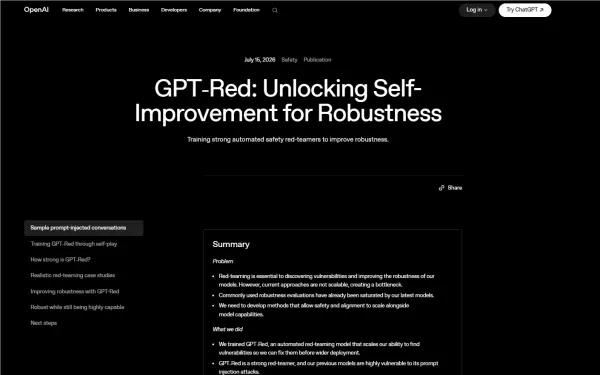
OpenAI released GPT-Red, an automated red team model using self-play reinforcement learning. It reduces direct prompt injection attack failure rates to 0.05%, achieving 84% attack success versus human 13%. Integrated into GPT-5.6Sol training, it enhances robustness without sacrificing general capabilities, demonstrating an AI safety flywheel effect.
OpenAI released GPT-Red, an automated red team model using self-play reinforcement learning. It reduces direct prompt injection attack failure rates to 0.05%, achieving 84% attack success versus human 13%. Integrated into GPT-5.6Sol training, it enhances robustness without sacrificing general capabilities, demonstrating an AI safety flywheel effect.
OpenAI launched a new 'Locked Use' feature for its Codex desktop agent on macOS. It allows the AI to perform tasks like UI operations and workflow automation even when the Mac is locked or the screen is off, moving beyond traditional 'screen-on' requirements. The feature, enabled via a specific plugin and user-granted permissions, aims to facilitate long-duration development tasks. It includes operational constraints and is initially unavailable in the EEA, UK, and Switzerland, raising new considerations for enterprise security and compliance.
OpenAI launched a new 'Locked Use' feature for its Codex desktop agent on macOS. It allows the AI to perform tasks like UI operations and workflow automation even when the Mac is locked or the screen is off, moving beyond traditional 'screen-on' requirements. The feature, enabled via a specific plugin and user-granted permissions, aims to facilitate long-duration development tasks. It includes operational constraints and is initially unavailable in the EEA, UK, and Switzerland, raising new considerations for enterprise security and compliance.
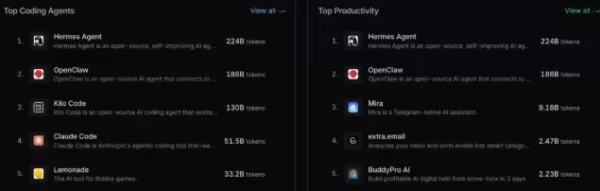
Hermes Agent surpasses OpenClaw to lead global token consumption. The Nous Research-developed AI agent framework features a self-evolving skill system, enabling automatic task analysis and skill reuse. It supports multiple secure execution environments and integrates with major messaging platforms, lowering the barrier for individual users.
Hermes Agent surpasses OpenClaw to lead global token consumption. The Nous Research-developed AI agent framework features a self-evolving skill system, enabling automatic task analysis and skill reuse. It supports multiple secure execution environments and integrates with major messaging platforms, lowering the barrier for individual users.
Meta is implementing an internal Model Capability Program installing tracking software on US employee computers to collect real-time mouse movements clicks and keyboard inputs The data aims to train AI models to handle complex office tasks autonomously as part of its vision for AI agents The practice raises privacy and legal compliance concerns particularly under regulations like GDPR
Meta is implementing an internal Model Capability Program installing tracking software on US employee computers to collect real-time mouse movements clicks and keyboard inputs The data aims to train AI models to handle complex office tasks autonomously as part of its vision for AI agents The practice raises privacy and legal compliance concerns particularly under regulations like GDPR
AI startup Periodic Labs emerges with $300M seed funding from top investors including Andreessen Horowitz and Nvidia. Founded by ex-Google Brain and OpenAI researchers, it aims to automate scientific discovery using AI-powered robotic labs, initially targeting superconductors and new materials while generating unprecedented real-world data for AI training. Competitors include smaller startups and academic projects pursuing similar AI-driven chemistry breakthroughs.
AI startup Periodic Labs emerges with $300M seed funding from top investors including Andreessen Horowitz and Nvidia. Founded by ex-Google Brain and OpenAI researchers, it aims to automate scientific discovery using AI-powered robotic labs, initially targeting superconductors and new materials while generating unprecedented real-world data for AI training. Competitors include smaller startups and academic projects pursuing similar AI-driven chemistry breakthroughs.