


 Home
HomeXiaomi MiMo-V2.5 Series API Gets Permanent Price Cut, Up to 99% Off
Amid the escalating AI model price wars, Xiaomi officially announced on May 27 that its MiMo large model would permanently reduce prices for the MiMo-V2.5 series API while simultaneously optimizing the billing system to further lower developers' calling costs through technological advancements.
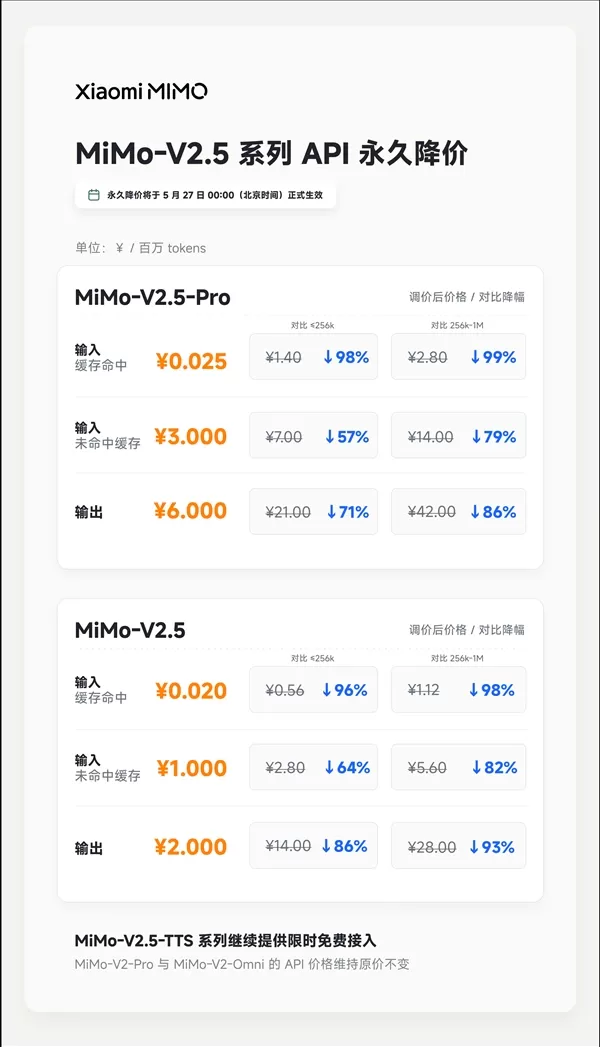
I. Significant API Price Cuts — Up to 99% Off
The price change took effect globally at 00:00 Beijing Time on May 27. It applies to the two core versions, MiMo-V2.5 and MiMo-V2.5Pro, and no longer differentiates based on context window length, simplifying the pricing structure for greater transparency.
Model VersionInput Cache Hit PriceMaximum DiscountOutput PriceMaximum DiscountMiMo-V2.5Pro0.025 yuan per million tokens, up to 99% off; output: 6 yuan per million tokens, up to 86% offMiMo-V2.50.02 yuan per million tokens, up to 98% off; output: 2 yuan per million tokens, up to 93% offII. Billing System Upgrade — More Value at No Extra Cost
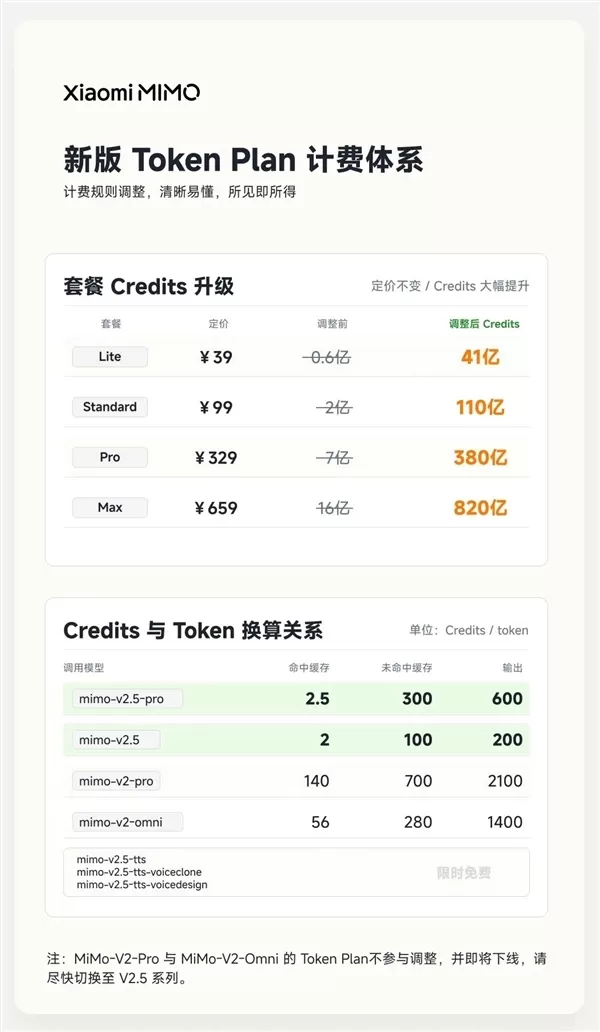
Beyond the direct API price cuts, Xiaomi has heavily optimized its Token Plan billing system:
Quadrupled Quota: Under the original pricing, the actual token usage quota has increased to 5 to 8 times the previous amount.
Simplified Rules: The introduction of Credits replaces the previous complex billing methods, making token consumption and cost calculation more intuitive for developers.
III. Technical Foundation — How Can It Keep Lowering Prices?
Xiaomi's official statement attributes these deep price cuts to technical breakthroughs in its underlying inference system architecture:
SWA Inference Optimization: By leveraging SGLang HiCache with full support for SWA (Sliding Window Attention Mechanism), the data transfer among GPU memory, CPU memory, and SSD has been reduced to one-seventh of the previous volume.
Improved Cache Efficiency: The number of cacheable tokens has increased nearly fivefold compared to the earlier optimized version, boosting cache hit rates and dramatically lowering per-inference cost.
Cluster Throughput Optimization: With the introduction of expert parallel (MoE) and input length bucketing strategies, the cluster's input throughput has seen a qualitative leap, maintaining high service quality while steadily reducing cost per token.
Xiaomi's move is seen as a proactive response to the current intense competition in large model commercialization. As price barriers continue to drop, the MiMo series' cost-effectiveness will become even more pronounced, accelerating the deep integration of AI capabilities across vertical industries and developer workflows.
Related article
 Stripe to Acquire OpenRouter as AI Model Routing Gains Momentum
Stripe has agreed to acquire OpenRouter, an AI model-routing platform that gives developers access to hundreds of models through a single interface. The deal adds model selection and routing to Stripe’s existing work around AI usage and token-based b
Former OpenAI Researcher Barrett Zoph Returns to Google to Support Gemini Development
Barret Zoph, who previously abruptly left and joined OpenAI due to a disagreement with Thinking Machines Lab CEO Miriam Mularati, has once again changed employers. Alphabet's Google announced that Zoph will return as Vice President of Research, bring
How Recursive Intelligence Raised $335M at $4B Valuation in 4 Months
The co-founders of startup Ricursive Intelligence seemed destined to be co-founders.Anna Goldie, CEO, and Azalia Mirhoseini, CTO, are so well-known in the AI community that they were among those AI engineers who “got those weird emails from Zuckerber
Related Special Topic Recommendations
Design & Art
Stripe to Acquire OpenRouter as AI Model Routing Gains Momentum
Stripe has agreed to acquire OpenRouter, an AI model-routing platform that gives developers access to hundreds of models through a single interface. The deal adds model selection and routing to Stripe’s existing work around AI usage and token-based b
Former OpenAI Researcher Barrett Zoph Returns to Google to Support Gemini Development
Barret Zoph, who previously abruptly left and joined OpenAI due to a disagreement with Thinking Machines Lab CEO Miriam Mularati, has once again changed employers. Alphabet's Google announced that Zoph will return as Vice President of Research, bring
How Recursive Intelligence Raised $335M at $4B Valuation in 4 Months
The co-founders of startup Ricursive Intelligence seemed destined to be co-founders.Anna Goldie, CEO, and Azalia Mirhoseini, CTO, are so well-known in the AI community that they were among those AI engineers who “got those weird emails from Zuckerber
Related Special Topic Recommendations
Design & Art
 Top AI Illustration Tools: Create Editorial Scenes and Cover Art Faster
2026 Latest Top-rated AI Illustration Tools: Our curated list features the best powerfully designed tools for creating stunning editorial scenes and eye-catching cover art quickly. Each option has gone through rigorous real-world tests, offering a free vs paid comparison to help you find the perfect match for your workflow. Try these must-try solutions today to unlock your AI edge and boost your creative productivity. Explore now at XIX.AI.
 10 tools
 xix.ai
Education and Learning
Top AI Tutors for Exam Prep: Practice Math, Science, and English
xix.ai
Education and Learning
Top AI Tutors for Exam Prep: Practice Math, Science, and English
2026 Latest Top-Rated Best AI Tutors for Exam Prep are here on XIX.AI! Our curated list features powerful game-changing tools that offer free vs paid comparison, real-world tests, and weekly updated rankings. They help boost your writing efficiency, simplify complex topic learning, and unlock your academic potential. Explore now to Discover your perfect exam prep tool and Start creating today to Unlock your AI edge!
10 tools
xix.ai
Finance
AI Budget Planning Tools for Personal Money Management
2026 Latest Best Top-Rated AI Budget Planning Tools for Personal Money Management are here on XIX.AI! This curated collection features powerful, game-changing solutions that help you conduct real-world tests, understand spending habits, and create personalized plans to boost productivity. Enjoy a free vs paid comparison along with detailed rankings. Must-try tools designed to simplify money management and unlock your AI edge. Explore now!
11 tools
xix.ai
Health & Wellness
AI Sleep Tracking Assistants: Improve Recovery with Better Bedtime Habits
2026 Latest Best Top-Rated AI Sleep Tracking Assistants curated for ultimate recovery. This fully updated weekly guide features powerful tools that deliver real-world tests, free vs paid comparison, and detailed rankings to help you find the must-try solution that boosts sleep quality and supports better bedtime habits. Explore now at XIX.AI to Unlock your AI edge.
10 tools
xix.ai
Data Analysis
AI SQL Copilots for Product and Revenue Analytics
2026 Latest Best Top-Rated AI SQL Copilots for Product and Revenue Analytics! XIX.AI has curated a powerful, game-changing collection of must-try tools that undergo real-world tests through weekly updated rankings. These tools help users boost productivity significantly by accelerating data analysis, streamlining complex queries, and generating accurate insights to drive smarter business decisions. Explore now to Discover your perfect tool for unlocking your AI edge!
14 tools
xix.ai
Education and Learning
Best AI Homework Helpers That Teach: Learn Concepts, Not Just Answers
2026 Latest Best Top-Rated AI Homework Helpers That Teach Core Concepts Not Just Answers Powerful Tools for Students Must-Try Curated List Weekly Updated Free vs Paid Comparison Real-World Tests Accurate Rankings to Help You Unlock Your Full Learning Potential Explore now to Discover your perfect tool for smarter studying.
10 tools
xix.ai

 Comments (0)
0/500
Comments (0)
0/500
Amid the escalating AI model price wars, Xiaomi officially announced on May 27 that its MiMo large model would permanently reduce prices for the MiMo-V2.5 series API while simultaneously optimizing the billing system to further lower developers' calling costs through technological advancements.
I. Significant API Price Cuts — Up to 99% Off
The price change took effect globally at 00:00 Beijing Time on May 27. It applies to the two core versions, MiMo-V2.5 and MiMo-V2.5Pro, and no longer differentiates based on context window length, simplifying the pricing structure for greater transparency.
Model VersionInput Cache Hit PriceMaximum DiscountOutput PriceMaximum DiscountMiMo-V2.5Pro0.025 yuan per million tokens, up to 99% off; output: 6 yuan per million tokens, up to 86% offMiMo-V2.50.02 yuan per million tokens, up to 98% off; output: 2 yuan per million tokens, up to 93% offII. Billing System Upgrade — More Value at No Extra Cost
Beyond the direct API price cuts, Xiaomi has heavily optimized its Token Plan billing system:
Quadrupled Quota: Under the original pricing, the actual token usage quota has increased to 5 to 8 times the previous amount.
Simplified Rules: The introduction of Credits replaces the previous complex billing methods, making token consumption and cost calculation more intuitive for developers.
III. Technical Foundation — How Can It Keep Lowering Prices?
Xiaomi's official statement attributes these deep price cuts to technical breakthroughs in its underlying inference system architecture:
SWA Inference Optimization: By leveraging SGLang HiCache with full support for SWA (Sliding Window Attention Mechanism), the data transfer among GPU memory, CPU memory, and SSD has been reduced to one-seventh of the previous volume.
Improved Cache Efficiency: The number of cacheable tokens has increased nearly fivefold compared to the earlier optimized version, boosting cache hit rates and dramatically lowering per-inference cost.
Cluster Throughput Optimization: With the introduction of expert parallel (MoE) and input length bucketing strategies, the cluster's input throughput has seen a qualitative leap, maintaining high service quality while steadily reducing cost per token.
Xiaomi's move is seen as a proactive response to the current intense competition in large model commercialization. As price barriers continue to drop, the MiMo series' cost-effectiveness will become even more pronounced, accelerating the deep integration of AI capabilities across vertical industries and developer workflows.








 Stripe to Acquire OpenRouter as AI Model Routing Gains Momentum
Stripe has agreed to acquire OpenRouter, an AI model-routing platform that gives developers access to hundreds of models through a single interface. The deal adds model selection and routing to Stripe’s existing work around AI usage and token-based b
Stripe to Acquire OpenRouter as AI Model Routing Gains Momentum
Stripe has agreed to acquire OpenRouter, an AI model-routing platform that gives developers access to hundreds of models through a single interface. The deal adds model selection and routing to Stripe’s existing work around AI usage and token-based b
 Former OpenAI Researcher Barrett Zoph Returns to Google to Support Gemini Development
Barret Zoph, who previously abruptly left and joined OpenAI due to a disagreement with Thinking Machines Lab CEO Miriam Mularati, has once again changed employers. Alphabet's Google announced that Zoph will return as Vice President of Research, bring
Former OpenAI Researcher Barrett Zoph Returns to Google to Support Gemini Development
Barret Zoph, who previously abruptly left and joined OpenAI due to a disagreement with Thinking Machines Lab CEO Miriam Mularati, has once again changed employers. Alphabet's Google announced that Zoph will return as Vice President of Research, bring
 How Recursive Intelligence Raised $335M at $4B Valuation in 4 Months
The co-founders of startup Ricursive Intelligence seemed destined to be co-founders.Anna Goldie, CEO, and Azalia Mirhoseini, CTO, are so well-known in the AI community that they were among those AI engineers who “got those weird emails from Zuckerber
How Recursive Intelligence Raised $335M at $4B Valuation in 4 Months
The co-founders of startup Ricursive Intelligence seemed destined to be co-founders.Anna Goldie, CEO, and Azalia Mirhoseini, CTO, are so well-known in the AI community that they were among those AI engineers who “got those weird emails from Zuckerber

2026 Latest Top-rated AI Illustration Tools: Our curated list features the best powerfully designed tools for creating stunning editorial scenes and eye-catching cover art quickly. Each option has gone through rigorous real-world tests, offering a free vs paid comparison to help you find the perfect match for your workflow. Try these must-try solutions today to unlock your AI edge and boost your creative productivity. Explore now at XIX.AI.
10 tools
xix.ai

2026 Latest Top-Rated Best AI Tutors for Exam Prep are here on XIX.AI! Our curated list features powerful game-changing tools that offer free vs paid comparison, real-world tests, and weekly updated rankings. They help boost your writing efficiency, simplify complex topic learning, and unlock your academic potential. Explore now to Discover your perfect exam prep tool and Start creating today to Unlock your AI edge!
10 tools
xix.ai

2026 Latest Best Top-Rated AI Budget Planning Tools for Personal Money Management are here on XIX.AI! This curated collection features powerful, game-changing solutions that help you conduct real-world tests, understand spending habits, and create personalized plans to boost productivity. Enjoy a free vs paid comparison along with detailed rankings. Must-try tools designed to simplify money management and unlock your AI edge. Explore now!
11 tools
xix.ai

2026 Latest Best Top-Rated AI Sleep Tracking Assistants curated for ultimate recovery. This fully updated weekly guide features powerful tools that deliver real-world tests, free vs paid comparison, and detailed rankings to help you find the must-try solution that boosts sleep quality and supports better bedtime habits. Explore now at XIX.AI to Unlock your AI edge.
10 tools
xix.ai

2026 Latest Best Top-Rated AI SQL Copilots for Product and Revenue Analytics! XIX.AI has curated a powerful, game-changing collection of must-try tools that undergo real-world tests through weekly updated rankings. These tools help users boost productivity significantly by accelerating data analysis, streamlining complex queries, and generating accurate insights to drive smarter business decisions. Explore now to Discover your perfect tool for unlocking your AI edge!
14 tools
xix.ai

2026 Latest Best Top-Rated AI Homework Helpers That Teach Core Concepts Not Just Answers Powerful Tools for Students Must-Try Curated List Weekly Updated Free vs Paid Comparison Real-World Tests Accurate Rankings to Help You Unlock Your Full Learning Potential Explore now to Discover your perfect tool for smarter studying.
10 tools
xix.ai












