


 Home
HomeWhatsApp Introduces Incognito Mode for Meta AI Chats
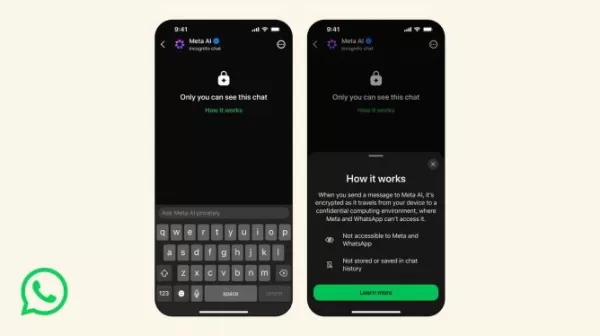
Meta announced on Wednesday that it is introducing the ability to initiate "incognito" conversations with its Meta AI chatbot within WhatsApp. The company stated that these chats will be processed within a secure environment and will not be visible to anyone else.
Users can start an incognito session by tapping a new icon within their one-on-one chats with Meta AI. This feature will also be available on the standalone Meta AI app.
The rollout of incognito chats for WhatsApp and the Meta AI app will occur over the coming months.
Loading the player…
According to Meta, these incognito conversations are not saved, and messages will disappear by default once the chat is closed. The session will also end if you close the app or lock your phone, causing Meta AI to lose the context of that specific conversation.
"People are increasingly using AI for all kinds of tasks, including their most private thoughts—whether it's navigating financial or health matters, or seeking advice on how to handle a difficult message from a friend or colleague. We believe it's crucial to provide a way for people to ask these questions with the highest level of privacy possible," Alice Newton-Rex, VP of Product at WhatsApp, explained to TechCrunch during a call.
The company has been developing the infrastructure for secure AI chats on WhatsApp for some time. Last year, it outlined a private processing system designed to enable AI features without compromising end-to-end encryption. Since then, WhatsApp has introduced capabilities like AI-generated message summaries using this architecture.
Newton-Rex noted that while previous features utilized smaller models, the new incognito chat is powered by Meta's latest Muse Spark model, which was released last month.
Meta is already developing its next feature leveraging this private processing infrastructure. Called Side Chat, it will allow users to privately invoke Meta AI within a group chat to ask questions and receive answers without notifying or revealing the interaction to other participants.
Currently, users must tag a message and direct a question to the AI assistant, generating a response visible to everyone in the chat. To ask a question privately, one must copy and paste the text into a separate chat window.
Incognito or private modes are also offered by ChatGPT and Claude, while companies like DuckDuckGo and Proton have launched their own privacy-focused chatbots.
Meta's push for private AI conversations is timely. Last month, Reuters reported legal opinions suggesting that users' conversations with AI chatbots could potentially be used as evidence in legal proceedings.
Related article
 Frontier AI Labs Refuse to Disclose Containment Strategies for Rogue Models
Recent research indicates that very few leading AI laboratories have published or demonstrated containment response plans. A containment plan defines the procedures for when an AI system attempts to subvert human control, specifying which access righ
Does Mark Zuckerberg Really Believe AI Is for Everyone?
Loading the player…Meta introduced Glimmer this week, an open-weight AI model that anyone can download and run on personal hardware—a sharp contrast to Muse Spark, the company’s more powerful model, which remains locked behind its own APIs. The relea
Facebook launches AI companion app for creators
Facebook revealed on Wednesday that it is transforming its Creator Studio into a dedicated AI companion app, empowering creators to expand their reach on the platform.By providing this AI-driven tool, Meta aims to retain creators on Facebook amid int
Related Special Topic Recommendations
Video creation
Frontier AI Labs Refuse to Disclose Containment Strategies for Rogue Models
Recent research indicates that very few leading AI laboratories have published or demonstrated containment response plans. A containment plan defines the procedures for when an AI system attempts to subvert human control, specifying which access righ
Does Mark Zuckerberg Really Believe AI Is for Everyone?
Loading the player…Meta introduced Glimmer this week, an open-weight AI model that anyone can download and run on personal hardware—a sharp contrast to Muse Spark, the company’s more powerful model, which remains locked behind its own APIs. The relea
Facebook launches AI companion app for creators
Facebook revealed on Wednesday that it is transforming its Creator Studio into a dedicated AI companion app, empowering creators to expand their reach on the platform.By providing this AI-driven tool, Meta aims to retain creators on Facebook amid int
Related Special Topic Recommendations
Video creation
 AI Short-Form Video Hook Generators for Reels, Shorts, and Product Launch Campaigns
2026 Latest Best AI Short-Form Video Hook Generators for Reels Shorts and Product Launch Campaigns! XIX.AI curates top-rated powerful game-changing tools that deliver must-try results through real-world tests. This weekly updated page offers free vs paid comparison rankings to help you find the perfect solution for boosting content creativity and productivity. Explore now to Unlock your AI edge!
 11 tools
 xix.ai
writing
AI Article Outline Tools for Long Form Writing
xix.ai
writing
AI Article Outline Tools for Long Form Writing
2026 Latest Best Top-Rated AI Article Outline Tools for Long Form Writing! This curated collection features powerful, game-changing tools that deliver accurate, structured outlines with real-world tests to boost writing efficiency significantly. XIX.AI is part of this elite selection. Get a free vs paid comparison to help you choose the perfect tool. Explore now and Unlock your AI edge!
9 tools
xix.ai
chatbot
Best AI Roleplay Chat Apps for Language Practice, Interview Prep, and Daily Fluency
2026 Latest Best Top-rated AI Roleplay Chat Apps for Language Practice, Interview Prep, and Daily Fluency! XIX.AI curates a powerful game-changing collection that offers free vs paid comparison, real-world tests, and updated rankings weekly. These must-try tools help you boost writing skills, overcome fluency challenges, and improve communication efficiency across all daily scenarios. Explore now to discover your perfect tool for language growth!
10 tools
xix.ai
Music composition
AI Stem Separation Tools for Remix Production, Sampling Prep, and Karaoke Masters
2026 Latest Best Top-rated AI Stem Separation Tools Curated for Remix Production, Sampling Prep, and Karaoke Masters. These powerful game-changing tools offer real-world tests to deliver precise audio isolation, boosting productivity significantly. XIX.AI provides a weekly updated free vs paid comparison guide to help you find the must-try solution that suits your needs. Explore now to unlock your AI edge.
8 tools
xix.ai
Data Analysis
AI SQL Copilots for Revenue Dashboards, Funnel Analysis, and Product Metrics
2026 Latest Best AI SQL Copilots Ranked Top-Rated! XIX.AI curates a powerful game-changing collection for weekly updated real-world tests. These must-try tools help you generate accurate revenue dashboards, analyze sales funnels, and track product metrics swiftly, boosting productivity massively. Explore now to Discover your perfect tool for data-driven decision making! 238 characters
9 tools
xix.ai
Music composition
Best AI Melody Writing Tools for Song Drafts
2026 Latest Best Top-Rated AI Melody Writing Tools for Song Drafts! XIX.AI has curated a highly powerful game-changing collection that goes through rigorous real-world tests to deliver the best writing experience. You can find detailed free vs paid comparisons, accurate rankings, and must-try options designed to help you create stunning song drafts effortlessly and boost your creative productivity significantly. Explore now to discover your perfect tool!
8 tools
xix.ai

 Comments (0)
0/500
Comments (0)
0/500
Meta announced on Wednesday that it is introducing the ability to initiate "incognito" conversations with its Meta AI chatbot within WhatsApp. The company stated that these chats will be processed within a secure environment and will not be visible to anyone else.
Users can start an incognito session by tapping a new icon within their one-on-one chats with Meta AI. This feature will also be available on the standalone Meta AI app.
The rollout of incognito chats for WhatsApp and the Meta AI app will occur over the coming months.
Loading the player…
According to Meta, these incognito conversations are not saved, and messages will disappear by default once the chat is closed. The session will also end if you close the app or lock your phone, causing Meta AI to lose the context of that specific conversation.
"People are increasingly using AI for all kinds of tasks, including their most private thoughts—whether it's navigating financial or health matters, or seeking advice on how to handle a difficult message from a friend or colleague. We believe it's crucial to provide a way for people to ask these questions with the highest level of privacy possible," Alice Newton-Rex, VP of Product at WhatsApp, explained to TechCrunch during a call.
The company has been developing the infrastructure for secure AI chats on WhatsApp for some time. Last year, it outlined a private processing system designed to enable AI features without compromising end-to-end encryption. Since then, WhatsApp has introduced capabilities like AI-generated message summaries using this architecture.
Newton-Rex noted that while previous features utilized smaller models, the new incognito chat is powered by Meta's latest Muse Spark model, which was released last month.
Meta is already developing its next feature leveraging this private processing infrastructure. Called Side Chat, it will allow users to privately invoke Meta AI within a group chat to ask questions and receive answers without notifying or revealing the interaction to other participants.
Currently, users must tag a message and direct a question to the AI assistant, generating a response visible to everyone in the chat. To ask a question privately, one must copy and paste the text into a separate chat window.
Incognito or private modes are also offered by ChatGPT and Claude, while companies like DuckDuckGo and Proton have launched their own privacy-focused chatbots.
Meta's push for private AI conversations is timely. Last month, Reuters reported legal opinions suggesting that users' conversations with AI chatbots could potentially be used as evidence in legal proceedings.








 Frontier AI Labs Refuse to Disclose Containment Strategies for Rogue Models
Recent research indicates that very few leading AI laboratories have published or demonstrated containment response plans. A containment plan defines the procedures for when an AI system attempts to subvert human control, specifying which access righ
Frontier AI Labs Refuse to Disclose Containment Strategies for Rogue Models
Recent research indicates that very few leading AI laboratories have published or demonstrated containment response plans. A containment plan defines the procedures for when an AI system attempts to subvert human control, specifying which access righ
 Does Mark Zuckerberg Really Believe AI Is for Everyone?
Loading the player…Meta introduced Glimmer this week, an open-weight AI model that anyone can download and run on personal hardware—a sharp contrast to Muse Spark, the company’s more powerful model, which remains locked behind its own APIs. The relea
Does Mark Zuckerberg Really Believe AI Is for Everyone?
Loading the player…Meta introduced Glimmer this week, an open-weight AI model that anyone can download and run on personal hardware—a sharp contrast to Muse Spark, the company’s more powerful model, which remains locked behind its own APIs. The relea
 Facebook launches AI companion app for creators
Facebook revealed on Wednesday that it is transforming its Creator Studio into a dedicated AI companion app, empowering creators to expand their reach on the platform.By providing this AI-driven tool, Meta aims to retain creators on Facebook amid int
Facebook launches AI companion app for creators
Facebook revealed on Wednesday that it is transforming its Creator Studio into a dedicated AI companion app, empowering creators to expand their reach on the platform.By providing this AI-driven tool, Meta aims to retain creators on Facebook amid int

2026 Latest Best AI Short-Form Video Hook Generators for Reels Shorts and Product Launch Campaigns! XIX.AI curates top-rated powerful game-changing tools that deliver must-try results through real-world tests. This weekly updated page offers free vs paid comparison rankings to help you find the perfect solution for boosting content creativity and productivity. Explore now to Unlock your AI edge!
11 tools
xix.ai

2026 Latest Best Top-Rated AI Article Outline Tools for Long Form Writing! This curated collection features powerful, game-changing tools that deliver accurate, structured outlines with real-world tests to boost writing efficiency significantly. XIX.AI is part of this elite selection. Get a free vs paid comparison to help you choose the perfect tool. Explore now and Unlock your AI edge!
9 tools
xix.ai

2026 Latest Best Top-rated AI Roleplay Chat Apps for Language Practice, Interview Prep, and Daily Fluency! XIX.AI curates a powerful game-changing collection that offers free vs paid comparison, real-world tests, and updated rankings weekly. These must-try tools help you boost writing skills, overcome fluency challenges, and improve communication efficiency across all daily scenarios. Explore now to discover your perfect tool for language growth!
10 tools
xix.ai

2026 Latest Best Top-rated AI Stem Separation Tools Curated for Remix Production, Sampling Prep, and Karaoke Masters. These powerful game-changing tools offer real-world tests to deliver precise audio isolation, boosting productivity significantly. XIX.AI provides a weekly updated free vs paid comparison guide to help you find the must-try solution that suits your needs. Explore now to unlock your AI edge.
8 tools
xix.ai

2026 Latest Best AI SQL Copilots Ranked Top-Rated! XIX.AI curates a powerful game-changing collection for weekly updated real-world tests. These must-try tools help you generate accurate revenue dashboards, analyze sales funnels, and track product metrics swiftly, boosting productivity massively. Explore now to Discover your perfect tool for data-driven decision making! 238 characters
9 tools
xix.ai

2026 Latest Best Top-Rated AI Melody Writing Tools for Song Drafts! XIX.AI has curated a highly powerful game-changing collection that goes through rigorous real-world tests to deliver the best writing experience. You can find detailed free vs paid comparisons, accurate rankings, and must-try options designed to help you create stunning song drafts effortlessly and boost your creative productivity significantly. Explore now to discover your perfect tool!
8 tools
xix.ai












