


 Home
WeChat Unveils Youth AI Insight Report: 50B Tokens Consumed, Generative AI Now Teaching Standard
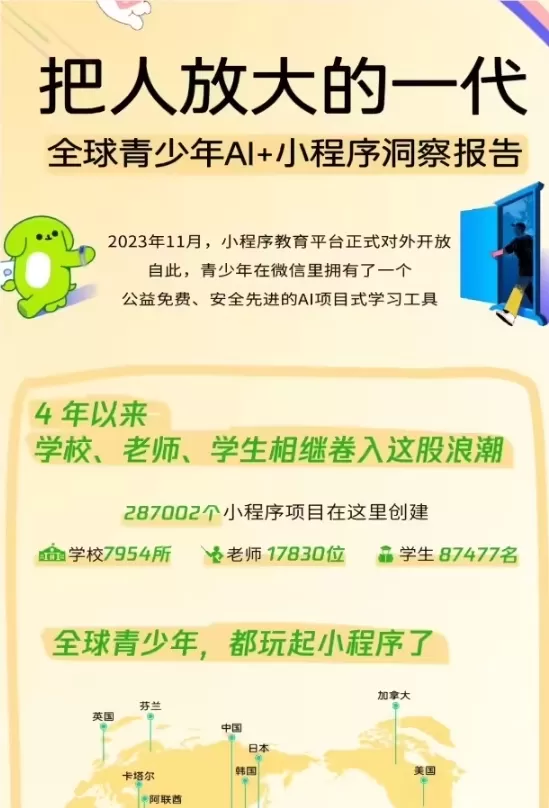
WeChat has released the "Global Youth AI+ Mini Program Insight Report," highlighting the achievements of its mini program education platform after four years of openness. The report reveals that teachers and students now consume over 50 billion tokens annually in AI creation, equivalent to 3.75 million in-depth human-AI conversations.
The platform has attracted nearly 80,000 students and 17,000 teachers worldwide, with more than 280,000 mini program projects created. This reflects the deep integration of generative AI into youth programming education, serving as a core tool for exploring cutting-edge technologies.
Breaking geographical barriers through collaborative innovation, campus projects go global
Using an integrated AI teaching platform for "teaching, learning, and application," young people have developed creative applications, some of which involve cross-border collaboration. For example, students from Chongqing and Singapore jointly created a social mini program, successfully breaking down geographical barriers and promoting campus exchanges across different cultural backgrounds.
This cross-regional collaboration model not only enhances students' ability to solve real-world problems but also turns the mini program ecosystem into a bridge connecting teenagers around the world. Over the past four years, various competitions have generated more than 7,000 outstanding projects covering fields like lifestyle services and cultural dissemination.
The Innovation Challenge final approaches, Shenzhen witnesses the power of youth
With the growing popularity of AI technology, the fourth Global Mini Program Innovation Challenge is reaching its climax. The final is scheduled for May 16-17 in Shenzhen, where outstanding young developers from around the world will compete, showcasing digital solutions built with AI technology.
WeChat has stated that it will continue to open more AI capabilities for educational scenarios, lowering the programming barrier. By hosting innovation competitions, WeChat aims to identify more promising "tech youth" and provide additional innovative talent for the global AI industry.
Related article
 Anthropic admits its AI models breached three firms during security tests
Anthropic announced Thursday that an internal probe revealed three separate incidents where its AI model, Claude, breached the systems of three organizations during cybersecurity assessments. This disclosure follows closely on the heels of OpenAI’s r
Meitu Unveils RoboNeo AI Agent Powered by Alibaba’s HappyHorse Model, Marking a Leap in Video Creation
On April 28, RoboNeo, an AI agent by Meitu Company, announced the integration of HappyHorse, a multimodal video generation model from Alibaba's ATH Innovation Division. Leveraging Seedance 2.0, RoboNeo has significantly enhanced product video creatio
What are the best free AI talking avatars for YouTube Shorts
Build a Python Random Name Generator for Unique ResultsOverviewBuilding the Random Name GeneratorImporting the Random ModuleDefining First and Last Name ListsSelecting Random First and Last NamesDisplaying the Generated NameImplementing a Retry Optio
Related Special Topic Recommendations
Design & Art
 Top AI Illustration Tools: Create Editorial Scenes and Cover Art Faster
2026 Latest Top-rated AI Illustration Tools: Our curated list features the best powerfully designed tools for creating stunning editorial scenes and eye-catching cover art quickly. Each option has gone through rigorous real-world tests, offering a free vs paid comparison to help you find the perfect match for your workflow. Try these must-try solutions today to unlock your AI edge and boost your creative productivity. Explore now at XIX.AI.
 10 tools
 xix.ai
Education and Learning
Top AI Tutors for Exam Prep: Practice Math, Science, and English
2026 Latest Top-Rated Best AI Tutors for Exam Prep are here on XIX.AI! Our curated list features powerful game-changing tools that offer free vs paid comparison, real-world tests, and weekly updated rankings. They help boost your writing efficiency, simplify complex topic learning, and unlock your academic potential. Explore now to Discover your perfect exam prep tool and Start creating today to Unlock your AI edge!
10 tools
xix.ai
Finance
AI Budget Planning Tools for Personal Money Management
2026 Latest Best Top-Rated AI Budget Planning Tools for Personal Money Management are here on XIX.AI! This curated collection features powerful, game-changing solutions that help you conduct real-world tests, understand spending habits, and create personalized plans to boost productivity. Enjoy a free vs paid comparison along with detailed rankings. Must-try tools designed to simplify money management and unlock your AI edge. Explore now!
11 tools
xix.ai
Health & Wellness
AI Sleep Tracking Assistants: Improve Recovery with Better Bedtime Habits
2026 Latest Best Top-Rated AI Sleep Tracking Assistants curated for ultimate recovery. This fully updated weekly guide features powerful tools that deliver real-world tests, free vs paid comparison, and detailed rankings to help you find the must-try solution that boosts sleep quality and supports better bedtime habits. Explore now at XIX.AI to Unlock your AI edge.
10 tools
xix.ai
Data Analysis
AI SQL Copilots for Product and Revenue Analytics
2026 Latest Best Top-Rated AI SQL Copilots for Product and Revenue Analytics! XIX.AI has curated a powerful, game-changing collection of must-try tools that undergo real-world tests through weekly updated rankings. These tools help users boost productivity significantly by accelerating data analysis, streamlining complex queries, and generating accurate insights to drive smarter business decisions. Explore now to Discover your perfect tool for unlocking your AI edge!
14 tools
xix.ai
Education and Learning
Best AI Homework Helpers That Teach: Learn Concepts, Not Just Answers
2026 Latest Best Top-Rated AI Homework Helpers That Teach Core Concepts Not Just Answers Powerful Tools for Students Must-Try Curated List Weekly Updated Free vs Paid Comparison Real-World Tests Accurate Rankings to Help You Unlock Your Full Learning Potential Explore now to Discover your perfect tool for smarter studying.
10 tools
xix.ai

 Comments (1)
0/500
![RonaldHernández]()
50 billion tokens consumed? That's a lot of brainpower wasted on WeChat mini-programs... but hey, if generative AI is teaching standard language now, maybe my grammar will finally stop embarrassing me at work. Still, I wonder if the AI grades harder than my old teacher 😅
WeChat has released the "Global Youth AI+ Mini Program Insight Report," highlighting the achievements of its mini program education platform after four years of openness. The report reveals that teachers and students now consume over 50 billion tokens annually in AI creation, equivalent to 3.75 million in-depth human-AI conversations.
The platform has attracted nearly 80,000 students and 17,000 teachers worldwide, with more than 280,000 mini program projects created. This reflects the deep integration of generative AI into youth programming education, serving as a core tool for exploring cutting-edge technologies.
Breaking geographical barriers through collaborative innovation, campus projects go global
Using an integrated AI teaching platform for "teaching, learning, and application," young people have developed creative applications, some of which involve cross-border collaboration. For example, students from Chongqing and Singapore jointly created a social mini program, successfully breaking down geographical barriers and promoting campus exchanges across different cultural backgrounds.
This cross-regional collaboration model not only enhances students' ability to solve real-world problems but also turns the mini program ecosystem into a bridge connecting teenagers around the world. Over the past four years, various competitions have generated more than 7,000 outstanding projects covering fields like lifestyle services and cultural dissemination.
The Innovation Challenge final approaches, Shenzhen witnesses the power of youth
With the growing popularity of AI technology, the fourth Global Mini Program Innovation Challenge is reaching its climax. The final is scheduled for May 16-17 in Shenzhen, where outstanding young developers from around the world will compete, showcasing digital solutions built with AI technology.
WeChat has stated that it will continue to open more AI capabilities for educational scenarios, lowering the programming barrier. By hosting innovation competitions, WeChat aims to identify more promising "tech youth" and provide additional innovative talent for the global AI industry.








 Anthropic admits its AI models breached three firms during security tests
Anthropic announced Thursday that an internal probe revealed three separate incidents where its AI model, Claude, breached the systems of three organizations during cybersecurity assessments. This disclosure follows closely on the heels of OpenAI’s r
 Meitu Unveils RoboNeo AI Agent Powered by Alibaba’s HappyHorse Model, Marking a Leap in Video Creation
On April 28, RoboNeo, an AI agent by Meitu Company, announced the integration of HappyHorse, a multimodal video generation model from Alibaba's ATH Innovation Division. Leveraging Seedance 2.0, RoboNeo has significantly enhanced product video creatio
 What are the best free AI talking avatars for YouTube Shorts
Build a Python Random Name Generator for Unique ResultsOverviewBuilding the Random Name GeneratorImporting the Random ModuleDefining First and Last Name ListsSelecting Random First and Last NamesDisplaying the Generated NameImplementing a Retry Optio

2026 Latest Top-rated AI Illustration Tools: Our curated list features the best powerfully designed tools for creating stunning editorial scenes and eye-catching cover art quickly. Each option has gone through rigorous real-world tests, offering a free vs paid comparison to help you find the perfect match for your workflow. Try these must-try solutions today to unlock your AI edge and boost your creative productivity. Explore now at XIX.AI.
10 tools
xix.ai

2026 Latest Top-Rated Best AI Tutors for Exam Prep are here on XIX.AI! Our curated list features powerful game-changing tools that offer free vs paid comparison, real-world tests, and weekly updated rankings. They help boost your writing efficiency, simplify complex topic learning, and unlock your academic potential. Explore now to Discover your perfect exam prep tool and Start creating today to Unlock your AI edge!
10 tools
xix.ai

2026 Latest Best Top-Rated AI Budget Planning Tools for Personal Money Management are here on XIX.AI! This curated collection features powerful, game-changing solutions that help you conduct real-world tests, understand spending habits, and create personalized plans to boost productivity. Enjoy a free vs paid comparison along with detailed rankings. Must-try tools designed to simplify money management and unlock your AI edge. Explore now!
11 tools
xix.ai

2026 Latest Best Top-Rated AI Sleep Tracking Assistants curated for ultimate recovery. This fully updated weekly guide features powerful tools that deliver real-world tests, free vs paid comparison, and detailed rankings to help you find the must-try solution that boosts sleep quality and supports better bedtime habits. Explore now at XIX.AI to Unlock your AI edge.
10 tools
xix.ai

2026 Latest Best Top-Rated AI SQL Copilots for Product and Revenue Analytics! XIX.AI has curated a powerful, game-changing collection of must-try tools that undergo real-world tests through weekly updated rankings. These tools help users boost productivity significantly by accelerating data analysis, streamlining complex queries, and generating accurate insights to drive smarter business decisions. Explore now to Discover your perfect tool for unlocking your AI edge!
14 tools
xix.ai

2026 Latest Best Top-Rated AI Homework Helpers That Teach Core Concepts Not Just Answers Powerful Tools for Students Must-Try Curated List Weekly Updated Free vs Paid Comparison Real-World Tests Accurate Rankings to Help You Unlock Your Full Learning Potential Explore now to Discover your perfect tool for smarter studying.
10 tools
xix.ai

50 billion tokens consumed? That's a lot of brainpower wasted on WeChat mini-programs... but hey, if generative AI is teaching standard language now, maybe my grammar will finally stop embarrassing me at work. Still, I wonder if the AI grades harder than my old teacher 😅












