


 Home
Upload a Photo, Instantly Build a 3D World: Ling Guang App Brings World Model to Mobile First
With just a photo and a smartphone, you can step into an AI-generated world.
On April 27, the Ant Lingguang App officially launched its "Experience World Model" feature, making it the first AGI product to offer world model experiences on a mobile device. Users simply upload a photo and can explore a 3D world for up to 60 seconds on their phone, with the ability to control their perspective as if playing a mobile game. From initiating the command to beginning the exploration takes mere seconds. This marks the first time the industry has achieved edge deployment of a world model with minute-level long-term consistency and real-time interactivity, once again setting the pace for AGI products. Lingguang has always been dedicated to pushing the boundaries of intelligence; earlier, it launched the "Flash App" feature, the first to generate an application on a mobile device within 30 seconds, spearheading the trend of "wish coding."
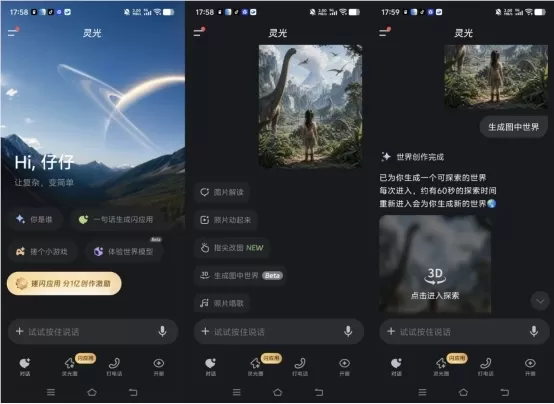
(Step-by-step: Open Lingguang, tap the "+" at bottom left to upload an image, then select "Generate the World in the Picture" to start exploring.)
The world model is considered a critical path toward AGI (General Artificial Intelligence) and an essential bridge connecting the digital and physical worlds. The "Experience World Model" feature in the Lingguang App is powered by the open-sourced Ant Lingbo LingBot-World-Fast world model.
Lingguang makes it easy to experience the world model. Open the app, upload a photo in the chat box, and the system intelligently suggests the next step—choose "Generate the World in the Picture." Alternatively, type a natural language prompt like "Show me this world from a first-person view," and the model starts generating in seconds.
Once inside the world model experience, Lingguang features a mobile-friendly dual-joystick interface. The left joystick moves the character through the 3D scene, while the right joystick rotates the view, allowing seamless exploration. This control scheme, familiar to mobile gamers, ensures zero learning curve for immersive exploration.
Deploying world models on mobile devices presents significant engineering challenges—high computational demands, tight latency constraints, and varying hardware. The Lingguang team overcame these using efficient, low-latency streaming technology, achieving response times under 100 milliseconds. This enables users to start exploring the 3D world within seconds, shattering the perception that world models are inherently resource-intensive and impractical.
Cai Wei, head of the Lingguang App, commented: "The Experience World Model feature is another step in Lingguang's journey to push the boundaries of intelligence. Our earlier Flash App function allowed users to generate a full application from natural language in just 30 seconds, giving everyday users the coding power once reserved for professional developers. Lingguang aims to continuously explore these frontiers, uncover unmet needs, and deliver great AI experiences to everyone."
Currently, the Lingguang App is available for download from major app stores, where users can immediately try the world model feature.
Related article
 Ctrip Business Travel Unveils AI Ecosystem with 7 Industry Agents and 17 Core Capabilities
Ctrip Business Travel has officially unveiled the "Ctrip Business Travel AI Ecosystem," leveraging large language models to fundamentally restructure corporate travel management. This comprehensive ecosystem addresses four core scenarios: travel arra
Stripe to Acquire OpenRouter as AI Model Routing Gains Momentum
Stripe has agreed to acquire OpenRouter, an AI model-routing platform that gives developers access to hundreds of models through a single interface. The deal adds model selection and routing to Stripe’s existing work around AI usage and token-based b
Former OpenAI Researcher Barrett Zoph Returns to Google to Support Gemini Development
Barret Zoph, who previously abruptly left and joined OpenAI due to a disagreement with Thinking Machines Lab CEO Miriam Mularati, has once again changed employers. Alphabet's Google announced that Zoph will return as Vice President of Research, bring
Related Special Topic Recommendations
Design & Art
 Top AI Illustration Tools: Create Editorial Scenes and Cover Art Faster
2026 Latest Top-rated AI Illustration Tools: Our curated list features the best powerfully designed tools for creating stunning editorial scenes and eye-catching cover art quickly. Each option has gone through rigorous real-world tests, offering a free vs paid comparison to help you find the perfect match for your workflow. Try these must-try solutions today to unlock your AI edge and boost your creative productivity. Explore now at XIX.AI.
 10 tools
 xix.ai
Education and Learning
Top AI Tutors for Exam Prep: Practice Math, Science, and English
2026 Latest Top-Rated Best AI Tutors for Exam Prep are here on XIX.AI! Our curated list features powerful game-changing tools that offer free vs paid comparison, real-world tests, and weekly updated rankings. They help boost your writing efficiency, simplify complex topic learning, and unlock your academic potential. Explore now to Discover your perfect exam prep tool and Start creating today to Unlock your AI edge!
10 tools
xix.ai
Finance
AI Budget Planning Tools for Personal Money Management
2026 Latest Best Top-Rated AI Budget Planning Tools for Personal Money Management are here on XIX.AI! This curated collection features powerful, game-changing solutions that help you conduct real-world tests, understand spending habits, and create personalized plans to boost productivity. Enjoy a free vs paid comparison along with detailed rankings. Must-try tools designed to simplify money management and unlock your AI edge. Explore now!
11 tools
xix.ai
Health & Wellness
AI Sleep Tracking Assistants: Improve Recovery with Better Bedtime Habits
2026 Latest Best Top-Rated AI Sleep Tracking Assistants curated for ultimate recovery. This fully updated weekly guide features powerful tools that deliver real-world tests, free vs paid comparison, and detailed rankings to help you find the must-try solution that boosts sleep quality and supports better bedtime habits. Explore now at XIX.AI to Unlock your AI edge.
10 tools
xix.ai
Data Analysis
AI SQL Copilots for Product and Revenue Analytics
2026 Latest Best Top-Rated AI SQL Copilots for Product and Revenue Analytics! XIX.AI has curated a powerful, game-changing collection of must-try tools that undergo real-world tests through weekly updated rankings. These tools help users boost productivity significantly by accelerating data analysis, streamlining complex queries, and generating accurate insights to drive smarter business decisions. Explore now to Discover your perfect tool for unlocking your AI edge!
14 tools
xix.ai
Education and Learning
Best AI Homework Helpers That Teach: Learn Concepts, Not Just Answers
2026 Latest Best Top-Rated AI Homework Helpers That Teach Core Concepts Not Just Answers Powerful Tools for Students Must-Try Curated List Weekly Updated Free vs Paid Comparison Real-World Tests Accurate Rankings to Help You Unlock Your Full Learning Potential Explore now to Discover your perfect tool for smarter studying.
10 tools
xix.ai

 Comments (0)
0/500
With just a photo and a smartphone, you can step into an AI-generated world.
On April 27, the Ant Lingguang App officially launched its "Experience World Model" feature, making it the first AGI product to offer world model experiences on a mobile device. Users simply upload a photo and can explore a 3D world for up to 60 seconds on their phone, with the ability to control their perspective as if playing a mobile game. From initiating the command to beginning the exploration takes mere seconds. This marks the first time the industry has achieved edge deployment of a world model with minute-level long-term consistency and real-time interactivity, once again setting the pace for AGI products. Lingguang has always been dedicated to pushing the boundaries of intelligence; earlier, it launched the "Flash App" feature, the first to generate an application on a mobile device within 30 seconds, spearheading the trend of "wish coding."
(Step-by-step: Open Lingguang, tap the "+" at bottom left to upload an image, then select "Generate the World in the Picture" to start exploring.)
The world model is considered a critical path toward AGI (General Artificial Intelligence) and an essential bridge connecting the digital and physical worlds. The "Experience World Model" feature in the Lingguang App is powered by the open-sourced Ant Lingbo LingBot-World-Fast world model.
Lingguang makes it easy to experience the world model. Open the app, upload a photo in the chat box, and the system intelligently suggests the next step—choose "Generate the World in the Picture." Alternatively, type a natural language prompt like "Show me this world from a first-person view," and the model starts generating in seconds.
Once inside the world model experience, Lingguang features a mobile-friendly dual-joystick interface. The left joystick moves the character through the 3D scene, while the right joystick rotates the view, allowing seamless exploration. This control scheme, familiar to mobile gamers, ensures zero learning curve for immersive exploration.
Deploying world models on mobile devices presents significant engineering challenges—high computational demands, tight latency constraints, and varying hardware. The Lingguang team overcame these using efficient, low-latency streaming technology, achieving response times under 100 milliseconds. This enables users to start exploring the 3D world within seconds, shattering the perception that world models are inherently resource-intensive and impractical.
Cai Wei, head of the Lingguang App, commented: "The Experience World Model feature is another step in Lingguang's journey to push the boundaries of intelligence. Our earlier Flash App function allowed users to generate a full application from natural language in just 30 seconds, giving everyday users the coding power once reserved for professional developers. Lingguang aims to continuously explore these frontiers, uncover unmet needs, and deliver great AI experiences to everyone."
Currently, the Lingguang App is available for download from major app stores, where users can immediately try the world model feature.








 Ctrip Business Travel Unveils AI Ecosystem with 7 Industry Agents and 17 Core Capabilities
Ctrip Business Travel has officially unveiled the "Ctrip Business Travel AI Ecosystem," leveraging large language models to fundamentally restructure corporate travel management. This comprehensive ecosystem addresses four core scenarios: travel arra
 Stripe to Acquire OpenRouter as AI Model Routing Gains Momentum
Stripe has agreed to acquire OpenRouter, an AI model-routing platform that gives developers access to hundreds of models through a single interface. The deal adds model selection and routing to Stripe’s existing work around AI usage and token-based b
 Former OpenAI Researcher Barrett Zoph Returns to Google to Support Gemini Development
Barret Zoph, who previously abruptly left and joined OpenAI due to a disagreement with Thinking Machines Lab CEO Miriam Mularati, has once again changed employers. Alphabet's Google announced that Zoph will return as Vice President of Research, bring

2026 Latest Top-rated AI Illustration Tools: Our curated list features the best powerfully designed tools for creating stunning editorial scenes and eye-catching cover art quickly. Each option has gone through rigorous real-world tests, offering a free vs paid comparison to help you find the perfect match for your workflow. Try these must-try solutions today to unlock your AI edge and boost your creative productivity. Explore now at XIX.AI.
10 tools
xix.ai

2026 Latest Top-Rated Best AI Tutors for Exam Prep are here on XIX.AI! Our curated list features powerful game-changing tools that offer free vs paid comparison, real-world tests, and weekly updated rankings. They help boost your writing efficiency, simplify complex topic learning, and unlock your academic potential. Explore now to Discover your perfect exam prep tool and Start creating today to Unlock your AI edge!
10 tools
xix.ai

2026 Latest Best Top-Rated AI Budget Planning Tools for Personal Money Management are here on XIX.AI! This curated collection features powerful, game-changing solutions that help you conduct real-world tests, understand spending habits, and create personalized plans to boost productivity. Enjoy a free vs paid comparison along with detailed rankings. Must-try tools designed to simplify money management and unlock your AI edge. Explore now!
11 tools
xix.ai

2026 Latest Best Top-Rated AI Sleep Tracking Assistants curated for ultimate recovery. This fully updated weekly guide features powerful tools that deliver real-world tests, free vs paid comparison, and detailed rankings to help you find the must-try solution that boosts sleep quality and supports better bedtime habits. Explore now at XIX.AI to Unlock your AI edge.
10 tools
xix.ai

2026 Latest Best Top-Rated AI SQL Copilots for Product and Revenue Analytics! XIX.AI has curated a powerful, game-changing collection of must-try tools that undergo real-world tests through weekly updated rankings. These tools help users boost productivity significantly by accelerating data analysis, streamlining complex queries, and generating accurate insights to drive smarter business decisions. Explore now to Discover your perfect tool for unlocking your AI edge!
14 tools
xix.ai

2026 Latest Best Top-Rated AI Homework Helpers That Teach Core Concepts Not Just Answers Powerful Tools for Students Must-Try Curated List Weekly Updated Free vs Paid Comparison Real-World Tests Accurate Rankings to Help You Unlock Your Full Learning Potential Explore now to Discover your perfect tool for smarter studying.
10 tools
xix.ai












