


 Home
HomeMaster Supply Chain Analytics With This Expert Cheat Sheet
In today's fast-moving business world, harnessing data analytics to enhance logistics and supply chain management has become essential. This comprehensive supply chain analytics guide delivers a wealth of resources, real-world case studies, and practical techniques tailored for data professionals, logistics managers, and anyone aiming to boost supply chain efficiency. Whether you're targeting cost savings, sustainability improvements, or operational excellence, this resource provides actionable strategies and valuable insights to revolutionize your supply chain approach.
Key Points
Explore diverse supply chain analytics tools and methods.
Examine case studies demonstrating cost-cutting and eco-friendly solutions.
Discover how data science transforms logistics management.
Implement practical techniques to refine supply chain operations.
Harness analytics for smarter business decisions.
Access open-source algorithms and modular code.
Introduction to Supply Chain Analytics Cheat Sheet
The Need for Data-Driven Supply Chains
Modern supply chains face unprecedented complexity, demanding smarter approaches than traditional methods. Data-driven analytics empowers businesses to extract operational insights, streamline processes, and make evidence-based decisions. This guide serves as your roadmap through the evolving landscape of intelligent supply chain management.
Regardless of your professional background—whether in data science, logistics, or general business operations—mastering supply chain analytics can significantly impact organizational performance. By identifying inefficiencies, improving workflows, and reducing expenses through data, companies can gain competitive advantages and ensure sustainable growth.
This resource explains how to maximize the cheat sheet's potential, offering value for beginners and experts alike through its carefully curated content.
What is the Supply Chain Analytics Cheat Sheet?
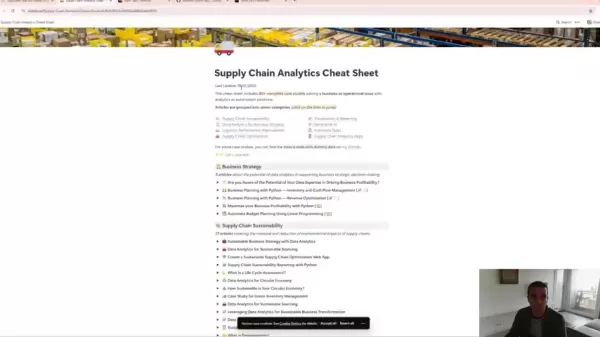
The Supply Chain Analytics Cheat Sheet is a specially compiled toolkit designed to help professionals optimize logistics through data. It features complete business case studies demonstrating analytics-driven solutions to operational challenges.
This resource provides inspiration, real-world examples, and instructional guides showing how data science tackles logistics problems. Organized by focus areas, it addresses diverse needs from financial efficiency to environmental responsibility.
- Project Inspiration: Offers practical ideas for supply chain-related data science initiatives, ideal for students and professionals.
- Case Studies: Demonstrates real-world applications of analytics solving supply chain issues.
- Cost Control Methods: Shares data-backed techniques for reducing operational expenditures.
- Sustainability Solutions: Highlights analytics applications for greener supply chain practices.
Leveraging the GitHub Repository
Accessing and Utilizing Source Code
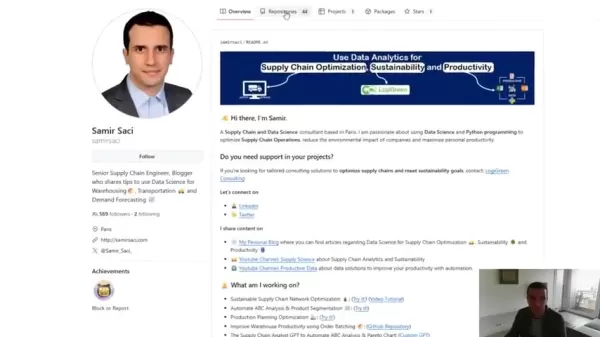
Many case studies include available source code on GitHub, enabling deeper exploration and customization. Contributor Samir Saci provides specific algorithmic modules
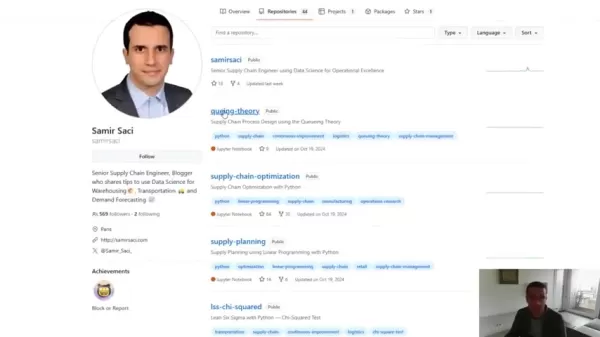
. These code examples allow direct application of case study lessons to your projects, creating valuable hands-on learning opportunities.
- GitHub-hosted executable code
- Specialized supply chain optimization modules
- Interactive Jupyter Notebooks and web applications
Navigating the Supply Chain Analytics Cheat Sheet Effectively
Understanding the Structure and Categories
The guide organizes content into seven focused categories for efficient information retrieval. This structure helps quickly locate relevant insights.
Sustainable Supply Chains: Methods to measure and minimize environmental impacts.
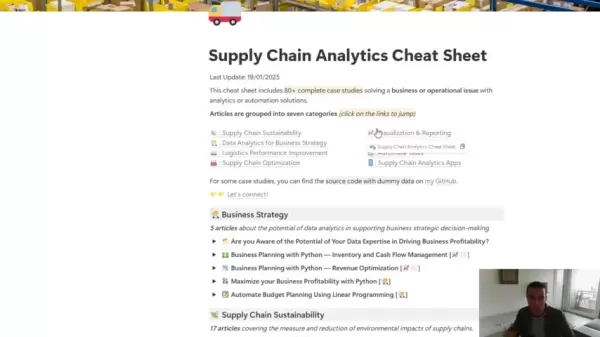
Strategic Business Analytics: Data applications supporting executive decisions.
Logistics Enhancement: Tools improving warehouse and transportation efficiency.
Supply Chain Refinement: Techniques optimizing flows for cost and performance.
Data Visualization: Solutions for impactful analytics presentation.
Generative AI Applications: How LLMs automate analytics tasks.
Analytics Applications: Sample modules and SaaS solutions with test data.
Understanding these categories helps quickly pinpoint relevant content for specific projects.
Dive into Logistics Performance Improvement
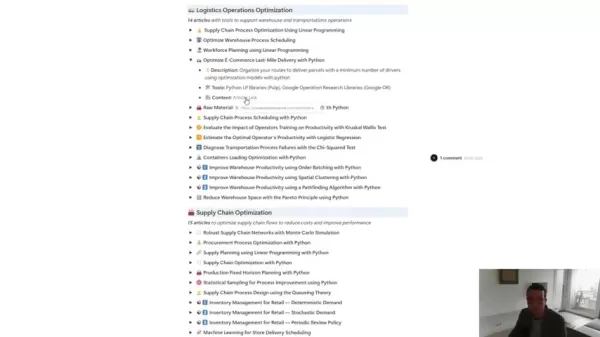
The Logistics Performance section provides targeted tools for transportation optimization.
- Warehouse scheduling optimization
- Workforce planning via linear programming
- E-commerce last-mile delivery solutions
- Food manufacturing supply scheduling
- Container loading optimization
- Warehouse productivity through order batching
- Space reduction using Pareto principles
Optimizing the Supply Chain
The Optimization section shares methods to enhance efficiency and reduce costs.
- Monte Carlo Simulation for resilient networks
- Python-based procurement optimization
- Linear programming for supply planning
- Python solutions for supply chain optimization
- Fixed horizon production planning
- Statistical sampling for process improvement
- Queuing Theory applications
- ML-powered delivery scheduling
Embrace Visualization and Reporting
Effective communication tools transform raw data into actionable insights.
- Descriptive analytics dashboards
- DataPane-powered logistics dashboards
- Interactive D3.js/Flask visualizations
- Performance analytics tools
- Automated control tower solutions
- Telegram-based shipment tracking
- Process mining techniques
Benefits and Drawbacks of Using the Cheat Sheet
Pros
Extensive collection of supply chain analytics materials.
Practical implementations solving business challenges.
Available code facilitating practical experimentation.
Logical category-based organization.
Dual focus on financial and environmental efficiency.
Clear, actionable guidance
Cons
Assumes basic data science knowledge.
Some solutions require supplementary software.
Content depth varies across sections.
Needs regular content refreshes
Core Features of the Supply Chain Analytics Cheat Sheet
Key Components and Functionalities
This resource combines knowledge and tools valuable across industries, featuring:
Practical Examples: Demonstrates analytics solving operational issues.
Available Code: GitHub-hosted modules enabling hands-on adaptation.
Instructional Guides: Step-by-step solutions for common challenges.
Organized Content: Clearly categorized for targeted access.
Supplementary Resources: Connections to external references.
Eco-Conscious Focus: Environmental impact reduction strategies.
Practical Guidance: Actionable business strategy recommendations
Practical Use Cases for Supply Chain Analytics
Real-World Applications of Data Analytics
The guide demonstrates analytics versatility through multiple implementations.
- Logistics Optimization: Enhancing warehouses, routes, and deliveries.
- Environmental Solutions: Reducing ecological footprints.
- Demand Prediction: Inventory optimization preventing shortages.
- Risk Identification: Predictive mitigation strategies.
- Purchasing Efficiency: Cost reduction through data analysis.
- Revenue Strategy: Performance optimization
Frequently Asked Questions
What is supply chain analytics?
Supply chain analytics applies data analysis techniques to understand and improve supply chain operations. It helps businesses optimize processes, control costs, enhance efficiency, and make evidence-based decisions.
Who can benefit from this cheat sheet?
Data professionals, logistics specialists, supply chain managers, business analysts, and students studying supply chain or data analytics will find value in this resource.
How often is the cheat sheet updated?
The cheat sheet receives periodic updates introducing new case studies and materials to maintain relevance.
Where can I find the source code mentioned in the cheat sheet?
Reference code appears in the creator's GitHub repository, with links typically included within the cheat sheet content.
Is this cheat sheet suitable for beginners?
While valuable for all levels, foundational data science and supply chain knowledge enhances comprehension and application of the materials.
Related Questions
What skills are needed for supply chain analytics?
Effective supply chain analytics requires data analysis proficiency, statistical knowledge, and programming skills (especially Python/R). Supply chain expertise covering inventory, logistics, procurement, and forecasting is equally important. Visualization and communication abilities ensure stakeholders understand and act on insights.
How can data analytics improve supply chain sustainability?
Analytics enables measurement and reduction of environmental impacts by tracking emissions, waste, resource use, and energy consumption. It evaluates supplier sustainability, traces material origins, and monitors compliance, helping organizations make responsible sourcing and production decisions for greener operations.
Related article
 Ctrip Business Travel Unveils AI Ecosystem with 7 Industry Agents and 17 Core Capabilities
Ctrip Business Travel has officially unveiled the "Ctrip Business Travel AI Ecosystem," leveraging large language models to fundamentally restructure corporate travel management. This comprehensive ecosystem addresses four core scenarios: travel arra
Stripe to Acquire OpenRouter as AI Model Routing Gains Momentum
Stripe has agreed to acquire OpenRouter, an AI model-routing platform that gives developers access to hundreds of models through a single interface. The deal adds model selection and routing to Stripe’s existing work around AI usage and token-based b
Former OpenAI Researcher Barrett Zoph Returns to Google to Support Gemini Development
Barret Zoph, who previously abruptly left and joined OpenAI due to a disagreement with Thinking Machines Lab CEO Miriam Mularati, has once again changed employers. Alphabet's Google announced that Zoph will return as Vice President of Research, bring
Related Special Topic Recommendations
Design & Art
Ctrip Business Travel Unveils AI Ecosystem with 7 Industry Agents and 17 Core Capabilities
Ctrip Business Travel has officially unveiled the "Ctrip Business Travel AI Ecosystem," leveraging large language models to fundamentally restructure corporate travel management. This comprehensive ecosystem addresses four core scenarios: travel arra
Stripe to Acquire OpenRouter as AI Model Routing Gains Momentum
Stripe has agreed to acquire OpenRouter, an AI model-routing platform that gives developers access to hundreds of models through a single interface. The deal adds model selection and routing to Stripe’s existing work around AI usage and token-based b
Former OpenAI Researcher Barrett Zoph Returns to Google to Support Gemini Development
Barret Zoph, who previously abruptly left and joined OpenAI due to a disagreement with Thinking Machines Lab CEO Miriam Mularati, has once again changed employers. Alphabet's Google announced that Zoph will return as Vice President of Research, bring
Related Special Topic Recommendations
Design & Art
 Top AI Illustration Tools: Create Editorial Scenes and Cover Art Faster
2026 Latest Top-rated AI Illustration Tools: Our curated list features the best powerfully designed tools for creating stunning editorial scenes and eye-catching cover art quickly. Each option has gone through rigorous real-world tests, offering a free vs paid comparison to help you find the perfect match for your workflow. Try these must-try solutions today to unlock your AI edge and boost your creative productivity. Explore now at XIX.AI.
 10 tools
 xix.ai
Education and Learning
Top AI Tutors for Exam Prep: Practice Math, Science, and English
xix.ai
Education and Learning
Top AI Tutors for Exam Prep: Practice Math, Science, and English
2026 Latest Top-Rated Best AI Tutors for Exam Prep are here on XIX.AI! Our curated list features powerful game-changing tools that offer free vs paid comparison, real-world tests, and weekly updated rankings. They help boost your writing efficiency, simplify complex topic learning, and unlock your academic potential. Explore now to Discover your perfect exam prep tool and Start creating today to Unlock your AI edge!
10 tools
xix.ai
Finance
AI Budget Planning Tools for Personal Money Management
2026 Latest Best Top-Rated AI Budget Planning Tools for Personal Money Management are here on XIX.AI! This curated collection features powerful, game-changing solutions that help you conduct real-world tests, understand spending habits, and create personalized plans to boost productivity. Enjoy a free vs paid comparison along with detailed rankings. Must-try tools designed to simplify money management and unlock your AI edge. Explore now!
11 tools
xix.ai
Health & Wellness
AI Sleep Tracking Assistants: Improve Recovery with Better Bedtime Habits
2026 Latest Best Top-Rated AI Sleep Tracking Assistants curated for ultimate recovery. This fully updated weekly guide features powerful tools that deliver real-world tests, free vs paid comparison, and detailed rankings to help you find the must-try solution that boosts sleep quality and supports better bedtime habits. Explore now at XIX.AI to Unlock your AI edge.
10 tools
xix.ai
Data Analysis
AI SQL Copilots for Product and Revenue Analytics
2026 Latest Best Top-Rated AI SQL Copilots for Product and Revenue Analytics! XIX.AI has curated a powerful, game-changing collection of must-try tools that undergo real-world tests through weekly updated rankings. These tools help users boost productivity significantly by accelerating data analysis, streamlining complex queries, and generating accurate insights to drive smarter business decisions. Explore now to Discover your perfect tool for unlocking your AI edge!
14 tools
xix.ai
Education and Learning
Best AI Homework Helpers That Teach: Learn Concepts, Not Just Answers
2026 Latest Best Top-Rated AI Homework Helpers That Teach Core Concepts Not Just Answers Powerful Tools for Students Must-Try Curated List Weekly Updated Free vs Paid Comparison Real-World Tests Accurate Rankings to Help You Unlock Your Full Learning Potential Explore now to Discover your perfect tool for smarter studying.
10 tools
xix.ai

 Comments (6)
0/500
Comments (6)
0/500
![AlbertHernández]()
Finally, a cheat sheet that actually makes sense! I've been drowning in supply chain jargon for months, and this guide cuts through the noise with real case studies. It's like finding a map in a maze. Definitely bookmarking this for my next logistics project. Thanks for sharing such a practical resource! 🚚📊
![KennethLee]()
I just finished going through this cheat sheet and it actually solved so many confusion I had about how to apply data analysis to optimize warehouse operations, super useful for busy logistics staff like me!
![AnthonyJohnson]()
La infografía es práctica, pero ¿en qué software recomiendan hacer ese tipo de análisis? 🤔 Como profesional logístico, lo más difícil es convencer a la directiva para invertir en herramientas…
![RobertWhite]()
Toujours étonné par la quantité de données à décortiquer en logistique. Ce guide a l'air plus concret que la théorie habituelle, même si la mise en pratique restera un défi pour les petites équipes. 😅 L'essentiel est d'éviter de se noyer dans les chiffres sans en tirer d'actions claires.
![DouglasPerez]()
Qué buen recurso para comprender mejor la optimización de la cadena de suministro a través de los datos 📊. Me parece genial que incluyan casos prácticos de la vida real, porque así podemos ver cómo aplicar estos conceptos en situaciones concretas. Mi empresa ha estado intentando mejorar su logística, y esta 'hoja de trucos' podría ser muy útil para nosotros. ¿Alguien más ha intentado implementar algo similar en su organización? ¿Qué resultados han obtenido?
![HenryBrown]()
Cet article tombe à pic! J'ai justement des problèmes de logistique dans mon taff, et l'idée d'utiliser l'analytique pour optimiser tout ça me parle tellement. Les études de cas pratiques, c'est exactement ce qu'il me faut pour convaincre mon boss d'investir un peu dans ces outils. Vivement la lecture! 📊
In today's fast-moving business world, harnessing data analytics to enhance logistics and supply chain management has become essential. This comprehensive supply chain analytics guide delivers a wealth of resources, real-world case studies, and practical techniques tailored for data professionals, logistics managers, and anyone aiming to boost supply chain efficiency. Whether you're targeting cost savings, sustainability improvements, or operational excellence, this resource provides actionable strategies and valuable insights to revolutionize your supply chain approach.
Key Points
Explore diverse supply chain analytics tools and methods.
Examine case studies demonstrating cost-cutting and eco-friendly solutions.
Discover how data science transforms logistics management.
Implement practical techniques to refine supply chain operations.
Harness analytics for smarter business decisions.
Access open-source algorithms and modular code.
Introduction to Supply Chain Analytics Cheat Sheet
The Need for Data-Driven Supply Chains
Modern supply chains face unprecedented complexity, demanding smarter approaches than traditional methods. Data-driven analytics empowers businesses to extract operational insights, streamline processes, and make evidence-based decisions. This guide serves as your roadmap through the evolving landscape of intelligent supply chain management.
Regardless of your professional background—whether in data science, logistics, or general business operations—mastering supply chain analytics can significantly impact organizational performance. By identifying inefficiencies, improving workflows, and reducing expenses through data, companies can gain competitive advantages and ensure sustainable growth.
This resource explains how to maximize the cheat sheet's potential, offering value for beginners and experts alike through its carefully curated content.
What is the Supply Chain Analytics Cheat Sheet?
The Supply Chain Analytics Cheat Sheet is a specially compiled toolkit designed to help professionals optimize logistics through data. It features complete business case studies demonstrating analytics-driven solutions to operational challenges.
This resource provides inspiration, real-world examples, and instructional guides showing how data science tackles logistics problems. Organized by focus areas, it addresses diverse needs from financial efficiency to environmental responsibility.
- Project Inspiration: Offers practical ideas for supply chain-related data science initiatives, ideal for students and professionals.
- Case Studies: Demonstrates real-world applications of analytics solving supply chain issues.
- Cost Control Methods: Shares data-backed techniques for reducing operational expenditures.
- Sustainability Solutions: Highlights analytics applications for greener supply chain practices.
Leveraging the GitHub Repository
Accessing and Utilizing Source Code
Many case studies include available source code on GitHub, enabling deeper exploration and customization. Contributor Samir Saci provides specific algorithmic modules
. These code examples allow direct application of case study lessons to your projects, creating valuable hands-on learning opportunities.
- GitHub-hosted executable code
- Specialized supply chain optimization modules
- Interactive Jupyter Notebooks and web applications
Navigating the Supply Chain Analytics Cheat Sheet Effectively
Understanding the Structure and Categories
The guide organizes content into seven focused categories for efficient information retrieval. This structure helps quickly locate relevant insights.
Sustainable Supply Chains: Methods to measure and minimize environmental impacts.
Strategic Business Analytics: Data applications supporting executive decisions.
Logistics Enhancement: Tools improving warehouse and transportation efficiency.
Supply Chain Refinement: Techniques optimizing flows for cost and performance.
Data Visualization: Solutions for impactful analytics presentation.
Generative AI Applications: How LLMs automate analytics tasks.
Analytics Applications: Sample modules and SaaS solutions with test data.
Understanding these categories helps quickly pinpoint relevant content for specific projects.
Dive into Logistics Performance Improvement
The Logistics Performance section provides targeted tools for transportation optimization.
- Warehouse scheduling optimization
- Workforce planning via linear programming
- E-commerce last-mile delivery solutions
- Food manufacturing supply scheduling
- Container loading optimization
- Warehouse productivity through order batching
- Space reduction using Pareto principles
Optimizing the Supply Chain
The Optimization section shares methods to enhance efficiency and reduce costs.
- Monte Carlo Simulation for resilient networks
- Python-based procurement optimization
- Linear programming for supply planning
- Python solutions for supply chain optimization
- Fixed horizon production planning
- Statistical sampling for process improvement
- Queuing Theory applications
- ML-powered delivery scheduling
Embrace Visualization and Reporting
Effective communication tools transform raw data into actionable insights.
- Descriptive analytics dashboards
- DataPane-powered logistics dashboards
- Interactive D3.js/Flask visualizations
- Performance analytics tools
- Automated control tower solutions
- Telegram-based shipment tracking
- Process mining techniques
Benefits and Drawbacks of Using the Cheat Sheet
Pros
Extensive collection of supply chain analytics materials.
Practical implementations solving business challenges.
Available code facilitating practical experimentation.
Logical category-based organization.
Dual focus on financial and environmental efficiency.
Clear, actionable guidance
Cons
Assumes basic data science knowledge.
Some solutions require supplementary software.
Content depth varies across sections.
Needs regular content refreshes
Core Features of the Supply Chain Analytics Cheat Sheet
Key Components and Functionalities
This resource combines knowledge and tools valuable across industries, featuring:
Practical Examples: Demonstrates analytics solving operational issues.
Available Code: GitHub-hosted modules enabling hands-on adaptation.
Instructional Guides: Step-by-step solutions for common challenges.
Organized Content: Clearly categorized for targeted access.
Supplementary Resources: Connections to external references.
Eco-Conscious Focus: Environmental impact reduction strategies.
Practical Guidance: Actionable business strategy recommendations
Practical Use Cases for Supply Chain Analytics
Real-World Applications of Data Analytics
The guide demonstrates analytics versatility through multiple implementations.
- Logistics Optimization: Enhancing warehouses, routes, and deliveries.
- Environmental Solutions: Reducing ecological footprints.
- Demand Prediction: Inventory optimization preventing shortages.
- Risk Identification: Predictive mitigation strategies.
- Purchasing Efficiency: Cost reduction through data analysis.
- Revenue Strategy: Performance optimization
Frequently Asked Questions
What is supply chain analytics?
Supply chain analytics applies data analysis techniques to understand and improve supply chain operations. It helps businesses optimize processes, control costs, enhance efficiency, and make evidence-based decisions.
Who can benefit from this cheat sheet?
Data professionals, logistics specialists, supply chain managers, business analysts, and students studying supply chain or data analytics will find value in this resource.
How often is the cheat sheet updated?
The cheat sheet receives periodic updates introducing new case studies and materials to maintain relevance.
Where can I find the source code mentioned in the cheat sheet?
Reference code appears in the creator's GitHub repository, with links typically included within the cheat sheet content.
Is this cheat sheet suitable for beginners?
While valuable for all levels, foundational data science and supply chain knowledge enhances comprehension and application of the materials.
Related Questions
What skills are needed for supply chain analytics?
Effective supply chain analytics requires data analysis proficiency, statistical knowledge, and programming skills (especially Python/R). Supply chain expertise covering inventory, logistics, procurement, and forecasting is equally important. Visualization and communication abilities ensure stakeholders understand and act on insights.
How can data analytics improve supply chain sustainability?
Analytics enables measurement and reduction of environmental impacts by tracking emissions, waste, resource use, and energy consumption. It evaluates supplier sustainability, traces material origins, and monitors compliance, helping organizations make responsible sourcing and production decisions for greener operations.








 Ctrip Business Travel Unveils AI Ecosystem with 7 Industry Agents and 17 Core Capabilities
Ctrip Business Travel has officially unveiled the "Ctrip Business Travel AI Ecosystem," leveraging large language models to fundamentally restructure corporate travel management. This comprehensive ecosystem addresses four core scenarios: travel arra
Ctrip Business Travel Unveils AI Ecosystem with 7 Industry Agents and 17 Core Capabilities
Ctrip Business Travel has officially unveiled the "Ctrip Business Travel AI Ecosystem," leveraging large language models to fundamentally restructure corporate travel management. This comprehensive ecosystem addresses four core scenarios: travel arra
 Stripe to Acquire OpenRouter as AI Model Routing Gains Momentum
Stripe has agreed to acquire OpenRouter, an AI model-routing platform that gives developers access to hundreds of models through a single interface. The deal adds model selection and routing to Stripe’s existing work around AI usage and token-based b
Stripe to Acquire OpenRouter as AI Model Routing Gains Momentum
Stripe has agreed to acquire OpenRouter, an AI model-routing platform that gives developers access to hundreds of models through a single interface. The deal adds model selection and routing to Stripe’s existing work around AI usage and token-based b
 Former OpenAI Researcher Barrett Zoph Returns to Google to Support Gemini Development
Barret Zoph, who previously abruptly left and joined OpenAI due to a disagreement with Thinking Machines Lab CEO Miriam Mularati, has once again changed employers. Alphabet's Google announced that Zoph will return as Vice President of Research, bring
Former OpenAI Researcher Barrett Zoph Returns to Google to Support Gemini Development
Barret Zoph, who previously abruptly left and joined OpenAI due to a disagreement with Thinking Machines Lab CEO Miriam Mularati, has once again changed employers. Alphabet's Google announced that Zoph will return as Vice President of Research, bring

2026 Latest Top-rated AI Illustration Tools: Our curated list features the best powerfully designed tools for creating stunning editorial scenes and eye-catching cover art quickly. Each option has gone through rigorous real-world tests, offering a free vs paid comparison to help you find the perfect match for your workflow. Try these must-try solutions today to unlock your AI edge and boost your creative productivity. Explore now at XIX.AI.
10 tools
xix.ai

2026 Latest Top-Rated Best AI Tutors for Exam Prep are here on XIX.AI! Our curated list features powerful game-changing tools that offer free vs paid comparison, real-world tests, and weekly updated rankings. They help boost your writing efficiency, simplify complex topic learning, and unlock your academic potential. Explore now to Discover your perfect exam prep tool and Start creating today to Unlock your AI edge!
10 tools
xix.ai
2026 Latest Best Top-Rated AI Budget Planning Tools for Personal Money Management are here on XIX.AI! This curated collection features powerful, game-changing solutions that help you conduct real-world tests, understand spending habits, and create personalized plans to boost productivity. Enjoy a free vs paid comparison along with detailed rankings. Must-try tools designed to simplify money management and unlock your AI edge. Explore now!
11 tools
xix.ai

2026 Latest Best Top-Rated AI Sleep Tracking Assistants curated for ultimate recovery. This fully updated weekly guide features powerful tools that deliver real-world tests, free vs paid comparison, and detailed rankings to help you find the must-try solution that boosts sleep quality and supports better bedtime habits. Explore now at XIX.AI to Unlock your AI edge.
10 tools
xix.ai
2026 Latest Best Top-Rated AI SQL Copilots for Product and Revenue Analytics! XIX.AI has curated a powerful, game-changing collection of must-try tools that undergo real-world tests through weekly updated rankings. These tools help users boost productivity significantly by accelerating data analysis, streamlining complex queries, and generating accurate insights to drive smarter business decisions. Explore now to Discover your perfect tool for unlocking your AI edge!
14 tools
xix.ai

2026 Latest Best Top-Rated AI Homework Helpers That Teach Core Concepts Not Just Answers Powerful Tools for Students Must-Try Curated List Weekly Updated Free vs Paid Comparison Real-World Tests Accurate Rankings to Help You Unlock Your Full Learning Potential Explore now to Discover your perfect tool for smarter studying.
10 tools
xix.ai

Finally, a cheat sheet that actually makes sense! I've been drowning in supply chain jargon for months, and this guide cuts through the noise with real case studies. It's like finding a map in a maze. Definitely bookmarking this for my next logistics project. Thanks for sharing such a practical resource! 🚚📊
I just finished going through this cheat sheet and it actually solved so many confusion I had about how to apply data analysis to optimize warehouse operations, super useful for busy logistics staff like me!
La infografía es práctica, pero ¿en qué software recomiendan hacer ese tipo de análisis? 🤔 Como profesional logístico, lo más difícil es convencer a la directiva para invertir en herramientas…
Toujours étonné par la quantité de données à décortiquer en logistique. Ce guide a l'air plus concret que la théorie habituelle, même si la mise en pratique restera un défi pour les petites équipes. 😅 L'essentiel est d'éviter de se noyer dans les chiffres sans en tirer d'actions claires.
Qué buen recurso para comprender mejor la optimización de la cadena de suministro a través de los datos 📊. Me parece genial que incluyan casos prácticos de la vida real, porque así podemos ver cómo aplicar estos conceptos en situaciones concretas. Mi empresa ha estado intentando mejorar su logística, y esta 'hoja de trucos' podría ser muy útil para nosotros. ¿Alguien más ha intentado implementar algo similar en su organización? ¿Qué resultados han obtenido?
Cet article tombe à pic! J'ai justement des problèmes de logistique dans mon taff, et l'idée d'utiliser l'analytique pour optimiser tout ça me parle tellement. Les études de cas pratiques, c'est exactement ce qu'il me faut pour convaincre mon boss d'investir un peu dans ces outils. Vivement la lecture! 📊












