


 Home
HomeTencent Launches Tusi, an AI Platform to Turn Ideas into Apps
On May 15th, a new application called "Toast" quietly launched. Developed internally by Tencent as an experimental vibe coding product, it's described as an "application generation and inspiration co-creation platform." Users simply describe their ideas in natural language, and the AI automatically breaks down the functions, generates a prototype, and packages it into a complete app that can be installed on a phone. The Android version is already available on the App Store and the official website, with the iOS version set to follow later.
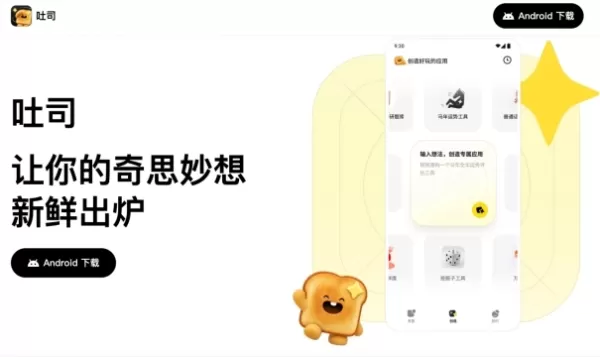
Users simply type a few sentences describing their concept, and the AI automatically handles function decomposition, creates a prototype preview, and packages it into an app with one click, ready for local download and installation—bringing their creative ideas to life.
According to the official website, Toast 1.0 offers four key capabilities:
Create Apps: Users enter their ideas → the AI automatically breaks them down into features → multiple rounds of dialogue refine details → one-click packaging into an APK (Android package) that can be downloaded directly to a phone.
Social Sharing: Apps created by users can be shared via links, QR codes, or installation packages.
Inspiration Square: Users can publish their apps as templates for others; anyone can create a copy with one click, or "add inspiration" to start a creative relay, letting great ideas evolve into new experiences.
App Search: Tap "Ask Toast" to search inspirations shared by others, or describe what you need and let the AI find a suitable app.
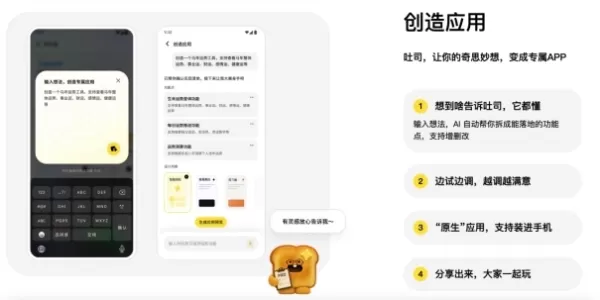
Currently, the AI-powered app generation space is attracting major internet companies to accelerate their entry. Rather than heavily emphasizing the removal of technical barriers, "Toast" focuses on two core pillars: "inspiration realization" and "co-creation." Its goal is to let anyone, even without any coding background, turn a thought into a real, usable app. Users can share their created apps on the square for others to try, and other users can remix existing templates. In the future, it will also support listing and downloading, forming a closed-loop ecosystem of "idea → app → distribution → co-creation."
During the public beta phase of Toast AI, it will be available for free for a limited time. Later, additional opportunities will be offered through sharing tasks.
Related article
 NSF to invest $90M in three new tech centers, including robotics
Science and Technology Centers build lasting partnerships across universities, industry, and government to accelerate the adoption of new ideas and technologies for scientific discovery. | Sources: NSF, left to right: Indiana University, Bloomington;
OpenAI Annual Revenue Tops $40 Billion, Surging 20% Month-on-Month in July
OpenAI is fast-tracking its US public listing later this year, with market consensus projecting a valuation exceeding $1 trillion. As investors closely monitor this AI leader, its financial results have proven remarkably robust.Internal reports indic
Anthropic Embeds Invisible Watermarks in Claude Output to Boost AI Content Traceability
On August 11, Anthropic announced the integration of "imperceptible watermarking" into its latest Claude models to trace the origin of AI-generated text. This invisible marker preserves text readability and meaning, remaining intact during copy-pasti
Related Special Topic Recommendations
Education and Learning
NSF to invest $90M in three new tech centers, including robotics
Science and Technology Centers build lasting partnerships across universities, industry, and government to accelerate the adoption of new ideas and technologies for scientific discovery. | Sources: NSF, left to right: Indiana University, Bloomington;
OpenAI Annual Revenue Tops $40 Billion, Surging 20% Month-on-Month in July
OpenAI is fast-tracking its US public listing later this year, with market consensus projecting a valuation exceeding $1 trillion. As investors closely monitor this AI leader, its financial results have proven remarkably robust.Internal reports indic
Anthropic Embeds Invisible Watermarks in Claude Output to Boost AI Content Traceability
On August 11, Anthropic announced the integration of "imperceptible watermarking" into its latest Claude models to trace the origin of AI-generated text. This invisible marker preserves text readability and meaning, remaining intact during copy-pasti
Related Special Topic Recommendations
Education and Learning
 ChatGPT Study Tools for Exam Revision, Flashcards, and Homework Explanations
2026 Latest Best ChatGPT Study Tools for Exam Revision, Flashcards, and Homework Explanations! XIX.AI has curated a top-rated list of powerful game-changing tools designed to boost your productivity. These must-try solutions offer free vs paid comparison, real-world tests, and detailed rankings to help you find the perfect option for efficient exam preparation and homework support. Explore now to unlock your AI edge!
 10 tools
 xix.ai
Education and Learning
AI Study Planner Tools for Exam Preparation
xix.ai
Education and Learning
AI Study Planner Tools for Exam Preparation
2026 Latest Best Top-Rated AI Study Planner Tools for Exam Preparation are here on XIX.AI! This curated collection features powerful, game-changing tools that help you streamline your review process, boost focus, and create personalized study schedules. We conduct real-world tests to determine the top options, offering a free vs paid comparison along with weekly updated rankings. Must-try solutions designed to maximize your productivity and help you ace every exam. Explore now to find your perfect tool!
14 tools
xix.ai
SEO
Best AI Keyword Gap Tools for Organic Growth
2026 Latest Best Top-rated AI Keyword Gap Tools for Organic Growth! XIX.AI has carefully curated a powerful, game-changing collection of the best tools available, featuring weekly updated rankings and real-world tests. You can find a detailed free vs paid comparison to help you choose the perfect option that boosts your content creation efficiency and unlocks your AI edge. Explore now!
8 tools
xix.ai
SEO
AI Internal Link Tools for Better Site Structure
2026 Latest Best Top-Rated AI Internal Link Tools for Better Site Structure are here on XIX.AI! This curated collection features powerful, game-changing solutions that go through real-world tests to deliver superior results. Get a free vs paid comparison, see rankings, and discover must-try options to boost your site’s SEO performance and streamline content organization. Explore now to unlock your AI edge!
11 tools
xix.ai
Productivity
Best AI Note Organizing Tools for Daily Work
2026 Latest Best Top-rated AI Note Organizing Tools for Daily Work are here on XIX.AI! This curated list features powerful, game-changing solutions that help boost productivity significantly through real-world tests and rigorous rankings. You’ll find a detailed free vs paid comparison to help you choose the perfect fit for your needs. Explore now to Discover your perfect tool and Unlock your AI edge in daily tasks!
11 tools
xix.ai
Finance
Best AI Investment Research Tools for Retail Analysts
2026 Latest Best Top-Rated AI Investment Research Tools for Retail Analysts, carefully curated by XIX.AI. These powerful tools offer game-changing advantages for accelerating content creation, boosting writing efficiency, and streamlining analysis tasks to help professionals unlock their AI edge. Get a free vs paid comparison along with real-world tests and detailed rankings. Explore now to discover your perfect tool!
11 tools
xix.ai

 Comments (0)
0/500
Comments (0)
0/500
On May 15th, a new application called "Toast" quietly launched. Developed internally by Tencent as an experimental vibe coding product, it's described as an "application generation and inspiration co-creation platform." Users simply describe their ideas in natural language, and the AI automatically breaks down the functions, generates a prototype, and packages it into a complete app that can be installed on a phone. The Android version is already available on the App Store and the official website, with the iOS version set to follow later.
Users simply type a few sentences describing their concept, and the AI automatically handles function decomposition, creates a prototype preview, and packages it into an app with one click, ready for local download and installation—bringing their creative ideas to life.
According to the official website, Toast 1.0 offers four key capabilities:
Create Apps: Users enter their ideas → the AI automatically breaks them down into features → multiple rounds of dialogue refine details → one-click packaging into an APK (Android package) that can be downloaded directly to a phone.
Social Sharing: Apps created by users can be shared via links, QR codes, or installation packages.
Inspiration Square: Users can publish their apps as templates for others; anyone can create a copy with one click, or "add inspiration" to start a creative relay, letting great ideas evolve into new experiences.
App Search: Tap "Ask Toast" to search inspirations shared by others, or describe what you need and let the AI find a suitable app.
Currently, the AI-powered app generation space is attracting major internet companies to accelerate their entry. Rather than heavily emphasizing the removal of technical barriers, "Toast" focuses on two core pillars: "inspiration realization" and "co-creation." Its goal is to let anyone, even without any coding background, turn a thought into a real, usable app. Users can share their created apps on the square for others to try, and other users can remix existing templates. In the future, it will also support listing and downloading, forming a closed-loop ecosystem of "idea → app → distribution → co-creation."
During the public beta phase of Toast AI, it will be available for free for a limited time. Later, additional opportunities will be offered through sharing tasks.







 NSF to invest $90M in three new tech centers, including robotics
Science and Technology Centers build lasting partnerships across universities, industry, and government to accelerate the adoption of new ideas and technologies for scientific discovery. | Sources: NSF, left to right: Indiana University, Bloomington;
NSF to invest $90M in three new tech centers, including robotics
Science and Technology Centers build lasting partnerships across universities, industry, and government to accelerate the adoption of new ideas and technologies for scientific discovery. | Sources: NSF, left to right: Indiana University, Bloomington;
 OpenAI Annual Revenue Tops $40 Billion, Surging 20% Month-on-Month in July
OpenAI is fast-tracking its US public listing later this year, with market consensus projecting a valuation exceeding $1 trillion. As investors closely monitor this AI leader, its financial results have proven remarkably robust.Internal reports indic
OpenAI Annual Revenue Tops $40 Billion, Surging 20% Month-on-Month in July
OpenAI is fast-tracking its US public listing later this year, with market consensus projecting a valuation exceeding $1 trillion. As investors closely monitor this AI leader, its financial results have proven remarkably robust.Internal reports indic
 Anthropic Embeds Invisible Watermarks in Claude Output to Boost AI Content Traceability
On August 11, Anthropic announced the integration of "imperceptible watermarking" into its latest Claude models to trace the origin of AI-generated text. This invisible marker preserves text readability and meaning, remaining intact during copy-pasti
Anthropic Embeds Invisible Watermarks in Claude Output to Boost AI Content Traceability
On August 11, Anthropic announced the integration of "imperceptible watermarking" into its latest Claude models to trace the origin of AI-generated text. This invisible marker preserves text readability and meaning, remaining intact during copy-pasti
2026 Latest Best ChatGPT Study Tools for Exam Revision, Flashcards, and Homework Explanations! XIX.AI has curated a top-rated list of powerful game-changing tools designed to boost your productivity. These must-try solutions offer free vs paid comparison, real-world tests, and detailed rankings to help you find the perfect option for efficient exam preparation and homework support. Explore now to unlock your AI edge!
10 tools
xix.ai

2026 Latest Best Top-Rated AI Study Planner Tools for Exam Preparation are here on XIX.AI! This curated collection features powerful, game-changing tools that help you streamline your review process, boost focus, and create personalized study schedules. We conduct real-world tests to determine the top options, offering a free vs paid comparison along with weekly updated rankings. Must-try solutions designed to maximize your productivity and help you ace every exam. Explore now to find your perfect tool!
14 tools
xix.ai

2026 Latest Best Top-rated AI Keyword Gap Tools for Organic Growth! XIX.AI has carefully curated a powerful, game-changing collection of the best tools available, featuring weekly updated rankings and real-world tests. You can find a detailed free vs paid comparison to help you choose the perfect option that boosts your content creation efficiency and unlocks your AI edge. Explore now!
8 tools
xix.ai
2026 Latest Best Top-Rated AI Internal Link Tools for Better Site Structure are here on XIX.AI! This curated collection features powerful, game-changing solutions that go through real-world tests to deliver superior results. Get a free vs paid comparison, see rankings, and discover must-try options to boost your site’s SEO performance and streamline content organization. Explore now to unlock your AI edge!
11 tools
xix.ai
2026 Latest Best Top-rated AI Note Organizing Tools for Daily Work are here on XIX.AI! This curated list features powerful, game-changing solutions that help boost productivity significantly through real-world tests and rigorous rankings. You’ll find a detailed free vs paid comparison to help you choose the perfect fit for your needs. Explore now to Discover your perfect tool and Unlock your AI edge in daily tasks!
11 tools
xix.ai
2026 Latest Best Top-Rated AI Investment Research Tools for Retail Analysts, carefully curated by XIX.AI. These powerful tools offer game-changing advantages for accelerating content creation, boosting writing efficiency, and streamlining analysis tasks to help professionals unlock their AI edge. Get a free vs paid comparison along with real-world tests and detailed rankings. Explore now to discover your perfect tool!
11 tools
xix.ai












