


 Home
StackGen Launches AI-Powered Platform for Autonomous Infrastructure Management
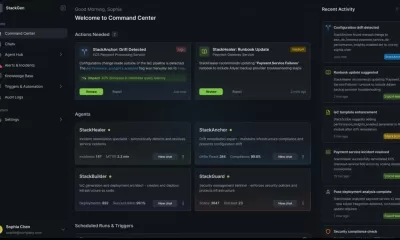
StackGen has officially launched its Autonomous Infrastructure Platform, a next-generation solution that redefines how cloud infrastructure is designed, managed, and scaled. Central to the platform are AI agents—specialized, intelligent modules that automate tasks ranging from resource provisioning and compliance monitoring to incident response. This release represents a major milestone in the journey toward intelligent, self-managing infrastructure, arriving at a pivotal moment when AI-driven development is rapidly outpacing manual operational processes.
What Makes StackGen Different
Unlike conventional infrastructure-as-code tools that rely on manual script creation and upkeep, StackGen’s platform operates on intent-based input. Developers simply describe what they need—such as a service, database, or deployment—and StackBuilder transforms that intent into fully configured infrastructure. The system automatically generates pipelines, enforces policy compliance, and integrates smoothly with existing DevOps toolchains. Additional agents are included for discovering current environments, applying compliance standards such as HIPAA and FedRAMP, autonomously addressing incidents, and continuously optimizing infrastructure for cost and performance.
This agent-driven approach is built on a deterministic foundation, preserving enterprise-grade reliability and governance. Every action taken by an agent is context-sensitive and aligned with organizational policies, ensuring that increased velocity does not compromise control.
The Problem It Solves
StackGen addresses a critical challenge facing the industry today: although AI has dramatically accelerated development—often doubling or trialing output—infrastructure management has remained a bottleneck. Developers can spend as much as 60% of their time provisioning and troubleshooting infrastructure instead of building new capabilities. For large enterprises, this inefficiency results in billions of dollars in lost productivity annually.
By automating manual infrastructure tasks, StackGen significantly boosts developer productivity. Early adopters have reported up to 95% automation of provisioning activities, a tenfold improvement in platform engineering efficiency, and measurable reductions in security incidents and production outages. With typical implementation times of just 4–6 weeks, the platform delivers rapid and quantifiable value.
An Industry at an Inflection Point
StackGen’s platform is part of a larger transformation occurring across enterprise technology. Analysts forecast the autonomous enterprise market to surpass $100 billion by the end of the decade, with AI-driven infrastructure playing a pivotal role. Gartner predicts that by 2028, 33% of infrastructure tasks will be handled semi-autonomously by AI—a dramatic increase from near zero just a year ago.
This shift is further supported by rapid growth in data center automation, projected to exceed $40 billion by 2032, alongside rising investment in generative AI for infrastructure and operations. As AI continues to reshape software development, testing, and deployment, underlying infrastructure must keep pace—or risk impeding innovation.
The Future of Autonomous Platforms
The emergence of platforms like StackGen signifies more than a tooling upgrade—it reflects a fundamental change in how enterprises will function. Infrastructure is evolving from a manual, code-centric model to one where intelligent agents interpret and execute human intent. Engineers now define outcomes rather than write Terraform scripts. Instead of manually correcting configuration drift, agents proactively identify and resolve it. And rather than waiting for human intervention during outages, systems self-heal in real time.
This shift doesn’t replace engineers—it elevates their responsibilities. Infrastructure teams will focus more on policy definition, organizational pattern design, and establishing trust boundaries for autonomous agents. The platform handles execution; people provide strategic direction.
What makes this model especially powerful is its scalability. Organizations can start with “copilot” setups—where agents suggest actions for human approval—and gradually progress to full “autopilot” operation as confidence and operational maturity grow. Over time, a fragmented landscape of manual scripts and ad-hoc processes becomes a cohesive, intelligent system that understands context, adapts to change, and continuously improves.
A New Era for Enterprise Infrastructure
As infrastructure grows more distributed—spanning hybrid clouds, edge deployments, and global compliance frameworks—the demand for unified, intelligent orchestration becomes essential. Autonomous infrastructure platforms deliver not only efficiency, but also resilience, security, and speed at a scale unattainable through manual processes.
StackGen’s launch offers one of the first fully-realized visions of this future. It’s more than just an automation tool—it’s the foundation of a new operational paradigm. In the coming years, more organizations are expected to adopt similar platforms, enabling infrastructure that builds, governs, heals, and optimizes itself—guided by human oversight, but free from human dependency.
The implications are far-reaching: shorter development cycles, stronger compliance, and infrastructure that operates at the speed of business. The age of reactive infrastructure management is coming to a close—and the autonomous future is now underway.
Related article
 Ctrip Business Travel Unveils AI Ecosystem with 7 Industry Agents and 17 Core Capabilities
Ctrip Business Travel has officially unveiled the "Ctrip Business Travel AI Ecosystem," leveraging large language models to fundamentally restructure corporate travel management. This comprehensive ecosystem addresses four core scenarios: travel arra
Stripe to Acquire OpenRouter as AI Model Routing Gains Momentum
Stripe has agreed to acquire OpenRouter, an AI model-routing platform that gives developers access to hundreds of models through a single interface. The deal adds model selection and routing to Stripe’s existing work around AI usage and token-based b
Former OpenAI Researcher Barrett Zoph Returns to Google to Support Gemini Development
Barret Zoph, who previously abruptly left and joined OpenAI due to a disagreement with Thinking Machines Lab CEO Miriam Mularati, has once again changed employers. Alphabet's Google announced that Zoph will return as Vice President of Research, bring
Related Special Topic Recommendations
Design & Art
 Top AI Illustration Tools: Create Editorial Scenes and Cover Art Faster
2026 Latest Top-rated AI Illustration Tools: Our curated list features the best powerfully designed tools for creating stunning editorial scenes and eye-catching cover art quickly. Each option has gone through rigorous real-world tests, offering a free vs paid comparison to help you find the perfect match for your workflow. Try these must-try solutions today to unlock your AI edge and boost your creative productivity. Explore now at XIX.AI.
 10 tools
 xix.ai
Education and Learning
Top AI Tutors for Exam Prep: Practice Math, Science, and English
2026 Latest Top-Rated Best AI Tutors for Exam Prep are here on XIX.AI! Our curated list features powerful game-changing tools that offer free vs paid comparison, real-world tests, and weekly updated rankings. They help boost your writing efficiency, simplify complex topic learning, and unlock your academic potential. Explore now to Discover your perfect exam prep tool and Start creating today to Unlock your AI edge!
10 tools
xix.ai
Finance
AI Budget Planning Tools for Personal Money Management
2026 Latest Best Top-Rated AI Budget Planning Tools for Personal Money Management are here on XIX.AI! This curated collection features powerful, game-changing solutions that help you conduct real-world tests, understand spending habits, and create personalized plans to boost productivity. Enjoy a free vs paid comparison along with detailed rankings. Must-try tools designed to simplify money management and unlock your AI edge. Explore now!
11 tools
xix.ai
Health & Wellness
AI Sleep Tracking Assistants: Improve Recovery with Better Bedtime Habits
2026 Latest Best Top-Rated AI Sleep Tracking Assistants curated for ultimate recovery. This fully updated weekly guide features powerful tools that deliver real-world tests, free vs paid comparison, and detailed rankings to help you find the must-try solution that boosts sleep quality and supports better bedtime habits. Explore now at XIX.AI to Unlock your AI edge.
10 tools
xix.ai
Data Analysis
AI SQL Copilots for Product and Revenue Analytics
2026 Latest Best Top-Rated AI SQL Copilots for Product and Revenue Analytics! XIX.AI has curated a powerful, game-changing collection of must-try tools that undergo real-world tests through weekly updated rankings. These tools help users boost productivity significantly by accelerating data analysis, streamlining complex queries, and generating accurate insights to drive smarter business decisions. Explore now to Discover your perfect tool for unlocking your AI edge!
14 tools
xix.ai
Education and Learning
Best AI Homework Helpers That Teach: Learn Concepts, Not Just Answers
2026 Latest Best Top-Rated AI Homework Helpers That Teach Core Concepts Not Just Answers Powerful Tools for Students Must-Try Curated List Weekly Updated Free vs Paid Comparison Real-World Tests Accurate Rankings to Help You Unlock Your Full Learning Potential Explore now to Discover your perfect tool for smarter studying.
10 tools
xix.ai

 Comments (1)
0/500
![PaulHill]()
Finally, someone gets it! Manual server config is so 2015. These AI agents sound like they could actually save us from 3 AM pager alerts. 🤖✨
StackGen has officially launched its Autonomous Infrastructure Platform, a next-generation solution that redefines how cloud infrastructure is designed, managed, and scaled. Central to the platform are AI agents—specialized, intelligent modules that automate tasks ranging from resource provisioning and compliance monitoring to incident response. This release represents a major milestone in the journey toward intelligent, self-managing infrastructure, arriving at a pivotal moment when AI-driven development is rapidly outpacing manual operational processes.
What Makes StackGen Different
Unlike conventional infrastructure-as-code tools that rely on manual script creation and upkeep, StackGen’s platform operates on intent-based input. Developers simply describe what they need—such as a service, database, or deployment—and StackBuilder transforms that intent into fully configured infrastructure. The system automatically generates pipelines, enforces policy compliance, and integrates smoothly with existing DevOps toolchains. Additional agents are included for discovering current environments, applying compliance standards such as HIPAA and FedRAMP, autonomously addressing incidents, and continuously optimizing infrastructure for cost and performance.
This agent-driven approach is built on a deterministic foundation, preserving enterprise-grade reliability and governance. Every action taken by an agent is context-sensitive and aligned with organizational policies, ensuring that increased velocity does not compromise control.
The Problem It Solves
StackGen addresses a critical challenge facing the industry today: although AI has dramatically accelerated development—often doubling or trialing output—infrastructure management has remained a bottleneck. Developers can spend as much as 60% of their time provisioning and troubleshooting infrastructure instead of building new capabilities. For large enterprises, this inefficiency results in billions of dollars in lost productivity annually.
By automating manual infrastructure tasks, StackGen significantly boosts developer productivity. Early adopters have reported up to 95% automation of provisioning activities, a tenfold improvement in platform engineering efficiency, and measurable reductions in security incidents and production outages. With typical implementation times of just 4–6 weeks, the platform delivers rapid and quantifiable value.
An Industry at an Inflection Point
StackGen’s platform is part of a larger transformation occurring across enterprise technology. Analysts forecast the autonomous enterprise market to surpass $100 billion by the end of the decade, with AI-driven infrastructure playing a pivotal role. Gartner predicts that by 2028, 33% of infrastructure tasks will be handled semi-autonomously by AI—a dramatic increase from near zero just a year ago.
This shift is further supported by rapid growth in data center automation, projected to exceed $40 billion by 2032, alongside rising investment in generative AI for infrastructure and operations. As AI continues to reshape software development, testing, and deployment, underlying infrastructure must keep pace—or risk impeding innovation.
The Future of Autonomous Platforms
The emergence of platforms like StackGen signifies more than a tooling upgrade—it reflects a fundamental change in how enterprises will function. Infrastructure is evolving from a manual, code-centric model to one where intelligent agents interpret and execute human intent. Engineers now define outcomes rather than write Terraform scripts. Instead of manually correcting configuration drift, agents proactively identify and resolve it. And rather than waiting for human intervention during outages, systems self-heal in real time.
This shift doesn’t replace engineers—it elevates their responsibilities. Infrastructure teams will focus more on policy definition, organizational pattern design, and establishing trust boundaries for autonomous agents. The platform handles execution; people provide strategic direction.
What makes this model especially powerful is its scalability. Organizations can start with “copilot” setups—where agents suggest actions for human approval—and gradually progress to full “autopilot” operation as confidence and operational maturity grow. Over time, a fragmented landscape of manual scripts and ad-hoc processes becomes a cohesive, intelligent system that understands context, adapts to change, and continuously improves.
A New Era for Enterprise Infrastructure
As infrastructure grows more distributed—spanning hybrid clouds, edge deployments, and global compliance frameworks—the demand for unified, intelligent orchestration becomes essential. Autonomous infrastructure platforms deliver not only efficiency, but also resilience, security, and speed at a scale unattainable through manual processes.
StackGen’s launch offers one of the first fully-realized visions of this future. It’s more than just an automation tool—it’s the foundation of a new operational paradigm. In the coming years, more organizations are expected to adopt similar platforms, enabling infrastructure that builds, governs, heals, and optimizes itself—guided by human oversight, but free from human dependency.
The implications are far-reaching: shorter development cycles, stronger compliance, and infrastructure that operates at the speed of business. The age of reactive infrastructure management is coming to a close—and the autonomous future is now underway.








 Ctrip Business Travel Unveils AI Ecosystem with 7 Industry Agents and 17 Core Capabilities
Ctrip Business Travel has officially unveiled the "Ctrip Business Travel AI Ecosystem," leveraging large language models to fundamentally restructure corporate travel management. This comprehensive ecosystem addresses four core scenarios: travel arra
 Stripe to Acquire OpenRouter as AI Model Routing Gains Momentum
Stripe has agreed to acquire OpenRouter, an AI model-routing platform that gives developers access to hundreds of models through a single interface. The deal adds model selection and routing to Stripe’s existing work around AI usage and token-based b
 Former OpenAI Researcher Barrett Zoph Returns to Google to Support Gemini Development
Barret Zoph, who previously abruptly left and joined OpenAI due to a disagreement with Thinking Machines Lab CEO Miriam Mularati, has once again changed employers. Alphabet's Google announced that Zoph will return as Vice President of Research, bring

2026 Latest Top-rated AI Illustration Tools: Our curated list features the best powerfully designed tools for creating stunning editorial scenes and eye-catching cover art quickly. Each option has gone through rigorous real-world tests, offering a free vs paid comparison to help you find the perfect match for your workflow. Try these must-try solutions today to unlock your AI edge and boost your creative productivity. Explore now at XIX.AI.
10 tools
xix.ai

2026 Latest Top-Rated Best AI Tutors for Exam Prep are here on XIX.AI! Our curated list features powerful game-changing tools that offer free vs paid comparison, real-world tests, and weekly updated rankings. They help boost your writing efficiency, simplify complex topic learning, and unlock your academic potential. Explore now to Discover your perfect exam prep tool and Start creating today to Unlock your AI edge!
10 tools
xix.ai

2026 Latest Best Top-Rated AI Budget Planning Tools for Personal Money Management are here on XIX.AI! This curated collection features powerful, game-changing solutions that help you conduct real-world tests, understand spending habits, and create personalized plans to boost productivity. Enjoy a free vs paid comparison along with detailed rankings. Must-try tools designed to simplify money management and unlock your AI edge. Explore now!
11 tools
xix.ai

2026 Latest Best Top-Rated AI Sleep Tracking Assistants curated for ultimate recovery. This fully updated weekly guide features powerful tools that deliver real-world tests, free vs paid comparison, and detailed rankings to help you find the must-try solution that boosts sleep quality and supports better bedtime habits. Explore now at XIX.AI to Unlock your AI edge.
10 tools
xix.ai

2026 Latest Best Top-Rated AI SQL Copilots for Product and Revenue Analytics! XIX.AI has curated a powerful, game-changing collection of must-try tools that undergo real-world tests through weekly updated rankings. These tools help users boost productivity significantly by accelerating data analysis, streamlining complex queries, and generating accurate insights to drive smarter business decisions. Explore now to Discover your perfect tool for unlocking your AI edge!
14 tools
xix.ai

2026 Latest Best Top-Rated AI Homework Helpers That Teach Core Concepts Not Just Answers Powerful Tools for Students Must-Try Curated List Weekly Updated Free vs Paid Comparison Real-World Tests Accurate Rankings to Help You Unlock Your Full Learning Potential Explore now to Discover your perfect tool for smarter studying.
10 tools
xix.ai

Finally, someone gets it! Manual server config is so 2015. These AI agents sound like they could actually save us from 3 AM pager alerts. 🤖✨












