


 Home
Spotify to Label AI Persona Profiles, Exclude Music From Recommendations
Spotify announced on Tuesday that it will start tagging AI-generated artists with “AI Persona” profile labels and exclude their tracks from editorial and algorithmic recommendations.
Starting in mid-September, Spotify users will see “AI Persona” badges on select artist profiles, indicating that the identity is AI-generated rather than human. While Spotify permits artists to self-identify as AI Personas, the platform will not rely solely on self-reporting.
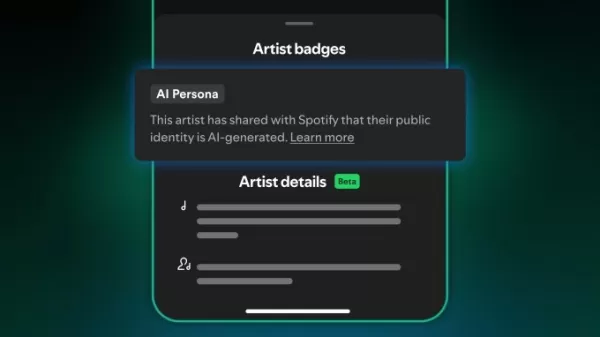
Image Credits:Spotify
The company will also proactively review artist profiles to identify those using photorealistic AI-generated names and imagery. Spotify stated that reviews will prioritize profiles meeting specific audience thresholds to ensure high-traffic artists are addressed first.
Once labeled, AI Persona badges will be visible on the artist’s profile banner and “About” section, within Search results, and on track rows across playlists.
By default, Spotify will exclude AI Personas from editorial and algorithmic recommendations, as well as from users’ personalized feeds—unless the user explicitly follows an AI Persona. Following an artist serves as a clear signal that the user wishes to hear more music from that specific entity.
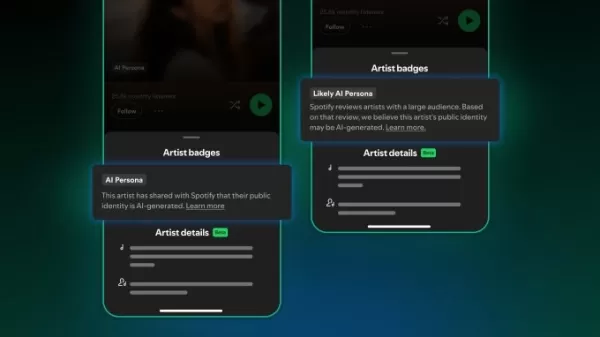
Image Credits:Spotify
This update expands Spotify’s existing AI policies, which outline guidelines for AI-generated music on the platform. First introduced in September 2025, the current policy uses industry-standard techniques to identify and label AI music, while banning unauthorized AI voice clones and deepfakes.
Like other music industry players, Spotify aims to balance AI-driven innovations—such as its AI-powered Prompted Playlists, AI DJ and chat features, and upcoming AI remixes—with the need to prevent an influx of low-quality, mass-produced AI content. Allowing such content to proliferate could degrade user experience and lead to subscription cancellations.
Spotify also confirmed that artists can appeal an AI Persona label if they believe it was applied incorrectly.
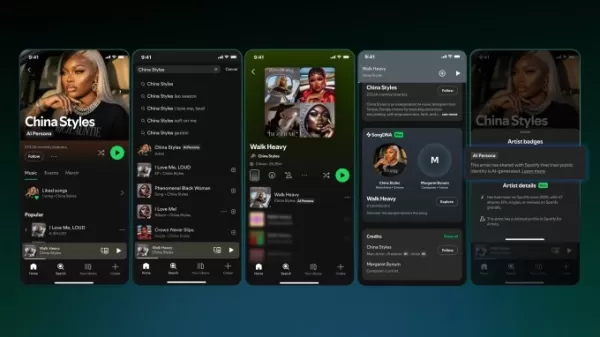
Image Credits:Spotify
Reflecting growing consumer backlash against AI-generated art, Spotify stated in its announcement: “While we believe all artists have creative choice in determining how they present themselves, Spotify’s programming is focused on elevating music from authentic artists building careers in music.”
However, the company clarified that an AI Persona label applies to the artist’s profile, not their music.
“Although there’s a broad spectrum in how artists use AI as a creative tool, the question of whether a profile represents an actual human is one where Spotify can help make a clear determination. This badge is about the artist’s public identity, not about how the music was made,” the company explained.
Details regarding how specific tracks were created will remain accessible through existing Spotify features like AI Credits and SongDNA.
In the coming months, Spotify will also launch a tool allowing users to report artist profiles that appear to be AI Personas but have not yet been labeled.
These labels will also help users distinguish between AI Personas and the upcoming AI-generated remixes and covers, which Spotify recently permitted through licensing deals with labels UMG and Merlin. These agreements allow for fan-made remixes and covers while ensuring revenue flows back to participating artists.
Regarding AI Personas, Spotify stated that artists can begin self-disclosing their status starting August 11, 2026, via Spotify for Artists. The labels themselves will go live next month.
Related article
 Key AI discussions shaping the agenda at AI LIVE London
The summit will convene C-suite executives from around the globe to address pressing challenges across global industries, ranging from AI-driven disruption to economic volatility.In anticipation of AI LIVE: The London Summit on 20–21 October 2026, AI
Alibaba, DeepSeek Drive China’s AI Model Race to Lower Costs
Alibaba has introduced Qwen3.8-Max, its most powerful AI model yet, as DeepSeek’s new V4-Flash gains attention for offering inference pricing lower than several competitors.With 2.4 trillion parameters, Qwen3.8-Max employs a mixture-of-experts archit
Former Spotify Exec Launches Vinyl Bar Startup in Shibuya to Redefine Music Apps
As generative AI continues to reshape the creative landscape, a new wave of startups is empowering users to produce music through AI prompts, mimicking the style of any artist. A Vinyl Bar in Shibuya, a startup with an indie band-inspired name, is de
Related Special Topic Recommendations
Design & Art
 Top AI Illustration Tools: Create Editorial Scenes and Cover Art Faster
2026 Latest Top-rated AI Illustration Tools: Our curated list features the best powerfully designed tools for creating stunning editorial scenes and eye-catching cover art quickly. Each option has gone through rigorous real-world tests, offering a free vs paid comparison to help you find the perfect match for your workflow. Try these must-try solutions today to unlock your AI edge and boost your creative productivity. Explore now at XIX.AI.
 10 tools
 xix.ai
Education and Learning
Top AI Tutors for Exam Prep: Practice Math, Science, and English
2026 Latest Top-Rated Best AI Tutors for Exam Prep are here on XIX.AI! Our curated list features powerful game-changing tools that offer free vs paid comparison, real-world tests, and weekly updated rankings. They help boost your writing efficiency, simplify complex topic learning, and unlock your academic potential. Explore now to Discover your perfect exam prep tool and Start creating today to Unlock your AI edge!
10 tools
xix.ai
Finance
AI Budget Planning Tools for Personal Money Management
2026 Latest Best Top-Rated AI Budget Planning Tools for Personal Money Management are here on XIX.AI! This curated collection features powerful, game-changing solutions that help you conduct real-world tests, understand spending habits, and create personalized plans to boost productivity. Enjoy a free vs paid comparison along with detailed rankings. Must-try tools designed to simplify money management and unlock your AI edge. Explore now!
11 tools
xix.ai
Health & Wellness
AI Sleep Tracking Assistants: Improve Recovery with Better Bedtime Habits
2026 Latest Best Top-Rated AI Sleep Tracking Assistants curated for ultimate recovery. This fully updated weekly guide features powerful tools that deliver real-world tests, free vs paid comparison, and detailed rankings to help you find the must-try solution that boosts sleep quality and supports better bedtime habits. Explore now at XIX.AI to Unlock your AI edge.
10 tools
xix.ai
Data Analysis
AI SQL Copilots for Product and Revenue Analytics
2026 Latest Best Top-Rated AI SQL Copilots for Product and Revenue Analytics! XIX.AI has curated a powerful, game-changing collection of must-try tools that undergo real-world tests through weekly updated rankings. These tools help users boost productivity significantly by accelerating data analysis, streamlining complex queries, and generating accurate insights to drive smarter business decisions. Explore now to Discover your perfect tool for unlocking your AI edge!
14 tools
xix.ai
Education and Learning
Best AI Homework Helpers That Teach: Learn Concepts, Not Just Answers
2026 Latest Best Top-Rated AI Homework Helpers That Teach Core Concepts Not Just Answers Powerful Tools for Students Must-Try Curated List Weekly Updated Free vs Paid Comparison Real-World Tests Accurate Rankings to Help You Unlock Your Full Learning Potential Explore now to Discover your perfect tool for smarter studying.
10 tools
xix.ai

 Comments (0)
0/500
Spotify announced on Tuesday that it will start tagging AI-generated artists with “AI Persona” profile labels and exclude their tracks from editorial and algorithmic recommendations.
Starting in mid-September, Spotify users will see “AI Persona” badges on select artist profiles, indicating that the identity is AI-generated rather than human. While Spotify permits artists to self-identify as AI Personas, the platform will not rely solely on self-reporting.
Image Credits:Spotify
The company will also proactively review artist profiles to identify those using photorealistic AI-generated names and imagery. Spotify stated that reviews will prioritize profiles meeting specific audience thresholds to ensure high-traffic artists are addressed first.
Once labeled, AI Persona badges will be visible on the artist’s profile banner and “About” section, within Search results, and on track rows across playlists.
By default, Spotify will exclude AI Personas from editorial and algorithmic recommendations, as well as from users’ personalized feeds—unless the user explicitly follows an AI Persona. Following an artist serves as a clear signal that the user wishes to hear more music from that specific entity.
Image Credits:Spotify
This update expands Spotify’s existing AI policies, which outline guidelines for AI-generated music on the platform. First introduced in September 2025, the current policy uses industry-standard techniques to identify and label AI music, while banning unauthorized AI voice clones and deepfakes.
Like other music industry players, Spotify aims to balance AI-driven innovations—such as its AI-powered Prompted Playlists, AI DJ and chat features, and upcoming AI remixes—with the need to prevent an influx of low-quality, mass-produced AI content. Allowing such content to proliferate could degrade user experience and lead to subscription cancellations.
Spotify also confirmed that artists can appeal an AI Persona label if they believe it was applied incorrectly.
Image Credits:Spotify
Reflecting growing consumer backlash against AI-generated art, Spotify stated in its announcement: “While we believe all artists have creative choice in determining how they present themselves, Spotify’s programming is focused on elevating music from authentic artists building careers in music.”
However, the company clarified that an AI Persona label applies to the artist’s profile, not their music.
“Although there’s a broad spectrum in how artists use AI as a creative tool, the question of whether a profile represents an actual human is one where Spotify can help make a clear determination. This badge is about the artist’s public identity, not about how the music was made,” the company explained.
Details regarding how specific tracks were created will remain accessible through existing Spotify features like AI Credits and SongDNA.
In the coming months, Spotify will also launch a tool allowing users to report artist profiles that appear to be AI Personas but have not yet been labeled.
These labels will also help users distinguish between AI Personas and the upcoming AI-generated remixes and covers, which Spotify recently permitted through licensing deals with labels UMG and Merlin. These agreements allow for fan-made remixes and covers while ensuring revenue flows back to participating artists.
Regarding AI Personas, Spotify stated that artists can begin self-disclosing their status starting August 11, 2026, via Spotify for Artists. The labels themselves will go live next month.








 Key AI discussions shaping the agenda at AI LIVE London
The summit will convene C-suite executives from around the globe to address pressing challenges across global industries, ranging from AI-driven disruption to economic volatility.In anticipation of AI LIVE: The London Summit on 20–21 October 2026, AI
 Alibaba, DeepSeek Drive China’s AI Model Race to Lower Costs
Alibaba has introduced Qwen3.8-Max, its most powerful AI model yet, as DeepSeek’s new V4-Flash gains attention for offering inference pricing lower than several competitors.With 2.4 trillion parameters, Qwen3.8-Max employs a mixture-of-experts archit
 Former Spotify Exec Launches Vinyl Bar Startup in Shibuya to Redefine Music Apps
As generative AI continues to reshape the creative landscape, a new wave of startups is empowering users to produce music through AI prompts, mimicking the style of any artist. A Vinyl Bar in Shibuya, a startup with an indie band-inspired name, is de

2026 Latest Top-rated AI Illustration Tools: Our curated list features the best powerfully designed tools for creating stunning editorial scenes and eye-catching cover art quickly. Each option has gone through rigorous real-world tests, offering a free vs paid comparison to help you find the perfect match for your workflow. Try these must-try solutions today to unlock your AI edge and boost your creative productivity. Explore now at XIX.AI.
10 tools
xix.ai

2026 Latest Top-Rated Best AI Tutors for Exam Prep are here on XIX.AI! Our curated list features powerful game-changing tools that offer free vs paid comparison, real-world tests, and weekly updated rankings. They help boost your writing efficiency, simplify complex topic learning, and unlock your academic potential. Explore now to Discover your perfect exam prep tool and Start creating today to Unlock your AI edge!
10 tools
xix.ai

2026 Latest Best Top-Rated AI Budget Planning Tools for Personal Money Management are here on XIX.AI! This curated collection features powerful, game-changing solutions that help you conduct real-world tests, understand spending habits, and create personalized plans to boost productivity. Enjoy a free vs paid comparison along with detailed rankings. Must-try tools designed to simplify money management and unlock your AI edge. Explore now!
11 tools
xix.ai

2026 Latest Best Top-Rated AI Sleep Tracking Assistants curated for ultimate recovery. This fully updated weekly guide features powerful tools that deliver real-world tests, free vs paid comparison, and detailed rankings to help you find the must-try solution that boosts sleep quality and supports better bedtime habits. Explore now at XIX.AI to Unlock your AI edge.
10 tools
xix.ai

2026 Latest Best Top-Rated AI SQL Copilots for Product and Revenue Analytics! XIX.AI has curated a powerful, game-changing collection of must-try tools that undergo real-world tests through weekly updated rankings. These tools help users boost productivity significantly by accelerating data analysis, streamlining complex queries, and generating accurate insights to drive smarter business decisions. Explore now to Discover your perfect tool for unlocking your AI edge!
14 tools
xix.ai

2026 Latest Best Top-Rated AI Homework Helpers That Teach Core Concepts Not Just Answers Powerful Tools for Students Must-Try Curated List Weekly Updated Free vs Paid Comparison Real-World Tests Accurate Rankings to Help You Unlock Your Full Learning Potential Explore now to Discover your perfect tool for smarter studying.
10 tools
xix.ai












