


 Home
HomeSkyReels V4 Tops Global Video Rankings, Chinese AI Audio-Visual Tech Reaches World-Class
Kunlun Wanyi's SkyReels V4, part of its TianGong AI large model family, has claimed the top spot globally in the text-to-video (with audio) category on Artificial Analysis. Its performance significantly surpasses mainstream models including Kling 3.0, Google Veo 3.1, Vidu Q3, and OpenAI Sora 2, establishing itself as the world's most powerful AI large model for video generation today.
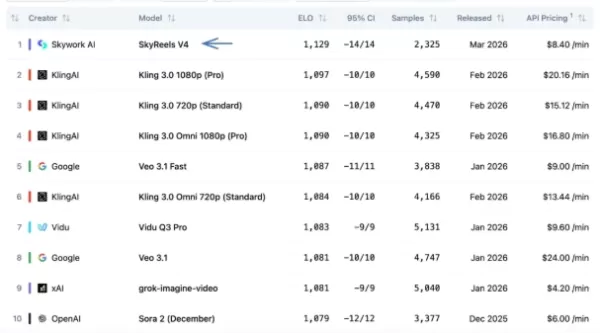
Core Breakthroughs: Full-Modal Reinforcement Learning and Logical Reasoning
SkyReels V4 introduces two core architectural innovations that address long-standing challenges in video generation consistency and narrative logic:
Reinforcement Learning System (RL): By building a full-modal semantic reward model and following a step-by-step curriculum learning path, the system equips the model with logical reasoning capabilities, enabling commercial-grade long-sequence video generation at 1080p resolution for 15 seconds.
Advanced Reference Tasks: New capabilities include "keyframe reference" and "grid map reference." The former accurately infers coherent scenes between key nodes, while the latter allows users to upload multiple story images, ensuring consistent character features and scene styles throughout short film creation.
With this top ranking, the SkyReels V4 API is now officially open to all scenarios, providing full access to the model's core capabilities:
Full Function Coverage: Including text-to-video, image-to-video, multimodal reference generation, video editing and repair, as well as joint audio-visual generation.
Low-Threshold Empowerment: E-commerce, education, content platforms, and development teams can directly leverage world-leading audio-visual generation capabilities without significant R&D investment.
Kunlun Wanyi has previously released and open-sourced multiple models in the SkyReels series. From V1's human-driven generation to V2's long-form video generation, and now V4's comprehensive breakthrough in audio-visual synchronization and logical expression, the SkyReels family demonstrates a clear evolution from "being able to generate" to "generating well."
The SkyReels V4 technical report has been released alongside this announcement. Developers can access the API documentation and begin business integration through the official platform. This milestone marks China's AI taking a global leadership position in the vertical sector of audio-visual content generation.
Related article
 Meta Removes AI Photo Editing Feature Following User Backlash
Meta, the social media giant, is once again embroiled in a public debate regarding the delicate balance between artificial intelligence and user privacy. According to TechCrunch, Meta’s Superintelligence Labs introduced a new AI image generator, Muse
DeepMind CEO Hassabis: I sleep six hours a day, usually feel energetic around 1 a.m.
Fortune recently featured an interview with Demis Hassabis, CEO of Google DeepMind, revealing his unconventional approach to rest and productivity. Hassabis disclosed that he sleeps very little, structuring his waking hours into two distinct work blo
OpenAI, Anthropic Vie for Market Share Despite Revenue Shortfalls
Despite recent reports suggesting OpenAI missed revenue targets, creating pressure on tech stocks this Tuesday, private AI lab investors remain resilient. Seasoned backers have confirmed they will not reduce investment despite negative media coverage
Related Special Topic Recommendations
Animation Creation
Meta Removes AI Photo Editing Feature Following User Backlash
Meta, the social media giant, is once again embroiled in a public debate regarding the delicate balance between artificial intelligence and user privacy. According to TechCrunch, Meta’s Superintelligence Labs introduced a new AI image generator, Muse
DeepMind CEO Hassabis: I sleep six hours a day, usually feel energetic around 1 a.m.
Fortune recently featured an interview with Demis Hassabis, CEO of Google DeepMind, revealing his unconventional approach to rest and productivity. Hassabis disclosed that he sleeps very little, structuring his waking hours into two distinct work blo
OpenAI, Anthropic Vie for Market Share Despite Revenue Shortfalls
Despite recent reports suggesting OpenAI missed revenue targets, creating pressure on tech stocks this Tuesday, private AI lab investors remain resilient. Seasoned backers have confirmed they will not reduce investment despite negative media coverage
Related Special Topic Recommendations
Animation Creation
 AI Scene Animation Tools for Social Media Content
2026 Latest Best Top-rated AI Scene Animation Tools for Social Media Content are curated here by XIX.AI. These powerful game-changing tools offer real-world tests and detailed free vs paid comparison, helping creators boost productivity significantly. Explore now to unlock your AI edge.
 9 tools
 xix.ai
Video creation
AI Short-Form Video Hook Generators for Reels, Shorts, and Product Launch Campaigns
xix.ai
Video creation
AI Short-Form Video Hook Generators for Reels, Shorts, and Product Launch Campaigns
2026 Latest Best AI Short-Form Video Hook Generators for Reels Shorts and Product Launch Campaigns! XIX.AI curates top-rated powerful game-changing tools that deliver must-try results through real-world tests. This weekly updated page offers free vs paid comparison rankings to help you find the perfect solution for boosting content creativity and productivity. Explore now to Unlock your AI edge!
11 tools
xix.ai
writing
AI Article Outline Tools for Long Form Writing
2026 Latest Best Top-Rated AI Article Outline Tools for Long Form Writing! This curated collection features powerful, game-changing tools that deliver accurate, structured outlines with real-world tests to boost writing efficiency significantly. XIX.AI is part of this elite selection. Get a free vs paid comparison to help you choose the perfect tool. Explore now and Unlock your AI edge!
9 tools
xix.ai
chatbot
Best AI Roleplay Chat Apps for Language Practice, Interview Prep, and Daily Fluency
2026 Latest Best Top-rated AI Roleplay Chat Apps for Language Practice, Interview Prep, and Daily Fluency! XIX.AI curates a powerful game-changing collection that offers free vs paid comparison, real-world tests, and updated rankings weekly. These must-try tools help you boost writing skills, overcome fluency challenges, and improve communication efficiency across all daily scenarios. Explore now to discover your perfect tool for language growth!
10 tools
xix.ai
Music composition
AI Stem Separation Tools for Remix Production, Sampling Prep, and Karaoke Masters
2026 Latest Best Top-rated AI Stem Separation Tools Curated for Remix Production, Sampling Prep, and Karaoke Masters. These powerful game-changing tools offer real-world tests to deliver precise audio isolation, boosting productivity significantly. XIX.AI provides a weekly updated free vs paid comparison guide to help you find the must-try solution that suits your needs. Explore now to unlock your AI edge.
8 tools
xix.ai
Data Analysis
AI SQL Copilots for Revenue Dashboards, Funnel Analysis, and Product Metrics
2026 Latest Best AI SQL Copilots Ranked Top-Rated! XIX.AI curates a powerful game-changing collection for weekly updated real-world tests. These must-try tools help you generate accurate revenue dashboards, analyze sales funnels, and track product metrics swiftly, boosting productivity massively. Explore now to Discover your perfect tool for data-driven decision making! 238 characters
9 tools
xix.ai

 Comments (0)
0/500
Comments (0)
0/500
Kunlun Wanyi's SkyReels V4, part of its TianGong AI large model family, has claimed the top spot globally in the text-to-video (with audio) category on Artificial Analysis. Its performance significantly surpasses mainstream models including Kling 3.0, Google Veo 3.1, Vidu Q3, and OpenAI Sora 2, establishing itself as the world's most powerful AI large model for video generation today.
Core Breakthroughs: Full-Modal Reinforcement Learning and Logical Reasoning
SkyReels V4 introduces two core architectural innovations that address long-standing challenges in video generation consistency and narrative logic:
Reinforcement Learning System (RL): By building a full-modal semantic reward model and following a step-by-step curriculum learning path, the system equips the model with logical reasoning capabilities, enabling commercial-grade long-sequence video generation at 1080p resolution for 15 seconds.
Advanced Reference Tasks: New capabilities include "keyframe reference" and "grid map reference." The former accurately infers coherent scenes between key nodes, while the latter allows users to upload multiple story images, ensuring consistent character features and scene styles throughout short film creation.
With this top ranking, the SkyReels V4 API is now officially open to all scenarios, providing full access to the model's core capabilities:
Full Function Coverage: Including text-to-video, image-to-video, multimodal reference generation, video editing and repair, as well as joint audio-visual generation.
Low-Threshold Empowerment: E-commerce, education, content platforms, and development teams can directly leverage world-leading audio-visual generation capabilities without significant R&D investment.
Kunlun Wanyi has previously released and open-sourced multiple models in the SkyReels series. From V1's human-driven generation to V2's long-form video generation, and now V4's comprehensive breakthrough in audio-visual synchronization and logical expression, the SkyReels family demonstrates a clear evolution from "being able to generate" to "generating well."
The SkyReels V4 technical report has been released alongside this announcement. Developers can access the API documentation and begin business integration through the official platform. This milestone marks China's AI taking a global leadership position in the vertical sector of audio-visual content generation.








 Meta Removes AI Photo Editing Feature Following User Backlash
Meta, the social media giant, is once again embroiled in a public debate regarding the delicate balance between artificial intelligence and user privacy. According to TechCrunch, Meta’s Superintelligence Labs introduced a new AI image generator, Muse
Meta Removes AI Photo Editing Feature Following User Backlash
Meta, the social media giant, is once again embroiled in a public debate regarding the delicate balance between artificial intelligence and user privacy. According to TechCrunch, Meta’s Superintelligence Labs introduced a new AI image generator, Muse
 DeepMind CEO Hassabis: I sleep six hours a day, usually feel energetic around 1 a.m.
Fortune recently featured an interview with Demis Hassabis, CEO of Google DeepMind, revealing his unconventional approach to rest and productivity. Hassabis disclosed that he sleeps very little, structuring his waking hours into two distinct work blo
DeepMind CEO Hassabis: I sleep six hours a day, usually feel energetic around 1 a.m.
Fortune recently featured an interview with Demis Hassabis, CEO of Google DeepMind, revealing his unconventional approach to rest and productivity. Hassabis disclosed that he sleeps very little, structuring his waking hours into two distinct work blo
 OpenAI, Anthropic Vie for Market Share Despite Revenue Shortfalls
Despite recent reports suggesting OpenAI missed revenue targets, creating pressure on tech stocks this Tuesday, private AI lab investors remain resilient. Seasoned backers have confirmed they will not reduce investment despite negative media coverage
OpenAI, Anthropic Vie for Market Share Despite Revenue Shortfalls
Despite recent reports suggesting OpenAI missed revenue targets, creating pressure on tech stocks this Tuesday, private AI lab investors remain resilient. Seasoned backers have confirmed they will not reduce investment despite negative media coverage

2026 Latest Best Top-rated AI Scene Animation Tools for Social Media Content are curated here by XIX.AI. These powerful game-changing tools offer real-world tests and detailed free vs paid comparison, helping creators boost productivity significantly. Explore now to unlock your AI edge.
9 tools
xix.ai

2026 Latest Best AI Short-Form Video Hook Generators for Reels Shorts and Product Launch Campaigns! XIX.AI curates top-rated powerful game-changing tools that deliver must-try results through real-world tests. This weekly updated page offers free vs paid comparison rankings to help you find the perfect solution for boosting content creativity and productivity. Explore now to Unlock your AI edge!
11 tools
xix.ai

2026 Latest Best Top-Rated AI Article Outline Tools for Long Form Writing! This curated collection features powerful, game-changing tools that deliver accurate, structured outlines with real-world tests to boost writing efficiency significantly. XIX.AI is part of this elite selection. Get a free vs paid comparison to help you choose the perfect tool. Explore now and Unlock your AI edge!
9 tools
xix.ai

2026 Latest Best Top-rated AI Roleplay Chat Apps for Language Practice, Interview Prep, and Daily Fluency! XIX.AI curates a powerful game-changing collection that offers free vs paid comparison, real-world tests, and updated rankings weekly. These must-try tools help you boost writing skills, overcome fluency challenges, and improve communication efficiency across all daily scenarios. Explore now to discover your perfect tool for language growth!
10 tools
xix.ai
2026 Latest Best Top-rated AI Stem Separation Tools Curated for Remix Production, Sampling Prep, and Karaoke Masters. These powerful game-changing tools offer real-world tests to deliver precise audio isolation, boosting productivity significantly. XIX.AI provides a weekly updated free vs paid comparison guide to help you find the must-try solution that suits your needs. Explore now to unlock your AI edge.
8 tools
xix.ai

2026 Latest Best AI SQL Copilots Ranked Top-Rated! XIX.AI curates a powerful game-changing collection for weekly updated real-world tests. These must-try tools help you generate accurate revenue dashboards, analyze sales funnels, and track product metrics swiftly, boosting productivity massively. Explore now to Discover your perfect tool for data-driven decision making! 238 characters
9 tools
xix.ai












