


 Home
HomeQwen3.5-Omni Breaks Records with 215 SOTA, Ushering in All-Senses AI Era
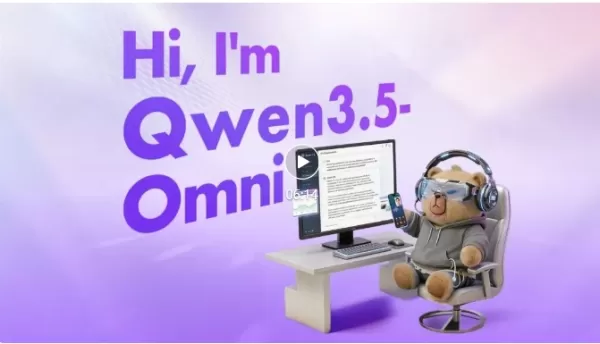
Tongyi Lab officially launched the new multimodal large model Qwen3.5-Omni last night. This model represents a significant leap forward in comprehension, interaction, and task execution compared to its predecessor, moving AI from a "screen-bound assistant" to an "intelligent agent that understands the physical world."
Core Advancements: Full Modality and 215 SOTA Benchmarks
Qwen3.5-Omni features a native "Full Modality" architecture, enabling it to seamlessly process text, images, audio, and video. Across evaluations covering audio-visual analysis, reasoning, dialogue, and translation, the model achieved 215 State-of-the-Art (SOTA) results. Notably, its general audio understanding and recognition capabilities have surpassed models like Gemini-3.1Pro, while its visual and text performance remains top-tier, matching its counterpart, the Qwen3.5 model of similar scale.
Technical Architecture: Hybrid-Attention MoE
The model builds on the classic Thinker-Talker framework with a foundational architectural overhaul:
Thinker (Understanding Center): Upgraded to a Hybrid-Attention Mixture of Experts (MoE), supporting an ultra-long context of 256K tokens. This allows it to process up to 10 hours of audio or 1 hour of video, accurately capturing fine-grained details in lengthy sequences using TMRoPE technology.
Talker (Expression Center): Incorporates new ARIA technology and RVQ coding, replacing computationally heavy DiT processes. This not only addresses common audio generation issues like word skipping and number mispronunciation but also endows the model with robust real-time voice control abilities.
Real-World Applications: From Vibe Coding to Voice Cloning
The capabilities of Qwen3.5-Omni enable several transformative application scenarios:
Natural Emergent Vibe Coding: The model exhibits impressive code comprehension and generation without specific training, allowing it to produce Python code or front-end prototypes directly from video logic.
Human-Like Real-Time Interaction: Supports semantic interruption. It can differentiate between background noise (like a cough) and intentional interruptions, and users can adjust tone (e.g., "happy") and volume via simple instructions.
Fine-Grained Video Analysis: Can generate structured, time-stamped captions, precisely identifying actions, background music shifts, and camera transitions within videos.
Personalized Voice Cloning: Users can create a highly natural, personalized "digital voice" by uploading a short audio sample, with support for 113 languages.
Qwen3.5-Omni is now available on the Alibaba Cloud BaiLian platform in Plus, Flash, and Light versions. A real-time dialogue (Realtime) API and Demo are also accessible through the ModelScope community.
Related article
 Former OpenAI Researcher Barrett Zoph Returns to Google to Support Gemini Development
Barret Zoph, who previously abruptly left and joined OpenAI due to a disagreement with Thinking Machines Lab CEO Miriam Mularati, has once again changed employers. Alphabet's Google announced that Zoph will return as Vice President of Research, bring
How Recursive Intelligence Raised $335M at $4B Valuation in 4 Months
The co-founders of startup Ricursive Intelligence seemed destined to be co-founders.Anna Goldie, CEO, and Azalia Mirhoseini, CTO, are so well-known in the AI community that they were among those AI engineers who “got those weird emails from Zuckerber
AI race won’t wait, nor will this TechCrunch Disrupt 25% discount
Every founder building in AI right now is asking the same question: Are we moving fast enough, and effectively enough? TechCrunch Disrupt 2026 puts you in the same room as the people wrestling with that existential question at the highest levels. Fro
Related Special Topic Recommendations
Design & Art
Former OpenAI Researcher Barrett Zoph Returns to Google to Support Gemini Development
Barret Zoph, who previously abruptly left and joined OpenAI due to a disagreement with Thinking Machines Lab CEO Miriam Mularati, has once again changed employers. Alphabet's Google announced that Zoph will return as Vice President of Research, bring
How Recursive Intelligence Raised $335M at $4B Valuation in 4 Months
The co-founders of startup Ricursive Intelligence seemed destined to be co-founders.Anna Goldie, CEO, and Azalia Mirhoseini, CTO, are so well-known in the AI community that they were among those AI engineers who “got those weird emails from Zuckerber
AI race won’t wait, nor will this TechCrunch Disrupt 25% discount
Every founder building in AI right now is asking the same question: Are we moving fast enough, and effectively enough? TechCrunch Disrupt 2026 puts you in the same room as the people wrestling with that existential question at the highest levels. Fro
Related Special Topic Recommendations
Design & Art
 Top AI Illustration Tools: Create Editorial Scenes and Cover Art Faster
2026 Latest Top-rated AI Illustration Tools: Our curated list features the best powerfully designed tools for creating stunning editorial scenes and eye-catching cover art quickly. Each option has gone through rigorous real-world tests, offering a free vs paid comparison to help you find the perfect match for your workflow. Try these must-try solutions today to unlock your AI edge and boost your creative productivity. Explore now at XIX.AI.
 10 tools
 xix.ai
Education and Learning
Top AI Tutors for Exam Prep: Practice Math, Science, and English
xix.ai
Education and Learning
Top AI Tutors for Exam Prep: Practice Math, Science, and English
2026 Latest Top-Rated Best AI Tutors for Exam Prep are here on XIX.AI! Our curated list features powerful game-changing tools that offer free vs paid comparison, real-world tests, and weekly updated rankings. They help boost your writing efficiency, simplify complex topic learning, and unlock your academic potential. Explore now to Discover your perfect exam prep tool and Start creating today to Unlock your AI edge!
10 tools
xix.ai
Finance
AI Budget Planning Tools for Personal Money Management
2026 Latest Best Top-Rated AI Budget Planning Tools for Personal Money Management are here on XIX.AI! This curated collection features powerful, game-changing solutions that help you conduct real-world tests, understand spending habits, and create personalized plans to boost productivity. Enjoy a free vs paid comparison along with detailed rankings. Must-try tools designed to simplify money management and unlock your AI edge. Explore now!
11 tools
xix.ai
Health & Wellness
AI Sleep Tracking Assistants: Improve Recovery with Better Bedtime Habits
2026 Latest Best Top-Rated AI Sleep Tracking Assistants curated for ultimate recovery. This fully updated weekly guide features powerful tools that deliver real-world tests, free vs paid comparison, and detailed rankings to help you find the must-try solution that boosts sleep quality and supports better bedtime habits. Explore now at XIX.AI to Unlock your AI edge.
10 tools
xix.ai
Data Analysis
AI SQL Copilots for Product and Revenue Analytics
2026 Latest Best Top-Rated AI SQL Copilots for Product and Revenue Analytics! XIX.AI has curated a powerful, game-changing collection of must-try tools that undergo real-world tests through weekly updated rankings. These tools help users boost productivity significantly by accelerating data analysis, streamlining complex queries, and generating accurate insights to drive smarter business decisions. Explore now to Discover your perfect tool for unlocking your AI edge!
14 tools
xix.ai
Education and Learning
Best AI Homework Helpers That Teach: Learn Concepts, Not Just Answers
2026 Latest Best Top-Rated AI Homework Helpers That Teach Core Concepts Not Just Answers Powerful Tools for Students Must-Try Curated List Weekly Updated Free vs Paid Comparison Real-World Tests Accurate Rankings to Help You Unlock Your Full Learning Potential Explore now to Discover your perfect tool for smarter studying.
10 tools
xix.ai

 Comments (1)
0/500
Comments (1)
0/500
![ScottWalker]()
'Screen-bound assistant'? More like screen-bound hype. 😏 215 SOTA benchmarks is impressive, but let's see how it performs in real-world chaos. Still, exciting times for multimodal AI!
Tongyi Lab officially launched the new multimodal large model Qwen3.5-Omni last night. This model represents a significant leap forward in comprehension, interaction, and task execution compared to its predecessor, moving AI from a "screen-bound assistant" to an "intelligent agent that understands the physical world."
Core Advancements: Full Modality and 215 SOTA Benchmarks
Qwen3.5-Omni features a native "Full Modality" architecture, enabling it to seamlessly process text, images, audio, and video. Across evaluations covering audio-visual analysis, reasoning, dialogue, and translation, the model achieved 215 State-of-the-Art (SOTA) results. Notably, its general audio understanding and recognition capabilities have surpassed models like Gemini-3.1Pro, while its visual and text performance remains top-tier, matching its counterpart, the Qwen3.5 model of similar scale.
Technical Architecture: Hybrid-Attention MoE
The model builds on the classic Thinker-Talker framework with a foundational architectural overhaul:
Thinker (Understanding Center): Upgraded to a Hybrid-Attention Mixture of Experts (MoE), supporting an ultra-long context of 256K tokens. This allows it to process up to 10 hours of audio or 1 hour of video, accurately capturing fine-grained details in lengthy sequences using TMRoPE technology.
Talker (Expression Center): Incorporates new ARIA technology and RVQ coding, replacing computationally heavy DiT processes. This not only addresses common audio generation issues like word skipping and number mispronunciation but also endows the model with robust real-time voice control abilities.
Real-World Applications: From Vibe Coding to Voice Cloning
The capabilities of Qwen3.5-Omni enable several transformative application scenarios:
Natural Emergent Vibe Coding: The model exhibits impressive code comprehension and generation without specific training, allowing it to produce Python code or front-end prototypes directly from video logic.
Human-Like Real-Time Interaction: Supports semantic interruption. It can differentiate between background noise (like a cough) and intentional interruptions, and users can adjust tone (e.g., "happy") and volume via simple instructions.
Fine-Grained Video Analysis: Can generate structured, time-stamped captions, precisely identifying actions, background music shifts, and camera transitions within videos.
Personalized Voice Cloning: Users can create a highly natural, personalized "digital voice" by uploading a short audio sample, with support for 113 languages.
Qwen3.5-Omni is now available on the Alibaba Cloud BaiLian platform in Plus, Flash, and Light versions. A real-time dialogue (Realtime) API and Demo are also accessible through the ModelScope community.








 Former OpenAI Researcher Barrett Zoph Returns to Google to Support Gemini Development
Barret Zoph, who previously abruptly left and joined OpenAI due to a disagreement with Thinking Machines Lab CEO Miriam Mularati, has once again changed employers. Alphabet's Google announced that Zoph will return as Vice President of Research, bring
Former OpenAI Researcher Barrett Zoph Returns to Google to Support Gemini Development
Barret Zoph, who previously abruptly left and joined OpenAI due to a disagreement with Thinking Machines Lab CEO Miriam Mularati, has once again changed employers. Alphabet's Google announced that Zoph will return as Vice President of Research, bring
 How Recursive Intelligence Raised $335M at $4B Valuation in 4 Months
The co-founders of startup Ricursive Intelligence seemed destined to be co-founders.Anna Goldie, CEO, and Azalia Mirhoseini, CTO, are so well-known in the AI community that they were among those AI engineers who “got those weird emails from Zuckerber
How Recursive Intelligence Raised $335M at $4B Valuation in 4 Months
The co-founders of startup Ricursive Intelligence seemed destined to be co-founders.Anna Goldie, CEO, and Azalia Mirhoseini, CTO, are so well-known in the AI community that they were among those AI engineers who “got those weird emails from Zuckerber
 AI race won’t wait, nor will this TechCrunch Disrupt 25% discount
Every founder building in AI right now is asking the same question: Are we moving fast enough, and effectively enough? TechCrunch Disrupt 2026 puts you in the same room as the people wrestling with that existential question at the highest levels. Fro
AI race won’t wait, nor will this TechCrunch Disrupt 25% discount
Every founder building in AI right now is asking the same question: Are we moving fast enough, and effectively enough? TechCrunch Disrupt 2026 puts you in the same room as the people wrestling with that existential question at the highest levels. Fro

2026 Latest Top-rated AI Illustration Tools: Our curated list features the best powerfully designed tools for creating stunning editorial scenes and eye-catching cover art quickly. Each option has gone through rigorous real-world tests, offering a free vs paid comparison to help you find the perfect match for your workflow. Try these must-try solutions today to unlock your AI edge and boost your creative productivity. Explore now at XIX.AI.
10 tools
xix.ai

2026 Latest Top-Rated Best AI Tutors for Exam Prep are here on XIX.AI! Our curated list features powerful game-changing tools that offer free vs paid comparison, real-world tests, and weekly updated rankings. They help boost your writing efficiency, simplify complex topic learning, and unlock your academic potential. Explore now to Discover your perfect exam prep tool and Start creating today to Unlock your AI edge!
10 tools
xix.ai

2026 Latest Best Top-Rated AI Budget Planning Tools for Personal Money Management are here on XIX.AI! This curated collection features powerful, game-changing solutions that help you conduct real-world tests, understand spending habits, and create personalized plans to boost productivity. Enjoy a free vs paid comparison along with detailed rankings. Must-try tools designed to simplify money management and unlock your AI edge. Explore now!
11 tools
xix.ai

2026 Latest Best Top-Rated AI Sleep Tracking Assistants curated for ultimate recovery. This fully updated weekly guide features powerful tools that deliver real-world tests, free vs paid comparison, and detailed rankings to help you find the must-try solution that boosts sleep quality and supports better bedtime habits. Explore now at XIX.AI to Unlock your AI edge.
10 tools
xix.ai

2026 Latest Best Top-Rated AI SQL Copilots for Product and Revenue Analytics! XIX.AI has curated a powerful, game-changing collection of must-try tools that undergo real-world tests through weekly updated rankings. These tools help users boost productivity significantly by accelerating data analysis, streamlining complex queries, and generating accurate insights to drive smarter business decisions. Explore now to Discover your perfect tool for unlocking your AI edge!
14 tools
xix.ai

2026 Latest Best Top-Rated AI Homework Helpers That Teach Core Concepts Not Just Answers Powerful Tools for Students Must-Try Curated List Weekly Updated Free vs Paid Comparison Real-World Tests Accurate Rankings to Help You Unlock Your Full Learning Potential Explore now to Discover your perfect tool for smarter studying.
10 tools
xix.ai

'Screen-bound assistant'? More like screen-bound hype. 😏 215 SOTA benchmarks is impressive, but let's see how it performs in real-world chaos. Still, exciting times for multimodal AI!












