


 Home
HomeHow to optimize communication and sociability for productive meetings in 2025?
Meetings are essential for collaboration, but they often fall short on efficiency. What if you could strategically design interactions to guarantee peak productivity? This article explores how to optimize meetings by pairing participants according to their sociability scores. We'll examine a Codeforces problem and its clever solution using priority queues, providing a framework for improving communication and ensuring every meeting is valuable. Turn your meeting space from a point of frustration into a center for effective discussion and decisive action. By grasping the principles of sociability and applying algorithmic strategies, you can achieve a new standard of meeting productivity, fostering the free flow of ideas and efficient decision-making. Let's get started!
Key Points
The core challenge is to maximize conversations in a meeting by strategically pairing individuals based on their sociability scores.
A priority queue efficiently manages and pairs the individuals with the highest remaining sociability.
The solution guarantees that each person only participates in as many conversations as their sociability score permits.
Effective pairing strategies are fundamental to achieving the best possible meeting productivity.
This problem underscores the value of algorithmic thinking in optimizing real-world communication.
Understanding the Productive Meeting Problem
What is the Productive Meeting Problem?
The 'Productive Meeting' problem, commonly featured on competitive programming platforms like Codeforces, presents an intriguing optimization and resource allocation challenge.
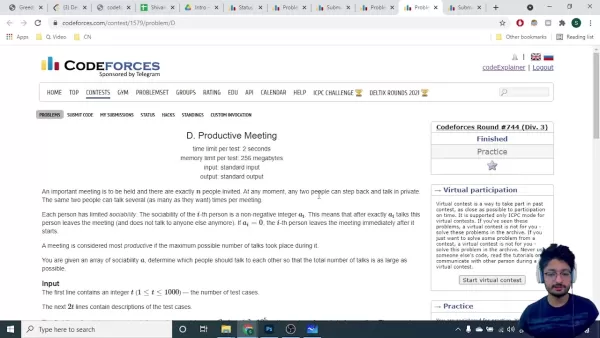
Imagine organizing a meeting with 'n' attendees. Each person has a 'sociability score' that indicates how many times they can actively engage in a one-on-one conversation. The objective is to maximize the total number of these paired interactions, or 'talks'. A 'talk' happens when two people converse, reducing each participant's sociability score by one. Once a score reaches zero, that person can no longer participate. The central difficulty is in devising a pairing strategy that yields the highest possible number of meaningful interactions. This problem touches on discrete optimization, algorithmic design, and the effective use of data structures. Solving it successfully requires logical reasoning, algorithmic planning, and practical coding skills.
Breaking Down the Problem Constraints
A thorough understanding of the constraints is crucial for solving the Productive Meeting problem effectively. These rules define the boundaries of any viable solution. 1.Limited Sociability: Every participant has a finite capacity for conversation. This prevents any single individual from monopolizing discussions and necessitates a strategic pairing approach. 2.Pairing Mechanism: Conversations are strictly between two people. Group discussions or solo monologues do not count toward the goal. 3.Sociability Reduction: Each conversation decreases the sociability score of both participants. This introduces a dynamic element, as the available 'conversational resources' change after every interaction. 4.Zero Sociability: Participants become inactive once their sociability score hits zero, effectively removing them from the pool of available partners. The algorithm must adapt to this shrinking pool. 5.Maximization Goal: The ultimate aim is to design a pairing sequence that produces the highest possible number of talks. This objective guides the entire algorithmic design process. By fully comprehending these constraints, we can develop an efficient, optimized solution that maximizes productivity within the given rules.
Priority Queues: The Algorithmic Key
How Priority Queues Optimize Pairing
A priority queue is an ideal data structure for solving the Productive Meeting problem.
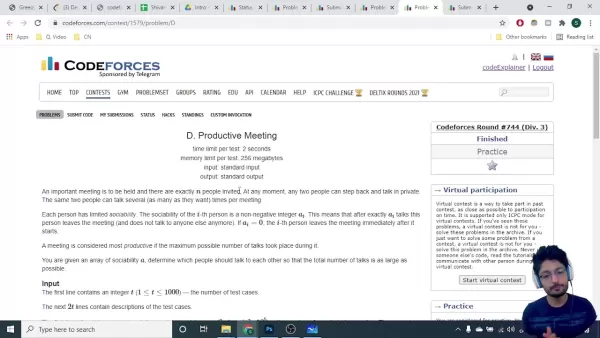
It organizes elements by priority, ensuring the highest-priority element is always accessible. Here, priority is determined by a participant's remaining sociability score.Here's how it streamlines the pairing process. 1.Maintaining Sociability Order: The priority queue keeps all participants sorted by their sociability scores, so those with the most remaining conversation potential are always at the front. 2.Efficient Selection: The algorithm can instantly retrieve the two participants with the highest scores for pairing, eliminating the need for slow, manual searches. 3.Dynamic Updates: After a pair converses, their scores decrease. The priority queue efficiently re-sorts these participants to maintain the correct order. 4.Handling Zero Sociability: When a participant's score reaches zero, they are removed from the queue. This ensures only active, available individuals are considered for future pairings. 5.Iterative Pairing: The priority queue enables a repeated pairing cycle. In each step, the top two participants are paired, their scores are updated, and they are re-inserted (if their score is still positive) or removed. By leveraging a priority queue, the algorithm dynamically adapts to the meeting's changing state, maximizing the total number of conversations and ensuring optimal productivity.
Step-by-Step Solution Using Priority Queue
Data Structures & Initialization
- Priority Queue (PQ): This is the core data structure. It stores pairs of {sociability, index}, sorted primarily by sociability (highest first). 2.Pair Vector (ans): This list stores the resulting pairs of participants who will converse. Initialize the PQ with the sociability scores and original indices (1 to n) of all participants. For example, with three participants having scores 1, 2, and 3, the PQ would initially contain {3,3}, {2,2}, {1,1}. Tracking indices is essential because the final output must identify participants by their original member number.
Pairing Logic
While the PQ contains at least two elements: 1.Extract Top Two: Remove the two elements with the highest sociability from the PQ. Let's call them 'first' and 'second'. 2.Record Pair: Store the indices of 'first' and 'second' in the 'ans' vector. 3.Decrement Sociability: Reduce the sociability scores of both 'first' and 'second' by 1, reflecting their completed conversation. 4.Re-insert (If Applicable): If 'first' and 'second' still have a positive sociability score, re-insert them back into the PQ with their updated scores.This ensures that participants remain in the pool only as long as they have conversation capacity left.
Edge Cases and Termination
This loop continues until fewer than two participants remain in the PQ, at which point no further pairings are possible. The 'ans' vector now contains the optimal sequence of paired interactions that maximizes the total talks for the meeting. Return this ans vector as the final solution. It's important to handle edge cases throughout the process. The termination condition is simply checking if the PQ size is less than two. Once this is true, the algorithm ends and returns the compiled list of conversation pairs.
Priority Queue Method for Meeting Optimization
Pros
Maximizes Engagement: Prioritizes interactions between the most sociable individuals.
Versatile: The underlying approach can be adapted to various resource allocation problems.
Adaptable: Efficiently responds to changes in participant availability during the process.
Optimizes talk count
Cons
Complexity: Requires familiarity with the priority queue data structure and its operations.
Overhead: Maintains sorting order after every update, which has a computational cost.
Non-obvious result
FAQ
Why use a priority queue instead of other data structures?
A priority queue is uniquely suited because it inherently maintains elements in a sorted order, which is critical for instantly identifying the most sociable participants. Alternative data structures would require manual sorting or searching, leading to slower and less efficient algorithms. Its ability to automatically remove members who reach zero capacity also contributes to an optimized solution.
Can this algorithm be applied to other resource allocation problems?
Yes, definitely. The core logic of the Productive Meeting algorithm is applicable to a wide array of resource allocation scenarios. Any situation involving limited resources that need to be paired or matched based on a weighted value can benefit from this approach. This style of problem-solving is highly relevant to numerous real-world optimization challenges, aiding significantly in data-driven decision-making.
Related Questions
How does changing the sociability score affect the pairing?
Modifying sociability scores directly influences the priority queue's order. Individuals with higher scores are given precedence for pairing. The algorithm's mechanism ensures that participants with greater remaining conversation potential engage with others first, which is key to maximizing the total talk count. A member with a high score enables more interactions with other active participants, directly impacting the efficiency and outcome of the solution.
What if the meeting rules changed to allow 3-person talks?
Allowing three-person talks would require a significant overhaul of the core algorithm. The priority queue would need to extract the top three elements in each iteration. Sociability scores would decrease by one for all three participants in a group talk. The re-insertion logic would also need adjustment to handle three updated participants. Furthermore, the termination condition would change, ending the process when fewer than three members remain in the queue.
Related article
 Anthropic Eyes $6B Acquisition of AI Startup Decart
The AI sector could be approaching a significant new acquisition. Reports indicate that Anthropic, a leading AI firm, is engaged in advanced talks to acquire the startup Decart. The transaction is valued at roughly $6 billion.Decart, a fast-rising te
Sun Zifeng to Visit South Korea Next Month, Targeting HBM4; Samsung May Join AMD AI Accelerator Memory Supply Chain
Following Dr. Lisa Su’s strategic roadmap, AMD has turned its attention to South Korea. Reports from September 30 indicate that she plans to visit the country next month for in-person discussions with Samsung Electronics executives, centering on AI c
AI² Robotics raises $735M at $3B valuation for wheeled humanoid robots
AI2 manufactures wheeled humanoid robots rather than bipedal systems, trading mobility range for mechanical simplicity and durability. | Credit: Ai2 RoboticsAI² Robotics has secured approximately $735 million in a new financing round, elevating its v
Related Special Topic Recommendations
Video creation
Anthropic Eyes $6B Acquisition of AI Startup Decart
The AI sector could be approaching a significant new acquisition. Reports indicate that Anthropic, a leading AI firm, is engaged in advanced talks to acquire the startup Decart. The transaction is valued at roughly $6 billion.Decart, a fast-rising te
Sun Zifeng to Visit South Korea Next Month, Targeting HBM4; Samsung May Join AMD AI Accelerator Memory Supply Chain
Following Dr. Lisa Su’s strategic roadmap, AMD has turned its attention to South Korea. Reports from September 30 indicate that she plans to visit the country next month for in-person discussions with Samsung Electronics executives, centering on AI c
AI² Robotics raises $735M at $3B valuation for wheeled humanoid robots
AI2 manufactures wheeled humanoid robots rather than bipedal systems, trading mobility range for mechanical simplicity and durability. | Credit: Ai2 RoboticsAI² Robotics has secured approximately $735 million in a new financing round, elevating its v
Related Special Topic Recommendations
Video creation
 Best AI Screen Recording Editors for Product Demos, Walkthroughs, and Training Clips
2026 Latest Best Top-rated AI screen recording editors curated by XIX.AI for product demos, walkthroughs, and training clips. These powerful game-changing tools offer real-world tests, free vs paid comparison, and weekly updated rankings to help you boost productivity significantly. Explore now to Discover your perfect tool for streamlining creative workflows! 238 characters
 10 tools
 xix.ai
Video creation
Best AI Screen Recording Editors for Product Demo Videos
xix.ai
Video creation
Best AI Screen Recording Editors for Product Demo Videos
2026 Latest Best Top-rated AI screen recording editors for product demo videos are here on XIX.AI! This curated list features powerful, game-changing tools that help you create professional-quality demos fast, boost writing efficiency, and deliver seamless results. Get a free vs paid comparison, see real-world tests, and check our updated weekly rankings. Explore now to discover your perfect tool and unlock your AI edge!
9 tools
xix.ai
design
AI Logo Drafting Tools for Early Brand Concepts
2026 Latest Best Top-Rated AI Logo Drafting Tools for Early Brand Concepts! This curated list features powerful game-changing solutions that help entrepreneurs and creatives quickly create professional logo designs, boost branding efficiency, and stay ahead in the competitive market. XIX.AI offers a free vs paid comparison along with real-world tests and weekly updated rankings to help you find the perfect tool. Explore now to Unlock your AI edge!
9 tools
xix.ai
Video creation
AI Short-Form Video Hook Generators for Reels and Shorts
2026 Latest Best Top-Rated AI Short-Form Video Hook Generators for Reels and Shorts are here on XIX.AI! This curated collection features powerful, game-changing tools that go through rigorous real-world tests to deliver must-try content ideas fast. You’ll also find a detailed free vs paid comparison along with updated weekly rankings. Explore now to discover your perfect tool and boost your creativity instantly!
10 tools
xix.ai
automation
Best AI Browser Automation Tools for Web Operations
2026 Latest Best Top-rated AI Browser Automation Tools for Web Operations are here on XIX.AI! This curated list features powerful, game-changing solutions that help boost productivity dramatically through real-world tests and strict rankings. We also provide a free vs paid comparison to help you choose the perfect option for streamlining web tasks, enhancing automation efficiency, and unlocking your AI edge. Explore now!
9 tools
xix.ai
Health & Wellness
AI Wellness Tools for Sleep and Habit Tracking
2026 Latest Best Top-Rated AI Wellness Tools for Sleep and Habit Tracking! XIX.AI curates a powerful, game-changing collection of must-try tools that offer real-world tests and detailed free vs paid comparison. These top-rated solutions help users boost sleep quality, monitor daily habits effectively, and unlock significant productivity improvements. Explore now to Discover your perfect tool and Start creating today to Unlock your AI edge!
11 tools
xix.ai

 Comments (1)
0/500
Comments (1)
0/500
![RogerRoberts]()
¿Organizar reuniones según intereses o personalidad? Interesante enfoque, aunque dudo de la escala en grandes empresas. Lo que no cubre es el efecto 'zoom fatigue' tras videollamadas largas. 😅 Espero que en 2025 logremos más equilibrio entre eficiencia y humanidad.
Meetings are essential for collaboration, but they often fall short on efficiency. What if you could strategically design interactions to guarantee peak productivity? This article explores how to optimize meetings by pairing participants according to their sociability scores. We'll examine a Codeforces problem and its clever solution using priority queues, providing a framework for improving communication and ensuring every meeting is valuable. Turn your meeting space from a point of frustration into a center for effective discussion and decisive action. By grasping the principles of sociability and applying algorithmic strategies, you can achieve a new standard of meeting productivity, fostering the free flow of ideas and efficient decision-making. Let's get started!
Key Points
The core challenge is to maximize conversations in a meeting by strategically pairing individuals based on their sociability scores.
A priority queue efficiently manages and pairs the individuals with the highest remaining sociability.
The solution guarantees that each person only participates in as many conversations as their sociability score permits.
Effective pairing strategies are fundamental to achieving the best possible meeting productivity.
This problem underscores the value of algorithmic thinking in optimizing real-world communication.
Understanding the Productive Meeting Problem
What is the Productive Meeting Problem?
The 'Productive Meeting' problem, commonly featured on competitive programming platforms like Codeforces, presents an intriguing optimization and resource allocation challenge.
Imagine organizing a meeting with 'n' attendees. Each person has a 'sociability score' that indicates how many times they can actively engage in a one-on-one conversation. The objective is to maximize the total number of these paired interactions, or 'talks'. A 'talk' happens when two people converse, reducing each participant's sociability score by one. Once a score reaches zero, that person can no longer participate. The central difficulty is in devising a pairing strategy that yields the highest possible number of meaningful interactions. This problem touches on discrete optimization, algorithmic design, and the effective use of data structures. Solving it successfully requires logical reasoning, algorithmic planning, and practical coding skills.
Breaking Down the Problem Constraints
A thorough understanding of the constraints is crucial for solving the Productive Meeting problem effectively. These rules define the boundaries of any viable solution. 1.Limited Sociability: Every participant has a finite capacity for conversation. This prevents any single individual from monopolizing discussions and necessitates a strategic pairing approach. 2.Pairing Mechanism: Conversations are strictly between two people. Group discussions or solo monologues do not count toward the goal. 3.Sociability Reduction: Each conversation decreases the sociability score of both participants. This introduces a dynamic element, as the available 'conversational resources' change after every interaction. 4.Zero Sociability: Participants become inactive once their sociability score hits zero, effectively removing them from the pool of available partners. The algorithm must adapt to this shrinking pool. 5.Maximization Goal: The ultimate aim is to design a pairing sequence that produces the highest possible number of talks. This objective guides the entire algorithmic design process. By fully comprehending these constraints, we can develop an efficient, optimized solution that maximizes productivity within the given rules.
Priority Queues: The Algorithmic Key
How Priority Queues Optimize Pairing
A priority queue is an ideal data structure for solving the Productive Meeting problem.
It organizes elements by priority, ensuring the highest-priority element is always accessible. Here, priority is determined by a participant's remaining sociability score.Here's how it streamlines the pairing process. 1.Maintaining Sociability Order: The priority queue keeps all participants sorted by their sociability scores, so those with the most remaining conversation potential are always at the front. 2.Efficient Selection: The algorithm can instantly retrieve the two participants with the highest scores for pairing, eliminating the need for slow, manual searches. 3.Dynamic Updates: After a pair converses, their scores decrease. The priority queue efficiently re-sorts these participants to maintain the correct order. 4.Handling Zero Sociability: When a participant's score reaches zero, they are removed from the queue. This ensures only active, available individuals are considered for future pairings. 5.Iterative Pairing: The priority queue enables a repeated pairing cycle. In each step, the top two participants are paired, their scores are updated, and they are re-inserted (if their score is still positive) or removed. By leveraging a priority queue, the algorithm dynamically adapts to the meeting's changing state, maximizing the total number of conversations and ensuring optimal productivity.
Step-by-Step Solution Using Priority Queue
Data Structures & Initialization
- Priority Queue (PQ): This is the core data structure. It stores pairs of {sociability, index}, sorted primarily by sociability (highest first). 2.Pair Vector (ans): This list stores the resulting pairs of participants who will converse. Initialize the PQ with the sociability scores and original indices (1 to n) of all participants. For example, with three participants having scores 1, 2, and 3, the PQ would initially contain {3,3}, {2,2}, {1,1}. Tracking indices is essential because the final output must identify participants by their original member number.
Pairing Logic
While the PQ contains at least two elements: 1.Extract Top Two: Remove the two elements with the highest sociability from the PQ. Let's call them 'first' and 'second'. 2.Record Pair: Store the indices of 'first' and 'second' in the 'ans' vector. 3.Decrement Sociability: Reduce the sociability scores of both 'first' and 'second' by 1, reflecting their completed conversation. 4.Re-insert (If Applicable): If 'first' and 'second' still have a positive sociability score, re-insert them back into the PQ with their updated scores.This ensures that participants remain in the pool only as long as they have conversation capacity left.
Edge Cases and Termination
This loop continues until fewer than two participants remain in the PQ, at which point no further pairings are possible. The 'ans' vector now contains the optimal sequence of paired interactions that maximizes the total talks for the meeting. Return this ans vector as the final solution. It's important to handle edge cases throughout the process. The termination condition is simply checking if the PQ size is less than two. Once this is true, the algorithm ends and returns the compiled list of conversation pairs.
Priority Queue Method for Meeting Optimization
Pros
Maximizes Engagement: Prioritizes interactions between the most sociable individuals.
Versatile: The underlying approach can be adapted to various resource allocation problems.
Adaptable: Efficiently responds to changes in participant availability during the process.
Optimizes talk count
Cons
Complexity: Requires familiarity with the priority queue data structure and its operations.
Overhead: Maintains sorting order after every update, which has a computational cost.
Non-obvious result
FAQ
Why use a priority queue instead of other data structures?
A priority queue is uniquely suited because it inherently maintains elements in a sorted order, which is critical for instantly identifying the most sociable participants. Alternative data structures would require manual sorting or searching, leading to slower and less efficient algorithms. Its ability to automatically remove members who reach zero capacity also contributes to an optimized solution.
Can this algorithm be applied to other resource allocation problems?
Yes, definitely. The core logic of the Productive Meeting algorithm is applicable to a wide array of resource allocation scenarios. Any situation involving limited resources that need to be paired or matched based on a weighted value can benefit from this approach. This style of problem-solving is highly relevant to numerous real-world optimization challenges, aiding significantly in data-driven decision-making.
Related Questions
How does changing the sociability score affect the pairing?
Modifying sociability scores directly influences the priority queue's order. Individuals with higher scores are given precedence for pairing. The algorithm's mechanism ensures that participants with greater remaining conversation potential engage with others first, which is key to maximizing the total talk count. A member with a high score enables more interactions with other active participants, directly impacting the efficiency and outcome of the solution.
What if the meeting rules changed to allow 3-person talks?
Allowing three-person talks would require a significant overhaul of the core algorithm. The priority queue would need to extract the top three elements in each iteration. Sociability scores would decrease by one for all three participants in a group talk. The re-insertion logic would also need adjustment to handle three updated participants. Furthermore, the termination condition would change, ending the process when fewer than three members remain in the queue.








 Anthropic Eyes $6B Acquisition of AI Startup Decart
The AI sector could be approaching a significant new acquisition. Reports indicate that Anthropic, a leading AI firm, is engaged in advanced talks to acquire the startup Decart. The transaction is valued at roughly $6 billion.Decart, a fast-rising te
Anthropic Eyes $6B Acquisition of AI Startup Decart
The AI sector could be approaching a significant new acquisition. Reports indicate that Anthropic, a leading AI firm, is engaged in advanced talks to acquire the startup Decart. The transaction is valued at roughly $6 billion.Decart, a fast-rising te
 Sun Zifeng to Visit South Korea Next Month, Targeting HBM4; Samsung May Join AMD AI Accelerator Memory Supply Chain
Following Dr. Lisa Su’s strategic roadmap, AMD has turned its attention to South Korea. Reports from September 30 indicate that she plans to visit the country next month for in-person discussions with Samsung Electronics executives, centering on AI c
Sun Zifeng to Visit South Korea Next Month, Targeting HBM4; Samsung May Join AMD AI Accelerator Memory Supply Chain
Following Dr. Lisa Su’s strategic roadmap, AMD has turned its attention to South Korea. Reports from September 30 indicate that she plans to visit the country next month for in-person discussions with Samsung Electronics executives, centering on AI c
 AI² Robotics raises $735M at $3B valuation for wheeled humanoid robots
AI2 manufactures wheeled humanoid robots rather than bipedal systems, trading mobility range for mechanical simplicity and durability. | Credit: Ai2 RoboticsAI² Robotics has secured approximately $735 million in a new financing round, elevating its v
AI² Robotics raises $735M at $3B valuation for wheeled humanoid robots
AI2 manufactures wheeled humanoid robots rather than bipedal systems, trading mobility range for mechanical simplicity and durability. | Credit: Ai2 RoboticsAI² Robotics has secured approximately $735 million in a new financing round, elevating its v

2026 Latest Best Top-rated AI screen recording editors curated by XIX.AI for product demos, walkthroughs, and training clips. These powerful game-changing tools offer real-world tests, free vs paid comparison, and weekly updated rankings to help you boost productivity significantly. Explore now to Discover your perfect tool for streamlining creative workflows! 238 characters
10 tools
xix.ai

2026 Latest Best Top-rated AI screen recording editors for product demo videos are here on XIX.AI! This curated list features powerful, game-changing tools that help you create professional-quality demos fast, boost writing efficiency, and deliver seamless results. Get a free vs paid comparison, see real-world tests, and check our updated weekly rankings. Explore now to discover your perfect tool and unlock your AI edge!
9 tools
xix.ai

2026 Latest Best Top-Rated AI Logo Drafting Tools for Early Brand Concepts! This curated list features powerful game-changing solutions that help entrepreneurs and creatives quickly create professional logo designs, boost branding efficiency, and stay ahead in the competitive market. XIX.AI offers a free vs paid comparison along with real-world tests and weekly updated rankings to help you find the perfect tool. Explore now to Unlock your AI edge!
9 tools
xix.ai

2026 Latest Best Top-Rated AI Short-Form Video Hook Generators for Reels and Shorts are here on XIX.AI! This curated collection features powerful, game-changing tools that go through rigorous real-world tests to deliver must-try content ideas fast. You’ll also find a detailed free vs paid comparison along with updated weekly rankings. Explore now to discover your perfect tool and boost your creativity instantly!
10 tools
xix.ai

2026 Latest Best Top-rated AI Browser Automation Tools for Web Operations are here on XIX.AI! This curated list features powerful, game-changing solutions that help boost productivity dramatically through real-world tests and strict rankings. We also provide a free vs paid comparison to help you choose the perfect option for streamlining web tasks, enhancing automation efficiency, and unlocking your AI edge. Explore now!
9 tools
xix.ai

2026 Latest Best Top-Rated AI Wellness Tools for Sleep and Habit Tracking! XIX.AI curates a powerful, game-changing collection of must-try tools that offer real-world tests and detailed free vs paid comparison. These top-rated solutions help users boost sleep quality, monitor daily habits effectively, and unlock significant productivity improvements. Explore now to Discover your perfect tool and Start creating today to Unlock your AI edge!
11 tools
xix.ai

¿Organizar reuniones según intereses o personalidad? Interesante enfoque, aunque dudo de la escala en grandes empresas. Lo que no cubre es el efecto 'zoom fatigue' tras videollamadas largas. 😅 Espero que en 2025 logremos más equilibrio entre eficiencia y humanidad.












