


 Home
HomePeer unveils AI-powered Global Simulation: A real-time digital twin of Earth
Peer, an AI-native platform transforming the internet into an enduring, interactive universe, has unveiled its Global Simulation—a real-time digital Earth where users appear as avatars, connect geographically, and cultivate relationships within a living spatial network.
Designed as a foundational ecosystem for autonomous AI, Peer serves as an operating system where artificial intelligence can navigate, perceive, and interact within a shared world. "By embodying AI within a persistent spatial environment, we're creating natural interfaces for human-AI collaboration," explained Tony Tran, Peer's CEO, during a GamesBeat interview. The platform supports both Web3 and Web2 connectivity.
"We've built the planet's first operating system that gives AI physical form and habitable space," Tran revealed. "Our planet-scale simulation works across all devices—from smartphones to VR headsets—because we engineered everything from the ground up."
The California-based startup has secured $68.5 million in funding, including recent infusions of $10.5 million and $3 million. With 65 team members actively expanding, Peer's application is currently available on Google Play and the Apple App Store.

Peer bridges the physical and digital worlds, connecting friends across both realms. "Our Global Simulation anchors digital experiences to real-world geography," Tran elaborated. "Users can instantly transport to Japan or virtually stroll neighborhoods while their AI companion—aware of physical locations—floats alongside, learning from environmental cues and social patterns."
Each user receives a personalized AI agent that learns and evolves alongside them, making artificial intelligence feel genuinely embodied and indispensable in daily life.
"This restores the tangible presence we lost from early internet days," Tran noted. "While Ready Player One-level immersion might take 5-10 years, we're making spatial computing accessible today—no expensive headsets required."
The platform merges geographic authenticity with imaginative potential through augmented reality, creating what Tran calls "a portal to emergent digital civilization—a viral social layer that monetizes like gaming while establishing foundational AI economies."
Where geography meets digital canvas
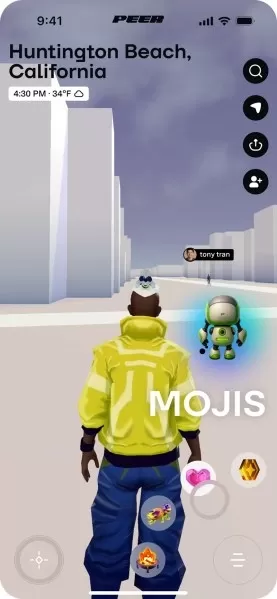
Peer's living 3D environment evolves continuously. Peer's core innovation lies in its dynamic global map—not a game world, but a persistent layer blending physical and digital realities. GPS and Virtual Positioning System technologies transform cartography into social space where communities organically form around shared locations.
"Unlike Pokémon Go's location-locked gameplay," Tran explained, "Peer enables global teleportation—explore Parisian cafés or Tokyo streets from your living room, then physically visit those locations later."
Tran describes Peer as "Roblox meets Pokémon Go meets Discord—but persistently scalable beyond entertainment into commerce, utility, and creation."
Architecture for digital embodiment

Tony Tran, Peer's visionary CEO. The platform's launch features include:
• Real-time Earth simulation enabling seamless global avatar navigation
• Customizable presence controls—from fully visible to completely private
• Location-aware interfaces replacing addictive feeds with meaningful discovery
• Composable World Layering—one planet, infinite personalized experiences
Two users standing in virtual Times Square might encounter completely different events, advertisements, or portals based on personal preferences—creating endless possibilities for creators and brands.
AI as your digital proxy
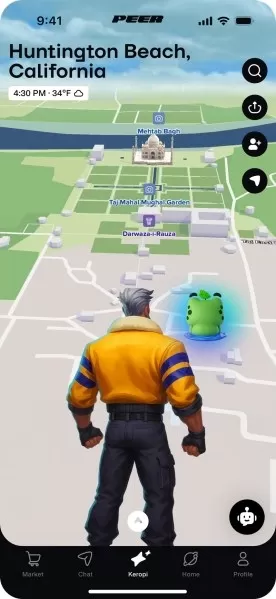
Peer blends real-world and digital gameplay seamlessly. "Imagine requesting historical overlays—viewing Stone Age Manhattan," Tran demonstrated. Unlike conventional AR games, Peer lets users literally step into maps as MMO avatars, with real-time weather affecting digital environments.
The platform enables AI-mediated social interactions: "Your agent can initiate conversations, deliver messages, or even search neighborhoods for lost pets—cloning itself to handle multiple tasks simultaneously," Tran explained.
While supporting blockchain verification for digital assets, Peer distinguishes itself as the first truly global persistence simulation—a planet-scale MMO accessible instantly from any smartphone without servers or regional barriers.
"We've created infinite entry points," Tran concluded. "From São Paulo to Seoul, anyone can begin their AI-powered journey through this new digital frontier."
Related article
 Stripe to Acquire OpenRouter as AI Model Routing Gains Momentum
Stripe has agreed to acquire OpenRouter, an AI model-routing platform that gives developers access to hundreds of models through a single interface. The deal adds model selection and routing to Stripe’s existing work around AI usage and token-based b
Former OpenAI Researcher Barrett Zoph Returns to Google to Support Gemini Development
Barret Zoph, who previously abruptly left and joined OpenAI due to a disagreement with Thinking Machines Lab CEO Miriam Mularati, has once again changed employers. Alphabet's Google announced that Zoph will return as Vice President of Research, bring
How Recursive Intelligence Raised $335M at $4B Valuation in 4 Months
The co-founders of startup Ricursive Intelligence seemed destined to be co-founders.Anna Goldie, CEO, and Azalia Mirhoseini, CTO, are so well-known in the AI community that they were among those AI engineers who “got those weird emails from Zuckerber
Related Special Topic Recommendations
Design & Art
Stripe to Acquire OpenRouter as AI Model Routing Gains Momentum
Stripe has agreed to acquire OpenRouter, an AI model-routing platform that gives developers access to hundreds of models through a single interface. The deal adds model selection and routing to Stripe’s existing work around AI usage and token-based b
Former OpenAI Researcher Barrett Zoph Returns to Google to Support Gemini Development
Barret Zoph, who previously abruptly left and joined OpenAI due to a disagreement with Thinking Machines Lab CEO Miriam Mularati, has once again changed employers. Alphabet's Google announced that Zoph will return as Vice President of Research, bring
How Recursive Intelligence Raised $335M at $4B Valuation in 4 Months
The co-founders of startup Ricursive Intelligence seemed destined to be co-founders.Anna Goldie, CEO, and Azalia Mirhoseini, CTO, are so well-known in the AI community that they were among those AI engineers who “got those weird emails from Zuckerber
Related Special Topic Recommendations
Design & Art
 Top AI Illustration Tools: Create Editorial Scenes and Cover Art Faster
2026 Latest Top-rated AI Illustration Tools: Our curated list features the best powerfully designed tools for creating stunning editorial scenes and eye-catching cover art quickly. Each option has gone through rigorous real-world tests, offering a free vs paid comparison to help you find the perfect match for your workflow. Try these must-try solutions today to unlock your AI edge and boost your creative productivity. Explore now at XIX.AI.
 10 tools
 xix.ai
Education and Learning
Top AI Tutors for Exam Prep: Practice Math, Science, and English
xix.ai
Education and Learning
Top AI Tutors for Exam Prep: Practice Math, Science, and English
2026 Latest Top-Rated Best AI Tutors for Exam Prep are here on XIX.AI! Our curated list features powerful game-changing tools that offer free vs paid comparison, real-world tests, and weekly updated rankings. They help boost your writing efficiency, simplify complex topic learning, and unlock your academic potential. Explore now to Discover your perfect exam prep tool and Start creating today to Unlock your AI edge!
10 tools
xix.ai
Finance
AI Budget Planning Tools for Personal Money Management
2026 Latest Best Top-Rated AI Budget Planning Tools for Personal Money Management are here on XIX.AI! This curated collection features powerful, game-changing solutions that help you conduct real-world tests, understand spending habits, and create personalized plans to boost productivity. Enjoy a free vs paid comparison along with detailed rankings. Must-try tools designed to simplify money management and unlock your AI edge. Explore now!
11 tools
xix.ai
Health & Wellness
AI Sleep Tracking Assistants: Improve Recovery with Better Bedtime Habits
2026 Latest Best Top-Rated AI Sleep Tracking Assistants curated for ultimate recovery. This fully updated weekly guide features powerful tools that deliver real-world tests, free vs paid comparison, and detailed rankings to help you find the must-try solution that boosts sleep quality and supports better bedtime habits. Explore now at XIX.AI to Unlock your AI edge.
10 tools
xix.ai
Data Analysis
AI SQL Copilots for Product and Revenue Analytics
2026 Latest Best Top-Rated AI SQL Copilots for Product and Revenue Analytics! XIX.AI has curated a powerful, game-changing collection of must-try tools that undergo real-world tests through weekly updated rankings. These tools help users boost productivity significantly by accelerating data analysis, streamlining complex queries, and generating accurate insights to drive smarter business decisions. Explore now to Discover your perfect tool for unlocking your AI edge!
14 tools
xix.ai
Education and Learning
Best AI Homework Helpers That Teach: Learn Concepts, Not Just Answers
2026 Latest Best Top-Rated AI Homework Helpers That Teach Core Concepts Not Just Answers Powerful Tools for Students Must-Try Curated List Weekly Updated Free vs Paid Comparison Real-World Tests Accurate Rankings to Help You Unlock Your Full Learning Potential Explore now to Discover your perfect tool for smarter studying.
10 tools
xix.ai

 Comments (2)
0/500
Comments (2)
0/500
![RalphThomas]()
Just read this—AI building a real-time digital twin of Earth? 🤯 Sounds like a sci-fi movie but the tech is already here! Love the avatar & relationship angle, though I wonder how they’ll handle privacy & energy consumption. Could this be the next metaverse buzz or just another hype? Still, seeing the net become an interactive universe is wild.
![CharlesRoberts]()
Essa ideia de um 'gêmeo digital' da Terra em tempo real me deixa um pouco cético. Parece mais um playground para quem já está hiperconectado, mas e o impacto energético de rodar algo assim? 🤔 A ideia de avatares interagindo com o mundo físico é legal, mas a gente já não vive demais no virtual? Será que isso vai realmente 'cultivar relacionamentos' ou só criar mais conexões superficiais? Achei a proposta ambiciosa, mas com um gosto de déjà vu de outras promessas do metaverso.
Peer, an AI-native platform transforming the internet into an enduring, interactive universe, has unveiled its Global Simulation—a real-time digital Earth where users appear as avatars, connect geographically, and cultivate relationships within a living spatial network.
Designed as a foundational ecosystem for autonomous AI, Peer serves as an operating system where artificial intelligence can navigate, perceive, and interact within a shared world. "By embodying AI within a persistent spatial environment, we're creating natural interfaces for human-AI collaboration," explained Tony Tran, Peer's CEO, during a GamesBeat interview. The platform supports both Web3 and Web2 connectivity.
"We've built the planet's first operating system that gives AI physical form and habitable space," Tran revealed. "Our planet-scale simulation works across all devices—from smartphones to VR headsets—because we engineered everything from the ground up."
The California-based startup has secured $68.5 million in funding, including recent infusions of $10.5 million and $3 million. With 65 team members actively expanding, Peer's application is currently available on Google Play and the Apple App Store.
"Our Global Simulation anchors digital experiences to real-world geography," Tran elaborated. "Users can instantly transport to Japan or virtually stroll neighborhoods while their AI companion—aware of physical locations—floats alongside, learning from environmental cues and social patterns."
Each user receives a personalized AI agent that learns and evolves alongside them, making artificial intelligence feel genuinely embodied and indispensable in daily life.
"This restores the tangible presence we lost from early internet days," Tran noted. "While Ready Player One-level immersion might take 5-10 years, we're making spatial computing accessible today—no expensive headsets required."
The platform merges geographic authenticity with imaginative potential through augmented reality, creating what Tran calls "a portal to emergent digital civilization—a viral social layer that monetizes like gaming while establishing foundational AI economies."
Where geography meets digital canvas
Peer's core innovation lies in its dynamic global map—not a game world, but a persistent layer blending physical and digital realities. GPS and Virtual Positioning System technologies transform cartography into social space where communities organically form around shared locations.
"Unlike Pokémon Go's location-locked gameplay," Tran explained, "Peer enables global teleportation—explore Parisian cafés or Tokyo streets from your living room, then physically visit those locations later."
Tran describes Peer as "Roblox meets Pokémon Go meets Discord—but persistently scalable beyond entertainment into commerce, utility, and creation."
Architecture for digital embodiment
The platform's launch features include:
• Real-time Earth simulation enabling seamless global avatar navigation
• Customizable presence controls—from fully visible to completely private
• Location-aware interfaces replacing addictive feeds with meaningful discovery
• Composable World Layering—one planet, infinite personalized experiences
Two users standing in virtual Times Square might encounter completely different events, advertisements, or portals based on personal preferences—creating endless possibilities for creators and brands.
AI as your digital proxy
"Imagine requesting historical overlays—viewing Stone Age Manhattan," Tran demonstrated. Unlike conventional AR games, Peer lets users literally step into maps as MMO avatars, with real-time weather affecting digital environments.
The platform enables AI-mediated social interactions: "Your agent can initiate conversations, deliver messages, or even search neighborhoods for lost pets—cloning itself to handle multiple tasks simultaneously," Tran explained.
While supporting blockchain verification for digital assets, Peer distinguishes itself as the first truly global persistence simulation—a planet-scale MMO accessible instantly from any smartphone without servers or regional barriers.
"We've created infinite entry points," Tran concluded. "From São Paulo to Seoul, anyone can begin their AI-powered journey through this new digital frontier."








 Stripe to Acquire OpenRouter as AI Model Routing Gains Momentum
Stripe has agreed to acquire OpenRouter, an AI model-routing platform that gives developers access to hundreds of models through a single interface. The deal adds model selection and routing to Stripe’s existing work around AI usage and token-based b
Stripe to Acquire OpenRouter as AI Model Routing Gains Momentum
Stripe has agreed to acquire OpenRouter, an AI model-routing platform that gives developers access to hundreds of models through a single interface. The deal adds model selection and routing to Stripe’s existing work around AI usage and token-based b
 Former OpenAI Researcher Barrett Zoph Returns to Google to Support Gemini Development
Barret Zoph, who previously abruptly left and joined OpenAI due to a disagreement with Thinking Machines Lab CEO Miriam Mularati, has once again changed employers. Alphabet's Google announced that Zoph will return as Vice President of Research, bring
Former OpenAI Researcher Barrett Zoph Returns to Google to Support Gemini Development
Barret Zoph, who previously abruptly left and joined OpenAI due to a disagreement with Thinking Machines Lab CEO Miriam Mularati, has once again changed employers. Alphabet's Google announced that Zoph will return as Vice President of Research, bring
 How Recursive Intelligence Raised $335M at $4B Valuation in 4 Months
The co-founders of startup Ricursive Intelligence seemed destined to be co-founders.Anna Goldie, CEO, and Azalia Mirhoseini, CTO, are so well-known in the AI community that they were among those AI engineers who “got those weird emails from Zuckerber
How Recursive Intelligence Raised $335M at $4B Valuation in 4 Months
The co-founders of startup Ricursive Intelligence seemed destined to be co-founders.Anna Goldie, CEO, and Azalia Mirhoseini, CTO, are so well-known in the AI community that they were among those AI engineers who “got those weird emails from Zuckerber

2026 Latest Top-rated AI Illustration Tools: Our curated list features the best powerfully designed tools for creating stunning editorial scenes and eye-catching cover art quickly. Each option has gone through rigorous real-world tests, offering a free vs paid comparison to help you find the perfect match for your workflow. Try these must-try solutions today to unlock your AI edge and boost your creative productivity. Explore now at XIX.AI.
10 tools
xix.ai

2026 Latest Top-Rated Best AI Tutors for Exam Prep are here on XIX.AI! Our curated list features powerful game-changing tools that offer free vs paid comparison, real-world tests, and weekly updated rankings. They help boost your writing efficiency, simplify complex topic learning, and unlock your academic potential. Explore now to Discover your perfect exam prep tool and Start creating today to Unlock your AI edge!
10 tools
xix.ai

2026 Latest Best Top-Rated AI Budget Planning Tools for Personal Money Management are here on XIX.AI! This curated collection features powerful, game-changing solutions that help you conduct real-world tests, understand spending habits, and create personalized plans to boost productivity. Enjoy a free vs paid comparison along with detailed rankings. Must-try tools designed to simplify money management and unlock your AI edge. Explore now!
11 tools
xix.ai

2026 Latest Best Top-Rated AI Sleep Tracking Assistants curated for ultimate recovery. This fully updated weekly guide features powerful tools that deliver real-world tests, free vs paid comparison, and detailed rankings to help you find the must-try solution that boosts sleep quality and supports better bedtime habits. Explore now at XIX.AI to Unlock your AI edge.
10 tools
xix.ai

2026 Latest Best Top-Rated AI SQL Copilots for Product and Revenue Analytics! XIX.AI has curated a powerful, game-changing collection of must-try tools that undergo real-world tests through weekly updated rankings. These tools help users boost productivity significantly by accelerating data analysis, streamlining complex queries, and generating accurate insights to drive smarter business decisions. Explore now to Discover your perfect tool for unlocking your AI edge!
14 tools
xix.ai

2026 Latest Best Top-Rated AI Homework Helpers That Teach Core Concepts Not Just Answers Powerful Tools for Students Must-Try Curated List Weekly Updated Free vs Paid Comparison Real-World Tests Accurate Rankings to Help You Unlock Your Full Learning Potential Explore now to Discover your perfect tool for smarter studying.
10 tools
xix.ai

Just read this—AI building a real-time digital twin of Earth? 🤯 Sounds like a sci-fi movie but the tech is already here! Love the avatar & relationship angle, though I wonder how they’ll handle privacy & energy consumption. Could this be the next metaverse buzz or just another hype? Still, seeing the net become an interactive universe is wild.
Essa ideia de um 'gêmeo digital' da Terra em tempo real me deixa um pouco cético. Parece mais um playground para quem já está hiperconectado, mas e o impacto energético de rodar algo assim? 🤔 A ideia de avatares interagindo com o mundo físico é legal, mas a gente já não vive demais no virtual? Será que isso vai realmente 'cultivar relacionamentos' ou só criar mais conexões superficiais? Achei a proposta ambiciosa, mas com um gosto de déjà vu de outras promessas do metaverso.












