


 Home
HomeOsaurus Integrates Local and Cloud AI Models on Mac
As AI models become increasingly commoditized, startups are competing to develop the software layer that operates on top of them. A notable player in this field is Osaurus, an open-source, Mac-exclusive LLM server. It enables users to switch between different local or cloud-based AI models while keeping their files and tools securely on their own hardware.
Osaurus originated from the concept of a desktop AI companion called Dinoki, which co-founder Terence Pae likened to an "AI-powered Clippy." Potential customers questioned why they should purchase the app if they still had to pay for tokens—the units AI companies charge for processing prompts and generating responses.
This prompted Pae to explore the possibilities of running AI locally in greater depth.
"That's how Osaurus began," Pae, a former software engineer at Tesla and Netflix, explained to TechCrunch. The initial idea was to attempt running an AI assistant directly on a user's device. "You can accomplish nearly everything locally on your Mac, such as browsing files, accessing your web browser, and checking system configurations. I realized this positioned Osaurus perfectly as a personal AI for individual users."
Pae started developing the tool publicly as an open-source project, continuously adding features and resolving bugs throughout the process.
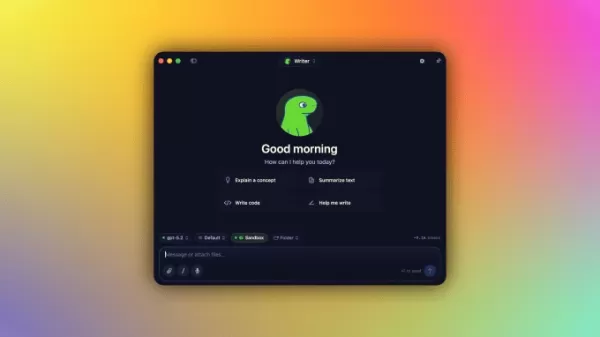
Image Credits: Osaurus, Inc.
Today, Osaurus offers flexible connections to locally hosted AI models or cloud providers like OpenAI and Anthropic. Users can freely select their preferred AI model while maintaining other aspects of the AI experience—such as the model's memory, personal files, and tools—on their own hardware.
Since different AI models possess unique strengths, this system's advantage lies in allowing users to switch to the model best suited for their specific task.
This architecture classifies Osaurus as a "harness"—a control layer that integrates various AI models, tools, and workflows through a single interface, similar to platforms like OpenClaw or Hermes. However, such tools are often designed for developers comfortable with terminal commands. In some cases, like with OpenClaw, they may also introduce security vulnerabilities.
In contrast, Osaurus provides a user-friendly interface for general consumers and addresses security by operating within a hardware-isolated, virtual sandbox. This confines the AI's access to a defined scope, protecting your computer and data.
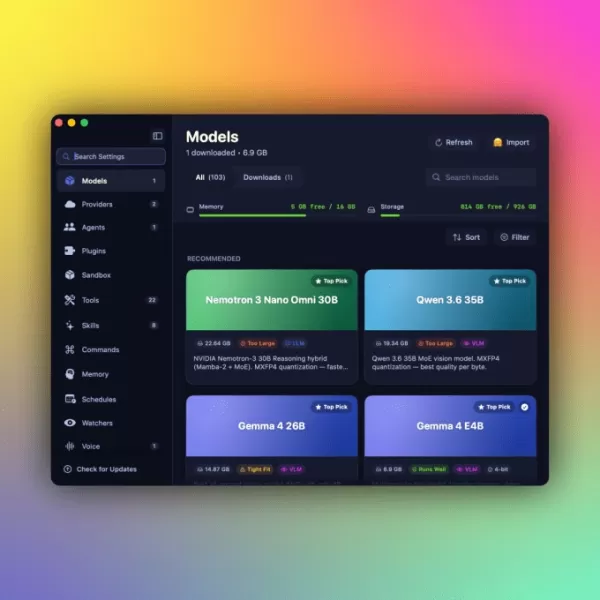
Image Credits: Osaurus, Inc.
Running AI models locally is still an emerging practice, as it demands significant resources and depends heavily on hardware. To operate local models, your system requires at least 64 GB of RAM. For larger models like DeepSeek v4, Pae recommends systems with approximately 128 GB of RAM.
Nevertheless, Pae is confident that the hardware demands for local AI will decrease over time.
"I recognize its potential because the intelligence per watt—a key metric for local AI—has been rising dramatically. It's on its own innovation trajectory. Last year, local AI struggled to complete sentences, but today it can execute tools, write code, access your browser, and even place orders on Amazon. It's continuously improving," he noted.
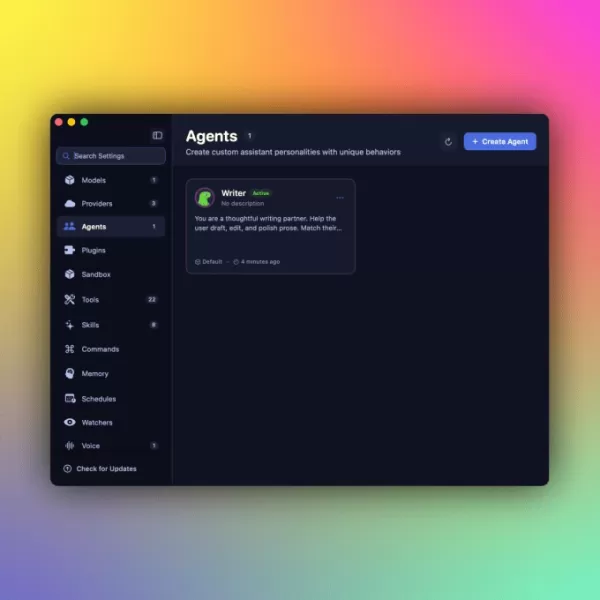
Image Credits: Osaurus, Inc.
Currently, Osaurus supports models including MiniMax M2.5, Gemma 4, Qwen3.6, GPT-OSS, Llama, and DeepSeek V4. It also integrates Apple's on-device foundation models, Liquid AI's LFM family of on-device models, and cloud connections to OpenAI, Anthropic, Gemini, xAI/Grok, Venice AI, OpenRouter, Ollama, and LM Studio.
As a full Model Context Protocol (MCP) server, it grants any MCP-compatible client access to your tools. Additionally, it comes pre-equipped with over 20 native plugins for Mail, Calendar, Vision, macOS utilities, XLSX, PPTX, Browser, Music, Git, Filesystem, Search, Fetch, and more.
A recent update added voice capability to Osaurus.
Since its launch nearly a year ago, the project has been downloaded over 112,000 times, according to its website.
The founders, including co-founder Sam Yoo, are currently participating in the New York-based startup accelerator Alliance. They are also planning future steps, which may involve offering Osaurus to businesses in sectors like legal or healthcare, where local LLMs could help address data privacy concerns.
As local AI models grow more powerful, the team believes they could reduce reliance on large-scale AI data centers.
"We're witnessing explosive growth in AI, where cloud providers must scale using massive data centers and infrastructure. Yet, we feel the value of local AI remains underappreciated," Pae stated. "Instead of depending on the cloud, organizations could deploy a Mac Studio on-premises, consuming significantly less power. You retain cloud-like capabilities without being dependent on a remote data center to run your AI," he added.
Related article
 Stripe to Acquire OpenRouter as AI Model Routing Gains Momentum
Stripe has agreed to acquire OpenRouter, an AI model-routing platform that gives developers access to hundreds of models through a single interface. The deal adds model selection and routing to Stripe’s existing work around AI usage and token-based b
Google AI Overviews Gain Ground in Search Results
According to Similarweb’s 2026 Generative AI Landscape report, Google’s AI-generated summaries appeared in 43% of US searches, a significant rise from 15% recorded a year prior.While AI Overviews present generated summaries within standard search res
Sequoia-backed Empirik raises $21M to forecast outages before they strike
Before joining Sequoia Capital in 2020 as chief digital and information officer, Avon Puri spent over a decade running infrastructure at Rubrik and VMware. Three years ago, as large language models began showing their true potential, Puri, alongside
Related Special Topic Recommendations
Design & Art
Stripe to Acquire OpenRouter as AI Model Routing Gains Momentum
Stripe has agreed to acquire OpenRouter, an AI model-routing platform that gives developers access to hundreds of models through a single interface. The deal adds model selection and routing to Stripe’s existing work around AI usage and token-based b
Google AI Overviews Gain Ground in Search Results
According to Similarweb’s 2026 Generative AI Landscape report, Google’s AI-generated summaries appeared in 43% of US searches, a significant rise from 15% recorded a year prior.While AI Overviews present generated summaries within standard search res
Sequoia-backed Empirik raises $21M to forecast outages before they strike
Before joining Sequoia Capital in 2020 as chief digital and information officer, Avon Puri spent over a decade running infrastructure at Rubrik and VMware. Three years ago, as large language models began showing their true potential, Puri, alongside
Related Special Topic Recommendations
Design & Art
 Top AI Illustration Tools: Create Editorial Scenes and Cover Art Faster
2026 Latest Top-rated AI Illustration Tools: Our curated list features the best powerfully designed tools for creating stunning editorial scenes and eye-catching cover art quickly. Each option has gone through rigorous real-world tests, offering a free vs paid comparison to help you find the perfect match for your workflow. Try these must-try solutions today to unlock your AI edge and boost your creative productivity. Explore now at XIX.AI.
 10 tools
 xix.ai
Education and Learning
Top AI Tutors for Exam Prep: Practice Math, Science, and English
xix.ai
Education and Learning
Top AI Tutors for Exam Prep: Practice Math, Science, and English
2026 Latest Top-Rated Best AI Tutors for Exam Prep are here on XIX.AI! Our curated list features powerful game-changing tools that offer free vs paid comparison, real-world tests, and weekly updated rankings. They help boost your writing efficiency, simplify complex topic learning, and unlock your academic potential. Explore now to Discover your perfect exam prep tool and Start creating today to Unlock your AI edge!
10 tools
xix.ai
Finance
AI Budget Planning Tools for Personal Money Management
2026 Latest Best Top-Rated AI Budget Planning Tools for Personal Money Management are here on XIX.AI! This curated collection features powerful, game-changing solutions that help you conduct real-world tests, understand spending habits, and create personalized plans to boost productivity. Enjoy a free vs paid comparison along with detailed rankings. Must-try tools designed to simplify money management and unlock your AI edge. Explore now!
11 tools
xix.ai
Health & Wellness
AI Sleep Tracking Assistants: Improve Recovery with Better Bedtime Habits
2026 Latest Best Top-Rated AI Sleep Tracking Assistants curated for ultimate recovery. This fully updated weekly guide features powerful tools that deliver real-world tests, free vs paid comparison, and detailed rankings to help you find the must-try solution that boosts sleep quality and supports better bedtime habits. Explore now at XIX.AI to Unlock your AI edge.
10 tools
xix.ai
Data Analysis
AI SQL Copilots for Product and Revenue Analytics
2026 Latest Best Top-Rated AI SQL Copilots for Product and Revenue Analytics! XIX.AI has curated a powerful, game-changing collection of must-try tools that undergo real-world tests through weekly updated rankings. These tools help users boost productivity significantly by accelerating data analysis, streamlining complex queries, and generating accurate insights to drive smarter business decisions. Explore now to Discover your perfect tool for unlocking your AI edge!
14 tools
xix.ai
Education and Learning
Best AI Homework Helpers That Teach: Learn Concepts, Not Just Answers
2026 Latest Best Top-Rated AI Homework Helpers That Teach Core Concepts Not Just Answers Powerful Tools for Students Must-Try Curated List Weekly Updated Free vs Paid Comparison Real-World Tests Accurate Rankings to Help You Unlock Your Full Learning Potential Explore now to Discover your perfect tool for smarter studying.
10 tools
xix.ai

 Comments (0)
0/500
Comments (0)
0/500
As AI models become increasingly commoditized, startups are competing to develop the software layer that operates on top of them. A notable player in this field is Osaurus, an open-source, Mac-exclusive LLM server. It enables users to switch between different local or cloud-based AI models while keeping their files and tools securely on their own hardware.
Osaurus originated from the concept of a desktop AI companion called Dinoki, which co-founder Terence Pae likened to an "AI-powered Clippy." Potential customers questioned why they should purchase the app if they still had to pay for tokens—the units AI companies charge for processing prompts and generating responses.
This prompted Pae to explore the possibilities of running AI locally in greater depth.
"That's how Osaurus began," Pae, a former software engineer at Tesla and Netflix, explained to TechCrunch. The initial idea was to attempt running an AI assistant directly on a user's device. "You can accomplish nearly everything locally on your Mac, such as browsing files, accessing your web browser, and checking system configurations. I realized this positioned Osaurus perfectly as a personal AI for individual users."
Pae started developing the tool publicly as an open-source project, continuously adding features and resolving bugs throughout the process.
Image Credits: Osaurus, Inc.
Today, Osaurus offers flexible connections to locally hosted AI models or cloud providers like OpenAI and Anthropic. Users can freely select their preferred AI model while maintaining other aspects of the AI experience—such as the model's memory, personal files, and tools—on their own hardware.
Since different AI models possess unique strengths, this system's advantage lies in allowing users to switch to the model best suited for their specific task.
This architecture classifies Osaurus as a "harness"—a control layer that integrates various AI models, tools, and workflows through a single interface, similar to platforms like OpenClaw or Hermes. However, such tools are often designed for developers comfortable with terminal commands. In some cases, like with OpenClaw, they may also introduce security vulnerabilities.
In contrast, Osaurus provides a user-friendly interface for general consumers and addresses security by operating within a hardware-isolated, virtual sandbox. This confines the AI's access to a defined scope, protecting your computer and data.
Image Credits: Osaurus, Inc.
Running AI models locally is still an emerging practice, as it demands significant resources and depends heavily on hardware. To operate local models, your system requires at least 64 GB of RAM. For larger models like DeepSeek v4, Pae recommends systems with approximately 128 GB of RAM.
Nevertheless, Pae is confident that the hardware demands for local AI will decrease over time.
"I recognize its potential because the intelligence per watt—a key metric for local AI—has been rising dramatically. It's on its own innovation trajectory. Last year, local AI struggled to complete sentences, but today it can execute tools, write code, access your browser, and even place orders on Amazon. It's continuously improving," he noted.
Image Credits: Osaurus, Inc.
Currently, Osaurus supports models including MiniMax M2.5, Gemma 4, Qwen3.6, GPT-OSS, Llama, and DeepSeek V4. It also integrates Apple's on-device foundation models, Liquid AI's LFM family of on-device models, and cloud connections to OpenAI, Anthropic, Gemini, xAI/Grok, Venice AI, OpenRouter, Ollama, and LM Studio.
As a full Model Context Protocol (MCP) server, it grants any MCP-compatible client access to your tools. Additionally, it comes pre-equipped with over 20 native plugins for Mail, Calendar, Vision, macOS utilities, XLSX, PPTX, Browser, Music, Git, Filesystem, Search, Fetch, and more.
A recent update added voice capability to Osaurus.
Since its launch nearly a year ago, the project has been downloaded over 112,000 times, according to its website.
The founders, including co-founder Sam Yoo, are currently participating in the New York-based startup accelerator Alliance. They are also planning future steps, which may involve offering Osaurus to businesses in sectors like legal or healthcare, where local LLMs could help address data privacy concerns.
As local AI models grow more powerful, the team believes they could reduce reliance on large-scale AI data centers.
"We're witnessing explosive growth in AI, where cloud providers must scale using massive data centers and infrastructure. Yet, we feel the value of local AI remains underappreciated," Pae stated. "Instead of depending on the cloud, organizations could deploy a Mac Studio on-premises, consuming significantly less power. You retain cloud-like capabilities without being dependent on a remote data center to run your AI," he added.








 Stripe to Acquire OpenRouter as AI Model Routing Gains Momentum
Stripe has agreed to acquire OpenRouter, an AI model-routing platform that gives developers access to hundreds of models through a single interface. The deal adds model selection and routing to Stripe’s existing work around AI usage and token-based b
Stripe to Acquire OpenRouter as AI Model Routing Gains Momentum
Stripe has agreed to acquire OpenRouter, an AI model-routing platform that gives developers access to hundreds of models through a single interface. The deal adds model selection and routing to Stripe’s existing work around AI usage and token-based b
 Google AI Overviews Gain Ground in Search Results
According to Similarweb’s 2026 Generative AI Landscape report, Google’s AI-generated summaries appeared in 43% of US searches, a significant rise from 15% recorded a year prior.While AI Overviews present generated summaries within standard search res
Google AI Overviews Gain Ground in Search Results
According to Similarweb’s 2026 Generative AI Landscape report, Google’s AI-generated summaries appeared in 43% of US searches, a significant rise from 15% recorded a year prior.While AI Overviews present generated summaries within standard search res
 Sequoia-backed Empirik raises $21M to forecast outages before they strike
Before joining Sequoia Capital in 2020 as chief digital and information officer, Avon Puri spent over a decade running infrastructure at Rubrik and VMware. Three years ago, as large language models began showing their true potential, Puri, alongside
Sequoia-backed Empirik raises $21M to forecast outages before they strike
Before joining Sequoia Capital in 2020 as chief digital and information officer, Avon Puri spent over a decade running infrastructure at Rubrik and VMware. Three years ago, as large language models began showing their true potential, Puri, alongside

2026 Latest Top-rated AI Illustration Tools: Our curated list features the best powerfully designed tools for creating stunning editorial scenes and eye-catching cover art quickly. Each option has gone through rigorous real-world tests, offering a free vs paid comparison to help you find the perfect match for your workflow. Try these must-try solutions today to unlock your AI edge and boost your creative productivity. Explore now at XIX.AI.
10 tools
xix.ai

2026 Latest Top-Rated Best AI Tutors for Exam Prep are here on XIX.AI! Our curated list features powerful game-changing tools that offer free vs paid comparison, real-world tests, and weekly updated rankings. They help boost your writing efficiency, simplify complex topic learning, and unlock your academic potential. Explore now to Discover your perfect exam prep tool and Start creating today to Unlock your AI edge!
10 tools
xix.ai

2026 Latest Best Top-Rated AI Budget Planning Tools for Personal Money Management are here on XIX.AI! This curated collection features powerful, game-changing solutions that help you conduct real-world tests, understand spending habits, and create personalized plans to boost productivity. Enjoy a free vs paid comparison along with detailed rankings. Must-try tools designed to simplify money management and unlock your AI edge. Explore now!
11 tools
xix.ai

2026 Latest Best Top-Rated AI Sleep Tracking Assistants curated for ultimate recovery. This fully updated weekly guide features powerful tools that deliver real-world tests, free vs paid comparison, and detailed rankings to help you find the must-try solution that boosts sleep quality and supports better bedtime habits. Explore now at XIX.AI to Unlock your AI edge.
10 tools
xix.ai

2026 Latest Best Top-Rated AI SQL Copilots for Product and Revenue Analytics! XIX.AI has curated a powerful, game-changing collection of must-try tools that undergo real-world tests through weekly updated rankings. These tools help users boost productivity significantly by accelerating data analysis, streamlining complex queries, and generating accurate insights to drive smarter business decisions. Explore now to Discover your perfect tool for unlocking your AI edge!
14 tools
xix.ai

2026 Latest Best Top-Rated AI Homework Helpers That Teach Core Concepts Not Just Answers Powerful Tools for Students Must-Try Curated List Weekly Updated Free vs Paid Comparison Real-World Tests Accurate Rankings to Help You Unlock Your Full Learning Potential Explore now to Discover your perfect tool for smarter studying.
10 tools
xix.ai












