


 Home
HomeOpenAI's Potential $3B Investment in Windsurf to Propel 'Vibe Coding' Movement
# openai
# low-code
# no-code
# Devin
# cursor
# o3
# Bolt
# Replit
# Codeium
# windsurf
# nlp
# devs
# lovable
# recall
# wave-6
OpenAI's Potential $3 Billion Acquisition of Windsurf: A Deep Dive into 'Vibe Coding'
The tech world is abuzz with the news that OpenAI might be eyeing a hefty $3 billion acquisition of Windsurf, previously known as Codeium. If this deal goes through, it would mark OpenAI's most significant acquisition yet, signaling a major move into the realm of full-stack coding experiences. This comes hot on the heels of their release of o3 and o4-mini, which boast the ability to "think with images," understanding even the most rudimentary sketches and diagrams. Not to mention, they've just launched the GPT-4.1 model family and secured a whopping $40 billion in funding. It's clear that OpenAI is on a roll, and the potential acquisition of Windsurf could cement their status as a powerhouse in the coding world.
The term 'vibe coding,' coined by OpenAI co-founder Andrej Karpathy, is making waves. It's all about using generative AI and natural language prompts to streamline coding tasks, focusing on intent over the nitty-gritty of manual coding. Windsurf is at the forefront of this movement, alongside other tools like Cursor, Replit, Lovable, Bolt, Devin, and Aider. Their recent release, Wave 6, targets common workflow bottlenecks, aiming to revolutionize how developers work.
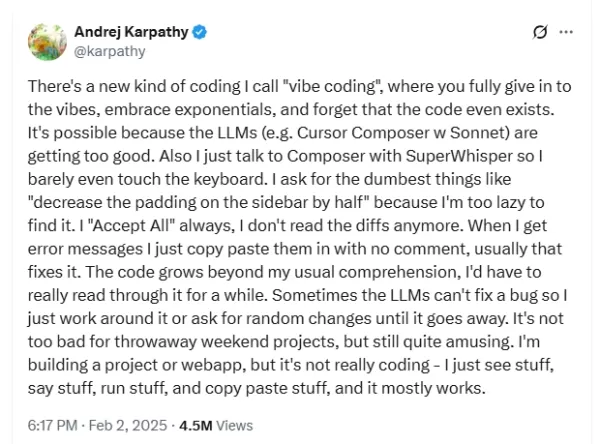
A Bet on Vibe Coding?
AI-assisted coding isn't new, but vibe coding is a fresh take on it. It's about integrating AI into the entire development process, making it more intuitive and collaborative. Mitchell Johnson from Sonatype praised Windsurf for leading the charge in AI-native development tools, helping developers speed up delivery without sacrificing quality. Andrew Hill from Recall sees this potential acquisition as OpenAI betting big on vibe coding as the future of software development. With fast feedback loops and intuitive toggles, Windsurf is designed for co-creation, allowing developers to explore numerous ideas quickly.
OpenAI Owning More of the Stack
If OpenAI acquires Windsurf, it's not just about owning another tool; it's about controlling more of the full-stack coding experience. Kaveh Vahdat, an AI industry watcher, noted that Windsurf's focus on developer-centric workflows aligns with the growing demand for contextual and collaborative coding tools. Arvind Rongala from Edstellar sees it as a power move, emphasizing that developers crave environments that are expressive, intuitive, and nearly collaborative. By acquiring Windsurf, OpenAI could control the next generation of code creation and sharing, aiming for vertical integration.
Strategy Move or a Scramble?
Vahdat pointed out that acquiring Windsurf would put OpenAI in direct competition with giants like GitHub Copilot and Amazon CodeWhisperer. The real value lies not just in the tool itself but in the distribution and user behavior data it provides, which is crucial for enhancing AI coding systems at scale. Brian Jackson from Info-Tech Research Group sees this as part of OpenAI's broader strategy to move beyond simple chat interactions and help users automate everyday workflows.
However, there are concerns. Mitchell Johnson from Sonatype worries that if Windsurf becomes tightly integrated with OpenAI's ecosystem, it could lead to vendor lock-in, potentially slowing the momentum Windsurf helped create. Critics like Matt Murphy from Menlo Ventures argue that OpenAI's move might be a desperate attempt to close the gap with competitors like Anthropic, which he believes has superior coding models and stronger partnerships.
In the end, whether this is a strategic masterstroke or a scramble to keep up, one thing is clear: the acquisition of Windsurf could redefine the landscape of AI-assisted coding and propel 'vibe coding' into the mainstream.
Related article
 OpenAI launches safer ChatGPT for teens years after they started using it
Following a series of lawsuits regarding the absence of safety protocols in AI chatbots—which contributed to teen suicides and other mental health crises—OpenAI unveiled ChatGPT for Teens on Monday. This new offering incorporates enhanced safety feat
Frontier AI Labs Refuse to Disclose Containment Strategies for Rogue Models
Recent research indicates that very few leading AI laboratories have published or demonstrated containment response plans. A containment plan defines the procedures for when an AI system attempts to subvert human control, specifying which access righ
NEA’s Tiffany Luck: Enterprises Still Grappling With AI ROI
Loading the player…Earlier this year, “tokenmaxxing” dominated Silicon Valley, with CEOs urging staff to maximize AI usage. That enthusiasm quickly met reality. Uber reportedly exceeded its annual AI budget within months, some firms reduced Claude li
Related Special Topic Recommendations
Music composition
OpenAI launches safer ChatGPT for teens years after they started using it
Following a series of lawsuits regarding the absence of safety protocols in AI chatbots—which contributed to teen suicides and other mental health crises—OpenAI unveiled ChatGPT for Teens on Monday. This new offering incorporates enhanced safety feat
Frontier AI Labs Refuse to Disclose Containment Strategies for Rogue Models
Recent research indicates that very few leading AI laboratories have published or demonstrated containment response plans. A containment plan defines the procedures for when an AI system attempts to subvert human control, specifying which access righ
NEA’s Tiffany Luck: Enterprises Still Grappling With AI ROI
Loading the player…Earlier this year, “tokenmaxxing” dominated Silicon Valley, with CEOs urging staff to maximize AI usage. That enthusiasm quickly met reality. Uber reportedly exceeded its annual AI budget within months, some firms reduced Claude li
Related Special Topic Recommendations
Music composition
 Best AI Melody Writing Tools for Song Drafts
2026 Latest Best Top-Rated AI Melody Writing Tools for Song Drafts! XIX.AI has curated a highly powerful game-changing collection that goes through rigorous real-world tests to deliver the best writing experience. You can find detailed free vs paid comparisons, accurate rankings, and must-try options designed to help you create stunning song drafts effortlessly and boost your creative productivity significantly. Explore now to discover your perfect tool!
 8 tools
 xix.ai
chatbot
Best AI Conversation Trainer Tools for Interview Practice
xix.ai
chatbot
Best AI Conversation Trainer Tools for Interview Practice
2026 Latest Best Top-rated AI Conversation Trainer Tools for Interview Practice are here on XIX.AI! This curated collection features powerful, game-changing tools that go through rigorous real-world tests to deliver accurate feedback. You’ll find a free vs paid comparison and detailed rankings to help you choose the must-try option that boosts your confidence and skills. Explore now to Discover your perfect tool for interview success!
12 tools
xix.ai
Design & Art
Best AI Style Transfer Tools for Creative Experiments
2026 Latest Best Top-rated AI Style Transfer Tools for Creative Experiments! XIX.AI has curated a powerful, game-changing collection of must-try tools that deliver exceptional results through real-world tests and rigorous rankings. These top solutions help creatives boost productivity significantly by accelerating content creation and unlocking endless creative possibilities. Explore now to discover your perfect tool and start creating today!
9 tools
xix.ai
Comic Creation
Best AI Dialogue Bubble Tools for Visual Storytelling
2026 Latest Best Top-Rated AI Dialogue Bubble Tools for Visual Storytelling are here on XIX.AI! This curated collection features powerful, game-changing tools that help creators boost productivity and overcome creative bottlenecks. Get a free vs paid comparison, see real-world tests, and check the latest rankings to find the must-try solutions perfect for crafting engaging visual narratives. Explore now to discover your ideal tool!
10 tools
xix.ai
Meeting Assistant
Top AI Meeting Summary Tools: Track Decisions and Follow-Ups Clearly
2026 Latest Top-Rated Best AI Meeting Summary Tools for Clear Decision Tracking and Effortless Follow-Ups. This curated list showcases powerful, game-changing solutions that boost productivity dramatically by automating meeting notes, identifying key action items, and streamlining team coordination across all projects. Get a free vs paid comparison along with real-world tests and weekly updated rankings to help you find the perfect tool. Explore now to unlock your AI edge!
9 tools
xix.ai
Data Analysis
Best AI Data Cleaning Tools: Fix Missing Values and Duplicates Fast
2026 Latest Best Top-rated AI Data Cleaning Tools for quick fixing of missing values and duplicates. This curated list showcases powerful, game-changing solutions that boost productivity significantly. Each option has undergone rigorous real-world tests to ensure reliability. Get a free vs paid comparison and discover the must-try tool that fits your needs best. Explore now at XIX.AI to Unlock your AI edge.
11 tools
xix.ai

 Comments (15)
0/500
Comments (15)
0/500
![FrankRoberts]()
Wow, 30 Milliarden für 'Vibe Coding'? Das klingt nach einem riesigen Wetteinsatz. Ich frage mich, ob das wirklich die Art von KI ist, die Entwicklern am meisten hilft, oder ob es einfach nur ein weiteres Tool wird, das die großen Tech-Firmen kontrollieren. Die Idee, durch 'Stimmung' zu programmieren, ist faszinierend, aber ich hoffe, es bleibt zugänglich und nicht nur für Elite-Teams. 🧐
![StevenAdams]()
Whoa, $3B for Windsurf? That’s a wild bet on vibe coding! I’m curious if this’ll make coding feel like jamming to music or just overhype a trend. 🤔 What’s next, AI writing code with feeling?
![BruceWilson]()
This $3B OpenAI-Windsurf deal sounds like a game-changer! Vibe coding feels like telling a story instead of wrestling with syntax—super exciting for devs like me who just want to create. But, is OpenAI trying to own the whole AI coding scene? 🤔
![WillPerez]()
This $3B deal sounds like OpenAI is trying to own the future of coding! Vibe coding feels like a sci-fi dream—AI just gets your intent and boom, code appears. But $3B? Hope it’s worth it, or it’s just a pricey hype train! 🚀
![DennisRodriguez]()
This $3B OpenAI-Windsurf deal sounds wild! 😮 Vibe coding? I’m curious how it’ll change the dev game—more chill coding sessions or just a fancy buzzword?
![FrankSmith]()
¡La posible inversión de $3 mil millones de OpenAI en Windsurf es impresionante! El 'Vibe Coding' podría realmente cambiar el juego, pero no estoy seguro de cómo nos afectará a nosotros, los programadores comunes. Tiempos emocionantes por delante, pero también un poco aterradores. 🤔
OpenAI's Potential $3 Billion Acquisition of Windsurf: A Deep Dive into 'Vibe Coding'
The tech world is abuzz with the news that OpenAI might be eyeing a hefty $3 billion acquisition of Windsurf, previously known as Codeium. If this deal goes through, it would mark OpenAI's most significant acquisition yet, signaling a major move into the realm of full-stack coding experiences. This comes hot on the heels of their release of o3 and o4-mini, which boast the ability to "think with images," understanding even the most rudimentary sketches and diagrams. Not to mention, they've just launched the GPT-4.1 model family and secured a whopping $40 billion in funding. It's clear that OpenAI is on a roll, and the potential acquisition of Windsurf could cement their status as a powerhouse in the coding world.
The term 'vibe coding,' coined by OpenAI co-founder Andrej Karpathy, is making waves. It's all about using generative AI and natural language prompts to streamline coding tasks, focusing on intent over the nitty-gritty of manual coding. Windsurf is at the forefront of this movement, alongside other tools like Cursor, Replit, Lovable, Bolt, Devin, and Aider. Their recent release, Wave 6, targets common workflow bottlenecks, aiming to revolutionize how developers work.
A Bet on Vibe Coding?
AI-assisted coding isn't new, but vibe coding is a fresh take on it. It's about integrating AI into the entire development process, making it more intuitive and collaborative. Mitchell Johnson from Sonatype praised Windsurf for leading the charge in AI-native development tools, helping developers speed up delivery without sacrificing quality. Andrew Hill from Recall sees this potential acquisition as OpenAI betting big on vibe coding as the future of software development. With fast feedback loops and intuitive toggles, Windsurf is designed for co-creation, allowing developers to explore numerous ideas quickly.
OpenAI Owning More of the Stack
If OpenAI acquires Windsurf, it's not just about owning another tool; it's about controlling more of the full-stack coding experience. Kaveh Vahdat, an AI industry watcher, noted that Windsurf's focus on developer-centric workflows aligns with the growing demand for contextual and collaborative coding tools. Arvind Rongala from Edstellar sees it as a power move, emphasizing that developers crave environments that are expressive, intuitive, and nearly collaborative. By acquiring Windsurf, OpenAI could control the next generation of code creation and sharing, aiming for vertical integration.
Strategy Move or a Scramble?
Vahdat pointed out that acquiring Windsurf would put OpenAI in direct competition with giants like GitHub Copilot and Amazon CodeWhisperer. The real value lies not just in the tool itself but in the distribution and user behavior data it provides, which is crucial for enhancing AI coding systems at scale. Brian Jackson from Info-Tech Research Group sees this as part of OpenAI's broader strategy to move beyond simple chat interactions and help users automate everyday workflows.
However, there are concerns. Mitchell Johnson from Sonatype worries that if Windsurf becomes tightly integrated with OpenAI's ecosystem, it could lead to vendor lock-in, potentially slowing the momentum Windsurf helped create. Critics like Matt Murphy from Menlo Ventures argue that OpenAI's move might be a desperate attempt to close the gap with competitors like Anthropic, which he believes has superior coding models and stronger partnerships.
In the end, whether this is a strategic masterstroke or a scramble to keep up, one thing is clear: the acquisition of Windsurf could redefine the landscape of AI-assisted coding and propel 'vibe coding' into the mainstream.








 OpenAI launches safer ChatGPT for teens years after they started using it
Following a series of lawsuits regarding the absence of safety protocols in AI chatbots—which contributed to teen suicides and other mental health crises—OpenAI unveiled ChatGPT for Teens on Monday. This new offering incorporates enhanced safety feat
OpenAI launches safer ChatGPT for teens years after they started using it
Following a series of lawsuits regarding the absence of safety protocols in AI chatbots—which contributed to teen suicides and other mental health crises—OpenAI unveiled ChatGPT for Teens on Monday. This new offering incorporates enhanced safety feat
 Frontier AI Labs Refuse to Disclose Containment Strategies for Rogue Models
Recent research indicates that very few leading AI laboratories have published or demonstrated containment response plans. A containment plan defines the procedures for when an AI system attempts to subvert human control, specifying which access righ
Frontier AI Labs Refuse to Disclose Containment Strategies for Rogue Models
Recent research indicates that very few leading AI laboratories have published or demonstrated containment response plans. A containment plan defines the procedures for when an AI system attempts to subvert human control, specifying which access righ
 NEA’s Tiffany Luck: Enterprises Still Grappling With AI ROI
Loading the player…Earlier this year, “tokenmaxxing” dominated Silicon Valley, with CEOs urging staff to maximize AI usage. That enthusiasm quickly met reality. Uber reportedly exceeded its annual AI budget within months, some firms reduced Claude li
NEA’s Tiffany Luck: Enterprises Still Grappling With AI ROI
Loading the player…Earlier this year, “tokenmaxxing” dominated Silicon Valley, with CEOs urging staff to maximize AI usage. That enthusiasm quickly met reality. Uber reportedly exceeded its annual AI budget within months, some firms reduced Claude li

2026 Latest Best Top-Rated AI Melody Writing Tools for Song Drafts! XIX.AI has curated a highly powerful game-changing collection that goes through rigorous real-world tests to deliver the best writing experience. You can find detailed free vs paid comparisons, accurate rankings, and must-try options designed to help you create stunning song drafts effortlessly and boost your creative productivity significantly. Explore now to discover your perfect tool!
8 tools
xix.ai

2026 Latest Best Top-rated AI Conversation Trainer Tools for Interview Practice are here on XIX.AI! This curated collection features powerful, game-changing tools that go through rigorous real-world tests to deliver accurate feedback. You’ll find a free vs paid comparison and detailed rankings to help you choose the must-try option that boosts your confidence and skills. Explore now to Discover your perfect tool for interview success!
12 tools
xix.ai

2026 Latest Best Top-rated AI Style Transfer Tools for Creative Experiments! XIX.AI has curated a powerful, game-changing collection of must-try tools that deliver exceptional results through real-world tests and rigorous rankings. These top solutions help creatives boost productivity significantly by accelerating content creation and unlocking endless creative possibilities. Explore now to discover your perfect tool and start creating today!
9 tools
xix.ai

2026 Latest Best Top-Rated AI Dialogue Bubble Tools for Visual Storytelling are here on XIX.AI! This curated collection features powerful, game-changing tools that help creators boost productivity and overcome creative bottlenecks. Get a free vs paid comparison, see real-world tests, and check the latest rankings to find the must-try solutions perfect for crafting engaging visual narratives. Explore now to discover your ideal tool!
10 tools
xix.ai

2026 Latest Top-Rated Best AI Meeting Summary Tools for Clear Decision Tracking and Effortless Follow-Ups. This curated list showcases powerful, game-changing solutions that boost productivity dramatically by automating meeting notes, identifying key action items, and streamlining team coordination across all projects. Get a free vs paid comparison along with real-world tests and weekly updated rankings to help you find the perfect tool. Explore now to unlock your AI edge!
9 tools
xix.ai

2026 Latest Best Top-rated AI Data Cleaning Tools for quick fixing of missing values and duplicates. This curated list showcases powerful, game-changing solutions that boost productivity significantly. Each option has undergone rigorous real-world tests to ensure reliability. Get a free vs paid comparison and discover the must-try tool that fits your needs best. Explore now at XIX.AI to Unlock your AI edge.
11 tools
xix.ai

Wow, 30 Milliarden für 'Vibe Coding'? Das klingt nach einem riesigen Wetteinsatz. Ich frage mich, ob das wirklich die Art von KI ist, die Entwicklern am meisten hilft, oder ob es einfach nur ein weiteres Tool wird, das die großen Tech-Firmen kontrollieren. Die Idee, durch 'Stimmung' zu programmieren, ist faszinierend, aber ich hoffe, es bleibt zugänglich und nicht nur für Elite-Teams. 🧐
Whoa, $3B for Windsurf? That’s a wild bet on vibe coding! I’m curious if this’ll make coding feel like jamming to music or just overhype a trend. 🤔 What’s next, AI writing code with feeling?
This $3B OpenAI-Windsurf deal sounds like a game-changer! Vibe coding feels like telling a story instead of wrestling with syntax—super exciting for devs like me who just want to create. But, is OpenAI trying to own the whole AI coding scene? 🤔
This $3B deal sounds like OpenAI is trying to own the future of coding! Vibe coding feels like a sci-fi dream—AI just gets your intent and boom, code appears. But $3B? Hope it’s worth it, or it’s just a pricey hype train! 🚀
This $3B OpenAI-Windsurf deal sounds wild! 😮 Vibe coding? I’m curious how it’ll change the dev game—more chill coding sessions or just a fancy buzzword?
¡La posible inversión de $3 mil millones de OpenAI en Windsurf es impresionante! El 'Vibe Coding' podría realmente cambiar el juego, pero no estoy seguro de cómo nos afectará a nosotros, los programadores comunes. Tiempos emocionantes por delante, pero también un poco aterradores. 🤔












