


 Home
HomeOpenAI Upgrades Prism with GPT-5.3 and Codex CLI, Simplifying LaTeX, Code, and Diagrams
No More Tool Chaos: Prism Delivers End-to-End Integrated Scientific Research
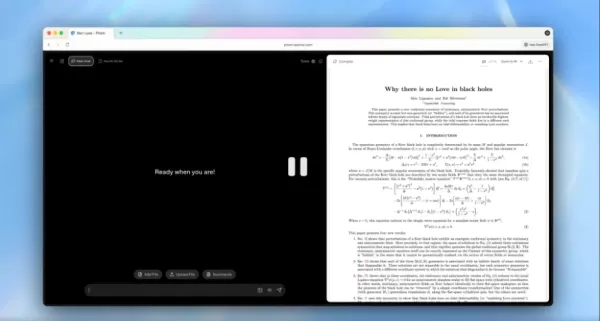
OpenAI has unveiled a major update to Prism, its AI-native workspace built for researchers. The upgrade brings the underlying model to GPT-5.3 and introduces a powerful Codex CLI, designed to eliminate the hassle of switching between text editors, PDF readers, LaTeX compilers, and reference managers.
Launched in January, Prism was designed as an all-in-one platform for scientific writing and collaboration. Users can edit LaTeX directly, manage extensive citations, generate academic charts in real time, and collaborate with team members seamlessly within a single immersive environment.
Core Evolution: Codex CLI Powers a Dual Engine for Computation and Writing
The standout feature of this update is the deep integration of Codex CLI. This shift transforms Prism from a mere writing assistant into a research platform with robust computational capabilities:
Local Execution: Researchers can now run Python or R code directly inside Prism for data cleaning and analysis, and instantly produce vector graphics that meet academic standards.
Automated Loop: The system supports an automated compile-check-revise cycle. Prism can automatically detect LaTeX compilation errors or data anomalies and attempt self-correction, significantly reducing the time from experimental data to final manuscript.
Support for Large Projects: For complex research projects involving hundreds of files, Prism offers persistent session support and direct file access, ensuring consistent logic and formatting across multi-chapter papers.

Model Leap: GPT-5.3 Delivers Million-Level Context Control
With the upgrade to GPT-5.3, Prism gains a significant advantage in handling ultra-long and complex research workflows. Optimized memory compression allows the system to maintain high instruction-following accuracy when processing multi-file projects with large amounts of raw data, effectively avoiding the logical gaps common in long-form writing.
An OpenAI spokesperson noted that Prism's core purpose is to let scientists retain control over their core logic while offloading repetitive tasks like formatting, code debugging, and citation verification to AI automation.
Available to All: Lowering the Barrier to Research
The upgraded Prism is now available to all global ChatGPT Free, Go, Plus, and Pro users. Whether you're a new graduate student or a seasoned professor, you can experience the efficiency gains of an AI-native research environment through this platform.
Related article
 Tencent Unveils AI-Native Cloud Storage to Disrupt Big Tech Dominance
Tencent Cloud Drive has officially launched without prior announcement, with its homepage currently displaying a prominent "COMING SOON" message. Despite the absence of an official statement or specific launch date, this development has already spark
King Charles Speaks Out on AI Safety Concerns
Left to right: King Charles with Alphabet Chief Scientist and Google DeepMind Founder Demis Hassabis, alongside NVIDIA CEO Jensen Huang. Photo credit: NVIDIA/LinkedInKing Charles convened leaders from NVIDIA, Google DeepMind, and Anthropic to discuss
MIIT: OpenHarmony Surpasses 1.35 Billion Devices as Downloads Hit 10 Billion
China’s open-source ecosystem took center stage during a recent State Council Information Office briefing, highlighting the nation's growing influence in technology. Held on July 20 at 10:00 a.m., the event featured key officials from the Ministry of
Related Special Topic Recommendations
Software Development
Tencent Unveils AI-Native Cloud Storage to Disrupt Big Tech Dominance
Tencent Cloud Drive has officially launched without prior announcement, with its homepage currently displaying a prominent "COMING SOON" message. Despite the absence of an official statement or specific launch date, this development has already spark
King Charles Speaks Out on AI Safety Concerns
Left to right: King Charles with Alphabet Chief Scientist and Google DeepMind Founder Demis Hassabis, alongside NVIDIA CEO Jensen Huang. Photo credit: NVIDIA/LinkedInKing Charles convened leaders from NVIDIA, Google DeepMind, and Anthropic to discuss
MIIT: OpenHarmony Surpasses 1.35 Billion Devices as Downloads Hit 10 Billion
China’s open-source ecosystem took center stage during a recent State Council Information Office briefing, highlighting the nation's growing influence in technology. Held on July 20 at 10:00 a.m., the event featured key officials from the Ministry of
Related Special Topic Recommendations
Software Development
 Best AI Release Note Generators for SaaS Engineering Teams
2026 Latest Best Top-rated AI Release Note Generators for SaaS Engineering Teams, carefully curated by XIX.AI. These powerful tools help teams create clear, concise updates fast, boost writing efficiency significantly, and avoid common mistakes. Enjoy a free vs paid comparison along with real-world tests and weekly updated rankings. Discover your perfect tool to unlock your AI edge today. Explore now!
 10 tools
 xix.ai
chatbot
Best AI Chatbot Tools for Customer Support
xix.ai
chatbot
Best AI Chatbot Tools for Customer Support
2026 Latest Best Top-Rated AI Chatbot Tools for Customer Support are here on XIX.AI! This curated list features powerful, game-changing solutions that boost efficiency across all customer service tasks. We conduct real-world tests and provide a weekly updated free vs paid comparison along with detailed rankings to help you find the must-try tool that matches your needs perfectly. Explore now to unlock your AI edge!
13 tools
xix.ai
SEO
AI Topic Cluster Tools for SEO Content Planning
2026 Latest Best Top-Rated AI Topic Cluster Tools for SEO Content Planning! XIX.AI curates a powerful game-changing collection that has undergone rigorous real-world tests and weekly updated rankings. These must-try tools help you plan high-quality content efficiently, boost writing productivity, and overcome creativity bottlenecks. Explore now to discover your perfect tool and unlock your AI edge in SEO work!
8 tools
xix.ai
writing
AI Editing Tools for Business and Academic Writing
2026 Latest Best Top-Rated AI Editing Tools for Business and Academic Writing! XIX.AI has curated a powerful, game-changing collection of must-try tools that go through rigorous real-world tests. You’ll find detailed free vs paid comparison, accurate rankings, and insights to help you boost writing efficiency, produce high-quality content faster, and meet tight deadlines. Explore now to unlock your AI edge!
9 tools
xix.ai
code
AI Debugging Tools for Python and JavaScript Projects
2026 Latest Best Top-Rated AI Debugging Tools for Python and JavaScript Projects, curated by XIX.AI. These powerful game-changing solutions offer real-world tests, weekly updated rankings, and a free vs paid comparison to help you fix coding errors faster, boost productivity, and unlock your AI edge. Explore now!
14 tools
xix.ai
Software Development
AI Code Search Tools for Large Repositories
2026 Latest Best AI Code Search Tools for Large Repositories ranked by expert teams. This curated list showcases top-rated solutions that deliver powerful, game-changing speed when navigating massive codebases. You’ll find a free vs paid comparison along with real-world tests to help you choose the perfect fit. XIX.AI provides exclusive insights to elevate your productivity. Explore now and unlock your AI edge.
9 tools
xix.ai

 Comments (0)
0/500
Comments (0)
0/500
No More Tool Chaos: Prism Delivers End-to-End Integrated Scientific Research
OpenAI has unveiled a major update to Prism, its AI-native workspace built for researchers. The upgrade brings the underlying model to GPT-5.3 and introduces a powerful Codex CLI, designed to eliminate the hassle of switching between text editors, PDF readers, LaTeX compilers, and reference managers.
Launched in January, Prism was designed as an all-in-one platform for scientific writing and collaboration. Users can edit LaTeX directly, manage extensive citations, generate academic charts in real time, and collaborate with team members seamlessly within a single immersive environment.
Core Evolution: Codex CLI Powers a Dual Engine for Computation and Writing
The standout feature of this update is the deep integration of Codex CLI. This shift transforms Prism from a mere writing assistant into a research platform with robust computational capabilities:
Local Execution: Researchers can now run Python or R code directly inside Prism for data cleaning and analysis, and instantly produce vector graphics that meet academic standards.
Automated Loop: The system supports an automated compile-check-revise cycle. Prism can automatically detect LaTeX compilation errors or data anomalies and attempt self-correction, significantly reducing the time from experimental data to final manuscript.
Support for Large Projects: For complex research projects involving hundreds of files, Prism offers persistent session support and direct file access, ensuring consistent logic and formatting across multi-chapter papers.
Model Leap: GPT-5.3 Delivers Million-Level Context Control
With the upgrade to GPT-5.3, Prism gains a significant advantage in handling ultra-long and complex research workflows. Optimized memory compression allows the system to maintain high instruction-following accuracy when processing multi-file projects with large amounts of raw data, effectively avoiding the logical gaps common in long-form writing.
An OpenAI spokesperson noted that Prism's core purpose is to let scientists retain control over their core logic while offloading repetitive tasks like formatting, code debugging, and citation verification to AI automation.
Available to All: Lowering the Barrier to Research
The upgraded Prism is now available to all global ChatGPT Free, Go, Plus, and Pro users. Whether you're a new graduate student or a seasoned professor, you can experience the efficiency gains of an AI-native research environment through this platform.








 Tencent Unveils AI-Native Cloud Storage to Disrupt Big Tech Dominance
Tencent Cloud Drive has officially launched without prior announcement, with its homepage currently displaying a prominent "COMING SOON" message. Despite the absence of an official statement or specific launch date, this development has already spark
Tencent Unveils AI-Native Cloud Storage to Disrupt Big Tech Dominance
Tencent Cloud Drive has officially launched without prior announcement, with its homepage currently displaying a prominent "COMING SOON" message. Despite the absence of an official statement or specific launch date, this development has already spark
 King Charles Speaks Out on AI Safety Concerns
Left to right: King Charles with Alphabet Chief Scientist and Google DeepMind Founder Demis Hassabis, alongside NVIDIA CEO Jensen Huang. Photo credit: NVIDIA/LinkedInKing Charles convened leaders from NVIDIA, Google DeepMind, and Anthropic to discuss
King Charles Speaks Out on AI Safety Concerns
Left to right: King Charles with Alphabet Chief Scientist and Google DeepMind Founder Demis Hassabis, alongside NVIDIA CEO Jensen Huang. Photo credit: NVIDIA/LinkedInKing Charles convened leaders from NVIDIA, Google DeepMind, and Anthropic to discuss
 MIIT: OpenHarmony Surpasses 1.35 Billion Devices as Downloads Hit 10 Billion
China’s open-source ecosystem took center stage during a recent State Council Information Office briefing, highlighting the nation's growing influence in technology. Held on July 20 at 10:00 a.m., the event featured key officials from the Ministry of
MIIT: OpenHarmony Surpasses 1.35 Billion Devices as Downloads Hit 10 Billion
China’s open-source ecosystem took center stage during a recent State Council Information Office briefing, highlighting the nation's growing influence in technology. Held on July 20 at 10:00 a.m., the event featured key officials from the Ministry of
2026 Latest Best Top-rated AI Release Note Generators for SaaS Engineering Teams, carefully curated by XIX.AI. These powerful tools help teams create clear, concise updates fast, boost writing efficiency significantly, and avoid common mistakes. Enjoy a free vs paid comparison along with real-world tests and weekly updated rankings. Discover your perfect tool to unlock your AI edge today. Explore now!
10 tools
xix.ai

2026 Latest Best Top-Rated AI Chatbot Tools for Customer Support are here on XIX.AI! This curated list features powerful, game-changing solutions that boost efficiency across all customer service tasks. We conduct real-world tests and provide a weekly updated free vs paid comparison along with detailed rankings to help you find the must-try tool that matches your needs perfectly. Explore now to unlock your AI edge!
13 tools
xix.ai

2026 Latest Best Top-Rated AI Topic Cluster Tools for SEO Content Planning! XIX.AI curates a powerful game-changing collection that has undergone rigorous real-world tests and weekly updated rankings. These must-try tools help you plan high-quality content efficiently, boost writing productivity, and overcome creativity bottlenecks. Explore now to discover your perfect tool and unlock your AI edge in SEO work!
8 tools
xix.ai

2026 Latest Best Top-Rated AI Editing Tools for Business and Academic Writing! XIX.AI has curated a powerful, game-changing collection of must-try tools that go through rigorous real-world tests. You’ll find detailed free vs paid comparison, accurate rankings, and insights to help you boost writing efficiency, produce high-quality content faster, and meet tight deadlines. Explore now to unlock your AI edge!
9 tools
xix.ai
2026 Latest Best Top-Rated AI Debugging Tools for Python and JavaScript Projects, curated by XIX.AI. These powerful game-changing solutions offer real-world tests, weekly updated rankings, and a free vs paid comparison to help you fix coding errors faster, boost productivity, and unlock your AI edge. Explore now!
14 tools
xix.ai

2026 Latest Best AI Code Search Tools for Large Repositories ranked by expert teams. This curated list showcases top-rated solutions that deliver powerful, game-changing speed when navigating massive codebases. You’ll find a free vs paid comparison along with real-world tests to help you choose the perfect fit. XIX.AI provides exclusive insights to elevate your productivity. Explore now and unlock your AI edge.
9 tools
xix.ai












