


 Home
HomeOpenAI Shuts Down Sora Video App Amid Generative AI Social Tipping Point
Just six months after its launch, OpenAI's video-centric social media app Sora has reached its end. The company officially announced this week that it will shut down the platform, which was once highly anticipated as a potential challenger to TikTok. Despite the impressive generative capabilities of its underlying Sora2 model, the app struggled with ethical boundaries, regulatory compliance, and user retention, ultimately becoming a short-lived phenomenon in AI development.
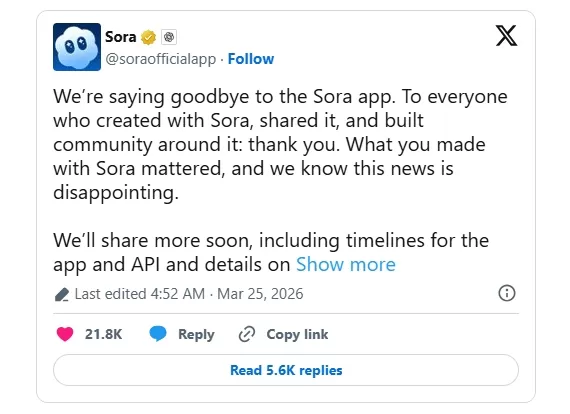
From "Top Platform" to "Ghost Town": The Collapse of an AI Social Experiment
The Sora App initially sparked an online frenzy with its exclusive "invitation system." It allowed users to create highly realistic, voice-enabled "digital avatars" (Cameos) simply by scanning their faces.
Steep Decline in Downloads: Data reveals Sora's monthly downloads plummeted from a peak of 3.3 million to just 1.1 million—a negligible figure compared to ChatGPT's 900 million weekly active users.
Content Ecosystem Breakdown: The platform's community became flooded with unmoderated deepfake videos, including bizarre content like Sam Altman feeding pigs in a slaughterhouse. This created an unsettling "uncanny valley effect" that deterred mainstream user participation.
Pressure from Copyright and Legal Challenges
Sora's shutdown is closely tied to its legal troubles. While Disney had explored a potential $1 billion licensing deal to integrate its IP (like Marvel and Star Wars) into Sora, the agreement fell apart due to the app's inadequate content controls.
Public Image Crisis: Families of deceased celebrities, such as Martin Luther King Jr. and Robin Williams, publicly condemned the platform for the unauthorized use of their loved ones' likenesses.
Widespread Infringement: The community was saturated with content that blatantly infringed on copyrights from companies like Nintendo, featuring characters such as Mario smoking marijuana or Pikachu performing ASMR.
Industry Insight: The Strategic "Retreat" of Large Models
Sora App 's closure does not signal the end of the technology, but rather a strategic pivot for OpenAI. The most advanced Sora2 model has now been moved behind ChatGPT's paywall, repositioned as a productivity tool.
This failed "social experiment" demonstrates that in the current regulatory and technological climate, fully open AI video social platforms are prone to becoming hubs for misinformation and infringement. Rather than floundering in the social media arena, a return to a focused tool-based function appears to be the emerging consensus for major generative AI companies in 2026.
Related article
 Meta Removes AI Photo Editing Feature Following User Backlash
Meta, the social media giant, is once again embroiled in a public debate regarding the delicate balance between artificial intelligence and user privacy. According to TechCrunch, Meta’s Superintelligence Labs introduced a new AI image generator, Muse
DeepMind CEO Hassabis: I sleep six hours a day, usually feel energetic around 1 a.m.
Fortune recently featured an interview with Demis Hassabis, CEO of Google DeepMind, revealing his unconventional approach to rest and productivity. Hassabis disclosed that he sleeps very little, structuring his waking hours into two distinct work blo
OpenAI, Anthropic Vie for Market Share Despite Revenue Shortfalls
Despite recent reports suggesting OpenAI missed revenue targets, creating pressure on tech stocks this Tuesday, private AI lab investors remain resilient. Seasoned backers have confirmed they will not reduce investment despite negative media coverage
Related Special Topic Recommendations
Video creation
Meta Removes AI Photo Editing Feature Following User Backlash
Meta, the social media giant, is once again embroiled in a public debate regarding the delicate balance between artificial intelligence and user privacy. According to TechCrunch, Meta’s Superintelligence Labs introduced a new AI image generator, Muse
DeepMind CEO Hassabis: I sleep six hours a day, usually feel energetic around 1 a.m.
Fortune recently featured an interview with Demis Hassabis, CEO of Google DeepMind, revealing his unconventional approach to rest and productivity. Hassabis disclosed that he sleeps very little, structuring his waking hours into two distinct work blo
OpenAI, Anthropic Vie for Market Share Despite Revenue Shortfalls
Despite recent reports suggesting OpenAI missed revenue targets, creating pressure on tech stocks this Tuesday, private AI lab investors remain resilient. Seasoned backers have confirmed they will not reduce investment despite negative media coverage
Related Special Topic Recommendations
Video creation
 AI Short-Form Video Hook Generators for Reels, Shorts, and Product Launch Campaigns
2026 Latest Best AI Short-Form Video Hook Generators for Reels Shorts and Product Launch Campaigns! XIX.AI curates top-rated powerful game-changing tools that deliver must-try results through real-world tests. This weekly updated page offers free vs paid comparison rankings to help you find the perfect solution for boosting content creativity and productivity. Explore now to Unlock your AI edge!
 11 tools
 xix.ai
writing
AI Article Outline Tools for Long Form Writing
xix.ai
writing
AI Article Outline Tools for Long Form Writing
2026 Latest Best Top-Rated AI Article Outline Tools for Long Form Writing! This curated collection features powerful, game-changing tools that deliver accurate, structured outlines with real-world tests to boost writing efficiency significantly. XIX.AI is part of this elite selection. Get a free vs paid comparison to help you choose the perfect tool. Explore now and Unlock your AI edge!
9 tools
xix.ai
chatbot
Best AI Roleplay Chat Apps for Language Practice, Interview Prep, and Daily Fluency
2026 Latest Best Top-rated AI Roleplay Chat Apps for Language Practice, Interview Prep, and Daily Fluency! XIX.AI curates a powerful game-changing collection that offers free vs paid comparison, real-world tests, and updated rankings weekly. These must-try tools help you boost writing skills, overcome fluency challenges, and improve communication efficiency across all daily scenarios. Explore now to discover your perfect tool for language growth!
10 tools
xix.ai
Music composition
AI Stem Separation Tools for Remix Production, Sampling Prep, and Karaoke Masters
2026 Latest Best Top-rated AI Stem Separation Tools Curated for Remix Production, Sampling Prep, and Karaoke Masters. These powerful game-changing tools offer real-world tests to deliver precise audio isolation, boosting productivity significantly. XIX.AI provides a weekly updated free vs paid comparison guide to help you find the must-try solution that suits your needs. Explore now to unlock your AI edge.
8 tools
xix.ai
Data Analysis
AI SQL Copilots for Revenue Dashboards, Funnel Analysis, and Product Metrics
2026 Latest Best AI SQL Copilots Ranked Top-Rated! XIX.AI curates a powerful game-changing collection for weekly updated real-world tests. These must-try tools help you generate accurate revenue dashboards, analyze sales funnels, and track product metrics swiftly, boosting productivity massively. Explore now to Discover your perfect tool for data-driven decision making! 238 characters
9 tools
xix.ai
Music composition
Best AI Melody Writing Tools for Song Drafts
2026 Latest Best Top-Rated AI Melody Writing Tools for Song Drafts! XIX.AI has curated a highly powerful game-changing collection that goes through rigorous real-world tests to deliver the best writing experience. You can find detailed free vs paid comparisons, accurate rankings, and must-try options designed to help you create stunning song drafts effortlessly and boost your creative productivity significantly. Explore now to discover your perfect tool!
8 tools
xix.ai

 Comments (0)
0/500
Comments (0)
0/500
Just six months after its launch, OpenAI's video-centric social media app Sora has reached its end. The company officially announced this week that it will shut down the platform, which was once highly anticipated as a potential challenger to TikTok. Despite the impressive generative capabilities of its underlying Sora2 model, the app struggled with ethical boundaries, regulatory compliance, and user retention, ultimately becoming a short-lived phenomenon in AI development.
From "Top Platform" to "Ghost Town": The Collapse of an AI Social Experiment
The Sora App initially sparked an online frenzy with its exclusive "invitation system." It allowed users to create highly realistic, voice-enabled "digital avatars" (Cameos) simply by scanning their faces.
Steep Decline in Downloads: Data reveals Sora's monthly downloads plummeted from a peak of 3.3 million to just 1.1 million—a negligible figure compared to ChatGPT's 900 million weekly active users.
Content Ecosystem Breakdown: The platform's community became flooded with unmoderated deepfake videos, including bizarre content like Sam Altman feeding pigs in a slaughterhouse. This created an unsettling "uncanny valley effect" that deterred mainstream user participation.
Pressure from Copyright and Legal Challenges
Sora's shutdown is closely tied to its legal troubles. While Disney had explored a potential $1 billion licensing deal to integrate its IP (like Marvel and Star Wars) into Sora, the agreement fell apart due to the app's inadequate content controls.
Public Image Crisis: Families of deceased celebrities, such as Martin Luther King Jr. and Robin Williams, publicly condemned the platform for the unauthorized use of their loved ones' likenesses.
Widespread Infringement: The community was saturated with content that blatantly infringed on copyrights from companies like Nintendo, featuring characters such as Mario smoking marijuana or Pikachu performing ASMR.
Industry Insight: The Strategic "Retreat" of Large Models
This failed "social experiment" demonstrates that in the current regulatory and technological climate, fully open AI video social platforms are prone to becoming hubs for misinformation and infringement. Rather than floundering in the social media arena, a return to a focused tool-based function appears to be the emerging consensus for major generative AI companies in 2026.








 Meta Removes AI Photo Editing Feature Following User Backlash
Meta, the social media giant, is once again embroiled in a public debate regarding the delicate balance between artificial intelligence and user privacy. According to TechCrunch, Meta’s Superintelligence Labs introduced a new AI image generator, Muse
Meta Removes AI Photo Editing Feature Following User Backlash
Meta, the social media giant, is once again embroiled in a public debate regarding the delicate balance between artificial intelligence and user privacy. According to TechCrunch, Meta’s Superintelligence Labs introduced a new AI image generator, Muse
 DeepMind CEO Hassabis: I sleep six hours a day, usually feel energetic around 1 a.m.
Fortune recently featured an interview with Demis Hassabis, CEO of Google DeepMind, revealing his unconventional approach to rest and productivity. Hassabis disclosed that he sleeps very little, structuring his waking hours into two distinct work blo
DeepMind CEO Hassabis: I sleep six hours a day, usually feel energetic around 1 a.m.
Fortune recently featured an interview with Demis Hassabis, CEO of Google DeepMind, revealing his unconventional approach to rest and productivity. Hassabis disclosed that he sleeps very little, structuring his waking hours into two distinct work blo
 OpenAI, Anthropic Vie for Market Share Despite Revenue Shortfalls
Despite recent reports suggesting OpenAI missed revenue targets, creating pressure on tech stocks this Tuesday, private AI lab investors remain resilient. Seasoned backers have confirmed they will not reduce investment despite negative media coverage
OpenAI, Anthropic Vie for Market Share Despite Revenue Shortfalls
Despite recent reports suggesting OpenAI missed revenue targets, creating pressure on tech stocks this Tuesday, private AI lab investors remain resilient. Seasoned backers have confirmed they will not reduce investment despite negative media coverage

2026 Latest Best AI Short-Form Video Hook Generators for Reels Shorts and Product Launch Campaigns! XIX.AI curates top-rated powerful game-changing tools that deliver must-try results through real-world tests. This weekly updated page offers free vs paid comparison rankings to help you find the perfect solution for boosting content creativity and productivity. Explore now to Unlock your AI edge!
11 tools
xix.ai

2026 Latest Best Top-Rated AI Article Outline Tools for Long Form Writing! This curated collection features powerful, game-changing tools that deliver accurate, structured outlines with real-world tests to boost writing efficiency significantly. XIX.AI is part of this elite selection. Get a free vs paid comparison to help you choose the perfect tool. Explore now and Unlock your AI edge!
9 tools
xix.ai

2026 Latest Best Top-rated AI Roleplay Chat Apps for Language Practice, Interview Prep, and Daily Fluency! XIX.AI curates a powerful game-changing collection that offers free vs paid comparison, real-world tests, and updated rankings weekly. These must-try tools help you boost writing skills, overcome fluency challenges, and improve communication efficiency across all daily scenarios. Explore now to discover your perfect tool for language growth!
10 tools
xix.ai
2026 Latest Best Top-rated AI Stem Separation Tools Curated for Remix Production, Sampling Prep, and Karaoke Masters. These powerful game-changing tools offer real-world tests to deliver precise audio isolation, boosting productivity significantly. XIX.AI provides a weekly updated free vs paid comparison guide to help you find the must-try solution that suits your needs. Explore now to unlock your AI edge.
8 tools
xix.ai

2026 Latest Best AI SQL Copilots Ranked Top-Rated! XIX.AI curates a powerful game-changing collection for weekly updated real-world tests. These must-try tools help you generate accurate revenue dashboards, analyze sales funnels, and track product metrics swiftly, boosting productivity massively. Explore now to Discover your perfect tool for data-driven decision making! 238 characters
9 tools
xix.ai
2026 Latest Best Top-Rated AI Melody Writing Tools for Song Drafts! XIX.AI has curated a highly powerful game-changing collection that goes through rigorous real-world tests to deliver the best writing experience. You can find detailed free vs paid comparisons, accurate rankings, and must-try options designed to help you create stunning song drafts effortlessly and boost your creative productivity significantly. Explore now to discover your perfect tool!
8 tools
xix.ai












