


 Home
Home
GPT-4o Returns as Default Model for All Paying ChatGPT Users; Altman Vows Advance Notice for Any Future Changes
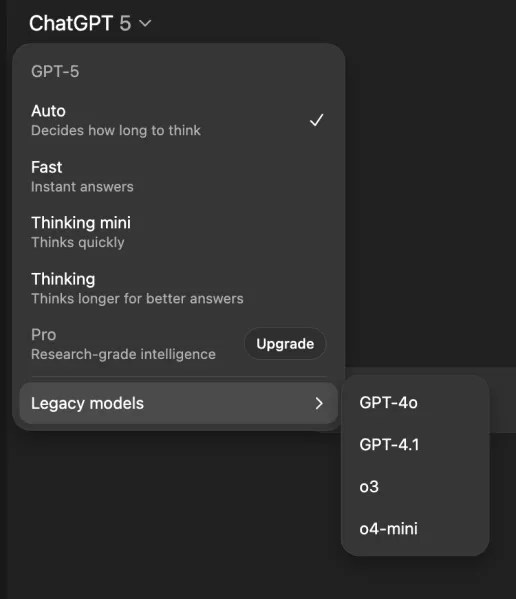
OpenAI has reinstated GPT-4o as a default option for all paying users, including subscribers to ChatGPT Plus, Pro, Team, Enterprise, and Edu tiers. Previously accessible only by enabling a "show legacy models" setting, the language model that powered ChatGPT prior to last week's GPT-5 launch is now readily available once again.
At the same time, paying subscribers will also see a new “Show additional models” setting enabled by default, restoring access to GPT-4.1, o3, and o4-mini—the latter two being reasoning-focused models.
OpenAI CEO and co-founder Sam Altman announced the shift on X just minutes ago, promising that if GPT-4o is ever removed in the future, the company will provide "plenty of notice."
Updates to ChatGPT:
You can now choose between “Auto”, “Fast”, and “Thinking” for GPT-5. Most users will want Auto, but the additional control will be useful for some people.
Rate limits are now 3,000 messages/week with GPT-5 Thinking, and then extra capacity on GPT-5 Thinking…
— Sam Altman (@sama) August 13, 2025
These models appear in the model selection menu at the top of the ChatGPT session screen, both on the web and across mobile and other applications.
This move comes after a rocky first week for GPT-5, which launched on August 7 in four variants—regular, mini, nano, and pro—some of which included optional “thinking” modes tailored for longer, reasoning-heavy tasks.
As VentureBeat previously reported, GPT-5’s debut received mixed feedback and encountered technical issues, including a malfunctioning “autoswitcher” that misdirected user prompts, inconsistent performance relative to GPT-4o, and user frustration over the abrupt removal of older models.
Altman's recent update introduces additional controls to the ChatGPT interface, giving users the ability to select between “Auto,” “Fast,” and “Thinking” modes when using GPT-5.
The “Thinking” mode, which supports a 196,000-token context window, is now subject to a 3,000-message weekly limit for paying users. Once this cap is reached, subscribers may continue using the scaled-back “GPT-5 Thinking mini” mode. Altman indicated these limits could be adjusted based on usage patterns.
Notably, GPT-4.5 remains available exclusively to Pro users, reflecting its high GPU cost.
Altman also suggested a forthcoming personality adjustment for GPT-5, aiming for a tone that feels “warmer” than the current default while avoiding the polarizing nature of GPT-4o.
The company is exploring per-user customization as a long-term approach—a potential solution to the strong emotional bonds some users have developed with earlier models.
These updates are expected to ease frustration among users who were unsettled by the sudden switch to GPT-5 and the removal of older OpenAI models, though they may also sustain the intense attachments some individuals have formed with specific AI personalities.
Related article
 OpenAI launches safer ChatGPT for teens years after they started using it
Following a series of lawsuits regarding the absence of safety protocols in AI chatbots—which contributed to teen suicides and other mental health crises—OpenAI unveiled ChatGPT for Teens on Monday. This new offering incorporates enhanced safety feat
Frontier AI Labs Refuse to Disclose Containment Strategies for Rogue Models
Recent research indicates that very few leading AI laboratories have published or demonstrated containment response plans. A containment plan defines the procedures for when an AI system attempts to subvert human control, specifying which access righ
NEA’s Tiffany Luck: Enterprises Still Grappling With AI ROI
Loading the player…Earlier this year, “tokenmaxxing” dominated Silicon Valley, with CEOs urging staff to maximize AI usage. That enthusiasm quickly met reality. Uber reportedly exceeded its annual AI budget within months, some firms reduced Claude li
Related Special Topic Recommendations
Video creation
OpenAI launches safer ChatGPT for teens years after they started using it
Following a series of lawsuits regarding the absence of safety protocols in AI chatbots—which contributed to teen suicides and other mental health crises—OpenAI unveiled ChatGPT for Teens on Monday. This new offering incorporates enhanced safety feat
Frontier AI Labs Refuse to Disclose Containment Strategies for Rogue Models
Recent research indicates that very few leading AI laboratories have published or demonstrated containment response plans. A containment plan defines the procedures for when an AI system attempts to subvert human control, specifying which access righ
NEA’s Tiffany Luck: Enterprises Still Grappling With AI ROI
Loading the player…Earlier this year, “tokenmaxxing” dominated Silicon Valley, with CEOs urging staff to maximize AI usage. That enthusiasm quickly met reality. Uber reportedly exceeded its annual AI budget within months, some firms reduced Claude li
Related Special Topic Recommendations
Video creation
 AI Short-Form Video Hook Generators for Reels, Shorts, and Product Launch Campaigns
2026 Latest Best AI Short-Form Video Hook Generators for Reels Shorts and Product Launch Campaigns! XIX.AI curates top-rated powerful game-changing tools that deliver must-try results through real-world tests. This weekly updated page offers free vs paid comparison rankings to help you find the perfect solution for boosting content creativity and productivity. Explore now to Unlock your AI edge!
 11 tools
 xix.ai
writing
AI Article Outline Tools for Long Form Writing
xix.ai
writing
AI Article Outline Tools for Long Form Writing
2026 Latest Best Top-Rated AI Article Outline Tools for Long Form Writing! This curated collection features powerful, game-changing tools that deliver accurate, structured outlines with real-world tests to boost writing efficiency significantly. XIX.AI is part of this elite selection. Get a free vs paid comparison to help you choose the perfect tool. Explore now and Unlock your AI edge!
9 tools
xix.ai
chatbot
Best AI Roleplay Chat Apps for Language Practice, Interview Prep, and Daily Fluency
2026 Latest Best Top-rated AI Roleplay Chat Apps for Language Practice, Interview Prep, and Daily Fluency! XIX.AI curates a powerful game-changing collection that offers free vs paid comparison, real-world tests, and updated rankings weekly. These must-try tools help you boost writing skills, overcome fluency challenges, and improve communication efficiency across all daily scenarios. Explore now to discover your perfect tool for language growth!
10 tools
xix.ai
Music composition
AI Stem Separation Tools for Remix Production, Sampling Prep, and Karaoke Masters
2026 Latest Best Top-rated AI Stem Separation Tools Curated for Remix Production, Sampling Prep, and Karaoke Masters. These powerful game-changing tools offer real-world tests to deliver precise audio isolation, boosting productivity significantly. XIX.AI provides a weekly updated free vs paid comparison guide to help you find the must-try solution that suits your needs. Explore now to unlock your AI edge.
8 tools
xix.ai
Data Analysis
AI SQL Copilots for Revenue Dashboards, Funnel Analysis, and Product Metrics
2026 Latest Best AI SQL Copilots Ranked Top-Rated! XIX.AI curates a powerful game-changing collection for weekly updated real-world tests. These must-try tools help you generate accurate revenue dashboards, analyze sales funnels, and track product metrics swiftly, boosting productivity massively. Explore now to Discover your perfect tool for data-driven decision making! 238 characters
9 tools
xix.ai
Music composition
Best AI Melody Writing Tools for Song Drafts
2026 Latest Best Top-Rated AI Melody Writing Tools for Song Drafts! XIX.AI has curated a highly powerful game-changing collection that goes through rigorous real-world tests to deliver the best writing experience. You can find detailed free vs paid comparisons, accurate rankings, and must-try options designed to help you create stunning song drafts effortlessly and boost your creative productivity significantly. Explore now to discover your perfect tool!
8 tools
xix.ai

 Comments (0)
0/500
Comments (0)
0/500
OpenAI has reinstated GPT-4o as a default option for all paying users, including subscribers to ChatGPT Plus, Pro, Team, Enterprise, and Edu tiers. Previously accessible only by enabling a "show legacy models" setting, the language model that powered ChatGPT prior to last week's GPT-5 launch is now readily available once again.
At the same time, paying subscribers will also see a new “Show additional models” setting enabled by default, restoring access to GPT-4.1, o3, and o4-mini—the latter two being reasoning-focused models.
OpenAI CEO and co-founder Sam Altman announced the shift on X just minutes ago, promising that if GPT-4o is ever removed in the future, the company will provide "plenty of notice."
Updates to ChatGPT:
— Sam Altman (@sama) August 13, 2025
You can now choose between “Auto”, “Fast”, and “Thinking” for GPT-5. Most users will want Auto, but the additional control will be useful for some people.
Rate limits are now 3,000 messages/week with GPT-5 Thinking, and then extra capacity on GPT-5 Thinking…
These models appear in the model selection menu at the top of the ChatGPT session screen, both on the web and across mobile and other applications.
This move comes after a rocky first week for GPT-5, which launched on August 7 in four variants—regular, mini, nano, and pro—some of which included optional “thinking” modes tailored for longer, reasoning-heavy tasks.
As VentureBeat previously reported, GPT-5’s debut received mixed feedback and encountered technical issues, including a malfunctioning “autoswitcher” that misdirected user prompts, inconsistent performance relative to GPT-4o, and user frustration over the abrupt removal of older models.
Altman's recent update introduces additional controls to the ChatGPT interface, giving users the ability to select between “Auto,” “Fast,” and “Thinking” modes when using GPT-5.
The “Thinking” mode, which supports a 196,000-token context window, is now subject to a 3,000-message weekly limit for paying users. Once this cap is reached, subscribers may continue using the scaled-back “GPT-5 Thinking mini” mode. Altman indicated these limits could be adjusted based on usage patterns.
Notably, GPT-4.5 remains available exclusively to Pro users, reflecting its high GPU cost.
Altman also suggested a forthcoming personality adjustment for GPT-5, aiming for a tone that feels “warmer” than the current default while avoiding the polarizing nature of GPT-4o.
The company is exploring per-user customization as a long-term approach—a potential solution to the strong emotional bonds some users have developed with earlier models.
These updates are expected to ease frustration among users who were unsettled by the sudden switch to GPT-5 and the removal of older OpenAI models, though they may also sustain the intense attachments some individuals have formed with specific AI personalities.








 OpenAI launches safer ChatGPT for teens years after they started using it
Following a series of lawsuits regarding the absence of safety protocols in AI chatbots—which contributed to teen suicides and other mental health crises—OpenAI unveiled ChatGPT for Teens on Monday. This new offering incorporates enhanced safety feat
OpenAI launches safer ChatGPT for teens years after they started using it
Following a series of lawsuits regarding the absence of safety protocols in AI chatbots—which contributed to teen suicides and other mental health crises—OpenAI unveiled ChatGPT for Teens on Monday. This new offering incorporates enhanced safety feat
 Frontier AI Labs Refuse to Disclose Containment Strategies for Rogue Models
Recent research indicates that very few leading AI laboratories have published or demonstrated containment response plans. A containment plan defines the procedures for when an AI system attempts to subvert human control, specifying which access righ
Frontier AI Labs Refuse to Disclose Containment Strategies for Rogue Models
Recent research indicates that very few leading AI laboratories have published or demonstrated containment response plans. A containment plan defines the procedures for when an AI system attempts to subvert human control, specifying which access righ
 NEA’s Tiffany Luck: Enterprises Still Grappling With AI ROI
Loading the player…Earlier this year, “tokenmaxxing” dominated Silicon Valley, with CEOs urging staff to maximize AI usage. That enthusiasm quickly met reality. Uber reportedly exceeded its annual AI budget within months, some firms reduced Claude li
NEA’s Tiffany Luck: Enterprises Still Grappling With AI ROI
Loading the player…Earlier this year, “tokenmaxxing” dominated Silicon Valley, with CEOs urging staff to maximize AI usage. That enthusiasm quickly met reality. Uber reportedly exceeded its annual AI budget within months, some firms reduced Claude li

2026 Latest Best AI Short-Form Video Hook Generators for Reels Shorts and Product Launch Campaigns! XIX.AI curates top-rated powerful game-changing tools that deliver must-try results through real-world tests. This weekly updated page offers free vs paid comparison rankings to help you find the perfect solution for boosting content creativity and productivity. Explore now to Unlock your AI edge!
11 tools
xix.ai

2026 Latest Best Top-Rated AI Article Outline Tools for Long Form Writing! This curated collection features powerful, game-changing tools that deliver accurate, structured outlines with real-world tests to boost writing efficiency significantly. XIX.AI is part of this elite selection. Get a free vs paid comparison to help you choose the perfect tool. Explore now and Unlock your AI edge!
9 tools
xix.ai
2026 Latest Best Top-rated AI Roleplay Chat Apps for Language Practice, Interview Prep, and Daily Fluency! XIX.AI curates a powerful game-changing collection that offers free vs paid comparison, real-world tests, and updated rankings weekly. These must-try tools help you boost writing skills, overcome fluency challenges, and improve communication efficiency across all daily scenarios. Explore now to discover your perfect tool for language growth!
10 tools
xix.ai
2026 Latest Best Top-rated AI Stem Separation Tools Curated for Remix Production, Sampling Prep, and Karaoke Masters. These powerful game-changing tools offer real-world tests to deliver precise audio isolation, boosting productivity significantly. XIX.AI provides a weekly updated free vs paid comparison guide to help you find the must-try solution that suits your needs. Explore now to unlock your AI edge.
8 tools
xix.ai

2026 Latest Best AI SQL Copilots Ranked Top-Rated! XIX.AI curates a powerful game-changing collection for weekly updated real-world tests. These must-try tools help you generate accurate revenue dashboards, analyze sales funnels, and track product metrics swiftly, boosting productivity massively. Explore now to Discover your perfect tool for data-driven decision making! 238 characters
9 tools
xix.ai
2026 Latest Best Top-Rated AI Melody Writing Tools for Song Drafts! XIX.AI has curated a highly powerful game-changing collection that goes through rigorous real-world tests to deliver the best writing experience. You can find detailed free vs paid comparisons, accurate rankings, and must-try options designed to help you create stunning song drafts effortlessly and boost your creative productivity significantly. Explore now to discover your perfect tool!
8 tools
xix.ai












