


 Home
Home
Moonshot AI’s Kimi K2.5, the first trillion-parameter multimodal model, retires at month’s end
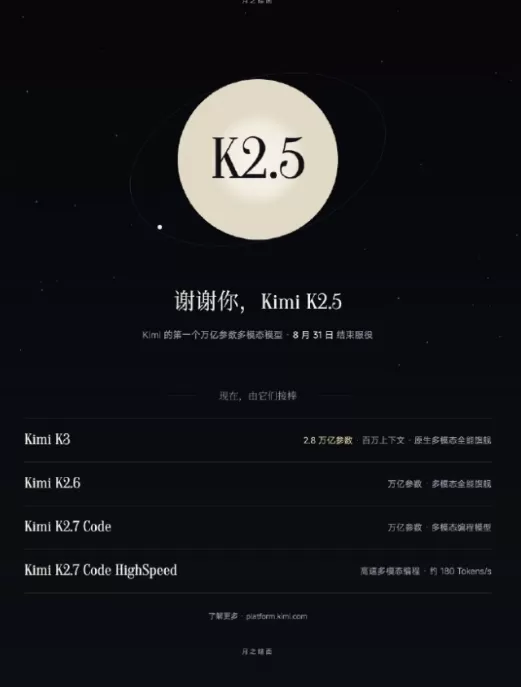
Moonshot announced via Kimi’s official Weibo that its inaugural trillion-parameter multimodal model, Kimi K2.5, will be retired by the end of this month. Launched and open-sourced in January, K2.5 stands as Kimi’s most versatile model to date, featuring a native multimodal architecture that handles visual and text inputs, supports both thinking and non-thinking modes, and enables dialogue and Agent tasks.
K3 Takes Over, Parameter Scale Rises Again
K2.5 achieved state-of-the-art performance in open-source models on tasks such as Agents, code, images, videos, and general intelligence. It is positioned as a general-purpose multimodal model that can switch between dialogue, complex reasoning, and automation tasks.
Its retirement also marks that Moonshot has officially shifted its focus to Kimi K3, which was open-sourced in July. This 2.8 trillion parameter model is built using the KDA hybrid linear attention mechanism and attention residual technology, and it natively supports visual understanding with a context window of up to 1 million tokens. The official stated that K3 is the first open-source model to reach a scale of 2.8 trillion parameters, and for the past 12 months, Kimi has held the record for the largest open-source model scale for 9 of those months.
Related article
 AI founders weigh open vs. closed models at TechCrunch Disrupt 2026
For AI startups, selecting a model is no longer just a one-time architectural choice.Open models are getting better. Frontier APIs keep improving. Models can be tailored for specific tasks, and some companies are building products that use multiple m
How AI and Robotics Are Transforming bp’s Oil Production
Digital twin technology enables bp to simulate energy asset operations, identifying improvement opportunities and predicting failures before they occur. Credit: bpRicky Burns, Transformation & Technology Manager at bp, explains how digital tools help
How to create free AI talking avatars?
Modern AI systems rely heavily on up-to-date, structured, and market-specific web data. According to McKinsey’s 2025 global survey, 88% of respondents reported that their organizations regularly utilize AI in at least one business function. As enterp
Related Special Topic Recommendations
Music composition
AI founders weigh open vs. closed models at TechCrunch Disrupt 2026
For AI startups, selecting a model is no longer just a one-time architectural choice.Open models are getting better. Frontier APIs keep improving. Models can be tailored for specific tasks, and some companies are building products that use multiple m
How AI and Robotics Are Transforming bp’s Oil Production
Digital twin technology enables bp to simulate energy asset operations, identifying improvement opportunities and predicting failures before they occur. Credit: bpRicky Burns, Transformation & Technology Manager at bp, explains how digital tools help
How to create free AI talking avatars?
Modern AI systems rely heavily on up-to-date, structured, and market-specific web data. According to McKinsey’s 2025 global survey, 88% of respondents reported that their organizations regularly utilize AI in at least one business function. As enterp
Related Special Topic Recommendations
Music composition
 Top AI Songwriting Assistants: Develop Lyrics, Chords, and Melodies
2026 Latest Top-Rated Best AI Songwriting Assistants are here on XIX.AI! This curated list features powerfully efficient tools that go through real-world tests to deliver high-quality lyrics, chords, and melodies effortlessly. Get a free vs paid comparison to find the perfect fit for your creative needs. Explore now to unlock your AI edge in music creation!
 12 tools
 xix.ai
automation
Top AI Agent Builders: Design Multi-Step Business Automations
xix.ai
automation
Top AI Agent Builders: Design Multi-Step Business Automations
2026 Latest Top-Rated Best AI Agent Builders for Creating Multi-Step Business Automations. This curated list features powerful, game-changing tools that go through rigorous real-world tests. You’ll find detailed free vs paid comparisons, comprehensive rankings, and weekly updated insights to help you choose the perfect solution that boosts your productivity significantly. Explore now at XIX.AI to unlock your AI edge!
11 tools
xix.ai
Productivity
AI Task Planning Tools for Busy Professionals
2026 Latest Best Top-rated AI Task Planning Tools for Busy Professionals! XIX.AI has curated a powerful, game-changing collection of highly efficient tools that help users streamline workflows, boost productivity, and overcome daily scheduling challenges. Each option goes through rigorous real-world tests to ensure reliability. Get a free vs paid comparison and discover the perfect tool to unlock your AI edge. Explore now!
15 tools
xix.ai
chatbot
Top AI Customer Chatbots: Answer FAQs and Qualify Leads 24/7
2026 Latest Top-rated AI Customer Chatbots featured on this curated list are the best solutions for answering customer FAQs instantly and qualifying leads around the clock. XIX.AI has conducted rigorous real-world tests to deliver a detailed free vs paid comparison along with up-to-date rankings, helping you find a powerful game-changing tool that boosts productivity significantly. Explore now to Discover your perfect AI chatbot solution!
9 tools
xix.ai
Design & Art
AI Storyboard Generators for Ad Creative Teams
2026 Latest Best AI Storyboard Generators for Ad Creative Teams! XIX.AI has curated a top-rated list of powerful, game-changing tools that help teams create stunning visual content faster through real-world tests and rigorous weekly updated rankings. Enjoy a free vs paid comparison to find the perfect fit for your workflow. Explore now to unlock your AI edge in ad creation!
8 tools
xix.ai
chatbot
AI Knowledge Chatbot Tools for Internal Documentation
2026 Latest Best Top-rated AI Knowledge Chatbot Tools for Internal Documentation are here on XIX.AI! This curated list features powerful game-changing solutions that significantly boost productivity by helping teams quickly generate high-quality content, streamline documentation creation, and overcome common writing challenges. We conduct rigorous real-world tests and provide a weekly updated free vs paid comparison along with detailed rankings to help you find the must-try option that fits your needs best. Explore now to Discover your perfect tool!
12 tools
xix.ai

 Comments (0)
0/500
Comments (0)
0/500
Moonshot announced via Kimi’s official Weibo that its inaugural trillion-parameter multimodal model, Kimi K2.5, will be retired by the end of this month. Launched and open-sourced in January, K2.5 stands as Kimi’s most versatile model to date, featuring a native multimodal architecture that handles visual and text inputs, supports both thinking and non-thinking modes, and enables dialogue and Agent tasks.
K3 Takes Over, Parameter Scale Rises Again
K2.5 achieved state-of-the-art performance in open-source models on tasks such as Agents, code, images, videos, and general intelligence. It is positioned as a general-purpose multimodal model that can switch between dialogue, complex reasoning, and automation tasks.
Its retirement also marks that Moonshot has officially shifted its focus to Kimi K3, which was open-sourced in July. This 2.8 trillion parameter model is built using the KDA hybrid linear attention mechanism and attention residual technology, and it natively supports visual understanding with a context window of up to 1 million tokens. The official stated that K3 is the first open-source model to reach a scale of 2.8 trillion parameters, and for the past 12 months, Kimi has held the record for the largest open-source model scale for 9 of those months.








 AI founders weigh open vs. closed models at TechCrunch Disrupt 2026
For AI startups, selecting a model is no longer just a one-time architectural choice.Open models are getting better. Frontier APIs keep improving. Models can be tailored for specific tasks, and some companies are building products that use multiple m
AI founders weigh open vs. closed models at TechCrunch Disrupt 2026
For AI startups, selecting a model is no longer just a one-time architectural choice.Open models are getting better. Frontier APIs keep improving. Models can be tailored for specific tasks, and some companies are building products that use multiple m
 How AI and Robotics Are Transforming bp’s Oil Production
Digital twin technology enables bp to simulate energy asset operations, identifying improvement opportunities and predicting failures before they occur. Credit: bpRicky Burns, Transformation & Technology Manager at bp, explains how digital tools help
How AI and Robotics Are Transforming bp’s Oil Production
Digital twin technology enables bp to simulate energy asset operations, identifying improvement opportunities and predicting failures before they occur. Credit: bpRicky Burns, Transformation & Technology Manager at bp, explains how digital tools help
 How to create free AI talking avatars?
Modern AI systems rely heavily on up-to-date, structured, and market-specific web data. According to McKinsey’s 2025 global survey, 88% of respondents reported that their organizations regularly utilize AI in at least one business function. As enterp
How to create free AI talking avatars?
Modern AI systems rely heavily on up-to-date, structured, and market-specific web data. According to McKinsey’s 2025 global survey, 88% of respondents reported that their organizations regularly utilize AI in at least one business function. As enterp
2026 Latest Top-Rated Best AI Songwriting Assistants are here on XIX.AI! This curated list features powerfully efficient tools that go through real-world tests to deliver high-quality lyrics, chords, and melodies effortlessly. Get a free vs paid comparison to find the perfect fit for your creative needs. Explore now to unlock your AI edge in music creation!
12 tools
xix.ai

2026 Latest Top-Rated Best AI Agent Builders for Creating Multi-Step Business Automations. This curated list features powerful, game-changing tools that go through rigorous real-world tests. You’ll find detailed free vs paid comparisons, comprehensive rankings, and weekly updated insights to help you choose the perfect solution that boosts your productivity significantly. Explore now at XIX.AI to unlock your AI edge!
11 tools
xix.ai

2026 Latest Best Top-rated AI Task Planning Tools for Busy Professionals! XIX.AI has curated a powerful, game-changing collection of highly efficient tools that help users streamline workflows, boost productivity, and overcome daily scheduling challenges. Each option goes through rigorous real-world tests to ensure reliability. Get a free vs paid comparison and discover the perfect tool to unlock your AI edge. Explore now!
15 tools
xix.ai

2026 Latest Top-rated AI Customer Chatbots featured on this curated list are the best solutions for answering customer FAQs instantly and qualifying leads around the clock. XIX.AI has conducted rigorous real-world tests to deliver a detailed free vs paid comparison along with up-to-date rankings, helping you find a powerful game-changing tool that boosts productivity significantly. Explore now to Discover your perfect AI chatbot solution!
9 tools
xix.ai

2026 Latest Best AI Storyboard Generators for Ad Creative Teams! XIX.AI has curated a top-rated list of powerful, game-changing tools that help teams create stunning visual content faster through real-world tests and rigorous weekly updated rankings. Enjoy a free vs paid comparison to find the perfect fit for your workflow. Explore now to unlock your AI edge in ad creation!
8 tools
xix.ai

2026 Latest Best Top-rated AI Knowledge Chatbot Tools for Internal Documentation are here on XIX.AI! This curated list features powerful game-changing solutions that significantly boost productivity by helping teams quickly generate high-quality content, streamline documentation creation, and overcome common writing challenges. We conduct rigorous real-world tests and provide a weekly updated free vs paid comparison along with detailed rankings to help you find the must-try option that fits your needs best. Explore now to Discover your perfect tool!
12 tools
xix.ai












