


 Home
HomeMicrosoft's Free Windows 10 Security Updates Come With a Key Condition
Microsoft announced last year that it would charge $30 for one year of additional security updates for Windows 10. Now, the company is allowing users to enroll in its Extended Security Updates (ESU) program for free ahead of Windows 10’s end-of-support date on October 14th. However, there is a condition.
Users have three ways to get ESU on their personal Windows 10 devices. The free option requires enabling Windows Backup to sync settings and folders to the cloud. Since Windows Backup uses OneDrive, you can manage within the 5GB of free storage—but if you have numerous files in your Documents folder, you may need to buy extra space for full functionality. This is the trade-off for receiving free extended updates on Windows 10.
The other two ESU options for Windows 10 include paying the $30 fee for a year of updates or redeeming 1,000 Microsoft Reward points. In July, Microsoft is introducing an enrollment wizard to Windows 10 with these three choices. “Once you choose an option and follow the on-screen steps, your PC will be enrolled automatically,” explains Yusuf Mehdi, executive vice president and consumer chief marketing officer at Microsoft.
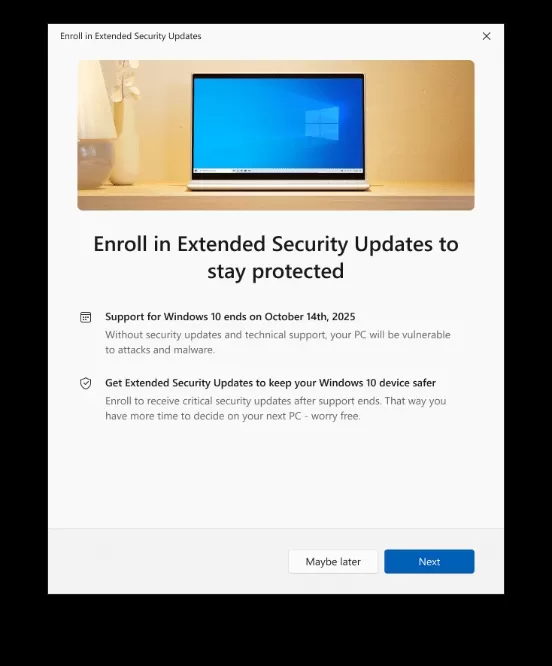
How consumers will enroll into Windows 10 extended security updates. Image: MicrosoftExtended security updates for Windows 10 will only be available to consumers until October 13th, 2026. Businesses, on the other hand, can purchase up to three years of critical security updates. Microsoft is also providing ESU at no cost for Windows 10 devices that access Windows 11 Cloud PCs via Windows 365 or Virtual Machines.
Microsoft is strongly encouraging users to move away from Windows 10 and has named 2025 “the year of the Windows 11 PC refresh.” Windows 11 became the leading operating system for PC gaming late last year. Still, 37 percent of Steam users continue to run Windows 10. With only a few months remaining to persuade Windows 10 users to upgrade or purchase new PCs, we can expect to see more full-screen alerts notifying customers about the upcoming support deadline.
Related article
 Microsoft, Azure and AI Tech Combat California Wildfire Risks
Microsoft invests in AI-driven wildfire detection, with Juan Lavista Ferres, CVP and Chief Data Scientist, discussing strategies to mitigate environmental damage.According to NASA, climate change impacts everyone on Earth, manifesting as rising tempe
Microsoft CEO Slams AI Labs Over Distillation
Satya Nadella, Microsoft’s CEO, calls out AI labs for hypocrisy regarding distillation criticism, a remark widely interpreted as targeting Anthropic. Credit: Getty ImagesMicrosoft CEO Satya Nadella challenges AI developers for limiting model distilla
Meta Challenges AWS and Google Cloud in Cloud Computing
Mark Zuckerberg, CEO of Meta. Image credit: Getty ImagesMark Zuckerberg confirms that selling computing capacity is an option as Meta Compute prepares to enter the cloud market, competing with Amazon and Google.Meta has announced plans to launch a cl
Related Special Topic Recommendations
chatbot
Microsoft, Azure and AI Tech Combat California Wildfire Risks
Microsoft invests in AI-driven wildfire detection, with Juan Lavista Ferres, CVP and Chief Data Scientist, discussing strategies to mitigate environmental damage.According to NASA, climate change impacts everyone on Earth, manifesting as rising tempe
Microsoft CEO Slams AI Labs Over Distillation
Satya Nadella, Microsoft’s CEO, calls out AI labs for hypocrisy regarding distillation criticism, a remark widely interpreted as targeting Anthropic. Credit: Getty ImagesMicrosoft CEO Satya Nadella challenges AI developers for limiting model distilla
Meta Challenges AWS and Google Cloud in Cloud Computing
Mark Zuckerberg, CEO of Meta. Image credit: Getty ImagesMark Zuckerberg confirms that selling computing capacity is an option as Meta Compute prepares to enter the cloud market, competing with Amazon and Google.Meta has announced plans to launch a cl
Related Special Topic Recommendations
chatbot
 Best AI Conversation Trainer Tools for Interview Practice
2026 Latest Best Top-rated AI Conversation Trainer Tools for Interview Practice are here on XIX.AI! This curated collection features powerful, game-changing tools that go through rigorous real-world tests to deliver accurate feedback. You’ll find a free vs paid comparison and detailed rankings to help you choose the must-try option that boosts your confidence and skills. Explore now to Discover your perfect tool for interview success!
 12 tools
 xix.ai
Design & Art
Best AI Style Transfer Tools for Creative Experiments
xix.ai
Design & Art
Best AI Style Transfer Tools for Creative Experiments
2026 Latest Best Top-rated AI Style Transfer Tools for Creative Experiments! XIX.AI has curated a powerful, game-changing collection of must-try tools that deliver exceptional results through real-world tests and rigorous rankings. These top solutions help creatives boost productivity significantly by accelerating content creation and unlocking endless creative possibilities. Explore now to discover your perfect tool and start creating today!
9 tools
xix.ai
Comic Creation
Best AI Dialogue Bubble Tools for Visual Storytelling
2026 Latest Best Top-Rated AI Dialogue Bubble Tools for Visual Storytelling are here on XIX.AI! This curated collection features powerful, game-changing tools that help creators boost productivity and overcome creative bottlenecks. Get a free vs paid comparison, see real-world tests, and check the latest rankings to find the must-try solutions perfect for crafting engaging visual narratives. Explore now to discover your ideal tool!
10 tools
xix.ai
Meeting Assistant
Top AI Meeting Summary Tools: Track Decisions and Follow-Ups Clearly
2026 Latest Top-Rated Best AI Meeting Summary Tools for Clear Decision Tracking and Effortless Follow-Ups. This curated list showcases powerful, game-changing solutions that boost productivity dramatically by automating meeting notes, identifying key action items, and streamlining team coordination across all projects. Get a free vs paid comparison along with real-world tests and weekly updated rankings to help you find the perfect tool. Explore now to unlock your AI edge!
9 tools
xix.ai
Data Analysis
Best AI Data Cleaning Tools: Fix Missing Values and Duplicates Fast
2026 Latest Best Top-rated AI Data Cleaning Tools for quick fixing of missing values and duplicates. This curated list showcases powerful, game-changing solutions that boost productivity significantly. Each option has undergone rigorous real-world tests to ensure reliability. Get a free vs paid comparison and discover the must-try tool that fits your needs best. Explore now at XIX.AI to Unlock your AI edge.
11 tools
xix.ai
Design & Art
Best AI Creative Ideation Tools for Artists: Break Through Visual Blocks
2026 Latest Best Top-Rated AI Creative Ideation Tools for Artists are curated by XIX.AI to help creators break through visual blocks and boost creativity instantly. These powerful game-changing tools offer real-world tests, detailed free vs paid comparison, and weekly updated rankings. Discover your perfect tool to accelerate content creation and unlock your AI edge today. Explore now!
14 tools
xix.ai

 Comments (1)
0/500
Comments (1)
0/500
![CharlesThomas]()
微軟這次免費提供ESU算是給Windows 10用戶一個緩衝吧?不過感覺更像是在為Windows 11鋪路,畢竟很多人還是不想換硬體。🤔 安全性更新免費當然好,但長期來看還是得升級系統才安心。
Microsoft announced last year that it would charge $30 for one year of additional security updates for Windows 10. Now, the company is allowing users to enroll in its Extended Security Updates (ESU) program for free ahead of Windows 10’s end-of-support date on October 14th. However, there is a condition.
Users have three ways to get ESU on their personal Windows 10 devices. The free option requires enabling Windows Backup to sync settings and folders to the cloud. Since Windows Backup uses OneDrive, you can manage within the 5GB of free storage—but if you have numerous files in your Documents folder, you may need to buy extra space for full functionality. This is the trade-off for receiving free extended updates on Windows 10.
The other two ESU options for Windows 10 include paying the $30 fee for a year of updates or redeeming 1,000 Microsoft Reward points. In July, Microsoft is introducing an enrollment wizard to Windows 10 with these three choices. “Once you choose an option and follow the on-screen steps, your PC will be enrolled automatically,” explains Yusuf Mehdi, executive vice president and consumer chief marketing officer at Microsoft.
Extended security updates for Windows 10 will only be available to consumers until October 13th, 2026. Businesses, on the other hand, can purchase up to three years of critical security updates. Microsoft is also providing ESU at no cost for Windows 10 devices that access Windows 11 Cloud PCs via Windows 365 or Virtual Machines.
Microsoft is strongly encouraging users to move away from Windows 10 and has named 2025 “the year of the Windows 11 PC refresh.” Windows 11 became the leading operating system for PC gaming late last year. Still, 37 percent of Steam users continue to run Windows 10. With only a few months remaining to persuade Windows 10 users to upgrade or purchase new PCs, we can expect to see more full-screen alerts notifying customers about the upcoming support deadline.








 Microsoft, Azure and AI Tech Combat California Wildfire Risks
Microsoft invests in AI-driven wildfire detection, with Juan Lavista Ferres, CVP and Chief Data Scientist, discussing strategies to mitigate environmental damage.According to NASA, climate change impacts everyone on Earth, manifesting as rising tempe
Microsoft, Azure and AI Tech Combat California Wildfire Risks
Microsoft invests in AI-driven wildfire detection, with Juan Lavista Ferres, CVP and Chief Data Scientist, discussing strategies to mitigate environmental damage.According to NASA, climate change impacts everyone on Earth, manifesting as rising tempe
 Microsoft CEO Slams AI Labs Over Distillation
Satya Nadella, Microsoft’s CEO, calls out AI labs for hypocrisy regarding distillation criticism, a remark widely interpreted as targeting Anthropic. Credit: Getty ImagesMicrosoft CEO Satya Nadella challenges AI developers for limiting model distilla
Microsoft CEO Slams AI Labs Over Distillation
Satya Nadella, Microsoft’s CEO, calls out AI labs for hypocrisy regarding distillation criticism, a remark widely interpreted as targeting Anthropic. Credit: Getty ImagesMicrosoft CEO Satya Nadella challenges AI developers for limiting model distilla
 Meta Challenges AWS and Google Cloud in Cloud Computing
Mark Zuckerberg, CEO of Meta. Image credit: Getty ImagesMark Zuckerberg confirms that selling computing capacity is an option as Meta Compute prepares to enter the cloud market, competing with Amazon and Google.Meta has announced plans to launch a cl
Meta Challenges AWS and Google Cloud in Cloud Computing
Mark Zuckerberg, CEO of Meta. Image credit: Getty ImagesMark Zuckerberg confirms that selling computing capacity is an option as Meta Compute prepares to enter the cloud market, competing with Amazon and Google.Meta has announced plans to launch a cl
2026 Latest Best Top-rated AI Conversation Trainer Tools for Interview Practice are here on XIX.AI! This curated collection features powerful, game-changing tools that go through rigorous real-world tests to deliver accurate feedback. You’ll find a free vs paid comparison and detailed rankings to help you choose the must-try option that boosts your confidence and skills. Explore now to Discover your perfect tool for interview success!
12 tools
xix.ai

2026 Latest Best Top-rated AI Style Transfer Tools for Creative Experiments! XIX.AI has curated a powerful, game-changing collection of must-try tools that deliver exceptional results through real-world tests and rigorous rankings. These top solutions help creatives boost productivity significantly by accelerating content creation and unlocking endless creative possibilities. Explore now to discover your perfect tool and start creating today!
9 tools
xix.ai

2026 Latest Best Top-Rated AI Dialogue Bubble Tools for Visual Storytelling are here on XIX.AI! This curated collection features powerful, game-changing tools that help creators boost productivity and overcome creative bottlenecks. Get a free vs paid comparison, see real-world tests, and check the latest rankings to find the must-try solutions perfect for crafting engaging visual narratives. Explore now to discover your ideal tool!
10 tools
xix.ai
2026 Latest Top-Rated Best AI Meeting Summary Tools for Clear Decision Tracking and Effortless Follow-Ups. This curated list showcases powerful, game-changing solutions that boost productivity dramatically by automating meeting notes, identifying key action items, and streamlining team coordination across all projects. Get a free vs paid comparison along with real-world tests and weekly updated rankings to help you find the perfect tool. Explore now to unlock your AI edge!
9 tools
xix.ai

2026 Latest Best Top-rated AI Data Cleaning Tools for quick fixing of missing values and duplicates. This curated list showcases powerful, game-changing solutions that boost productivity significantly. Each option has undergone rigorous real-world tests to ensure reliability. Get a free vs paid comparison and discover the must-try tool that fits your needs best. Explore now at XIX.AI to Unlock your AI edge.
11 tools
xix.ai

2026 Latest Best Top-Rated AI Creative Ideation Tools for Artists are curated by XIX.AI to help creators break through visual blocks and boost creativity instantly. These powerful game-changing tools offer real-world tests, detailed free vs paid comparison, and weekly updated rankings. Discover your perfect tool to accelerate content creation and unlock your AI edge today. Explore now!
14 tools
xix.ai

微軟這次免費提供ESU算是給Windows 10用戶一個緩衝吧?不過感覺更像是在為Windows 11鋪路,畢竟很多人還是不想換硬體。🤔 安全性更新免費當然好,但長期來看還是得升級系統才安心。












