


 Home
HomeMicrosoft Confirms Win11 2026 Update: Taskbar Returns, AI Activates Digital Detox
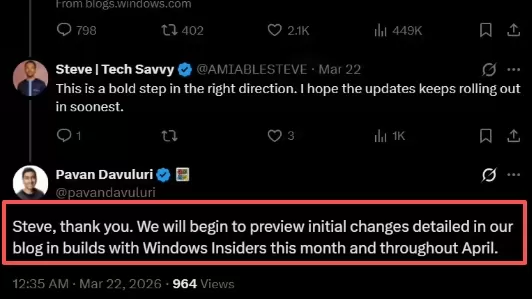
After years of system bloat and controversial reputation, Microsoft has finally decided to perform a "major surgery" on Windows 11. Pavan Davuluri, head of Microsoft Windows, recently confirmed that a series of core improvements aimed at enhancing speed and usability will be rolled out from this month until April.
The most surprising change in this update is Microsoft's decision to reduce the presence of AI. To create a quieter system environment, Microsoft will minimize the intervention of Copilot in the following native applications:
Snipping Tool and Photos: Remove redundant AI suggestions, giving users a clean editing space.
Notepad and Widgets: Remove unnecessary AI sidebars, reducing system resource usage.
After years of user requests, Microsoft has finally brought back one of the most iconic features: movable taskbar. Users can now reposition the taskbar at the top or sides of the screen according to their preferences. Additionally, the taskbar supports resizing, leaving more display space on the screen.
Performance Jump: Say Goodbye to Lag and Forced Reboots
In response to the long-standing performance issues in Windows 11, Microsoft promises to achieve a "perceptible" speed improvement through the following technical measures:
Framework Migration: Migrate more system components to WinUI3, significantly reducing interaction latency.
Memory Optimization: Reduce base memory usage and improve multi-tasking responsiveness under heavy load.
Update Autonomy: Allow users to pause updates as needed and greatly reduce the number of forced reboots caused by patch installations.
Differing from previous annual major version updates, Scott Hanselman, a Microsoft technical researcher, stated that these improvements will follow a "monthly update, phased rollout" model. This means that preview experience members in the Canary and Dev channels will get the first chance to test this month, while regular users will gradually receive these performance patches in the monthly "Tuesday patches" coming up.
This 2026 update marks Microsoft's return to focusing on the fundamental user experience of the operating system, instead of blindly adding AI features. When Windows 11 no longer forces users to log in to an account or endure AI ads everywhere, the system may finally become the productivity tool that Microsoft promised it would be—a system that is "worth updating immediately upon release."
Related article
 Google Launches Gemini Enterprise Legal Tools for Law Firms
On Tuesday, Google broadened its Gemini Enterprise platform by introducing Gemini Enterprise for Legal, a dedicated solution for attorneys and law firms, marking a significant escalation in the race among major tech companies to capture AI-driven dem
Official support for Tongyi Qianwen arrives as Unsloth Dynamic V3 shrinks Qwen3.8-27B with a 1-bit version running on 8GB memory
Tongyi Qianwen (Qwen) recently publicly acknowledged the Unsloth team for releasing the Qwen3.8-27B GGUF quantized version, praising it as "smaller and smarter." This exchange has ignited widespread discussion in the open-source community, underscori
OpenAI launches GPT-6 Astra, marking a major step toward artificial general intelligence
OpenAI has officially introduced its newest flagship large language model, GPT-6Astra. During a media briefing, company president Greg Brockman praised the model highly, suggesting that it may mark humanity’s entry into the era of artificial general
Related Special Topic Recommendations
Meeting Assistant
Google Launches Gemini Enterprise Legal Tools for Law Firms
On Tuesday, Google broadened its Gemini Enterprise platform by introducing Gemini Enterprise for Legal, a dedicated solution for attorneys and law firms, marking a significant escalation in the race among major tech companies to capture AI-driven dem
Official support for Tongyi Qianwen arrives as Unsloth Dynamic V3 shrinks Qwen3.8-27B with a 1-bit version running on 8GB memory
Tongyi Qianwen (Qwen) recently publicly acknowledged the Unsloth team for releasing the Qwen3.8-27B GGUF quantized version, praising it as "smaller and smarter." This exchange has ignited widespread discussion in the open-source community, underscori
OpenAI launches GPT-6 Astra, marking a major step toward artificial general intelligence
OpenAI has officially introduced its newest flagship large language model, GPT-6Astra. During a media briefing, company president Greg Brockman praised the model highly, suggesting that it may mark humanity’s entry into the era of artificial general
Related Special Topic Recommendations
Meeting Assistant
 AI Voice-to-Minutes Assistants: Convert Team Talks into Clean Notes
2026 Latest Best Top-Rated AI Voice-to-Minutes Assistants Guide! XIX.AI has curated a highly powerful, game-changing collection of tools designed to transform every team conversation into flawless, organized notes instantly. Our weekly updated rankings cover free vs paid options, along with real-world tests showing their effectiveness for boosting productivity across all work scenarios. Must-try for anyone looking to unlock their AI edge. Explore now!
 9 tools
 xix.ai
Animation Creation
Best AI Lip-Sync Generators for Dialogue Scenes
xix.ai
Animation Creation
Best AI Lip-Sync Generators for Dialogue Scenes
2026 Latest Best Top-Rated AI Lip-Sync Generators for Dialogue Scenes are here on XIX.AI! This curated collection features powerful, game-changing tools that deliver flawless synchronized lip movements for any script, boosting your video editing efficiency significantly. Enjoy a free vs paid comparison along with real-world tests and weekly updated rankings to help you find the must-try perfect fit. Explore now to unlock your AI edge!
8 tools
xix.ai
Prompt
AI Prompt Optimizers: Refine Instructions for Better Output Quality
2026 Latest Best Top-Rated AI Prompt Optimizers Curated for Maximum Output Quality! XIX.AI delivers powerful game-changing solutions that help you refine instructions effortlessly, boost writing efficiency, and unlock higher-quality results every time. Get a free vs paid comparison along with real-world tests and weekly updated rankings. Explore now to Discover your perfect tool and Unlock your AI edge!
16 tools
xix.ai
Animation Creation
Runway AI Motion Tools for Ad Storyboards, Character Scenes, and Visual Prototypes
2026 Latest Best Runway AI Motion Tools Top-rated curated powerful game-changing options for creating ad storyboards character scenes and visual prototypes through real-world tests Weekly updated free vs paid comparison rankings Help you boost productivity significantly Explore now
9 tools
xix.ai
Academic Research
AI Dataset Discovery Tools for Academic Projects
2026 Latest Best Top-Rated AI Dataset Discovery Tools for Academic Projects! XIX.AI has curated a powerful, game-changing collection of highly reliable options, all going through strict real-world tests and updated weekly. You can find detailed free vs paid comparison info to help you pick the perfect tool that boosts your research efficiency and delivers top-quality results. Explore now to unlock your AI edge!
16 tools
xix.ai
Social Media
Best AI Caption Generators: Write Platform-Specific Social Posts Fast
2026 Latest Best AI Caption Generators page! XIX.AI curated a top-rated list of must-try powerful tools for writing platform-specific social posts quickly. These tools go through rigorous real-world tests, offering free vs paid comparison and clear rankings to help you find the best option that boosts your productivity and unlocks your AI edge. Explore now!
11 tools
xix.ai

 Comments (0)
0/500
Comments (0)
0/500
After years of system bloat and controversial reputation, Microsoft has finally decided to perform a "major surgery" on Windows 11. Pavan Davuluri, head of Microsoft Windows, recently confirmed that a series of core improvements aimed at enhancing speed and usability will be rolled out from this month until April.
The most surprising change in this update is Microsoft's decision to reduce the presence of AI. To create a quieter system environment, Microsoft will minimize the intervention of Copilot in the following native applications:
Snipping Tool and Photos: Remove redundant AI suggestions, giving users a clean editing space.
Notepad and Widgets: Remove unnecessary AI sidebars, reducing system resource usage.
After years of user requests, Microsoft has finally brought back one of the most iconic features: movable taskbar. Users can now reposition the taskbar at the top or sides of the screen according to their preferences. Additionally, the taskbar supports resizing, leaving more display space on the screen.
Performance Jump: Say Goodbye to Lag and Forced Reboots
In response to the long-standing performance issues in Windows 11, Microsoft promises to achieve a "perceptible" speed improvement through the following technical measures:
Framework Migration: Migrate more system components to WinUI3, significantly reducing interaction latency.
Memory Optimization: Reduce base memory usage and improve multi-tasking responsiveness under heavy load.
Update Autonomy: Allow users to pause updates as needed and greatly reduce the number of forced reboots caused by patch installations.
Differing from previous annual major version updates, Scott Hanselman, a Microsoft technical researcher, stated that these improvements will follow a "monthly update, phased rollout" model. This means that preview experience members in the Canary and Dev channels will get the first chance to test this month, while regular users will gradually receive these performance patches in the monthly "Tuesday patches" coming up.
This 2026 update marks Microsoft's return to focusing on the fundamental user experience of the operating system, instead of blindly adding AI features. When Windows 11 no longer forces users to log in to an account or endure AI ads everywhere, the system may finally become the productivity tool that Microsoft promised it would be—a system that is "worth updating immediately upon release."








 Google Launches Gemini Enterprise Legal Tools for Law Firms
On Tuesday, Google broadened its Gemini Enterprise platform by introducing Gemini Enterprise for Legal, a dedicated solution for attorneys and law firms, marking a significant escalation in the race among major tech companies to capture AI-driven dem
Google Launches Gemini Enterprise Legal Tools for Law Firms
On Tuesday, Google broadened its Gemini Enterprise platform by introducing Gemini Enterprise for Legal, a dedicated solution for attorneys and law firms, marking a significant escalation in the race among major tech companies to capture AI-driven dem
 Official support for Tongyi Qianwen arrives as Unsloth Dynamic V3 shrinks Qwen3.8-27B with a 1-bit version running on 8GB memory
Tongyi Qianwen (Qwen) recently publicly acknowledged the Unsloth team for releasing the Qwen3.8-27B GGUF quantized version, praising it as "smaller and smarter." This exchange has ignited widespread discussion in the open-source community, underscori
Official support for Tongyi Qianwen arrives as Unsloth Dynamic V3 shrinks Qwen3.8-27B with a 1-bit version running on 8GB memory
Tongyi Qianwen (Qwen) recently publicly acknowledged the Unsloth team for releasing the Qwen3.8-27B GGUF quantized version, praising it as "smaller and smarter." This exchange has ignited widespread discussion in the open-source community, underscori
 OpenAI launches GPT-6 Astra, marking a major step toward artificial general intelligence
OpenAI has officially introduced its newest flagship large language model, GPT-6Astra. During a media briefing, company president Greg Brockman praised the model highly, suggesting that it may mark humanity’s entry into the era of artificial general
OpenAI launches GPT-6 Astra, marking a major step toward artificial general intelligence
OpenAI has officially introduced its newest flagship large language model, GPT-6Astra. During a media briefing, company president Greg Brockman praised the model highly, suggesting that it may mark humanity’s entry into the era of artificial general
2026 Latest Best Top-Rated AI Voice-to-Minutes Assistants Guide! XIX.AI has curated a highly powerful, game-changing collection of tools designed to transform every team conversation into flawless, organized notes instantly. Our weekly updated rankings cover free vs paid options, along with real-world tests showing their effectiveness for boosting productivity across all work scenarios. Must-try for anyone looking to unlock their AI edge. Explore now!
9 tools
xix.ai
2026 Latest Best Top-Rated AI Lip-Sync Generators for Dialogue Scenes are here on XIX.AI! This curated collection features powerful, game-changing tools that deliver flawless synchronized lip movements for any script, boosting your video editing efficiency significantly. Enjoy a free vs paid comparison along with real-world tests and weekly updated rankings to help you find the must-try perfect fit. Explore now to unlock your AI edge!
8 tools
xix.ai
2026 Latest Best Top-Rated AI Prompt Optimizers Curated for Maximum Output Quality! XIX.AI delivers powerful game-changing solutions that help you refine instructions effortlessly, boost writing efficiency, and unlock higher-quality results every time. Get a free vs paid comparison along with real-world tests and weekly updated rankings. Explore now to Discover your perfect tool and Unlock your AI edge!
16 tools
xix.ai
2026 Latest Best Runway AI Motion Tools Top-rated curated powerful game-changing options for creating ad storyboards character scenes and visual prototypes through real-world tests Weekly updated free vs paid comparison rankings Help you boost productivity significantly Explore now
9 tools
xix.ai
2026 Latest Best Top-Rated AI Dataset Discovery Tools for Academic Projects! XIX.AI has curated a powerful, game-changing collection of highly reliable options, all going through strict real-world tests and updated weekly. You can find detailed free vs paid comparison info to help you pick the perfect tool that boosts your research efficiency and delivers top-quality results. Explore now to unlock your AI edge!
16 tools
xix.ai

2026 Latest Best AI Caption Generators page! XIX.AI curated a top-rated list of must-try powerful tools for writing platform-specific social posts quickly. These tools go through rigorous real-world tests, offering free vs paid comparison and clear rankings to help you find the best option that boosts your productivity and unlocks your AI edge. Explore now!
11 tools
xix.ai












