


 Home
HomeMeta restricts teen access to AI characters ahead of update
Meta has announced a global pause on teen access to its AI characters across all its apps. The company clarified to TechCrunch that this is not an abandonment of the feature, but a step toward developing an updated version specifically designed for younger users.
This decision comes just days before a trial is set to begin in New Mexico, where Meta faces accusations of failing to protect children from sexual exploitation on its platforms. A recent Wired report also noted Meta's efforts to limit legal discovery concerning social media's impact on teen mental health.
Last October, Meta previewed parental controls for its AI characters, allowing guardians to monitor topics and block access to specific characters, with the option to disable chats entirely. While these features were slated for release this year, Meta is now temporarily disabling all AI character access for teens while it works on the new version.
The company stated that feedback from parents, who sought greater insight and control over their teens' interactions with AI, directly influenced this policy change.
Meta has been progressively tightening restrictions on teen exposure to AI content. Also in October, it introduced parental controls on Instagram, inspired by PG-13 movie ratings, to tailor the teen AI experience by restricting access to topics like extreme violence, nudity, and graphic drug use.
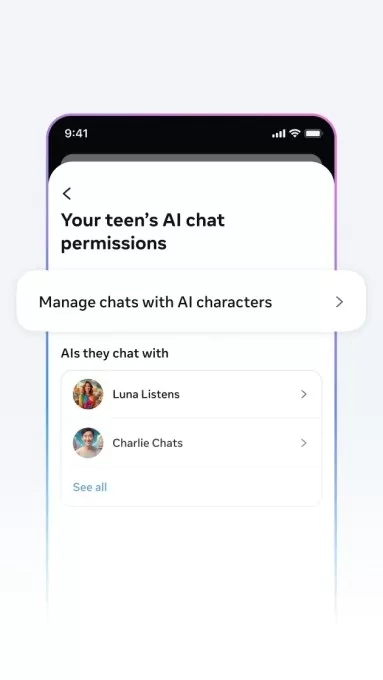
Meta’s previously previewed controls for AI characters. Image Credits: Meta “Starting in the coming weeks, teens will no longer be able to access AI characters across our apps until the updated experience is ready. This will apply to anyone who has given us a teen birthday, as well as people who claim to be adults but who we suspect are teens based on our age prediction technology,” the company said in an updated blog post.
Meta added that the forthcoming AI characters will include built-in parental controls. These new characters are designed to provide age-appropriate responses, focusing on suitable topics such as education, sports, and hobbies.
Social media platforms are facing intense regulatory scrutiny. Beyond the New Mexico case, Meta is preparing for another trial next week, where it is accused of contributing to social media addiction. CEO Mark Zuckerberg is expected to testify once that trial commences.
The pressure extends beyond social media to AI companies, which have also adjusted their services for younger users following lawsuits. In October, Character.AI, which lets users chat with various AI avatars, banned open-ended chatbot conversations for users under 18, later announcing plans for interactive stories for children. Recently, OpenAI implemented new teen safety rules for ChatGPT and began using age prediction to apply content restrictions.
Correction: This post was updated to clarify that the new version of AI characters will be accessible to everyone, not just teens, when it launches. It will include parental controls.
Related article
 Stripe to Acquire OpenRouter as AI Model Routing Gains Momentum
Stripe has agreed to acquire OpenRouter, an AI model-routing platform that gives developers access to hundreds of models through a single interface. The deal adds model selection and routing to Stripe’s existing work around AI usage and token-based b
Former OpenAI Researcher Barrett Zoph Returns to Google to Support Gemini Development
Barret Zoph, who previously abruptly left and joined OpenAI due to a disagreement with Thinking Machines Lab CEO Miriam Mularati, has once again changed employers. Alphabet's Google announced that Zoph will return as Vice President of Research, bring
How Recursive Intelligence Raised $335M at $4B Valuation in 4 Months
The co-founders of startup Ricursive Intelligence seemed destined to be co-founders.Anna Goldie, CEO, and Azalia Mirhoseini, CTO, are so well-known in the AI community that they were among those AI engineers who “got those weird emails from Zuckerber
Related Special Topic Recommendations
Design & Art
Stripe to Acquire OpenRouter as AI Model Routing Gains Momentum
Stripe has agreed to acquire OpenRouter, an AI model-routing platform that gives developers access to hundreds of models through a single interface. The deal adds model selection and routing to Stripe’s existing work around AI usage and token-based b
Former OpenAI Researcher Barrett Zoph Returns to Google to Support Gemini Development
Barret Zoph, who previously abruptly left and joined OpenAI due to a disagreement with Thinking Machines Lab CEO Miriam Mularati, has once again changed employers. Alphabet's Google announced that Zoph will return as Vice President of Research, bring
How Recursive Intelligence Raised $335M at $4B Valuation in 4 Months
The co-founders of startup Ricursive Intelligence seemed destined to be co-founders.Anna Goldie, CEO, and Azalia Mirhoseini, CTO, are so well-known in the AI community that they were among those AI engineers who “got those weird emails from Zuckerber
Related Special Topic Recommendations
Design & Art
 Top AI Illustration Tools: Create Editorial Scenes and Cover Art Faster
2026 Latest Top-rated AI Illustration Tools: Our curated list features the best powerfully designed tools for creating stunning editorial scenes and eye-catching cover art quickly. Each option has gone through rigorous real-world tests, offering a free vs paid comparison to help you find the perfect match for your workflow. Try these must-try solutions today to unlock your AI edge and boost your creative productivity. Explore now at XIX.AI.
 10 tools
 xix.ai
Education and Learning
Top AI Tutors for Exam Prep: Practice Math, Science, and English
xix.ai
Education and Learning
Top AI Tutors for Exam Prep: Practice Math, Science, and English
2026 Latest Top-Rated Best AI Tutors for Exam Prep are here on XIX.AI! Our curated list features powerful game-changing tools that offer free vs paid comparison, real-world tests, and weekly updated rankings. They help boost your writing efficiency, simplify complex topic learning, and unlock your academic potential. Explore now to Discover your perfect exam prep tool and Start creating today to Unlock your AI edge!
10 tools
xix.ai
Finance
AI Budget Planning Tools for Personal Money Management
2026 Latest Best Top-Rated AI Budget Planning Tools for Personal Money Management are here on XIX.AI! This curated collection features powerful, game-changing solutions that help you conduct real-world tests, understand spending habits, and create personalized plans to boost productivity. Enjoy a free vs paid comparison along with detailed rankings. Must-try tools designed to simplify money management and unlock your AI edge. Explore now!
11 tools
xix.ai
Health & Wellness
AI Sleep Tracking Assistants: Improve Recovery with Better Bedtime Habits
2026 Latest Best Top-Rated AI Sleep Tracking Assistants curated for ultimate recovery. This fully updated weekly guide features powerful tools that deliver real-world tests, free vs paid comparison, and detailed rankings to help you find the must-try solution that boosts sleep quality and supports better bedtime habits. Explore now at XIX.AI to Unlock your AI edge.
10 tools
xix.ai
Data Analysis
AI SQL Copilots for Product and Revenue Analytics
2026 Latest Best Top-Rated AI SQL Copilots for Product and Revenue Analytics! XIX.AI has curated a powerful, game-changing collection of must-try tools that undergo real-world tests through weekly updated rankings. These tools help users boost productivity significantly by accelerating data analysis, streamlining complex queries, and generating accurate insights to drive smarter business decisions. Explore now to Discover your perfect tool for unlocking your AI edge!
14 tools
xix.ai
Education and Learning
Best AI Homework Helpers That Teach: Learn Concepts, Not Just Answers
2026 Latest Best Top-Rated AI Homework Helpers That Teach Core Concepts Not Just Answers Powerful Tools for Students Must-Try Curated List Weekly Updated Free vs Paid Comparison Real-World Tests Accurate Rankings to Help You Unlock Your Full Learning Potential Explore now to Discover your perfect tool for smarter studying.
10 tools
xix.ai

 Comments (0)
0/500
Comments (0)
0/500
Meta has announced a global pause on teen access to its AI characters across all its apps. The company clarified to TechCrunch that this is not an abandonment of the feature, but a step toward developing an updated version specifically designed for younger users.
This decision comes just days before a trial is set to begin in New Mexico, where Meta faces accusations of failing to protect children from sexual exploitation on its platforms. A recent Wired report also noted Meta's efforts to limit legal discovery concerning social media's impact on teen mental health.
Last October, Meta previewed parental controls for its AI characters, allowing guardians to monitor topics and block access to specific characters, with the option to disable chats entirely. While these features were slated for release this year, Meta is now temporarily disabling all AI character access for teens while it works on the new version.
The company stated that feedback from parents, who sought greater insight and control over their teens' interactions with AI, directly influenced this policy change.
Meta has been progressively tightening restrictions on teen exposure to AI content. Also in October, it introduced parental controls on Instagram, inspired by PG-13 movie ratings, to tailor the teen AI experience by restricting access to topics like extreme violence, nudity, and graphic drug use.
“Starting in the coming weeks, teens will no longer be able to access AI characters across our apps until the updated experience is ready. This will apply to anyone who has given us a teen birthday, as well as people who claim to be adults but who we suspect are teens based on our age prediction technology,” the company said in an updated blog post.
Meta added that the forthcoming AI characters will include built-in parental controls. These new characters are designed to provide age-appropriate responses, focusing on suitable topics such as education, sports, and hobbies.
Social media platforms are facing intense regulatory scrutiny. Beyond the New Mexico case, Meta is preparing for another trial next week, where it is accused of contributing to social media addiction. CEO Mark Zuckerberg is expected to testify once that trial commences.
The pressure extends beyond social media to AI companies, which have also adjusted their services for younger users following lawsuits. In October, Character.AI, which lets users chat with various AI avatars, banned open-ended chatbot conversations for users under 18, later announcing plans for interactive stories for children. Recently, OpenAI implemented new teen safety rules for ChatGPT and began using age prediction to apply content restrictions.
Correction: This post was updated to clarify that the new version of AI characters will be accessible to everyone, not just teens, when it launches. It will include parental controls.








 Stripe to Acquire OpenRouter as AI Model Routing Gains Momentum
Stripe has agreed to acquire OpenRouter, an AI model-routing platform that gives developers access to hundreds of models through a single interface. The deal adds model selection and routing to Stripe’s existing work around AI usage and token-based b
Stripe to Acquire OpenRouter as AI Model Routing Gains Momentum
Stripe has agreed to acquire OpenRouter, an AI model-routing platform that gives developers access to hundreds of models through a single interface. The deal adds model selection and routing to Stripe’s existing work around AI usage and token-based b
 Former OpenAI Researcher Barrett Zoph Returns to Google to Support Gemini Development
Barret Zoph, who previously abruptly left and joined OpenAI due to a disagreement with Thinking Machines Lab CEO Miriam Mularati, has once again changed employers. Alphabet's Google announced that Zoph will return as Vice President of Research, bring
Former OpenAI Researcher Barrett Zoph Returns to Google to Support Gemini Development
Barret Zoph, who previously abruptly left and joined OpenAI due to a disagreement with Thinking Machines Lab CEO Miriam Mularati, has once again changed employers. Alphabet's Google announced that Zoph will return as Vice President of Research, bring
 How Recursive Intelligence Raised $335M at $4B Valuation in 4 Months
The co-founders of startup Ricursive Intelligence seemed destined to be co-founders.Anna Goldie, CEO, and Azalia Mirhoseini, CTO, are so well-known in the AI community that they were among those AI engineers who “got those weird emails from Zuckerber
How Recursive Intelligence Raised $335M at $4B Valuation in 4 Months
The co-founders of startup Ricursive Intelligence seemed destined to be co-founders.Anna Goldie, CEO, and Azalia Mirhoseini, CTO, are so well-known in the AI community that they were among those AI engineers who “got those weird emails from Zuckerber

2026 Latest Top-rated AI Illustration Tools: Our curated list features the best powerfully designed tools for creating stunning editorial scenes and eye-catching cover art quickly. Each option has gone through rigorous real-world tests, offering a free vs paid comparison to help you find the perfect match for your workflow. Try these must-try solutions today to unlock your AI edge and boost your creative productivity. Explore now at XIX.AI.
10 tools
xix.ai

2026 Latest Top-Rated Best AI Tutors for Exam Prep are here on XIX.AI! Our curated list features powerful game-changing tools that offer free vs paid comparison, real-world tests, and weekly updated rankings. They help boost your writing efficiency, simplify complex topic learning, and unlock your academic potential. Explore now to Discover your perfect exam prep tool and Start creating today to Unlock your AI edge!
10 tools
xix.ai

2026 Latest Best Top-Rated AI Budget Planning Tools for Personal Money Management are here on XIX.AI! This curated collection features powerful, game-changing solutions that help you conduct real-world tests, understand spending habits, and create personalized plans to boost productivity. Enjoy a free vs paid comparison along with detailed rankings. Must-try tools designed to simplify money management and unlock your AI edge. Explore now!
11 tools
xix.ai

2026 Latest Best Top-Rated AI Sleep Tracking Assistants curated for ultimate recovery. This fully updated weekly guide features powerful tools that deliver real-world tests, free vs paid comparison, and detailed rankings to help you find the must-try solution that boosts sleep quality and supports better bedtime habits. Explore now at XIX.AI to Unlock your AI edge.
10 tools
xix.ai

2026 Latest Best Top-Rated AI SQL Copilots for Product and Revenue Analytics! XIX.AI has curated a powerful, game-changing collection of must-try tools that undergo real-world tests through weekly updated rankings. These tools help users boost productivity significantly by accelerating data analysis, streamlining complex queries, and generating accurate insights to drive smarter business decisions. Explore now to Discover your perfect tool for unlocking your AI edge!
14 tools
xix.ai

2026 Latest Best Top-Rated AI Homework Helpers That Teach Core Concepts Not Just Answers Powerful Tools for Students Must-Try Curated List Weekly Updated Free vs Paid Comparison Real-World Tests Accurate Rankings to Help You Unlock Your Full Learning Potential Explore now to Discover your perfect tool for smarter studying.
10 tools
xix.ai












