


 Home
HomeMeituan Open-Source Audio Model Sets New Voice Cloning Benchmark
Audio generation is experiencing a fundamental shift from multi-stage cascade architectures to end-to-end models. To overcome the information loss and error accumulation inherent in the traditional "Mel spectrogram" intermediate representation used in TTS systems, the Meituan LongCat team has officially released and open-sourced LongCat-AudioDiT (available in 1B and 3.5B parameter versions). This model successfully surpasses previous performance limits in zero-shot voice cloning by performing direct waveform latent space modeling.
Core Architecture: Moving Beyond Mel Spectrograms
LongCat-AudioDiT discards the conventional multi-stage pipeline of "acoustic feature prediction + neural vocoder," establishing instead a streamlined minimal architecture built upon a Wav-VAE (Waveform Variational Autoencoder) and a DiT (Diffusion Transformer).
Efficient Wav-VAE: Utilizing a fully convolutional design, it compresses 24kHz waveforms by a factor of 2000x to an 11.7Hz frame rate. Through non-parametric shortcut branches and multi-objective adversarial training, it ensures the reconstructed waveform maintains precise time-frequency structure while delivering excellent natural listening quality.
Semantic-Enhanced DiT: The model innovatively fuses the original word embeddings from the UMT5 text encoder with its top-level hidden states. This compensates for phonetic details lost in high-level semantic representations, significantly boosting the intelligibility of the generated speech.
Inference Optimization: Precisely Correcting Voice Drift
To further enhance generation quality, the team implemented two critical technical refinements:
Dual Constraint Mechanism: This technique identifies and corrects the persistent "training-inference mismatch" problem in flow-matching TTS. By forcibly resetting the latent variables in the prompt area during inference, it completely resolves issues of speaker voice drift and instability.
Adaptive Projection Guidance (APG): APG replaces traditional classifier-free guidance (CFG). It can accurately filter beneficial components within the guidance signal while suppressing components that cause audio degradation, significantly improving speech naturalness without inducing spectral "over-saturation."
Performance: SOTA-Level Cloning Accuracy
In benchmark tests on the Seed dataset, LongCat-AudioDiT demonstrates dominant performance:
Similarity (SIM): The 3.5B model achieved a score of 0.818 on the Seed-ZH test set and 0.797 on the challenging Seed-Hard sentence set, outperforming notable models like Seed-TTS, CosyVoice3.5, and MiniMax-Speech.
Accuracy: It ranks among the industry's top performers across key metrics, including an English WER of 1.50% and a Chinese difficult sentence CER of 6.04%.
Remarkably, LongCat-AudioDiT achieves superior results compared to multi-stage trained models using only single-stage training on pre-processed ASR transcription data. The associated research paper, source code, and model weights are now fully open-sourced and available on GitHub and HuggingFace.
Project Links:
GitHub: https://github.com/meituan-longcat/LongCat-AudioDiT
HuggingFace: https://huggingface.co/meituan-longcat/LongCat-AudioDiT
Related article
 How AI LIVE: London Will Explore AI & Industrial Automation
The summit will convene C-suite executives from around the globe to address pressing challenges in global industries, ranging from AI-driven disruption to economic volatility.AI LIVE: The London Summit will gather over 2,000 international leaders und
Google Chrome 149 Teams with Gemini 3.5 Flash to Enhance Screenshot Interaction
Google has natively integrated the Gemini 3.5 Flash model into its latest Chrome 149 browser release, introducing a new "Select from screen" interaction feature.This feature enables users to directly select portions of the screen for targeted AI conv
Uber HR to Exhaust Annual Budget in 4 Months, Cuts Staff; Official Denies AI Link
Uber has initiated a significant overhaul of its human resources division, led by new president Jill Hazelbaker. The restructuring involves a 23% workforce reduction within the department to optimize operational efficiency.CEO Dara Khosrowshahi clari
Related Special Topic Recommendations
automation
How AI LIVE: London Will Explore AI & Industrial Automation
The summit will convene C-suite executives from around the globe to address pressing challenges in global industries, ranging from AI-driven disruption to economic volatility.AI LIVE: The London Summit will gather over 2,000 international leaders und
Google Chrome 149 Teams with Gemini 3.5 Flash to Enhance Screenshot Interaction
Google has natively integrated the Gemini 3.5 Flash model into its latest Chrome 149 browser release, introducing a new "Select from screen" interaction feature.This feature enables users to directly select portions of the screen for targeted AI conv
Uber HR to Exhaust Annual Budget in 4 Months, Cuts Staff; Official Denies AI Link
Uber has initiated a significant overhaul of its human resources division, led by new president Jill Hazelbaker. The restructuring involves a 23% workforce reduction within the department to optimize operational efficiency.CEO Dara Khosrowshahi clari
Related Special Topic Recommendations
automation
 Best AI Task Routing Tools for Support Workflows
2026 Latest Best Top-rated AI Task Routing Tools for Support Workflows! XIX.AI has curated a highly powerful game-changing collection of must-try solutions, all undergoing rigorous real-world tests and updated weekly. These tools streamline workflows, boost productivity, and help teams deliver faster, more efficient support. Explore now to discover your perfect tool and unlock your AI edge!
 17 tools
 xix.ai
Academic Research
AI Citation and Paper Summary Tools
xix.ai
Academic Research
AI Citation and Paper Summary Tools
2026 Latest Best Top-Rated AI Citation and Paper Summary Tools Curated by XIX.AI. Get powerful game-changing solutions for quick content creation, improved writing efficiency, and boosting productivity. We offer a free vs paid comparison along with real-world tests and weekly updated rankings to help you find the must-try tool that fits your needs perfectly. Explore now to Unlock your AI edge.
10 tools
xix.ai
Productivity
Best AI Productivity Tools for Daily Work
2026 Latest Best Top-Rated AI Productivity Tools for Daily Work! XIX.AI has curated a powerful, game-changing selection based on rigorous weekly updated rankings and real-world tests. You’ll find must-try options that boost writing efficiency, streamline content creation, and help you overcome daily work challenges. Get a free vs paid comparison to find the perfect fit for your needs. Explore now to unlock your AI edge!
9 tools
xix.ai
Academic Research
AI Systematic Review Tools for Research Screening
2026 Latest Best Top-Rated AI Systematic Review Tools for Research Screening are here on XIX.AI! This curated collection includes powerful, game-changing solutions that go through rigorous real-world tests to deliver accurate results. We also offer a free vs paid comparison along with weekly updated rankings to help you find the must-try option that boosts your research efficiency significantly. Explore now to unlock your AI edge in academic work!
11 tools
xix.ai
Design & Art
AI Moodboard Tools for Brand and Art Direction
2026 Latest Best AI Moodboard Tools for Brand and Art Direction! XIX.AI has curated a top-rated list of powerful, game-changing tools that help creators boost productivity significantly. You’ll find detailed weekly updated rankings, free vs paid comparison, and real-world tests to help you choose the perfect option. Must-try features include instant idea generation, seamless collaboration, and optimized workflows for all your design projects. Explore now to unlock your AI edge!
9 tools
xix.ai
Academic Research
AI Systematic Review Tools for Screening Abstracts, Datasets, and Citation Networks
2026 Latest Best Top-rated AI Systematic Review Tools for Screening Abstracts, Datasets, and Citation Networks are curated by XIX.AI through rigorous real-world tests. These powerful game-changing tools offer a free vs paid comparison to help researchers boost productivity significantly. Explore now to discover your perfect tool for accelerating scientific research.
9 tools
xix.ai

 Comments (1)
0/500
Comments (1)
0/500
![FredGreen]()
Honestly, the switch from multi-stage cascades to end-to-end models in audio generation sounds like a huge leap forward. But I'm wondering—how do they ensure the cloned voice doesn't pick up weird artifacts or biases from the training data? Also, open-sourcing it is cool, but I hope they've thought about potential misuse, like deepfake audio scams. 😅
Audio generation is experiencing a fundamental shift from multi-stage cascade architectures to end-to-end models. To overcome the information loss and error accumulation inherent in the traditional "Mel spectrogram" intermediate representation used in TTS systems, the Meituan LongCat team has officially released and open-sourced LongCat-AudioDiT (available in 1B and 3.5B parameter versions). This model successfully surpasses previous performance limits in zero-shot voice cloning by performing direct waveform latent space modeling.
Core Architecture: Moving Beyond Mel Spectrograms
LongCat-AudioDiT discards the conventional multi-stage pipeline of "acoustic feature prediction + neural vocoder," establishing instead a streamlined minimal architecture built upon a Wav-VAE (Waveform Variational Autoencoder) and a DiT (Diffusion Transformer).
Efficient Wav-VAE: Utilizing a fully convolutional design, it compresses 24kHz waveforms by a factor of 2000x to an 11.7Hz frame rate. Through non-parametric shortcut branches and multi-objective adversarial training, it ensures the reconstructed waveform maintains precise time-frequency structure while delivering excellent natural listening quality.
Semantic-Enhanced DiT: The model innovatively fuses the original word embeddings from the UMT5 text encoder with its top-level hidden states. This compensates for phonetic details lost in high-level semantic representations, significantly boosting the intelligibility of the generated speech.
Inference Optimization: Precisely Correcting Voice Drift
To further enhance generation quality, the team implemented two critical technical refinements:
Dual Constraint Mechanism: This technique identifies and corrects the persistent "training-inference mismatch" problem in flow-matching TTS. By forcibly resetting the latent variables in the prompt area during inference, it completely resolves issues of speaker voice drift and instability.
Adaptive Projection Guidance (APG): APG replaces traditional classifier-free guidance (CFG). It can accurately filter beneficial components within the guidance signal while suppressing components that cause audio degradation, significantly improving speech naturalness without inducing spectral "over-saturation."
Performance: SOTA-Level Cloning Accuracy
In benchmark tests on the Seed dataset, LongCat-AudioDiT demonstrates dominant performance:
Similarity (SIM): The 3.5B model achieved a score of 0.818 on the Seed-ZH test set and 0.797 on the challenging Seed-Hard sentence set, outperforming notable models like Seed-TTS, CosyVoice3.5, and MiniMax-Speech.
Accuracy: It ranks among the industry's top performers across key metrics, including an English WER of 1.50% and a Chinese difficult sentence CER of 6.04%.
Remarkably, LongCat-AudioDiT achieves superior results compared to multi-stage trained models using only single-stage training on pre-processed ASR transcription data. The associated research paper, source code, and model weights are now fully open-sourced and available on GitHub and HuggingFace.
Project Links:
GitHub: https://github.com/meituan-longcat/LongCat-AudioDiT
HuggingFace: https://huggingface.co/meituan-longcat/LongCat-AudioDiT








 How AI LIVE: London Will Explore AI & Industrial Automation
The summit will convene C-suite executives from around the globe to address pressing challenges in global industries, ranging from AI-driven disruption to economic volatility.AI LIVE: The London Summit will gather over 2,000 international leaders und
How AI LIVE: London Will Explore AI & Industrial Automation
The summit will convene C-suite executives from around the globe to address pressing challenges in global industries, ranging from AI-driven disruption to economic volatility.AI LIVE: The London Summit will gather over 2,000 international leaders und
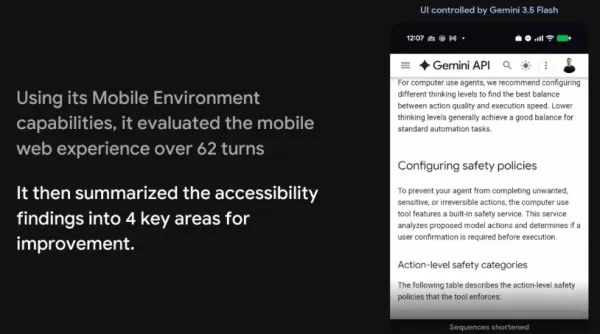 Google Chrome 149 Teams with Gemini 3.5 Flash to Enhance Screenshot Interaction
Google has natively integrated the Gemini 3.5 Flash model into its latest Chrome 149 browser release, introducing a new "Select from screen" interaction feature.This feature enables users to directly select portions of the screen for targeted AI conv
Google Chrome 149 Teams with Gemini 3.5 Flash to Enhance Screenshot Interaction
Google has natively integrated the Gemini 3.5 Flash model into its latest Chrome 149 browser release, introducing a new "Select from screen" interaction feature.This feature enables users to directly select portions of the screen for targeted AI conv
 Uber HR to Exhaust Annual Budget in 4 Months, Cuts Staff; Official Denies AI Link
Uber has initiated a significant overhaul of its human resources division, led by new president Jill Hazelbaker. The restructuring involves a 23% workforce reduction within the department to optimize operational efficiency.CEO Dara Khosrowshahi clari
Uber HR to Exhaust Annual Budget in 4 Months, Cuts Staff; Official Denies AI Link
Uber has initiated a significant overhaul of its human resources division, led by new president Jill Hazelbaker. The restructuring involves a 23% workforce reduction within the department to optimize operational efficiency.CEO Dara Khosrowshahi clari

2026 Latest Best Top-rated AI Task Routing Tools for Support Workflows! XIX.AI has curated a highly powerful game-changing collection of must-try solutions, all undergoing rigorous real-world tests and updated weekly. These tools streamline workflows, boost productivity, and help teams deliver faster, more efficient support. Explore now to discover your perfect tool and unlock your AI edge!
17 tools
xix.ai
2026 Latest Best Top-Rated AI Citation and Paper Summary Tools Curated by XIX.AI. Get powerful game-changing solutions for quick content creation, improved writing efficiency, and boosting productivity. We offer a free vs paid comparison along with real-world tests and weekly updated rankings to help you find the must-try tool that fits your needs perfectly. Explore now to Unlock your AI edge.
10 tools
xix.ai

2026 Latest Best Top-Rated AI Productivity Tools for Daily Work! XIX.AI has curated a powerful, game-changing selection based on rigorous weekly updated rankings and real-world tests. You’ll find must-try options that boost writing efficiency, streamline content creation, and help you overcome daily work challenges. Get a free vs paid comparison to find the perfect fit for your needs. Explore now to unlock your AI edge!
9 tools
xix.ai

2026 Latest Best Top-Rated AI Systematic Review Tools for Research Screening are here on XIX.AI! This curated collection includes powerful, game-changing solutions that go through rigorous real-world tests to deliver accurate results. We also offer a free vs paid comparison along with weekly updated rankings to help you find the must-try option that boosts your research efficiency significantly. Explore now to unlock your AI edge in academic work!
11 tools
xix.ai

2026 Latest Best AI Moodboard Tools for Brand and Art Direction! XIX.AI has curated a top-rated list of powerful, game-changing tools that help creators boost productivity significantly. You’ll find detailed weekly updated rankings, free vs paid comparison, and real-world tests to help you choose the perfect option. Must-try features include instant idea generation, seamless collaboration, and optimized workflows for all your design projects. Explore now to unlock your AI edge!
9 tools
xix.ai

2026 Latest Best Top-rated AI Systematic Review Tools for Screening Abstracts, Datasets, and Citation Networks are curated by XIX.AI through rigorous real-world tests. These powerful game-changing tools offer a free vs paid comparison to help researchers boost productivity significantly. Explore now to discover your perfect tool for accelerating scientific research.
9 tools
xix.ai

Honestly, the switch from multi-stage cascades to end-to-end models in audio generation sounds like a huge leap forward. But I'm wondering—how do they ensure the cloned voice doesn't pick up weird artifacts or biases from the training data? Also, open-sourcing it is cool, but I hope they've thought about potential misuse, like deepfake audio scams. 😅












