


 Home
Home
How to master the Distributive Property for multiplication? 2025 learning guide for students.
Mastering mathematics can often feel like climbing a mountain. Mastering multiplication, especially with larger numbers, is a common hurdle. The distributive property is a powerful technique that makes multiplication manageable. This guide will demystify this property with clear explanations and practical examples for students and teachers.
Key Points
The distributive property breaks down complex multiplication problems into simpler steps.
A strong grasp of place value is essential for correctly applying this property.
Visual tools, like area models, make the distributive property easier to understand.
Learning this concept builds a strong foundation for more advanced math.
Regular practice is crucial for mastering the distributive property.
Understanding Place Value and the Distributive Property
What is Place Value?
A solid understanding of place value is the first step to mastering the distributive property. Our number system depends not just on digits, but on their position.
Cons
ider the number 352. The '3' in the hundreds place represents 300. The '5' in the tens place represents 50, and the '2' in the ones place is simply 2. This breakdown is key to using the distributive property effectively. Each digit's value is determined by its position, which is fundamental for accurate calculations and a deeper mathematical intuition. Strong place value skills improve number sense and make mental math easier. This structure also simplifies operations like multiplying by tens or hundreds, as moving to the next column represents a change in magnitude. This principle is essential for managing complex calculations.
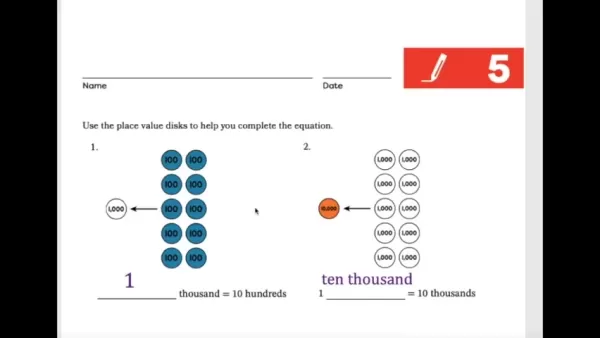
This foundational concept directly supports the distributive property, allowing numbers to be split into easier parts for multiplication.
The Distributive Property Explained
The distributive property states that multiplying a number by a sum (or difference) is the same as multiplying it by each part of the sum separately and then adding (or subtracting) the results. In practice, you can split a large number into smaller, easier-to-manage components. This is helpful for mental math and offers a flexible way to approach numbers. This core mathematical principle simplifies complex multiplication by turning one difficult problem into several easier ones, leading to more intuitive and accurate problem-solving.
For instance, instead of calculating 6 x 17 directly, you can split 17 into 10 + 7. Next, calculate 6 x 10 and 6 x 7, then add the results: (6 x 10) + (6 x 7) = 60 + 42 = 102. This method replaces one challenging multiplication with two simple ones and an addition. Mastering this property improves calculation skills and promotes a strategic, adaptable approach to math.
Applying the Distributive Property: An Area Model Example
The area model is an excellent way to visualize the distributive property. Picture a rectangle that is 12 units long and 3 units wide. Traditionally, you'd find the area by calculating 3 x 12. Using the distributive property, we can break the length of 12 into parts like 10 + 2.
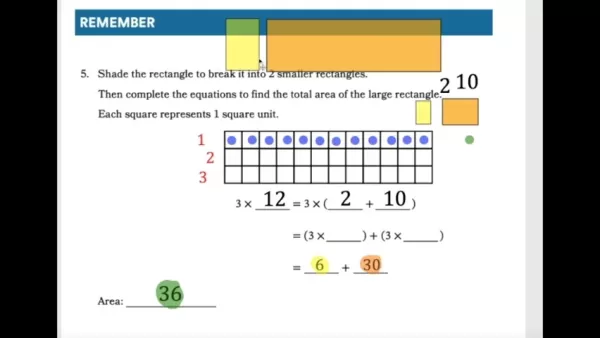
Now, imagine splitting the rectangle into two smaller ones. The first is 10 units by 3 units, and the second is 2 units by 3 units. The area of the first is 3 x 10 = 30 square units. The area of the second is 3 x 2 = 6 square units. Adding these gives the total area: 30 + 6 = 36 square units. So, 3 x 12 = 36.
This model perfectly illustrates the distributive property: a larger problem (3 x 12) is broken into simpler multiplications (3 x 10 and 3 x 2), then combined for the answer. This method simplifies computation and creates a visual understanding of how multiplication distributes over addition. It's a powerful tool for teaching and learning, particularly with larger numbers.
Step-by-Step Guide to Using the Distributive Property
Step 1: Break Down the Larger Number
Identify the larger number in your multiplication problem. Decompose it into a sum of smaller numbers that are easier to work with. Aim for multiples of ten where possible. For example, for 7 x 16, break 16 into 10 + 6. This converts one multiplication into a series of simpler tasks.
Step 2: Distribute the Multiplication
Multiply the number outside the parentheses by each number inside. Using our example, 7 x 16 becomes 7 x (10 + 6). Distribute the 7 to get (7 x 10) + (7 x 6). This step breaks the original problem into easier calculations.
Step 3: Perform the Smaller Multiplications
Calculate each of the simpler multiplication problems. In our example, (7 x 10) + (7 x 6) becomes 70 + 42. These are much easier to compute, whether mentally or on paper.
Step 4: Add the Products Together
Add the results from the previous step. Adding 70 + 42 gives 112. This sum is the answer to the original problem, confirming that 7 x 16 = 112. This step combines the results into the final answer.
Step 5: Practice, Practice, Practice!
Consistent practice is the key to mastery. Start with simple problems and gradually tackle more difficult ones. Apply your skills to real-world scenarios, like figuring out sale prices or total quantities.
Cons
istent practice builds both confidence and skill, allowing you to use the distributive property effectively in many situations.Pros and Cons of Using the Distributive Property
Pros
Simplifies Complex Problems: Breaks multiplication into manageable steps.
Enhances Mental Math Skills: Makes calculations easier to perform without writing.
Provides Visual Understanding: Area models improve conceptual grasp.
Reduces Errors: Simpler steps lead to fewer calculation mistakes.
Builds Number Sense: Strengthens understanding of how numbers relate.
Cons
Can Be Time-
Cons
uming: The process may take longer than direct multiplication for some.Requires Careful Steps: Precision is needed to avoid mistakes in distribution.
Not Ideal for Small Numbers: Less efficient for very simple calculations.
May Confuse Some Learners: The concept can be tricky at first.
Over-Reliance: Depending solely on it might hinder learning other methods.
Frequently Asked Questions
Is the distributive property only useful for multiplication?
While primarily used with multiplication, the distributive principle also applies to operations like division. The core idea—distributing an operation across terms in a sum or difference—remains the same. This versatility makes it a valuable tool across different areas of mathematics. Understanding its broader applications deepens overall mathematical comprehension.
Can the distributive property be used with more than two numbers inside the parentheses?
Yes, it can be applied to any number of terms. For example, 4 x (5 + 3 + 2) becomes (4 x 5) + (4 x 3) + (4 x 2). This scalability makes the property highly versatile for simplifying complex expressions with multiple parts. Mastering this extension allows for efficient handling of more sophisticated problems.
How does the distributive property relate to factoring?
The distributive property and factoring are inverse operations. Distributing expands an expression (e.g., a(b + c) = ab + ac), while factoring condenses it by finding a common factor (e.g., ab + ac = a(b + c)). Understanding this relationship deepens proficiency in algebraic manipulation and problem-solving.
Related Questions
What are some real-world applications of the distributive property?
This property has many practical uses, especially in scaling and proportional reasoning. It applies when calculating costs for bulk purchases, applying discounts, or figuring out taxes. Beyond shopping, it simplifies tasks in resource allocation, financial planning, and recipe scaling, demonstrating its everyday utility.
Related article
 Qwen-Audio-3.0-TTS: Qwen's Large Voice Synthesis Model Cuts First Packet Delay to 300ms
The competition in voice technology among major AI developers has intensified with a new entry. On July 20, Qwen released its latest audio synthesis model, Qwen-Audio-3.0-TTS, shifting control from complex technical configurations to simple natural l
Claude’s Cowork feature now recalls your past chat instructions
Anthropic’s update to Claude’s memory system removes a major friction point in using AI agents: the repetitive need to re-explain context that the AI already retains. By merging the memory architectures of standard chat and Claude Cowork, Claude now
Chen Tianqiao Returns After Nine Years, Investing $2B in Discovery-Driven AI
From Gaming Mogul to Consciousness Pioneer: The Return of a Former BillionaireAfter nine years of retirement, Shanda Group founder Chen Tianqiao gave his first international media interview in March 2026. Once the youngest Chinese billionaire and gam
Related Special Topic Recommendations
Design & Art
Qwen-Audio-3.0-TTS: Qwen's Large Voice Synthesis Model Cuts First Packet Delay to 300ms
The competition in voice technology among major AI developers has intensified with a new entry. On July 20, Qwen released its latest audio synthesis model, Qwen-Audio-3.0-TTS, shifting control from complex technical configurations to simple natural l
Claude’s Cowork feature now recalls your past chat instructions
Anthropic’s update to Claude’s memory system removes a major friction point in using AI agents: the repetitive need to re-explain context that the AI already retains. By merging the memory architectures of standard chat and Claude Cowork, Claude now
Chen Tianqiao Returns After Nine Years, Investing $2B in Discovery-Driven AI
From Gaming Mogul to Consciousness Pioneer: The Return of a Former BillionaireAfter nine years of retirement, Shanda Group founder Chen Tianqiao gave his first international media interview in March 2026. Once the youngest Chinese billionaire and gam
Related Special Topic Recommendations
Design & Art
 Top AI Illustration Tools: Create Editorial Scenes and Cover Art Faster
2026 Latest Top-rated AI Illustration Tools: Our curated list features the best powerfully designed tools for creating stunning editorial scenes and eye-catching cover art quickly. Each option has gone through rigorous real-world tests, offering a free vs paid comparison to help you find the perfect match for your workflow. Try these must-try solutions today to unlock your AI edge and boost your creative productivity. Explore now at XIX.AI.
 10 tools
 xix.ai
Education and Learning
Top AI Tutors for Exam Prep: Practice Math, Science, and English
xix.ai
Education and Learning
Top AI Tutors for Exam Prep: Practice Math, Science, and English
2026 Latest Top-Rated Best AI Tutors for Exam Prep are here on XIX.AI! Our curated list features powerful game-changing tools that offer free vs paid comparison, real-world tests, and weekly updated rankings. They help boost your writing efficiency, simplify complex topic learning, and unlock your academic potential. Explore now to Discover your perfect exam prep tool and Start creating today to Unlock your AI edge!
10 tools
xix.ai
Finance
AI Budget Planning Tools for Personal Money Management
2026 Latest Best Top-Rated AI Budget Planning Tools for Personal Money Management are here on XIX.AI! This curated collection features powerful, game-changing solutions that help you conduct real-world tests, understand spending habits, and create personalized plans to boost productivity. Enjoy a free vs paid comparison along with detailed rankings. Must-try tools designed to simplify money management and unlock your AI edge. Explore now!
11 tools
xix.ai
Health & Wellness
AI Sleep Tracking Assistants: Improve Recovery with Better Bedtime Habits
2026 Latest Best Top-Rated AI Sleep Tracking Assistants curated for ultimate recovery. This fully updated weekly guide features powerful tools that deliver real-world tests, free vs paid comparison, and detailed rankings to help you find the must-try solution that boosts sleep quality and supports better bedtime habits. Explore now at XIX.AI to Unlock your AI edge.
10 tools
xix.ai
Data Analysis
AI SQL Copilots for Product and Revenue Analytics
2026 Latest Best Top-Rated AI SQL Copilots for Product and Revenue Analytics! XIX.AI has curated a powerful, game-changing collection of must-try tools that undergo real-world tests through weekly updated rankings. These tools help users boost productivity significantly by accelerating data analysis, streamlining complex queries, and generating accurate insights to drive smarter business decisions. Explore now to Discover your perfect tool for unlocking your AI edge!
14 tools
xix.ai
Education and Learning
Best AI Homework Helpers That Teach: Learn Concepts, Not Just Answers
2026 Latest Best Top-Rated AI Homework Helpers That Teach Core Concepts Not Just Answers Powerful Tools for Students Must-Try Curated List Weekly Updated Free vs Paid Comparison Real-World Tests Accurate Rankings to Help You Unlock Your Full Learning Potential Explore now to Discover your perfect tool for smarter studying.
10 tools
xix.ai

 Comments (3)
0/500
Comments (3)
0/500
![AlbertGarcía]()
Finally, a math guide that doesn't feel like torture! 🎓 The distributive property is a game-changer for breaking down those scary big numbers. I remember struggling with this in 5th grade, so this 2025 update looks super helpful for anyone needing a refresher. Thanks for making it less intimidating! ✨
![EricJohnson]()
この分配法則の説明、すごく分かりやすい!特に大きな数の掛け算でつまずいていたので、この記事は本当に役立ちそう。数学が苦手な人にもおすすめできる内容だね。これで宿題が少し楽になるかも… 😅 でも、AIがこういう教育的なコンテンツを生成する時代って、教師の役割はどう変わっていくんだろう?ちょっと考えさせられる。
![TerryHernández]()
Also das mit dem Distributivgesetz hab ich in der Schule nie so richtig kapiert. Aber der Artikel erklärt es echt gut, vor allem die Beispiele mit größeren Zahlen. Vielleicht sollte ich das mal meinem Neffen zeigen, der hat gerade damit zu kämpfen. Mathe muss ja nicht immer ein Kampf sein 😅 Finde es cool, dass es solche Guides für Schüler gibt.
Mastering mathematics can often feel like climbing a mountain. Mastering multiplication, especially with larger numbers, is a common hurdle. The distributive property is a powerful technique that makes multiplication manageable. This guide will demystify this property with clear explanations and practical examples for students and teachers.
Key Points
The distributive property breaks down complex multiplication problems into simpler steps.
A strong grasp of place value is essential for correctly applying this property.
Visual tools, like area models, make the distributive property easier to understand.
Learning this concept builds a strong foundation for more advanced math.
Regular practice is crucial for mastering the distributive property.
Understanding Place Value and the Distributive Property
What is Place Value?
A solid understanding of place value is the first step to mastering the distributive property. Our number system depends not just on digits, but on their position.
Cons
ider the number 352. The '3' in the hundreds place represents 300. The '5' in the tens place represents 50, and the '2' in the ones place is simply 2. This breakdown is key to using the distributive property effectively. Each digit's value is determined by its position, which is fundamental for accurate calculations and a deeper mathematical intuition. Strong place value skills improve number sense and make mental math easier.This structure also simplifies operations like multiplying by tens or hundreds, as moving to the next column represents a change in magnitude. This principle is essential for managing complex calculations.
This foundational concept directly supports the distributive property, allowing numbers to be split into easier parts for multiplication.
The Distributive Property Explained
The distributive property states that multiplying a number by a sum (or difference) is the same as multiplying it by each part of the sum separately and then adding (or subtracting) the results. In practice, you can split a large number into smaller, easier-to-manage components. This is helpful for mental math and offers a flexible way to approach numbers. This core mathematical principle simplifies complex multiplication by turning one difficult problem into several easier ones, leading to more intuitive and accurate problem-solving.
For instance, instead of calculating 6 x 17 directly, you can split 17 into 10 + 7. Next, calculate 6 x 10 and 6 x 7, then add the results: (6 x 10) + (6 x 7) = 60 + 42 = 102. This method replaces one challenging multiplication with two simple ones and an addition. Mastering this property improves calculation skills and promotes a strategic, adaptable approach to math.
Applying the Distributive Property: An Area Model Example
The area model is an excellent way to visualize the distributive property. Picture a rectangle that is 12 units long and 3 units wide. Traditionally, you'd find the area by calculating 3 x 12. Using the distributive property, we can break the length of 12 into parts like 10 + 2.
Now, imagine splitting the rectangle into two smaller ones. The first is 10 units by 3 units, and the second is 2 units by 3 units. The area of the first is 3 x 10 = 30 square units. The area of the second is 3 x 2 = 6 square units. Adding these gives the total area: 30 + 6 = 36 square units. So, 3 x 12 = 36.
This model perfectly illustrates the distributive property: a larger problem (3 x 12) is broken into simpler multiplications (3 x 10 and 3 x 2), then combined for the answer. This method simplifies computation and creates a visual understanding of how multiplication distributes over addition. It's a powerful tool for teaching and learning, particularly with larger numbers.
Step-by-Step Guide to Using the Distributive Property
Step 1: Break Down the Larger Number
Identify the larger number in your multiplication problem. Decompose it into a sum of smaller numbers that are easier to work with. Aim for multiples of ten where possible. For example, for 7 x 16, break 16 into 10 + 6. This converts one multiplication into a series of simpler tasks.
Step 2: Distribute the Multiplication
Multiply the number outside the parentheses by each number inside. Using our example, 7 x 16 becomes 7 x (10 + 6). Distribute the 7 to get (7 x 10) + (7 x 6). This step breaks the original problem into easier calculations.
Step 3: Perform the Smaller Multiplications
Calculate each of the simpler multiplication problems. In our example, (7 x 10) + (7 x 6) becomes 70 + 42. These are much easier to compute, whether mentally or on paper.
Step 4: Add the Products Together
Add the results from the previous step. Adding 70 + 42 gives 112. This sum is the answer to the original problem, confirming that 7 x 16 = 112. This step combines the results into the final answer.
Step 5: Practice, Practice, Practice!
Consistent practice is the key to mastery. Start with simple problems and gradually tackle more difficult ones. Apply your skills to real-world scenarios, like figuring out sale prices or total quantities.
Cons
istent practice builds both confidence and skill, allowing you to use the distributive property effectively in many situations.Pros and Cons of Using the Distributive Property
Pros
Simplifies Complex Problems: Breaks multiplication into manageable steps.
Enhances Mental Math Skills: Makes calculations easier to perform without writing.
Provides Visual Understanding: Area models improve conceptual grasp.
Reduces Errors: Simpler steps lead to fewer calculation mistakes.
Builds Number Sense: Strengthens understanding of how numbers relate.
Cons
Can Be Time-
Cons
uming: The process may take longer than direct multiplication for some.Requires Careful Steps: Precision is needed to avoid mistakes in distribution.
Not Ideal for Small Numbers: Less efficient for very simple calculations.
May Confuse Some Learners: The concept can be tricky at first.
Over-Reliance: Depending solely on it might hinder learning other methods.
Frequently Asked Questions
Is the distributive property only useful for multiplication?
While primarily used with multiplication, the distributive principle also applies to operations like division. The core idea—distributing an operation across terms in a sum or difference—remains the same. This versatility makes it a valuable tool across different areas of mathematics. Understanding its broader applications deepens overall mathematical comprehension.
Can the distributive property be used with more than two numbers inside the parentheses?
Yes, it can be applied to any number of terms. For example, 4 x (5 + 3 + 2) becomes (4 x 5) + (4 x 3) + (4 x 2). This scalability makes the property highly versatile for simplifying complex expressions with multiple parts. Mastering this extension allows for efficient handling of more sophisticated problems.
How does the distributive property relate to factoring?
The distributive property and factoring are inverse operations. Distributing expands an expression (e.g., a(b + c) = ab + ac), while factoring condenses it by finding a common factor (e.g., ab + ac = a(b + c)). Understanding this relationship deepens proficiency in algebraic manipulation and problem-solving.
Related Questions
What are some real-world applications of the distributive property?
This property has many practical uses, especially in scaling and proportional reasoning. It applies when calculating costs for bulk purchases, applying discounts, or figuring out taxes. Beyond shopping, it simplifies tasks in resource allocation, financial planning, and recipe scaling, demonstrating its everyday utility.








 Qwen-Audio-3.0-TTS: Qwen's Large Voice Synthesis Model Cuts First Packet Delay to 300ms
The competition in voice technology among major AI developers has intensified with a new entry. On July 20, Qwen released its latest audio synthesis model, Qwen-Audio-3.0-TTS, shifting control from complex technical configurations to simple natural l
Qwen-Audio-3.0-TTS: Qwen's Large Voice Synthesis Model Cuts First Packet Delay to 300ms
The competition in voice technology among major AI developers has intensified with a new entry. On July 20, Qwen released its latest audio synthesis model, Qwen-Audio-3.0-TTS, shifting control from complex technical configurations to simple natural l
 Claude’s Cowork feature now recalls your past chat instructions
Anthropic’s update to Claude’s memory system removes a major friction point in using AI agents: the repetitive need to re-explain context that the AI already retains. By merging the memory architectures of standard chat and Claude Cowork, Claude now
Claude’s Cowork feature now recalls your past chat instructions
Anthropic’s update to Claude’s memory system removes a major friction point in using AI agents: the repetitive need to re-explain context that the AI already retains. By merging the memory architectures of standard chat and Claude Cowork, Claude now
 Chen Tianqiao Returns After Nine Years, Investing $2B in Discovery-Driven AI
From Gaming Mogul to Consciousness Pioneer: The Return of a Former BillionaireAfter nine years of retirement, Shanda Group founder Chen Tianqiao gave his first international media interview in March 2026. Once the youngest Chinese billionaire and gam
Chen Tianqiao Returns After Nine Years, Investing $2B in Discovery-Driven AI
From Gaming Mogul to Consciousness Pioneer: The Return of a Former BillionaireAfter nine years of retirement, Shanda Group founder Chen Tianqiao gave his first international media interview in March 2026. Once the youngest Chinese billionaire and gam

2026 Latest Top-rated AI Illustration Tools: Our curated list features the best powerfully designed tools for creating stunning editorial scenes and eye-catching cover art quickly. Each option has gone through rigorous real-world tests, offering a free vs paid comparison to help you find the perfect match for your workflow. Try these must-try solutions today to unlock your AI edge and boost your creative productivity. Explore now at XIX.AI.
10 tools
xix.ai

2026 Latest Top-Rated Best AI Tutors for Exam Prep are here on XIX.AI! Our curated list features powerful game-changing tools that offer free vs paid comparison, real-world tests, and weekly updated rankings. They help boost your writing efficiency, simplify complex topic learning, and unlock your academic potential. Explore now to Discover your perfect exam prep tool and Start creating today to Unlock your AI edge!
10 tools
xix.ai

2026 Latest Best Top-Rated AI Budget Planning Tools for Personal Money Management are here on XIX.AI! This curated collection features powerful, game-changing solutions that help you conduct real-world tests, understand spending habits, and create personalized plans to boost productivity. Enjoy a free vs paid comparison along with detailed rankings. Must-try tools designed to simplify money management and unlock your AI edge. Explore now!
11 tools
xix.ai

2026 Latest Best Top-Rated AI Sleep Tracking Assistants curated for ultimate recovery. This fully updated weekly guide features powerful tools that deliver real-world tests, free vs paid comparison, and detailed rankings to help you find the must-try solution that boosts sleep quality and supports better bedtime habits. Explore now at XIX.AI to Unlock your AI edge.
10 tools
xix.ai

2026 Latest Best Top-Rated AI SQL Copilots for Product and Revenue Analytics! XIX.AI has curated a powerful, game-changing collection of must-try tools that undergo real-world tests through weekly updated rankings. These tools help users boost productivity significantly by accelerating data analysis, streamlining complex queries, and generating accurate insights to drive smarter business decisions. Explore now to Discover your perfect tool for unlocking your AI edge!
14 tools
xix.ai

2026 Latest Best Top-Rated AI Homework Helpers That Teach Core Concepts Not Just Answers Powerful Tools for Students Must-Try Curated List Weekly Updated Free vs Paid Comparison Real-World Tests Accurate Rankings to Help You Unlock Your Full Learning Potential Explore now to Discover your perfect tool for smarter studying.
10 tools
xix.ai

Finally, a math guide that doesn't feel like torture! 🎓 The distributive property is a game-changer for breaking down those scary big numbers. I remember struggling with this in 5th grade, so this 2025 update looks super helpful for anyone needing a refresher. Thanks for making it less intimidating! ✨
この分配法則の説明、すごく分かりやすい!特に大きな数の掛け算でつまずいていたので、この記事は本当に役立ちそう。数学が苦手な人にもおすすめできる内容だね。これで宿題が少し楽になるかも… 😅 でも、AIがこういう教育的なコンテンツを生成する時代って、教師の役割はどう変わっていくんだろう?ちょっと考えさせられる。
Also das mit dem Distributivgesetz hab ich in der Schule nie so richtig kapiert. Aber der Artikel erklärt es echt gut, vor allem die Beispiele mit größeren Zahlen. Vielleicht sollte ich das mal meinem Neffen zeigen, der hat gerade damit zu kämpfen. Mathe muss ja nicht immer ein Kampf sein 😅 Finde es cool, dass es solche Guides für Schüler gibt.












