


 Home
HomeMantis Biotech Creates Human 'Digital Twins' to Tackle Medical Data Shortage

Large language models trained on massive datasets have the potential to accelerate genomics research, streamline clinical documentation, enhance real-time diagnostics, aid clinical decision-making, speed up drug discovery, and even create synthetic data to propel experiments forward.
However, their transformative potential for biomedical research frequently hits a roadblock: beyond the structured data foundational to healthcare, these models falter with edge cases such as rare diseases and atypical conditions, where reliable, representative data is lacking.
New York-based Mantis Biotech asserts it is developing the solution to bridge this data availability gap. The company's platform integrates diverse data sources to produce synthetic datasets, which can then be used to construct "digital twins" of the human body—predictive, physics-based models of anatomy, physiology, and behavior.
The company promotes these digital twins for data aggregation and analysis. They could be employed to study and test new medical procedures, train surgical robots, and simulate or predict medical issues and even behavioral patterns. For instance, a sports team could forecast the probability of a specific NFL player developing an Achilles tendon injury based on recent performance, training load, diet, and career longevity, Mantis founder and CEO Georgia Witchel explained in a recent TechCrunch interview.
To build these twins, the Mantis platform first aggregates data from sources like textbooks, motion capture cameras, biometric sensors, training logs, and medical imaging. It then uses an LLM-based system to route, validate, and synthesize these varied data streams. This information is processed through a physics engine to create high-fidelity renders of the dataset, which subsequently train predictive models.
"We can take all these disparate data sources and transform them into predictive models for human performance. Any scenario where you need to forecast how a person will perform is an excellent use case for our technology," Witchel said.
The physics engine layer is crucial, Witchel told TechCrunch, as it enhances available information by grounding the generated synthetic data and realistically modeling anatomical physics.
"If you needed to estimate the hand pose of someone missing a finger, it would be extremely difficult due to a lack of publicly available, labeled datasets for that condition. We could generate that dataset very easily by simply modifying our physics model—telling it to remove a specific finger and regenerate," she explained.
Because the Mantis platform addresses gaps in data sources, Witchel believes it has broad potential across the biomedical industry, where information on procedures or patients is often difficult to access, unstructured, or siloed. She emphasized its value for edge cases and rare diseases, where data is scarce due to ethical and regulatory constraints on using patient data in public datasets or for AI training.
"You know how a three-year-old might play with a Barbie doll, holding it by one leg and banging it on a table? I want people to adopt that mindset with our digital twins," she said. "I believe it will open people up to the idea that humans can be tested virtually. Currently, the prevailing mindset is the opposite, which is completely understandable—people's privacy must be respected. In fact, I don't believe personal data should be exploited at all, especially when you have these digital twins as an alternative."
Currently, Mantis has found success in professional sports, likely due to the need to model high-performance athletes. Witchel noted that one of the startup's primary clients is an NBA team.
"We create digital representations of the athletes. It shows not just how an athlete jumped today, but how they've jumped every single day over the past year, and how those jumps change over time relative to their sleep patterns or how often they raise their arms overhead," she explained.
The startup recently secured $7.4 million in seed funding led by Decibel VC, with participation from Y Combinator, several angel investors, and Liquid 2. The capital will be used for hiring, advertising, marketing, and go-to-market initiatives.
Witchel stated that Mantis's next steps are to continue developing the technology and eventually release the platform to the public, focusing on preventative healthcare. The company is also working to serve pharmaceutical labs and researchers conducting FDA trials, aiming to provide insights into patient treatment responses.
Related article
 Atlas: The Tech Powering Hyundai's Humanoid Robot's FIFA Debut
Atlas appeared at the Brazil vs. Norway match this weekend. Credit: Hyundai Motor CompanyHyundai Motor Company used advanced software and virtual simulations to bring the Boston Dynamics humanoid robot into a live World Cup football match.Football fa
Ctrip Business Travel Unveils AI Ecosystem with 7 Industry Agents and 17 Core Capabilities
Ctrip Business Travel has officially unveiled the "Ctrip Business Travel AI Ecosystem," leveraging large language models to fundamentally restructure corporate travel management. This comprehensive ecosystem addresses four core scenarios: travel arra
Stripe to Acquire OpenRouter as AI Model Routing Gains Momentum
Stripe has agreed to acquire OpenRouter, an AI model-routing platform that gives developers access to hundreds of models through a single interface. The deal adds model selection and routing to Stripe’s existing work around AI usage and token-based b
Related Special Topic Recommendations
Design & Art
Atlas: The Tech Powering Hyundai's Humanoid Robot's FIFA Debut
Atlas appeared at the Brazil vs. Norway match this weekend. Credit: Hyundai Motor CompanyHyundai Motor Company used advanced software and virtual simulations to bring the Boston Dynamics humanoid robot into a live World Cup football match.Football fa
Ctrip Business Travel Unveils AI Ecosystem with 7 Industry Agents and 17 Core Capabilities
Ctrip Business Travel has officially unveiled the "Ctrip Business Travel AI Ecosystem," leveraging large language models to fundamentally restructure corporate travel management. This comprehensive ecosystem addresses four core scenarios: travel arra
Stripe to Acquire OpenRouter as AI Model Routing Gains Momentum
Stripe has agreed to acquire OpenRouter, an AI model-routing platform that gives developers access to hundreds of models through a single interface. The deal adds model selection and routing to Stripe’s existing work around AI usage and token-based b
Related Special Topic Recommendations
Design & Art
 Top AI Illustration Tools: Create Editorial Scenes and Cover Art Faster
2026 Latest Top-rated AI Illustration Tools: Our curated list features the best powerfully designed tools for creating stunning editorial scenes and eye-catching cover art quickly. Each option has gone through rigorous real-world tests, offering a free vs paid comparison to help you find the perfect match for your workflow. Try these must-try solutions today to unlock your AI edge and boost your creative productivity. Explore now at XIX.AI.
 10 tools
 xix.ai
Education and Learning
Top AI Tutors for Exam Prep: Practice Math, Science, and English
xix.ai
Education and Learning
Top AI Tutors for Exam Prep: Practice Math, Science, and English
2026 Latest Top-Rated Best AI Tutors for Exam Prep are here on XIX.AI! Our curated list features powerful game-changing tools that offer free vs paid comparison, real-world tests, and weekly updated rankings. They help boost your writing efficiency, simplify complex topic learning, and unlock your academic potential. Explore now to Discover your perfect exam prep tool and Start creating today to Unlock your AI edge!
10 tools
xix.ai
Finance
AI Budget Planning Tools for Personal Money Management
2026 Latest Best Top-Rated AI Budget Planning Tools for Personal Money Management are here on XIX.AI! This curated collection features powerful, game-changing solutions that help you conduct real-world tests, understand spending habits, and create personalized plans to boost productivity. Enjoy a free vs paid comparison along with detailed rankings. Must-try tools designed to simplify money management and unlock your AI edge. Explore now!
11 tools
xix.ai
Health & Wellness
AI Sleep Tracking Assistants: Improve Recovery with Better Bedtime Habits
2026 Latest Best Top-Rated AI Sleep Tracking Assistants curated for ultimate recovery. This fully updated weekly guide features powerful tools that deliver real-world tests, free vs paid comparison, and detailed rankings to help you find the must-try solution that boosts sleep quality and supports better bedtime habits. Explore now at XIX.AI to Unlock your AI edge.
10 tools
xix.ai
Data Analysis
AI SQL Copilots for Product and Revenue Analytics
2026 Latest Best Top-Rated AI SQL Copilots for Product and Revenue Analytics! XIX.AI has curated a powerful, game-changing collection of must-try tools that undergo real-world tests through weekly updated rankings. These tools help users boost productivity significantly by accelerating data analysis, streamlining complex queries, and generating accurate insights to drive smarter business decisions. Explore now to Discover your perfect tool for unlocking your AI edge!
14 tools
xix.ai
Education and Learning
Best AI Homework Helpers That Teach: Learn Concepts, Not Just Answers
2026 Latest Best Top-Rated AI Homework Helpers That Teach Core Concepts Not Just Answers Powerful Tools for Students Must-Try Curated List Weekly Updated Free vs Paid Comparison Real-World Tests Accurate Rankings to Help You Unlock Your Full Learning Potential Explore now to Discover your perfect tool for smarter studying.
10 tools
xix.ai

 Comments (0)
0/500
Comments (0)
0/500
Large language models trained on massive datasets have the potential to accelerate genomics research, streamline clinical documentation, enhance real-time diagnostics, aid clinical decision-making, speed up drug discovery, and even create synthetic data to propel experiments forward.
However, their transformative potential for biomedical research frequently hits a roadblock: beyond the structured data foundational to healthcare, these models falter with edge cases such as rare diseases and atypical conditions, where reliable, representative data is lacking.
New York-based Mantis Biotech asserts it is developing the solution to bridge this data availability gap. The company's platform integrates diverse data sources to produce synthetic datasets, which can then be used to construct "digital twins" of the human body—predictive, physics-based models of anatomy, physiology, and behavior.
The company promotes these digital twins for data aggregation and analysis. They could be employed to study and test new medical procedures, train surgical robots, and simulate or predict medical issues and even behavioral patterns. For instance, a sports team could forecast the probability of a specific NFL player developing an Achilles tendon injury based on recent performance, training load, diet, and career longevity, Mantis founder and CEO Georgia Witchel explained in a recent TechCrunch interview.
To build these twins, the Mantis platform first aggregates data from sources like textbooks, motion capture cameras, biometric sensors, training logs, and medical imaging. It then uses an LLM-based system to route, validate, and synthesize these varied data streams. This information is processed through a physics engine to create high-fidelity renders of the dataset, which subsequently train predictive models.
"We can take all these disparate data sources and transform them into predictive models for human performance. Any scenario where you need to forecast how a person will perform is an excellent use case for our technology," Witchel said.
The physics engine layer is crucial, Witchel told TechCrunch, as it enhances available information by grounding the generated synthetic data and realistically modeling anatomical physics.
"If you needed to estimate the hand pose of someone missing a finger, it would be extremely difficult due to a lack of publicly available, labeled datasets for that condition. We could generate that dataset very easily by simply modifying our physics model—telling it to remove a specific finger and regenerate," she explained.
Because the Mantis platform addresses gaps in data sources, Witchel believes it has broad potential across the biomedical industry, where information on procedures or patients is often difficult to access, unstructured, or siloed. She emphasized its value for edge cases and rare diseases, where data is scarce due to ethical and regulatory constraints on using patient data in public datasets or for AI training.
"You know how a three-year-old might play with a Barbie doll, holding it by one leg and banging it on a table? I want people to adopt that mindset with our digital twins," she said. "I believe it will open people up to the idea that humans can be tested virtually. Currently, the prevailing mindset is the opposite, which is completely understandable—people's privacy must be respected. In fact, I don't believe personal data should be exploited at all, especially when you have these digital twins as an alternative."
Currently, Mantis has found success in professional sports, likely due to the need to model high-performance athletes. Witchel noted that one of the startup's primary clients is an NBA team.
"We create digital representations of the athletes. It shows not just how an athlete jumped today, but how they've jumped every single day over the past year, and how those jumps change over time relative to their sleep patterns or how often they raise their arms overhead," she explained.
The startup recently secured $7.4 million in seed funding led by Decibel VC, with participation from Y Combinator, several angel investors, and Liquid 2. The capital will be used for hiring, advertising, marketing, and go-to-market initiatives.
Witchel stated that Mantis's next steps are to continue developing the technology and eventually release the platform to the public, focusing on preventative healthcare. The company is also working to serve pharmaceutical labs and researchers conducting FDA trials, aiming to provide insights into patient treatment responses.








 Atlas: The Tech Powering Hyundai's Humanoid Robot's FIFA Debut
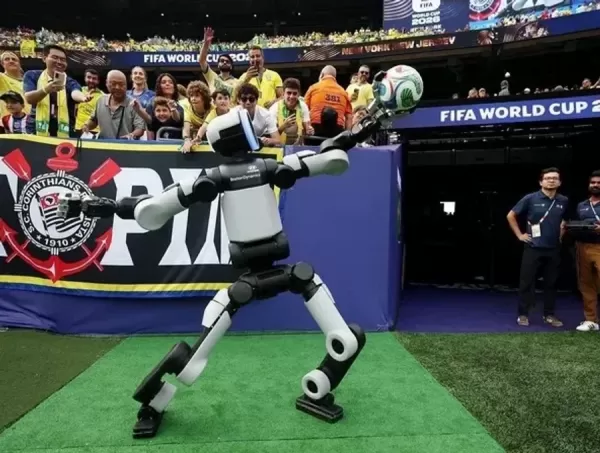
Atlas appeared at the Brazil vs. Norway match this weekend. Credit: Hyundai Motor CompanyHyundai Motor Company used advanced software and virtual simulations to bring the Boston Dynamics humanoid robot into a live World Cup football match.Football fa
Atlas: The Tech Powering Hyundai's Humanoid Robot's FIFA Debut
Atlas appeared at the Brazil vs. Norway match this weekend. Credit: Hyundai Motor CompanyHyundai Motor Company used advanced software and virtual simulations to bring the Boston Dynamics humanoid robot into a live World Cup football match.Football fa
 Ctrip Business Travel Unveils AI Ecosystem with 7 Industry Agents and 17 Core Capabilities
Ctrip Business Travel has officially unveiled the "Ctrip Business Travel AI Ecosystem," leveraging large language models to fundamentally restructure corporate travel management. This comprehensive ecosystem addresses four core scenarios: travel arra
Ctrip Business Travel Unveils AI Ecosystem with 7 Industry Agents and 17 Core Capabilities
Ctrip Business Travel has officially unveiled the "Ctrip Business Travel AI Ecosystem," leveraging large language models to fundamentally restructure corporate travel management. This comprehensive ecosystem addresses four core scenarios: travel arra
 Stripe to Acquire OpenRouter as AI Model Routing Gains Momentum
Stripe has agreed to acquire OpenRouter, an AI model-routing platform that gives developers access to hundreds of models through a single interface. The deal adds model selection and routing to Stripe’s existing work around AI usage and token-based b
Stripe to Acquire OpenRouter as AI Model Routing Gains Momentum
Stripe has agreed to acquire OpenRouter, an AI model-routing platform that gives developers access to hundreds of models through a single interface. The deal adds model selection and routing to Stripe’s existing work around AI usage and token-based b

2026 Latest Top-rated AI Illustration Tools: Our curated list features the best powerfully designed tools for creating stunning editorial scenes and eye-catching cover art quickly. Each option has gone through rigorous real-world tests, offering a free vs paid comparison to help you find the perfect match for your workflow. Try these must-try solutions today to unlock your AI edge and boost your creative productivity. Explore now at XIX.AI.
10 tools
xix.ai

2026 Latest Top-Rated Best AI Tutors for Exam Prep are here on XIX.AI! Our curated list features powerful game-changing tools that offer free vs paid comparison, real-world tests, and weekly updated rankings. They help boost your writing efficiency, simplify complex topic learning, and unlock your academic potential. Explore now to Discover your perfect exam prep tool and Start creating today to Unlock your AI edge!
10 tools
xix.ai

2026 Latest Best Top-Rated AI Budget Planning Tools for Personal Money Management are here on XIX.AI! This curated collection features powerful, game-changing solutions that help you conduct real-world tests, understand spending habits, and create personalized plans to boost productivity. Enjoy a free vs paid comparison along with detailed rankings. Must-try tools designed to simplify money management and unlock your AI edge. Explore now!
11 tools
xix.ai

2026 Latest Best Top-Rated AI Sleep Tracking Assistants curated for ultimate recovery. This fully updated weekly guide features powerful tools that deliver real-world tests, free vs paid comparison, and detailed rankings to help you find the must-try solution that boosts sleep quality and supports better bedtime habits. Explore now at XIX.AI to Unlock your AI edge.
10 tools
xix.ai

2026 Latest Best Top-Rated AI SQL Copilots for Product and Revenue Analytics! XIX.AI has curated a powerful, game-changing collection of must-try tools that undergo real-world tests through weekly updated rankings. These tools help users boost productivity significantly by accelerating data analysis, streamlining complex queries, and generating accurate insights to drive smarter business decisions. Explore now to Discover your perfect tool for unlocking your AI edge!
14 tools
xix.ai

2026 Latest Best Top-Rated AI Homework Helpers That Teach Core Concepts Not Just Answers Powerful Tools for Students Must-Try Curated List Weekly Updated Free vs Paid Comparison Real-World Tests Accurate Rankings to Help You Unlock Your Full Learning Potential Explore now to Discover your perfect tool for smarter studying.
10 tools
xix.ai












