


 Home
HomeLuma AI unveils Uni-1 autoregressive model that generates text and pixels simultaneously
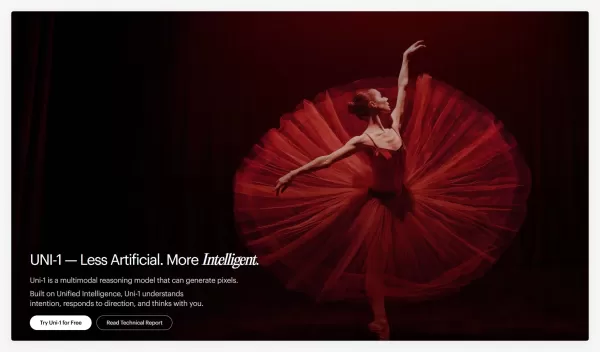
Luma Labs launched its image generation model Uni-1 on March 23, marking the company's first publicly available model built on the Unified Intelligence architecture. Free trial access is now open on the official website, with API pricing announced and enterprise access channels rolling out gradually.
Architecture Shift: From Diffusion Models to Autoregressive
Uni-1 moves away from the prevailing diffusion model approach, opting instead for a decoder-only autoregressive Transformer. It arranges text and image tokens in an alternating sequence within a single sequence, completing inference and pixel generation in one forward pass.
Luma CEO Amit Jain explained that traditional solutions typically first use a language model for planning, then hand off to a diffusion model for generation, causing information loss between the two stages. Uni-1’s design aims to eliminate this gap.
Jain previously worked at Apple and contributed to Vision Pro engineering.
Capabilities: Reference Image Control and Cross-Style Generation
Uni-1 supports image generation guided by one or more reference images, preserving the subject's identity, posture, and composition. Official tests show stable performance in handling character consistency and portrait control in multi-reference image mode.
The model claims support for 76 visual styles, covering categories such as realistic photography, comics, and ukiyo-e.
In a demonstration, inputting "Draw an infographic of the Golden Gate Bridge" led the model to automatically plan the layout, generate a bridge structure diagram, and annotate data such as "1711 Meters," with the internal reasoning process visible in real time.
Benchmarks: Leading in Spatial Reasoning and Reference Generation
Data published by Luma shows that Uni-1 scored 0.51 on the RISEBench reasoning benchmark, higher than Google Nano Banana 2's 0.50 and OpenAI GPT Image 1.5's 0.46. Its spatial reasoning score reached 0.58, and logical reasoning 0.32, roughly double that of GPT Image.
On the ODinW-13 object detection benchmark, Uni-1 achieved 46.2 mAP, close to Google Gemini 3 Pro's 46.3.
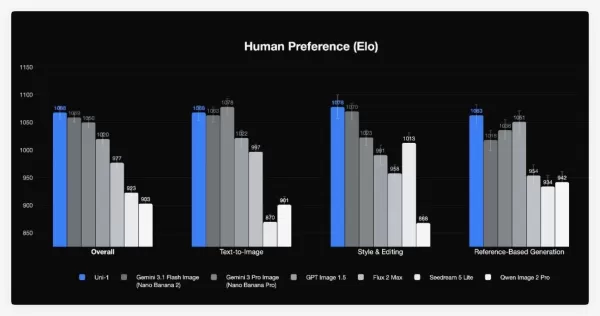
In human preference Elo rankings, Uni-1 placed first in overall preference, style and editing, and reference generation, and second in text-to-image generation.
Pricing
API charges are token-based: $0.50 per million tokens for input text, $1.20 per million tokens for input images, $3.00 per million tokens for output text and thought chain, and $45.45 per million tokens for output images.
Converted to a per-image basis: text-to-image (2048px) costs approximately $0.0909, editing with a single reference image around $0.0933, and eight reference images about $0.1101.
VentureBeat reported that in enterprise scenarios with 2K resolution, Uni-1 costs 10% to 30% less than Google Nano Banana 2.
Background
Luma Labs previously focused on video generation products like Dream Machine (Ray3 series). On March 5, the company released the Luma Agents creative agent platform, also based on the Unified Intelligence architecture. Uni-1 is the first application of this architecture in a static image product.
Within hours of the release, related posts on the X platform garnered over 2.3 million views. Luma stated that video and audio versions will follow, though specific timelines have not been disclosed.
Try it at: lumalabs.ai/uni-1
Related article
 Former OpenAI Researcher Barrett Zoph Returns to Google to Support Gemini Development
Barret Zoph, who previously abruptly left and joined OpenAI due to a disagreement with Thinking Machines Lab CEO Miriam Mularati, has once again changed employers. Alphabet's Google announced that Zoph will return as Vice President of Research, bring
How Recursive Intelligence Raised $335M at $4B Valuation in 4 Months
The co-founders of startup Ricursive Intelligence seemed destined to be co-founders.Anna Goldie, CEO, and Azalia Mirhoseini, CTO, are so well-known in the AI community that they were among those AI engineers who “got those weird emails from Zuckerber
AI race won’t wait, nor will this TechCrunch Disrupt 25% discount
Every founder building in AI right now is asking the same question: Are we moving fast enough, and effectively enough? TechCrunch Disrupt 2026 puts you in the same room as the people wrestling with that existential question at the highest levels. Fro
Related Special Topic Recommendations
Design & Art
Former OpenAI Researcher Barrett Zoph Returns to Google to Support Gemini Development
Barret Zoph, who previously abruptly left and joined OpenAI due to a disagreement with Thinking Machines Lab CEO Miriam Mularati, has once again changed employers. Alphabet's Google announced that Zoph will return as Vice President of Research, bring
How Recursive Intelligence Raised $335M at $4B Valuation in 4 Months
The co-founders of startup Ricursive Intelligence seemed destined to be co-founders.Anna Goldie, CEO, and Azalia Mirhoseini, CTO, are so well-known in the AI community that they were among those AI engineers who “got those weird emails from Zuckerber
AI race won’t wait, nor will this TechCrunch Disrupt 25% discount
Every founder building in AI right now is asking the same question: Are we moving fast enough, and effectively enough? TechCrunch Disrupt 2026 puts you in the same room as the people wrestling with that existential question at the highest levels. Fro
Related Special Topic Recommendations
Design & Art
 Top AI Illustration Tools: Create Editorial Scenes and Cover Art Faster
2026 Latest Top-rated AI Illustration Tools: Our curated list features the best powerfully designed tools for creating stunning editorial scenes and eye-catching cover art quickly. Each option has gone through rigorous real-world tests, offering a free vs paid comparison to help you find the perfect match for your workflow. Try these must-try solutions today to unlock your AI edge and boost your creative productivity. Explore now at XIX.AI.
 10 tools
 xix.ai
Education and Learning
Top AI Tutors for Exam Prep: Practice Math, Science, and English
xix.ai
Education and Learning
Top AI Tutors for Exam Prep: Practice Math, Science, and English
2026 Latest Top-Rated Best AI Tutors for Exam Prep are here on XIX.AI! Our curated list features powerful game-changing tools that offer free vs paid comparison, real-world tests, and weekly updated rankings. They help boost your writing efficiency, simplify complex topic learning, and unlock your academic potential. Explore now to Discover your perfect exam prep tool and Start creating today to Unlock your AI edge!
10 tools
xix.ai
Finance
AI Budget Planning Tools for Personal Money Management
2026 Latest Best Top-Rated AI Budget Planning Tools for Personal Money Management are here on XIX.AI! This curated collection features powerful, game-changing solutions that help you conduct real-world tests, understand spending habits, and create personalized plans to boost productivity. Enjoy a free vs paid comparison along with detailed rankings. Must-try tools designed to simplify money management and unlock your AI edge. Explore now!
11 tools
xix.ai
Health & Wellness
AI Sleep Tracking Assistants: Improve Recovery with Better Bedtime Habits
2026 Latest Best Top-Rated AI Sleep Tracking Assistants curated for ultimate recovery. This fully updated weekly guide features powerful tools that deliver real-world tests, free vs paid comparison, and detailed rankings to help you find the must-try solution that boosts sleep quality and supports better bedtime habits. Explore now at XIX.AI to Unlock your AI edge.
10 tools
xix.ai
Data Analysis
AI SQL Copilots for Product and Revenue Analytics
2026 Latest Best Top-Rated AI SQL Copilots for Product and Revenue Analytics! XIX.AI has curated a powerful, game-changing collection of must-try tools that undergo real-world tests through weekly updated rankings. These tools help users boost productivity significantly by accelerating data analysis, streamlining complex queries, and generating accurate insights to drive smarter business decisions. Explore now to Discover your perfect tool for unlocking your AI edge!
14 tools
xix.ai
Education and Learning
Best AI Homework Helpers That Teach: Learn Concepts, Not Just Answers
2026 Latest Best Top-Rated AI Homework Helpers That Teach Core Concepts Not Just Answers Powerful Tools for Students Must-Try Curated List Weekly Updated Free vs Paid Comparison Real-World Tests Accurate Rankings to Help You Unlock Your Full Learning Potential Explore now to Discover your perfect tool for smarter studying.
10 tools
xix.ai

 Comments (0)
0/500
Comments (0)
0/500
Luma Labs launched its image generation model Uni-1 on March 23, marking the company's first publicly available model built on the Unified Intelligence architecture. Free trial access is now open on the official website, with API pricing announced and enterprise access channels rolling out gradually.
Architecture Shift: From Diffusion Models to Autoregressive
Uni-1 moves away from the prevailing diffusion model approach, opting instead for a decoder-only autoregressive Transformer. It arranges text and image tokens in an alternating sequence within a single sequence, completing inference and pixel generation in one forward pass.
Luma CEO Amit Jain explained that traditional solutions typically first use a language model for planning, then hand off to a diffusion model for generation, causing information loss between the two stages. Uni-1’s design aims to eliminate this gap.
Jain previously worked at Apple and contributed to Vision Pro engineering.
Capabilities: Reference Image Control and Cross-Style Generation
Uni-1 supports image generation guided by one or more reference images, preserving the subject's identity, posture, and composition. Official tests show stable performance in handling character consistency and portrait control in multi-reference image mode.
The model claims support for 76 visual styles, covering categories such as realistic photography, comics, and ukiyo-e.
In a demonstration, inputting "Draw an infographic of the Golden Gate Bridge" led the model to automatically plan the layout, generate a bridge structure diagram, and annotate data such as "1711 Meters," with the internal reasoning process visible in real time.
Benchmarks: Leading in Spatial Reasoning and Reference Generation
Data published by Luma shows that Uni-1 scored 0.51 on the RISEBench reasoning benchmark, higher than Google Nano Banana 2's 0.50 and OpenAI GPT Image 1.5's 0.46. Its spatial reasoning score reached 0.58, and logical reasoning 0.32, roughly double that of GPT Image.
On the ODinW-13 object detection benchmark, Uni-1 achieved 46.2 mAP, close to Google Gemini 3 Pro's 46.3.
In human preference Elo rankings, Uni-1 placed first in overall preference, style and editing, and reference generation, and second in text-to-image generation.
Pricing
API charges are token-based: $0.50 per million tokens for input text, $1.20 per million tokens for input images, $3.00 per million tokens for output text and thought chain, and $45.45 per million tokens for output images.
Converted to a per-image basis: text-to-image (2048px) costs approximately $0.0909, editing with a single reference image around $0.0933, and eight reference images about $0.1101.
VentureBeat reported that in enterprise scenarios with 2K resolution, Uni-1 costs 10% to 30% less than Google Nano Banana 2.
Background
Luma Labs previously focused on video generation products like Dream Machine (Ray3 series). On March 5, the company released the Luma Agents creative agent platform, also based on the Unified Intelligence architecture. Uni-1 is the first application of this architecture in a static image product.
Within hours of the release, related posts on the X platform garnered over 2.3 million views. Luma stated that video and audio versions will follow, though specific timelines have not been disclosed.
Try it at: lumalabs.ai/uni-1








 Former OpenAI Researcher Barrett Zoph Returns to Google to Support Gemini Development
Barret Zoph, who previously abruptly left and joined OpenAI due to a disagreement with Thinking Machines Lab CEO Miriam Mularati, has once again changed employers. Alphabet's Google announced that Zoph will return as Vice President of Research, bring
Former OpenAI Researcher Barrett Zoph Returns to Google to Support Gemini Development
Barret Zoph, who previously abruptly left and joined OpenAI due to a disagreement with Thinking Machines Lab CEO Miriam Mularati, has once again changed employers. Alphabet's Google announced that Zoph will return as Vice President of Research, bring
 How Recursive Intelligence Raised $335M at $4B Valuation in 4 Months
The co-founders of startup Ricursive Intelligence seemed destined to be co-founders.Anna Goldie, CEO, and Azalia Mirhoseini, CTO, are so well-known in the AI community that they were among those AI engineers who “got those weird emails from Zuckerber
How Recursive Intelligence Raised $335M at $4B Valuation in 4 Months
The co-founders of startup Ricursive Intelligence seemed destined to be co-founders.Anna Goldie, CEO, and Azalia Mirhoseini, CTO, are so well-known in the AI community that they were among those AI engineers who “got those weird emails from Zuckerber
 AI race won’t wait, nor will this TechCrunch Disrupt 25% discount
Every founder building in AI right now is asking the same question: Are we moving fast enough, and effectively enough? TechCrunch Disrupt 2026 puts you in the same room as the people wrestling with that existential question at the highest levels. Fro
AI race won’t wait, nor will this TechCrunch Disrupt 25% discount
Every founder building in AI right now is asking the same question: Are we moving fast enough, and effectively enough? TechCrunch Disrupt 2026 puts you in the same room as the people wrestling with that existential question at the highest levels. Fro
2026 Latest Top-rated AI Illustration Tools: Our curated list features the best powerfully designed tools for creating stunning editorial scenes and eye-catching cover art quickly. Each option has gone through rigorous real-world tests, offering a free vs paid comparison to help you find the perfect match for your workflow. Try these must-try solutions today to unlock your AI edge and boost your creative productivity. Explore now at XIX.AI.
10 tools
xix.ai

2026 Latest Top-Rated Best AI Tutors for Exam Prep are here on XIX.AI! Our curated list features powerful game-changing tools that offer free vs paid comparison, real-world tests, and weekly updated rankings. They help boost your writing efficiency, simplify complex topic learning, and unlock your academic potential. Explore now to Discover your perfect exam prep tool and Start creating today to Unlock your AI edge!
10 tools
xix.ai

2026 Latest Best Top-Rated AI Budget Planning Tools for Personal Money Management are here on XIX.AI! This curated collection features powerful, game-changing solutions that help you conduct real-world tests, understand spending habits, and create personalized plans to boost productivity. Enjoy a free vs paid comparison along with detailed rankings. Must-try tools designed to simplify money management and unlock your AI edge. Explore now!
11 tools
xix.ai

2026 Latest Best Top-Rated AI Sleep Tracking Assistants curated for ultimate recovery. This fully updated weekly guide features powerful tools that deliver real-world tests, free vs paid comparison, and detailed rankings to help you find the must-try solution that boosts sleep quality and supports better bedtime habits. Explore now at XIX.AI to Unlock your AI edge.
10 tools
xix.ai

2026 Latest Best Top-Rated AI SQL Copilots for Product and Revenue Analytics! XIX.AI has curated a powerful, game-changing collection of must-try tools that undergo real-world tests through weekly updated rankings. These tools help users boost productivity significantly by accelerating data analysis, streamlining complex queries, and generating accurate insights to drive smarter business decisions. Explore now to Discover your perfect tool for unlocking your AI edge!
14 tools
xix.ai

2026 Latest Best Top-Rated AI Homework Helpers That Teach Core Concepts Not Just Answers Powerful Tools for Students Must-Try Curated List Weekly Updated Free vs Paid Comparison Real-World Tests Accurate Rankings to Help You Unlock Your Full Learning Potential Explore now to Discover your perfect tool for smarter studying.
10 tools
xix.ai












