


 Home
HomeLobotomy Corporation Live Stream Plagued by AI Storytelling Issues
The fusion of AI and narrative creation opens up thrilling possibilities, but what unfolds when artificial intelligence tries to spin tales in volatile settings? This journey explores the comedy and unpredictable twists of an AI-powered narrative stream set in the demanding universe of Lobotomy Corporation. From garbled words to complete plot derailments, the stream showcases both the potential and the challenges of using AI for creative tasks.
Key Points
AI-generated storytelling can produce surprisingly funny results.
Misinterpreting context often leads to absurd and hilarious scenarios.
Audience input can dramatically alter and steer the AI's story direction.
Establishing clear guidelines is essential for successful AI-driven creative work.
Setting the Stage: Lobotomy Corporation and AI Storytelling
The Premise of Lobotomy Corporation
In Lobotomy Corporation, players oversee a secretive research facility responsible for containing and studying Abnormalities—beings that break the laws of physics and biology. The game combines strategy, resource management, and rogue-lite elements, forming a intricate system where mistakes frequently cause chaotic and lethal outcomes.
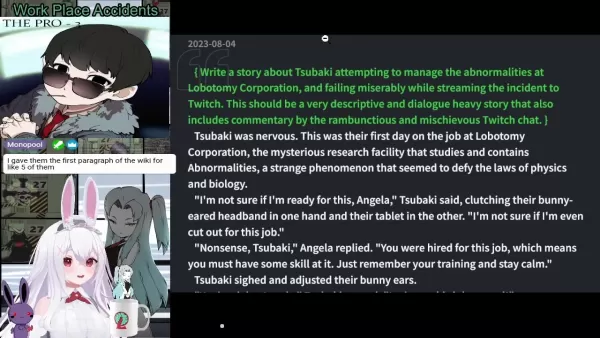
Introducing an AI that tries to craft a logical story based on player actions and in-game happenings only magnifies the possibilities for both catastrophe and entertainment.
Lobotomy Corporation: A World of AnomaliesLobotomy Corporation offers a sharp departure from conventional story-driven games. Instead of following a predetermined plot, Lobotomy Corporation emphasizes emergent narratives. The volatile nature of the Abnormalities, scarce resources, and the persistent risk of containment failures generate a fluid setting where every choice matters immensely. Adding an AI to this mix escalates the turmoil, as it strives to make sense of and react to events as they happen, usually with comical outcomes.
Why AI Storytelling in This Context?The appeal of observing an AI try to narrate a story within Lobotomy Corporation comes from the fundamental clash between the AI's restricted comprehension and the game's complex systems. The AI, missing human insight and background, finds it hard to understand the subtleties of the game's universe, resulting in amusing misunderstandings and story detours. This conflict produces a uniquely engaging spectacle, allowing viewers to see the AI's creative journey live, including its blunders and surprising successes.
The AI’s Misadventures: A First Day Disaster
The stream begins with the AI instructed to "Write a story about Tsubaki trying to manage the abnormalities at Lobotomy Corporation and failing terribly while streaming the event on Twitch.”
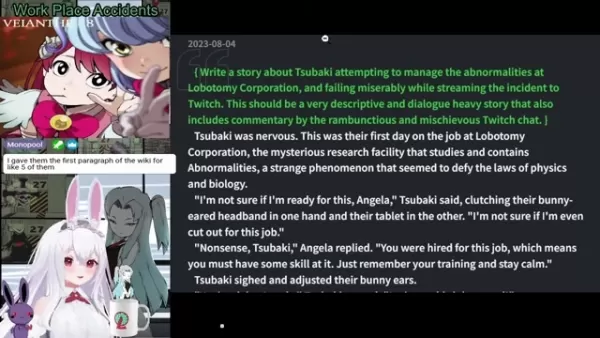
The opening sentences show the AI's ability to establish a simple premise: "Tsubaki was nervous. This was their first day on the job at Lobotomy Corporation." Yet, the AI's shortcomings soon emerge as it fails to keep a steady storyline and integrate the game's real-time developments. The AI describes Tsubaki gripping their "bunny-eared headband," revealing a quick error regarding the character's appearance. This sets the stage for the stream: a sequence of humorous blunders and narrative collapses that emphasize the difficulties of AI storytelling.
The dialogue created by the AI feels awkward and frequently illogical, demonstrating its trouble with handling human feelings and drives. This creates a gap between what the AI intends and the story it actually produces, enhancing the stream's entertainment value. A standout funny instance happens when the AI insists, “These are real bunny ears, this is lies and slander that these bunny ears come from a headband.” Spectators watching horrific deaths and chaos commenting “LOL PepeLoser” as a monster consumes employees adds another layer of commentary to the ridiculous scene. It's a darkly funny juxtaposition that highlights the AI's shallow grasp of the events on screen.
Key Takeaways: Lessons from an AI Storytelling Fiasco
Defining Parameters and Boundaries
The AI's difficulty in telling a logical story highlights the necessity for precise parameters and limits in AI creative ventures. Without such frameworks, the AI tends to go off on unrelated tangents and generate incoherent material. It serves as a caution that AI, as an instrument, needs fine-tuning to match human creative visions and objectives.
Importance of Contextual AwarenessAIs frequently stumble because they lack contextual awareness, unable to comprehend the finer points of human conduct, feelings, and cultural allusions. The AI's efforts to replicate human conversation often yield stiff and unnatural dialogues, which, while amusing, reveal the distance between artificial and human intellect.
Audience Interaction: A Double-Edged SwordViewer participation can deeply affect the AI's creative flow, as demonstrated in this live session. While audience suggestions can introduce fun and unpredictability, they can also cause the narrative to fall apart. Managing the influx of information and viewer cues is crucial to keep the AI focused and generating content that fits the planned story.
AI Storytelling: A Complement, Not a ReplacementThe AI's blunders should not be seen as a condemnation of AI storytelling but as a demonstration of its existing boundaries. As AI technology progresses, it will probably become a more useful asset for artistic projects. Nevertheless, for the time being, AI is more likely to support human creativity rather than take its place.
AI Storytelling: Weighing the Advantages and Disadvantages
Pros
Quick Content Creation: AI can generate stories and plotlines far more rapidly than human authors.
Customization: AI can adapt stories to match specific user tastes and interests.
Innovative Ideas: AI can come up with fresh and surprising story components.
Cons
Limited Emotional Resonance: AI has difficulty portraying the complete range of human feelings.
Contextual Errors: AI often misreads the intricacies of social, cultural, and situational backgrounds.
No Capacity for Improvement: AI does not possess the human ability for introspection and refinement.
FAQ
What is Lobotomy Corporation?
Lobotomy Corporation is a management simulation game created by Project Moon. Players run a facility that holds and researches hazardous beings called Abnormalities. The objective is to harvest energy from these entities while stopping them from breaking out and causing destruction.
What is AI Storytelling?
AI storytelling refers to employing artificial intelligence programs to produce narratives, conversations, and story developments. AI storytelling tools utilize machine learning to examine large text datasets and recognize patterns in language, tone, and composition. It then applies this understanding to craft new stories or enhance current ones.
What are the Benefits of AI Storytelling?
AI storytelling provides potential advantages like fast content generation, tailoring stories to user likes, and broadening creative horizons. However, existing AI storytelling technologies have constraints in grasping intricate plots and human sentiments.
Related Questions
What are other ways AI is currently being used in gaming?
AI is transforming gaming in numerous areas besides storytelling. Non-player characters (NPCs) with dynamic behaviors, procedural generation for building huge and diverse game environments, customized gaming sessions, and automated testing and bug detection are some instances of AI's wide-ranging uses.Enhanced Non-Player Characters (NPCs)Standard NPCs typically operate on set scripts, making them easy to anticipate and less interesting. NPCs enhanced with AI, however, demonstrate responsive actions, learning from player engagements and adapting their responses. These NPCs can form bonds with players, express feelings, and even develop their characters throughout the game, leading to a richer and more realistic experience. For instance, think about the possibilities of AI-driven NPCs in a role-playing game. Such NPCs could recall previous encounters, change their opinions based on player decisions, and provide customized missions and conversations.Procedural Content GenerationBuilding large and varied game worlds is a lengthy and expensive endeavor. Procedural content generation (PCG) uses AI to automatically create game content like terrains, structures, tasks, and equipment. PCG allows developers to produce enormous and distinct game settings rapidly and effectively, lowering production expenses and improving game longevity. Imagine an open-world game created through algorithms where the setting, objectives, and personas are different every time you play.Personalized Gaming ExperiencesAI can examine player statistics to customize the gameplay to individual styles. By monitoring how a player behaves, AI can modify the challenge setting, offer tailored suggestions, and even adjust the narrative to fit the player's approach. This degree of customization boosts player involvement and contentment, making the game more fulfilling and fun. Consider a game that adjusts its difficulty dynamically based on the player's proficiency, maintaining a constant level of engagement and challenge.Automated Testing and Quality AssuranceTesting and quality control are crucial yet often monotonous parts of game production. AI can streamline these tasks by mimicking different player actions and detecting possible errors and issues. AI-assisted testing can greatly cut down development duration and guarantee a more polished end product. Envision AI programs thoroughly testing a game, finding glitches that human testers could overlook, and securing a more seamless player experience.AI is a game-changing influence in the video game sector, with the capacity to completely reshape gameplay, world-building, and user interactions. As AI tech keeps improving, we can anticipate even more creative and impressive uses of AI in games.
Related article
 Stripe to Acquire OpenRouter as AI Model Routing Gains Momentum
Stripe has agreed to acquire OpenRouter, an AI model-routing platform that gives developers access to hundreds of models through a single interface. The deal adds model selection and routing to Stripe’s existing work around AI usage and token-based b
Former OpenAI Researcher Barrett Zoph Returns to Google to Support Gemini Development
Barret Zoph, who previously abruptly left and joined OpenAI due to a disagreement with Thinking Machines Lab CEO Miriam Mularati, has once again changed employers. Alphabet's Google announced that Zoph will return as Vice President of Research, bring
How Recursive Intelligence Raised $335M at $4B Valuation in 4 Months
The co-founders of startup Ricursive Intelligence seemed destined to be co-founders.Anna Goldie, CEO, and Azalia Mirhoseini, CTO, are so well-known in the AI community that they were among those AI engineers who “got those weird emails from Zuckerber
Related Special Topic Recommendations
Design & Art
Stripe to Acquire OpenRouter as AI Model Routing Gains Momentum
Stripe has agreed to acquire OpenRouter, an AI model-routing platform that gives developers access to hundreds of models through a single interface. The deal adds model selection and routing to Stripe’s existing work around AI usage and token-based b
Former OpenAI Researcher Barrett Zoph Returns to Google to Support Gemini Development
Barret Zoph, who previously abruptly left and joined OpenAI due to a disagreement with Thinking Machines Lab CEO Miriam Mularati, has once again changed employers. Alphabet's Google announced that Zoph will return as Vice President of Research, bring
How Recursive Intelligence Raised $335M at $4B Valuation in 4 Months
The co-founders of startup Ricursive Intelligence seemed destined to be co-founders.Anna Goldie, CEO, and Azalia Mirhoseini, CTO, are so well-known in the AI community that they were among those AI engineers who “got those weird emails from Zuckerber
Related Special Topic Recommendations
Design & Art
 Top AI Illustration Tools: Create Editorial Scenes and Cover Art Faster
2026 Latest Top-rated AI Illustration Tools: Our curated list features the best powerfully designed tools for creating stunning editorial scenes and eye-catching cover art quickly. Each option has gone through rigorous real-world tests, offering a free vs paid comparison to help you find the perfect match for your workflow. Try these must-try solutions today to unlock your AI edge and boost your creative productivity. Explore now at XIX.AI.
 10 tools
 xix.ai
Education and Learning
Top AI Tutors for Exam Prep: Practice Math, Science, and English
xix.ai
Education and Learning
Top AI Tutors for Exam Prep: Practice Math, Science, and English
2026 Latest Top-Rated Best AI Tutors for Exam Prep are here on XIX.AI! Our curated list features powerful game-changing tools that offer free vs paid comparison, real-world tests, and weekly updated rankings. They help boost your writing efficiency, simplify complex topic learning, and unlock your academic potential. Explore now to Discover your perfect exam prep tool and Start creating today to Unlock your AI edge!
10 tools
xix.ai
Finance
AI Budget Planning Tools for Personal Money Management
2026 Latest Best Top-Rated AI Budget Planning Tools for Personal Money Management are here on XIX.AI! This curated collection features powerful, game-changing solutions that help you conduct real-world tests, understand spending habits, and create personalized plans to boost productivity. Enjoy a free vs paid comparison along with detailed rankings. Must-try tools designed to simplify money management and unlock your AI edge. Explore now!
11 tools
xix.ai
Health & Wellness
AI Sleep Tracking Assistants: Improve Recovery with Better Bedtime Habits
2026 Latest Best Top-Rated AI Sleep Tracking Assistants curated for ultimate recovery. This fully updated weekly guide features powerful tools that deliver real-world tests, free vs paid comparison, and detailed rankings to help you find the must-try solution that boosts sleep quality and supports better bedtime habits. Explore now at XIX.AI to Unlock your AI edge.
10 tools
xix.ai
Data Analysis
AI SQL Copilots for Product and Revenue Analytics
2026 Latest Best Top-Rated AI SQL Copilots for Product and Revenue Analytics! XIX.AI has curated a powerful, game-changing collection of must-try tools that undergo real-world tests through weekly updated rankings. These tools help users boost productivity significantly by accelerating data analysis, streamlining complex queries, and generating accurate insights to drive smarter business decisions. Explore now to Discover your perfect tool for unlocking your AI edge!
14 tools
xix.ai
Education and Learning
Best AI Homework Helpers That Teach: Learn Concepts, Not Just Answers
2026 Latest Best Top-Rated AI Homework Helpers That Teach Core Concepts Not Just Answers Powerful Tools for Students Must-Try Curated List Weekly Updated Free vs Paid Comparison Real-World Tests Accurate Rankings to Help You Unlock Your Full Learning Potential Explore now to Discover your perfect tool for smarter studying.
10 tools
xix.ai

 Comments (2)
0/500
Comments (2)
0/500
![WillLopez]()
Just watched the stream and lol, the AI totally lost the plot halfway through. One minute it's a thriller, next it's explaining how to make toast like it's a cosmic event. Kinda funny but also scary? Like, is it learning or just glitching out? 🤖✨ #AImess #LiveStreamFail
![KevinGonzalez]()
Watching that stream was wild - the AI kept generating absurd plot twists that made no sense in the Lobotomy Corp setting. It's like the algorithm was trying to write horror but ended up with comedy gold. 😂 Makes you wonder if we're ready for AI storytellers in games with complex lore.
The fusion of AI and narrative creation opens up thrilling possibilities, but what unfolds when artificial intelligence tries to spin tales in volatile settings? This journey explores the comedy and unpredictable twists of an AI-powered narrative stream set in the demanding universe of Lobotomy Corporation. From garbled words to complete plot derailments, the stream showcases both the potential and the challenges of using AI for creative tasks.
Key Points
AI-generated storytelling can produce surprisingly funny results.
Misinterpreting context often leads to absurd and hilarious scenarios.
Audience input can dramatically alter and steer the AI's story direction.
Establishing clear guidelines is essential for successful AI-driven creative work.
Setting the Stage: Lobotomy Corporation and AI Storytelling
The Premise of Lobotomy Corporation
In Lobotomy Corporation, players oversee a secretive research facility responsible for containing and studying Abnormalities—beings that break the laws of physics and biology. The game combines strategy, resource management, and rogue-lite elements, forming a intricate system where mistakes frequently cause chaotic and lethal outcomes.
Introducing an AI that tries to craft a logical story based on player actions and in-game happenings only magnifies the possibilities for both catastrophe and entertainment.
Lobotomy Corporation: A World of AnomaliesLobotomy Corporation offers a sharp departure from conventional story-driven games. Instead of following a predetermined plot, Lobotomy Corporation emphasizes emergent narratives. The volatile nature of the Abnormalities, scarce resources, and the persistent risk of containment failures generate a fluid setting where every choice matters immensely. Adding an AI to this mix escalates the turmoil, as it strives to make sense of and react to events as they happen, usually with comical outcomes.
Why AI Storytelling in This Context?The appeal of observing an AI try to narrate a story within Lobotomy Corporation comes from the fundamental clash between the AI's restricted comprehension and the game's complex systems. The AI, missing human insight and background, finds it hard to understand the subtleties of the game's universe, resulting in amusing misunderstandings and story detours. This conflict produces a uniquely engaging spectacle, allowing viewers to see the AI's creative journey live, including its blunders and surprising successes.
The AI’s Misadventures: A First Day Disaster
The stream begins with the AI instructed to "Write a story about Tsubaki trying to manage the abnormalities at Lobotomy Corporation and failing terribly while streaming the event on Twitch.”
The opening sentences show the AI's ability to establish a simple premise: "Tsubaki was nervous. This was their first day on the job at Lobotomy Corporation." Yet, the AI's shortcomings soon emerge as it fails to keep a steady storyline and integrate the game's real-time developments. The AI describes Tsubaki gripping their "bunny-eared headband," revealing a quick error regarding the character's appearance. This sets the stage for the stream: a sequence of humorous blunders and narrative collapses that emphasize the difficulties of AI storytelling.
The dialogue created by the AI feels awkward and frequently illogical, demonstrating its trouble with handling human feelings and drives. This creates a gap between what the AI intends and the story it actually produces, enhancing the stream's entertainment value. A standout funny instance happens when the AI insists, “These are real bunny ears, this is lies and slander that these bunny ears come from a headband.” Spectators watching horrific deaths and chaos commenting “LOL PepeLoser” as a monster consumes employees adds another layer of commentary to the ridiculous scene. It's a darkly funny juxtaposition that highlights the AI's shallow grasp of the events on screen.
Key Takeaways: Lessons from an AI Storytelling Fiasco
Defining Parameters and Boundaries
The AI's difficulty in telling a logical story highlights the necessity for precise parameters and limits in AI creative ventures. Without such frameworks, the AI tends to go off on unrelated tangents and generate incoherent material. It serves as a caution that AI, as an instrument, needs fine-tuning to match human creative visions and objectives.
Importance of Contextual AwarenessAIs frequently stumble because they lack contextual awareness, unable to comprehend the finer points of human conduct, feelings, and cultural allusions. The AI's efforts to replicate human conversation often yield stiff and unnatural dialogues, which, while amusing, reveal the distance between artificial and human intellect.
Audience Interaction: A Double-Edged SwordViewer participation can deeply affect the AI's creative flow, as demonstrated in this live session. While audience suggestions can introduce fun and unpredictability, they can also cause the narrative to fall apart. Managing the influx of information and viewer cues is crucial to keep the AI focused and generating content that fits the planned story.
AI Storytelling: A Complement, Not a ReplacementThe AI's blunders should not be seen as a condemnation of AI storytelling but as a demonstration of its existing boundaries. As AI technology progresses, it will probably become a more useful asset for artistic projects. Nevertheless, for the time being, AI is more likely to support human creativity rather than take its place.
AI Storytelling: Weighing the Advantages and Disadvantages
Pros
Quick Content Creation: AI can generate stories and plotlines far more rapidly than human authors.
Customization: AI can adapt stories to match specific user tastes and interests.
Innovative Ideas: AI can come up with fresh and surprising story components.
Cons
Limited Emotional Resonance: AI has difficulty portraying the complete range of human feelings.
Contextual Errors: AI often misreads the intricacies of social, cultural, and situational backgrounds.
No Capacity for Improvement: AI does not possess the human ability for introspection and refinement.
FAQ
What is Lobotomy Corporation?
Lobotomy Corporation is a management simulation game created by Project Moon. Players run a facility that holds and researches hazardous beings called Abnormalities. The objective is to harvest energy from these entities while stopping them from breaking out and causing destruction.
What is AI Storytelling?
AI storytelling refers to employing artificial intelligence programs to produce narratives, conversations, and story developments. AI storytelling tools utilize machine learning to examine large text datasets and recognize patterns in language, tone, and composition. It then applies this understanding to craft new stories or enhance current ones.
What are the Benefits of AI Storytelling?
AI storytelling provides potential advantages like fast content generation, tailoring stories to user likes, and broadening creative horizons. However, existing AI storytelling technologies have constraints in grasping intricate plots and human sentiments.
Related Questions
What are other ways AI is currently being used in gaming?
AI is transforming gaming in numerous areas besides storytelling. Non-player characters (NPCs) with dynamic behaviors, procedural generation for building huge and diverse game environments, customized gaming sessions, and automated testing and bug detection are some instances of AI's wide-ranging uses.Enhanced Non-Player Characters (NPCs)Standard NPCs typically operate on set scripts, making them easy to anticipate and less interesting. NPCs enhanced with AI, however, demonstrate responsive actions, learning from player engagements and adapting their responses. These NPCs can form bonds with players, express feelings, and even develop their characters throughout the game, leading to a richer and more realistic experience. For instance, think about the possibilities of AI-driven NPCs in a role-playing game. Such NPCs could recall previous encounters, change their opinions based on player decisions, and provide customized missions and conversations.Procedural Content GenerationBuilding large and varied game worlds is a lengthy and expensive endeavor. Procedural content generation (PCG) uses AI to automatically create game content like terrains, structures, tasks, and equipment. PCG allows developers to produce enormous and distinct game settings rapidly and effectively, lowering production expenses and improving game longevity. Imagine an open-world game created through algorithms where the setting, objectives, and personas are different every time you play.Personalized Gaming ExperiencesAI can examine player statistics to customize the gameplay to individual styles. By monitoring how a player behaves, AI can modify the challenge setting, offer tailored suggestions, and even adjust the narrative to fit the player's approach. This degree of customization boosts player involvement and contentment, making the game more fulfilling and fun. Consider a game that adjusts its difficulty dynamically based on the player's proficiency, maintaining a constant level of engagement and challenge.Automated Testing and Quality AssuranceTesting and quality control are crucial yet often monotonous parts of game production. AI can streamline these tasks by mimicking different player actions and detecting possible errors and issues. AI-assisted testing can greatly cut down development duration and guarantee a more polished end product. Envision AI programs thoroughly testing a game, finding glitches that human testers could overlook, and securing a more seamless player experience.AI is a game-changing influence in the video game sector, with the capacity to completely reshape gameplay, world-building, and user interactions. As AI tech keeps improving, we can anticipate even more creative and impressive uses of AI in games.








 Stripe to Acquire OpenRouter as AI Model Routing Gains Momentum
Stripe has agreed to acquire OpenRouter, an AI model-routing platform that gives developers access to hundreds of models through a single interface. The deal adds model selection and routing to Stripe’s existing work around AI usage and token-based b
Stripe to Acquire OpenRouter as AI Model Routing Gains Momentum
Stripe has agreed to acquire OpenRouter, an AI model-routing platform that gives developers access to hundreds of models through a single interface. The deal adds model selection and routing to Stripe’s existing work around AI usage and token-based b
 Former OpenAI Researcher Barrett Zoph Returns to Google to Support Gemini Development
Barret Zoph, who previously abruptly left and joined OpenAI due to a disagreement with Thinking Machines Lab CEO Miriam Mularati, has once again changed employers. Alphabet's Google announced that Zoph will return as Vice President of Research, bring
Former OpenAI Researcher Barrett Zoph Returns to Google to Support Gemini Development
Barret Zoph, who previously abruptly left and joined OpenAI due to a disagreement with Thinking Machines Lab CEO Miriam Mularati, has once again changed employers. Alphabet's Google announced that Zoph will return as Vice President of Research, bring
 How Recursive Intelligence Raised $335M at $4B Valuation in 4 Months
The co-founders of startup Ricursive Intelligence seemed destined to be co-founders.Anna Goldie, CEO, and Azalia Mirhoseini, CTO, are so well-known in the AI community that they were among those AI engineers who “got those weird emails from Zuckerber
How Recursive Intelligence Raised $335M at $4B Valuation in 4 Months
The co-founders of startup Ricursive Intelligence seemed destined to be co-founders.Anna Goldie, CEO, and Azalia Mirhoseini, CTO, are so well-known in the AI community that they were among those AI engineers who “got those weird emails from Zuckerber

2026 Latest Top-rated AI Illustration Tools: Our curated list features the best powerfully designed tools for creating stunning editorial scenes and eye-catching cover art quickly. Each option has gone through rigorous real-world tests, offering a free vs paid comparison to help you find the perfect match for your workflow. Try these must-try solutions today to unlock your AI edge and boost your creative productivity. Explore now at XIX.AI.
10 tools
xix.ai

2026 Latest Top-Rated Best AI Tutors for Exam Prep are here on XIX.AI! Our curated list features powerful game-changing tools that offer free vs paid comparison, real-world tests, and weekly updated rankings. They help boost your writing efficiency, simplify complex topic learning, and unlock your academic potential. Explore now to Discover your perfect exam prep tool and Start creating today to Unlock your AI edge!
10 tools
xix.ai

2026 Latest Best Top-Rated AI Budget Planning Tools for Personal Money Management are here on XIX.AI! This curated collection features powerful, game-changing solutions that help you conduct real-world tests, understand spending habits, and create personalized plans to boost productivity. Enjoy a free vs paid comparison along with detailed rankings. Must-try tools designed to simplify money management and unlock your AI edge. Explore now!
11 tools
xix.ai

2026 Latest Best Top-Rated AI Sleep Tracking Assistants curated for ultimate recovery. This fully updated weekly guide features powerful tools that deliver real-world tests, free vs paid comparison, and detailed rankings to help you find the must-try solution that boosts sleep quality and supports better bedtime habits. Explore now at XIX.AI to Unlock your AI edge.
10 tools
xix.ai

2026 Latest Best Top-Rated AI SQL Copilots for Product and Revenue Analytics! XIX.AI has curated a powerful, game-changing collection of must-try tools that undergo real-world tests through weekly updated rankings. These tools help users boost productivity significantly by accelerating data analysis, streamlining complex queries, and generating accurate insights to drive smarter business decisions. Explore now to Discover your perfect tool for unlocking your AI edge!
14 tools
xix.ai

2026 Latest Best Top-Rated AI Homework Helpers That Teach Core Concepts Not Just Answers Powerful Tools for Students Must-Try Curated List Weekly Updated Free vs Paid Comparison Real-World Tests Accurate Rankings to Help You Unlock Your Full Learning Potential Explore now to Discover your perfect tool for smarter studying.
10 tools
xix.ai

Just watched the stream and lol, the AI totally lost the plot halfway through. One minute it's a thriller, next it's explaining how to make toast like it's a cosmic event. Kinda funny but also scary? Like, is it learning or just glitching out? 🤖✨ #AImess #LiveStreamFail
Watching that stream was wild - the AI kept generating absurd plot twists that made no sense in the Lobotomy Corp setting. It's like the algorithm was trying to write horror but ended up with comedy gold. 😂 Makes you wonder if we're ready for AI storytellers in games with complex lore.












