


 Home
Librarians Host Viral 'Avoiding AI' Workshops For Those Fed Up With Big Tech
“Everyone is glued to their screens in my library program,” joked Charlie Bailey, a South Philadelphia librarian. He invited his audience to take out their phones so he could guide them through disabling Apple Intelligence and Gemini.
Bailey stands in a children’s library classroom, anchored by a colorful rug that reminds us M is for “moon” and Z is for “zebra.” But the 20-some adults in the room aren’t here for alphabet lessons. They are attending a workshop called Avoiding AI, which, in this context, does not stand for “apple” and “igloo.”
“I was inspired by the frustration people feel when AI tools are forced upon them, and the sense that unwanted AI is suddenly everywhere in our lives,” Bailey told TechCrunch.
Bailey begins the hour-long session with an overview of how AI chatbots and consumer AI tools function, explaining why people might use these products and why they might choose to abstain. Then, he walks through the most popular tech platforms and devices, providing step-by-step instructions on the projector to help attendees turn off specific features.
“As a librarian, I view this as advancing digital literacy and helping people reclaim autonomy over whether they want to use AI tools,” Bailey said. “It’s crucial, especially when avoiding these tools is so difficult and the design seems to force adoption.”
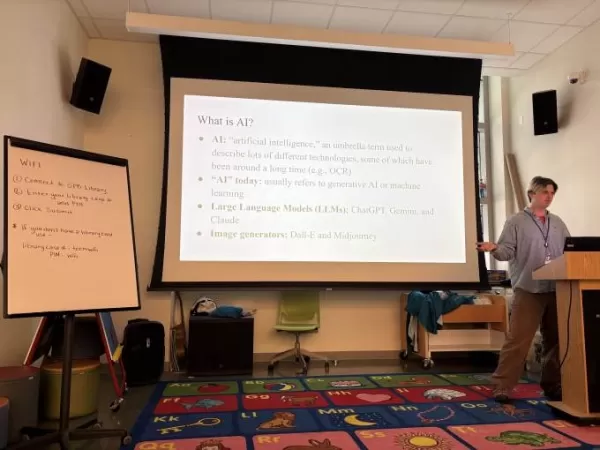
Charlie Bailey hosts an “Avoiding AI” workshopImage Credits:TechCrunch
Bailey got the idea for the Avoiding AI workshop from Hannah Cyrus, a librarian in Maine. He was one of dozens of librarians from around the world who contacted Cyrus after she published a journal article about developing her own workshop.
“This has never happened before with anything I’ve worked on,” Cyrus told TechCrunch. “Nobody has ever been emailing me like, ‘Can you give me your Intro to Computers slides?’”
At the Bangor Public Library, patrons turn to Cyrus when they need help with anything involving technology.
“More and more, I was getting questions about, ‘How do I turn this [AI] stuff off? Why is it trying to write my emails for me? Why is it trying to summarize my one-sentence email that I can easily read?’” Cyrus said. “I just decided that with so much media hype out there about AI products, it would be a good opportunity to teach people about the basics of what is happening when you’re using this technology, and then getting into how to turn it off if you don’t want to use it.”
Usually, Cyrus’ classes like Intro to Computers get about a dozen attendees. But so many people expressed interest in her first Avoiding AI workshop that she had to cut off registration at 30 people, open a waitlist, and share the workshop on Zoom. Including the livestream, about 70 people attended each of Cyrus’ first two workshops.
When Bailey followed Cyrus’ lead to host a workshop in Philadelphia, the reception was similarly unprecedented. The library’s Instagram post about the “Avoiding AI” event got over 2,000 likes and 220 shares, whereas most of the library’s posts don’t get more than a few dozen likes. He scheduled a second program because the first got too many registrations.
View this post on Instagram
“As an information professional, it feels good to see people skeptical of AI,” Bailey said. “It felt really good to see how many people share this feeling.”
There’s a sense of camaraderie among the room of strangers during the workshop. When Bailey invites attendees to share their own tips, one person explains that when you append “&udm=14” to a Google Search, it will hide AI results. Bailey writes the string of characters down on a whiteboard next to the log-in credentials for the teen Wi-Fi server.
“You have to go through all the trouble to buy a home in today’s world, and two years from now, there could be a data center next to your house,” one workshop attendee named Johnny says.
“I keep getting AI shoved down my throat at work, and every time I see it, I think about the environment,” another attendee named Gabrielle adds. But she’s also not writing off AI as a technology altogether. “I’m not against AI in terms of medical breakthroughs.”
AI naysayers know that this technology is far broader than just chatbots and deepfake apps. Cyrus mentioned how useful optical character recognition is for scanning old documents at the library. But for her and the people who go to her workshops, the anti-AI movement isn’t about rejecting technology altogether so much as it is about advocating for more control, agency, and freedom in how people use technology.
“I think the forced adoption of AI on people’s devices might be the straw that’s breaking the camel’s back in some ways,” she said. “The awareness has been growing for a long time that these products and these companies that make them have an outsized influence over us, and that we’re not really using these products in the way that we would like to.”
Related article
 Ando Launches Team Messaging App Bridging Human and AI Collaboration
In 2025, as Sara Du assisted companies in developing MCP servers, a recurring question emerged: how could teams leverage AI agents directly within Slack? The path was obstructed by significant technical barriers, including the complexity of message s
Sequoia-backed Empirik raises $21M to forecast outages before they strike
Before joining Sequoia Capital in 2020 as chief digital and information officer, Avon Puri spent over a decade running infrastructure at Rubrik and VMware. Three years ago, as large language models began showing their true potential, Puri, alongside
OpenAI launches GPT-5.5 Instant as ChatGPT’s new default model
OpenAI launched GPT-5.5 Instant on Monday, replacing GPT-5.3 Instant as the default ChatGPT model. The company states that this update minimizes hallucinations in high-stakes fields like law, medicine, and finance, while preserving the fast response
Related Special Topic Recommendations
Design & Art
 Top AI Illustration Tools: Create Editorial Scenes and Cover Art Faster
2026 Latest Top-rated AI Illustration Tools: Our curated list features the best powerfully designed tools for creating stunning editorial scenes and eye-catching cover art quickly. Each option has gone through rigorous real-world tests, offering a free vs paid comparison to help you find the perfect match for your workflow. Try these must-try solutions today to unlock your AI edge and boost your creative productivity. Explore now at XIX.AI.
 10 tools
 xix.ai
Education and Learning
Top AI Tutors for Exam Prep: Practice Math, Science, and English
2026 Latest Top-Rated Best AI Tutors for Exam Prep are here on XIX.AI! Our curated list features powerful game-changing tools that offer free vs paid comparison, real-world tests, and weekly updated rankings. They help boost your writing efficiency, simplify complex topic learning, and unlock your academic potential. Explore now to Discover your perfect exam prep tool and Start creating today to Unlock your AI edge!
10 tools
xix.ai
Finance
AI Budget Planning Tools for Personal Money Management
2026 Latest Best Top-Rated AI Budget Planning Tools for Personal Money Management are here on XIX.AI! This curated collection features powerful, game-changing solutions that help you conduct real-world tests, understand spending habits, and create personalized plans to boost productivity. Enjoy a free vs paid comparison along with detailed rankings. Must-try tools designed to simplify money management and unlock your AI edge. Explore now!
11 tools
xix.ai
Health & Wellness
AI Sleep Tracking Assistants: Improve Recovery with Better Bedtime Habits
2026 Latest Best Top-Rated AI Sleep Tracking Assistants curated for ultimate recovery. This fully updated weekly guide features powerful tools that deliver real-world tests, free vs paid comparison, and detailed rankings to help you find the must-try solution that boosts sleep quality and supports better bedtime habits. Explore now at XIX.AI to Unlock your AI edge.
10 tools
xix.ai
Data Analysis
AI SQL Copilots for Product and Revenue Analytics
2026 Latest Best Top-Rated AI SQL Copilots for Product and Revenue Analytics! XIX.AI has curated a powerful, game-changing collection of must-try tools that undergo real-world tests through weekly updated rankings. These tools help users boost productivity significantly by accelerating data analysis, streamlining complex queries, and generating accurate insights to drive smarter business decisions. Explore now to Discover your perfect tool for unlocking your AI edge!
14 tools
xix.ai
Education and Learning
Best AI Homework Helpers That Teach: Learn Concepts, Not Just Answers
2026 Latest Best Top-Rated AI Homework Helpers That Teach Core Concepts Not Just Answers Powerful Tools for Students Must-Try Curated List Weekly Updated Free vs Paid Comparison Real-World Tests Accurate Rankings to Help You Unlock Your Full Learning Potential Explore now to Discover your perfect tool for smarter studying.
10 tools
xix.ai

 Comments (0)
0/500
“Everyone is glued to their screens in my library program,” joked Charlie Bailey, a South Philadelphia librarian. He invited his audience to take out their phones so he could guide them through disabling Apple Intelligence and Gemini.
Bailey stands in a children’s library classroom, anchored by a colorful rug that reminds us M is for “moon” and Z is for “zebra.” But the 20-some adults in the room aren’t here for alphabet lessons. They are attending a workshop called Avoiding AI, which, in this context, does not stand for “apple” and “igloo.”
“I was inspired by the frustration people feel when AI tools are forced upon them, and the sense that unwanted AI is suddenly everywhere in our lives,” Bailey told TechCrunch.
Bailey begins the hour-long session with an overview of how AI chatbots and consumer AI tools function, explaining why people might use these products and why they might choose to abstain. Then, he walks through the most popular tech platforms and devices, providing step-by-step instructions on the projector to help attendees turn off specific features.
“As a librarian, I view this as advancing digital literacy and helping people reclaim autonomy over whether they want to use AI tools,” Bailey said. “It’s crucial, especially when avoiding these tools is so difficult and the design seems to force adoption.”
Charlie Bailey hosts an “Avoiding AI” workshopImage Credits:TechCrunch
Bailey got the idea for the Avoiding AI workshop from Hannah Cyrus, a librarian in Maine. He was one of dozens of librarians from around the world who contacted Cyrus after she published a journal article about developing her own workshop.
“This has never happened before with anything I’ve worked on,” Cyrus told TechCrunch. “Nobody has ever been emailing me like, ‘Can you give me your Intro to Computers slides?’”
At the Bangor Public Library, patrons turn to Cyrus when they need help with anything involving technology.
“More and more, I was getting questions about, ‘How do I turn this [AI] stuff off? Why is it trying to write my emails for me? Why is it trying to summarize my one-sentence email that I can easily read?’” Cyrus said. “I just decided that with so much media hype out there about AI products, it would be a good opportunity to teach people about the basics of what is happening when you’re using this technology, and then getting into how to turn it off if you don’t want to use it.”
Usually, Cyrus’ classes like Intro to Computers get about a dozen attendees. But so many people expressed interest in her first Avoiding AI workshop that she had to cut off registration at 30 people, open a waitlist, and share the workshop on Zoom. Including the livestream, about 70 people attended each of Cyrus’ first two workshops.
When Bailey followed Cyrus’ lead to host a workshop in Philadelphia, the reception was similarly unprecedented. The library’s Instagram post about the “Avoiding AI” event got over 2,000 likes and 220 shares, whereas most of the library’s posts don’t get more than a few dozen likes. He scheduled a second program because the first got too many registrations.
View this post on Instagram
“As an information professional, it feels good to see people skeptical of AI,” Bailey said. “It felt really good to see how many people share this feeling.”
There’s a sense of camaraderie among the room of strangers during the workshop. When Bailey invites attendees to share their own tips, one person explains that when you append “&udm=14” to a Google Search, it will hide AI results. Bailey writes the string of characters down on a whiteboard next to the log-in credentials for the teen Wi-Fi server.
“You have to go through all the trouble to buy a home in today’s world, and two years from now, there could be a data center next to your house,” one workshop attendee named Johnny says.
“I keep getting AI shoved down my throat at work, and every time I see it, I think about the environment,” another attendee named Gabrielle adds. But she’s also not writing off AI as a technology altogether. “I’m not against AI in terms of medical breakthroughs.”
AI naysayers know that this technology is far broader than just chatbots and deepfake apps. Cyrus mentioned how useful optical character recognition is for scanning old documents at the library. But for her and the people who go to her workshops, the anti-AI movement isn’t about rejecting technology altogether so much as it is about advocating for more control, agency, and freedom in how people use technology.
“I think the forced adoption of AI on people’s devices might be the straw that’s breaking the camel’s back in some ways,” she said. “The awareness has been growing for a long time that these products and these companies that make them have an outsized influence over us, and that we’re not really using these products in the way that we would like to.”








 Ando Launches Team Messaging App Bridging Human and AI Collaboration
In 2025, as Sara Du assisted companies in developing MCP servers, a recurring question emerged: how could teams leverage AI agents directly within Slack? The path was obstructed by significant technical barriers, including the complexity of message s
 Sequoia-backed Empirik raises $21M to forecast outages before they strike
Before joining Sequoia Capital in 2020 as chief digital and information officer, Avon Puri spent over a decade running infrastructure at Rubrik and VMware. Three years ago, as large language models began showing their true potential, Puri, alongside
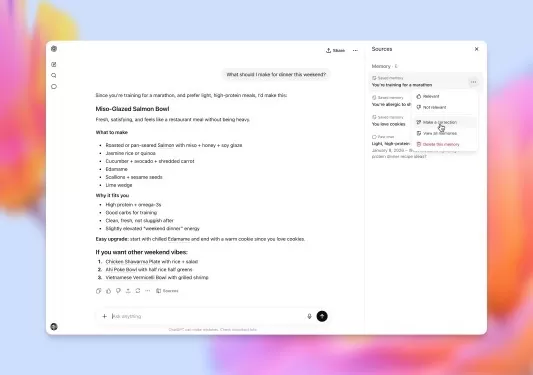 OpenAI launches GPT-5.5 Instant as ChatGPT’s new default model
OpenAI launched GPT-5.5 Instant on Monday, replacing GPT-5.3 Instant as the default ChatGPT model. The company states that this update minimizes hallucinations in high-stakes fields like law, medicine, and finance, while preserving the fast response

2026 Latest Top-rated AI Illustration Tools: Our curated list features the best powerfully designed tools for creating stunning editorial scenes and eye-catching cover art quickly. Each option has gone through rigorous real-world tests, offering a free vs paid comparison to help you find the perfect match for your workflow. Try these must-try solutions today to unlock your AI edge and boost your creative productivity. Explore now at XIX.AI.
10 tools
xix.ai

2026 Latest Top-Rated Best AI Tutors for Exam Prep are here on XIX.AI! Our curated list features powerful game-changing tools that offer free vs paid comparison, real-world tests, and weekly updated rankings. They help boost your writing efficiency, simplify complex topic learning, and unlock your academic potential. Explore now to Discover your perfect exam prep tool and Start creating today to Unlock your AI edge!
10 tools
xix.ai

2026 Latest Best Top-Rated AI Budget Planning Tools for Personal Money Management are here on XIX.AI! This curated collection features powerful, game-changing solutions that help you conduct real-world tests, understand spending habits, and create personalized plans to boost productivity. Enjoy a free vs paid comparison along with detailed rankings. Must-try tools designed to simplify money management and unlock your AI edge. Explore now!
11 tools
xix.ai

2026 Latest Best Top-Rated AI Sleep Tracking Assistants curated for ultimate recovery. This fully updated weekly guide features powerful tools that deliver real-world tests, free vs paid comparison, and detailed rankings to help you find the must-try solution that boosts sleep quality and supports better bedtime habits. Explore now at XIX.AI to Unlock your AI edge.
10 tools
xix.ai

2026 Latest Best Top-Rated AI SQL Copilots for Product and Revenue Analytics! XIX.AI has curated a powerful, game-changing collection of must-try tools that undergo real-world tests through weekly updated rankings. These tools help users boost productivity significantly by accelerating data analysis, streamlining complex queries, and generating accurate insights to drive smarter business decisions. Explore now to Discover your perfect tool for unlocking your AI edge!
14 tools
xix.ai

2026 Latest Best Top-Rated AI Homework Helpers That Teach Core Concepts Not Just Answers Powerful Tools for Students Must-Try Curated List Weekly Updated Free vs Paid Comparison Real-World Tests Accurate Rankings to Help You Unlock Your Full Learning Potential Explore now to Discover your perfect tool for smarter studying.
10 tools
xix.ai












