


 Home
HomeLangChain Summarization: Comparing Map-Reduce and Refine Methods
LangChain provides powerful automated text summarization tools, essential in our current information-rich environment. Its Map-Reduce and Refine techniques are particularly effective for condensing long texts into accessible summaries. By understanding how these methods work, their advantages, and their constraints, developers can select the best approach for their specific application. This blog compares the Map-Reduce and Refine methods, examining their mechanisms, implementation, and ideal use cases.
Key Points
Map-Reduce method: Summarizes individual text sections separately, then merges the results.
Refine method: Progressively enhances a summary by integrating details from each subsequent text segment.
Context length: The maximum text amount an LLM can analyze in one go, which influences summarization tactics.
Token counts: Measuring token usage in the source text to efficiently handle context limitations.
Buffer size: Reserving extra token capacity to avoid exceeding context limits during summarization.
Understanding LangChain Text Summarization
The Challenge of Long Input Text
A major obstacle in text summarization with Large Language Models is their restricted context capacity.
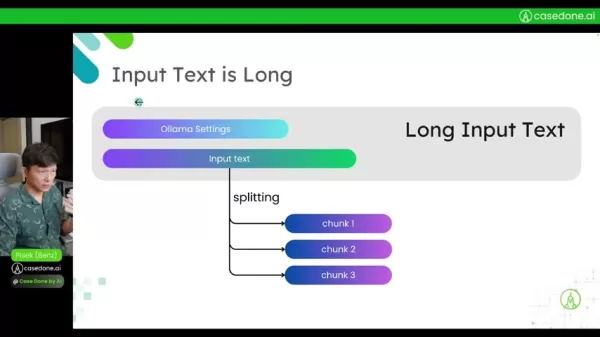
LLMs can only process a limited text volume per analysis. If the source text is too long, summarization becomes unreliable. LangChain addresses this by dividing documents into smaller, workable sections.
To summarize lengthy documents effectively, the text must be segmented into portions that fit the model's processing capacity. These methods preserve all relevant information while allowing the model to maintain contextual understanding.
Breaking long texts into segments helps LLMs process information efficiently and create summaries. Both Map-Reduce and Refine techniques assist in managing this segmented information.
Two Approaches to Text Summarization with LangChain
LangChain features two main summarization strategies: Map-Reduce and Refine. Each uses a different approach to work within context limits and produce precise summaries. Knowing these differences helps developers pick the right method for their project.
- Map-Reduce: This technique summarizes each text segment individually before combining them into a final summary.
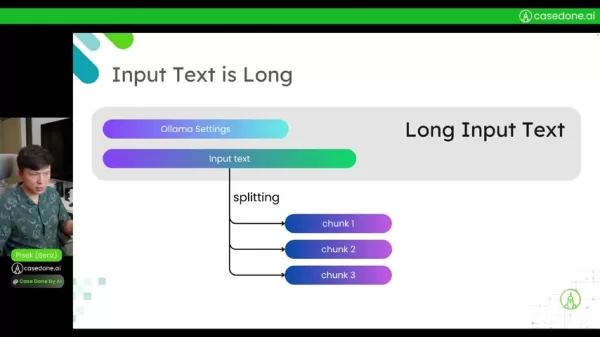
The original text is split into segments that the LLM summarizes separately. These summaries are then merged and processed further to create the final output.
- Refine: This sequential method begins with a summary of the first text segment, then repeatedly improves it by adding information from each following segment. This step-by-step refinement can yield more contextually aware and detailed summaries. Each approach has distinct benefits and drawbacks, influenced by factors like document length, required summary quality, and available processing resources.
Map-Reduce Method
Key Steps
The Map-Reduce technique involves two main phases that transform extended text into concise summaries:
- Map Step: Every text segment is analyzed separately to produce its own summary.
The input text is divided into sections based on the model's processing capacity. The LLM creates a summary for each section to extract its main points.
- Reduce Step: The separate summaries are merged into one unified summary. After summarizing all segments, the process combines these summaries. The combined results undergo additional processing to generate the final summary.
Advantages of Map-Reduce
The Map-Reduce approach provides several benefits for certain summarization needs:
- Parallel Processing: The initial summarization step can run simultaneously, potentially speeding up processing for very large documents.
- Scalability: It can manage exceptionally long documents by dividing them into smaller sections.
- Efficiency: Map-Reduce makes optimal use of the context window, enabling the model to gather important information from every text segment and produce high-quality summaries.
Limitations of Map-Reduce
Despite its strengths, the Map-Reduce method has certain drawbacks:
- Context Loss: Analyzing sections independently might miss broader contextual connections, possibly reducing summary accuracy.
- Incoherence: The final summary might lack smooth transitions if the individual summaries aren't well integrated.
- Limited Sequential Understanding: Map-Reduce may have difficulty recognizing sequential relationships or dependencies between different text sections.
The Refine Method
Pros
Initial summary captures information from the first segment.
Following segments gradually improve the summary.
Preserves contextual relationships between sections.
May achieve better topic transition and flow.
Cons
Step-by-step process can take more time.
No option for parallel processing acceleration.
Must proceed in strict sequence.
Summary Cut-Off
Set Summary Length
When building an effective summarization system, both the summary length and original text size must be considered.
Establish a buffer that accommodates both the input text and summary size to prevent information loss.
Key factors for summary length include:
- Token Counts: Developers should understand token sizes to properly manage text processing and summary generation.
- Summary Length: The summary should be concise enough to capture essential information without exceeding context limits.
- Buffer: Calculate a safe buffer margin for all tokens to properly configure the LLM.
FAQ
What is LangChain?
LangChain is a framework that simplifies building applications with large language models. It offers tools and structures for various tasks like document handling, query resolution, and text summarization. LangChain accelerates development by letting programmers concentrate on creating smart applications instead of managing LLM complexities.
When should I use the Map-Reduce method?
The Map-Reduce method works best for summarizing very long documents where processing speed and scalability matter most. It's also appropriate when text segments are fairly self-contained and don't require extensive cross-referencing. If parallel processing is available, Map-Reduce can dramatically cut down processing time.
When is the Refine method more appropriate?
The Refine method is preferable when maintaining contextual flow and coherence is critical. It's especially useful when text segments are interconnected and understanding information progression is vital for generating accurate summaries. However, its sequential nature can make it slower than Map-Reduce for particularly large documents.
Related Questions
How can I optimize context length in LangChain summarization?
Optimizing context length requires careful management of text volume during each summarization stage. This involves:Precisely calculating token usage for source text, summaries, and safety margins.Adapting segment sizes to fit context limits while retaining key details.Applying methods like trimming or filtering to remove non-essential content before summarization.Using LangChain's integrated token counting features for accurate context control.
Can I combine Map-Reduce and Refine methods for better summarization?
Yes, integrating Map-Reduce and Refine methods can enhance summarization outcomes. A combined strategy might use Map-Reduce for initial summaries of major document sections, then apply Refine to progressively enhance and unify these into a final, cohesive summary. This hybrid method balances processing speed and scalability with contextual precision and logical flow.
Related article
 Stripe to Acquire OpenRouter as AI Model Routing Gains Momentum
Stripe has agreed to acquire OpenRouter, an AI model-routing platform that gives developers access to hundreds of models through a single interface. The deal adds model selection and routing to Stripe’s existing work around AI usage and token-based b
Former OpenAI Researcher Barrett Zoph Returns to Google to Support Gemini Development
Barret Zoph, who previously abruptly left and joined OpenAI due to a disagreement with Thinking Machines Lab CEO Miriam Mularati, has once again changed employers. Alphabet's Google announced that Zoph will return as Vice President of Research, bring
How Recursive Intelligence Raised $335M at $4B Valuation in 4 Months
The co-founders of startup Ricursive Intelligence seemed destined to be co-founders.Anna Goldie, CEO, and Azalia Mirhoseini, CTO, are so well-known in the AI community that they were among those AI engineers who “got those weird emails from Zuckerber
Related Special Topic Recommendations
Design & Art
Stripe to Acquire OpenRouter as AI Model Routing Gains Momentum
Stripe has agreed to acquire OpenRouter, an AI model-routing platform that gives developers access to hundreds of models through a single interface. The deal adds model selection and routing to Stripe’s existing work around AI usage and token-based b
Former OpenAI Researcher Barrett Zoph Returns to Google to Support Gemini Development
Barret Zoph, who previously abruptly left and joined OpenAI due to a disagreement with Thinking Machines Lab CEO Miriam Mularati, has once again changed employers. Alphabet's Google announced that Zoph will return as Vice President of Research, bring
How Recursive Intelligence Raised $335M at $4B Valuation in 4 Months
The co-founders of startup Ricursive Intelligence seemed destined to be co-founders.Anna Goldie, CEO, and Azalia Mirhoseini, CTO, are so well-known in the AI community that they were among those AI engineers who “got those weird emails from Zuckerber
Related Special Topic Recommendations
Design & Art
 Top AI Illustration Tools: Create Editorial Scenes and Cover Art Faster
2026 Latest Top-rated AI Illustration Tools: Our curated list features the best powerfully designed tools for creating stunning editorial scenes and eye-catching cover art quickly. Each option has gone through rigorous real-world tests, offering a free vs paid comparison to help you find the perfect match for your workflow. Try these must-try solutions today to unlock your AI edge and boost your creative productivity. Explore now at XIX.AI.
 10 tools
 xix.ai
Education and Learning
Top AI Tutors for Exam Prep: Practice Math, Science, and English
xix.ai
Education and Learning
Top AI Tutors for Exam Prep: Practice Math, Science, and English
2026 Latest Top-Rated Best AI Tutors for Exam Prep are here on XIX.AI! Our curated list features powerful game-changing tools that offer free vs paid comparison, real-world tests, and weekly updated rankings. They help boost your writing efficiency, simplify complex topic learning, and unlock your academic potential. Explore now to Discover your perfect exam prep tool and Start creating today to Unlock your AI edge!
10 tools
xix.ai
Finance
AI Budget Planning Tools for Personal Money Management
2026 Latest Best Top-Rated AI Budget Planning Tools for Personal Money Management are here on XIX.AI! This curated collection features powerful, game-changing solutions that help you conduct real-world tests, understand spending habits, and create personalized plans to boost productivity. Enjoy a free vs paid comparison along with detailed rankings. Must-try tools designed to simplify money management and unlock your AI edge. Explore now!
11 tools
xix.ai
Health & Wellness
AI Sleep Tracking Assistants: Improve Recovery with Better Bedtime Habits
2026 Latest Best Top-Rated AI Sleep Tracking Assistants curated for ultimate recovery. This fully updated weekly guide features powerful tools that deliver real-world tests, free vs paid comparison, and detailed rankings to help you find the must-try solution that boosts sleep quality and supports better bedtime habits. Explore now at XIX.AI to Unlock your AI edge.
10 tools
xix.ai
Data Analysis
AI SQL Copilots for Product and Revenue Analytics
2026 Latest Best Top-Rated AI SQL Copilots for Product and Revenue Analytics! XIX.AI has curated a powerful, game-changing collection of must-try tools that undergo real-world tests through weekly updated rankings. These tools help users boost productivity significantly by accelerating data analysis, streamlining complex queries, and generating accurate insights to drive smarter business decisions. Explore now to Discover your perfect tool for unlocking your AI edge!
14 tools
xix.ai
Education and Learning
Best AI Homework Helpers That Teach: Learn Concepts, Not Just Answers
2026 Latest Best Top-Rated AI Homework Helpers That Teach Core Concepts Not Just Answers Powerful Tools for Students Must-Try Curated List Weekly Updated Free vs Paid Comparison Real-World Tests Accurate Rankings to Help You Unlock Your Full Learning Potential Explore now to Discover your perfect tool for smarter studying.
10 tools
xix.ai

 Comments (3)
0/500
Comments (3)
0/500
![MarkScott]()
Любопытно, как эти методы суммирования справятся с русской художественной литературой — там ведь столько нюансов! Может, попробовать на 'Войне и мире'? 😂
![ThomasLewis]()
なるほど、この記事を読んでLangChainのMap-ReduceとRefine、二つの要約手法の違いが少し見えてきました。長文処理のシーンに合わせて使い分けるのが良さそうですね。技術記事はちょっと硬いですが、実戦での具体的な使用例も知りたいです🤔
![TimothyBaker]()
个人觉得Map-Reduce在批量处理长文档时特别实用👌,不过Refine方法生成的摘要连贯性真的强好多!最近写论文正好需要这类工具,有没有小伙伴试过结合两种方法混合使用呀?
LangChain provides powerful automated text summarization tools, essential in our current information-rich environment. Its Map-Reduce and Refine techniques are particularly effective for condensing long texts into accessible summaries. By understanding how these methods work, their advantages, and their constraints, developers can select the best approach for their specific application. This blog compares the Map-Reduce and Refine methods, examining their mechanisms, implementation, and ideal use cases.
Key Points
Map-Reduce method: Summarizes individual text sections separately, then merges the results.
Refine method: Progressively enhances a summary by integrating details from each subsequent text segment.
Context length: The maximum text amount an LLM can analyze in one go, which influences summarization tactics.
Token counts: Measuring token usage in the source text to efficiently handle context limitations.
Buffer size: Reserving extra token capacity to avoid exceeding context limits during summarization.
Understanding LangChain Text Summarization
The Challenge of Long Input Text
A major obstacle in text summarization with Large Language Models is their restricted context capacity.
LLMs can only process a limited text volume per analysis. If the source text is too long, summarization becomes unreliable. LangChain addresses this by dividing documents into smaller, workable sections.
To summarize lengthy documents effectively, the text must be segmented into portions that fit the model's processing capacity. These methods preserve all relevant information while allowing the model to maintain contextual understanding.
Breaking long texts into segments helps LLMs process information efficiently and create summaries. Both Map-Reduce and Refine techniques assist in managing this segmented information.
Two Approaches to Text Summarization with LangChain
LangChain features two main summarization strategies: Map-Reduce and Refine. Each uses a different approach to work within context limits and produce precise summaries. Knowing these differences helps developers pick the right method for their project.
- Map-Reduce: This technique summarizes each text segment individually before combining them into a final summary.
The original text is split into segments that the LLM summarizes separately. These summaries are then merged and processed further to create the final output.
- Refine: This sequential method begins with a summary of the first text segment, then repeatedly improves it by adding information from each following segment. This step-by-step refinement can yield more contextually aware and detailed summaries. Each approach has distinct benefits and drawbacks, influenced by factors like document length, required summary quality, and available processing resources.
Map-Reduce Method
Key Steps
The Map-Reduce technique involves two main phases that transform extended text into concise summaries:
- Map Step: Every text segment is analyzed separately to produce its own summary.
The input text is divided into sections based on the model's processing capacity. The LLM creates a summary for each section to extract its main points.
- Reduce Step: The separate summaries are merged into one unified summary. After summarizing all segments, the process combines these summaries. The combined results undergo additional processing to generate the final summary.
Advantages of Map-Reduce
The Map-Reduce approach provides several benefits for certain summarization needs:
- Parallel Processing: The initial summarization step can run simultaneously, potentially speeding up processing for very large documents.
- Scalability: It can manage exceptionally long documents by dividing them into smaller sections.
- Efficiency: Map-Reduce makes optimal use of the context window, enabling the model to gather important information from every text segment and produce high-quality summaries.
Limitations of Map-Reduce
Despite its strengths, the Map-Reduce method has certain drawbacks:
- Context Loss: Analyzing sections independently might miss broader contextual connections, possibly reducing summary accuracy.
- Incoherence: The final summary might lack smooth transitions if the individual summaries aren't well integrated.
- Limited Sequential Understanding: Map-Reduce may have difficulty recognizing sequential relationships or dependencies between different text sections.
The Refine Method
Pros
Initial summary captures information from the first segment.
Following segments gradually improve the summary.
Preserves contextual relationships between sections.
May achieve better topic transition and flow.
Cons
Step-by-step process can take more time.
No option for parallel processing acceleration.
Must proceed in strict sequence.
Summary Cut-Off
Set Summary Length
When building an effective summarization system, both the summary length and original text size must be considered.
Establish a buffer that accommodates both the input text and summary size to prevent information loss.
Key factors for summary length include:
- Token Counts: Developers should understand token sizes to properly manage text processing and summary generation.
- Summary Length: The summary should be concise enough to capture essential information without exceeding context limits.
- Buffer: Calculate a safe buffer margin for all tokens to properly configure the LLM.
FAQ
What is LangChain?
LangChain is a framework that simplifies building applications with large language models. It offers tools and structures for various tasks like document handling, query resolution, and text summarization. LangChain accelerates development by letting programmers concentrate on creating smart applications instead of managing LLM complexities.
When should I use the Map-Reduce method?
The Map-Reduce method works best for summarizing very long documents where processing speed and scalability matter most. It's also appropriate when text segments are fairly self-contained and don't require extensive cross-referencing. If parallel processing is available, Map-Reduce can dramatically cut down processing time.
When is the Refine method more appropriate?
The Refine method is preferable when maintaining contextual flow and coherence is critical. It's especially useful when text segments are interconnected and understanding information progression is vital for generating accurate summaries. However, its sequential nature can make it slower than Map-Reduce for particularly large documents.
Related Questions
How can I optimize context length in LangChain summarization?
Optimizing context length requires careful management of text volume during each summarization stage. This involves:Precisely calculating token usage for source text, summaries, and safety margins.Adapting segment sizes to fit context limits while retaining key details.Applying methods like trimming or filtering to remove non-essential content before summarization.Using LangChain's integrated token counting features for accurate context control.
Can I combine Map-Reduce and Refine methods for better summarization?
Yes, integrating Map-Reduce and Refine methods can enhance summarization outcomes. A combined strategy might use Map-Reduce for initial summaries of major document sections, then apply Refine to progressively enhance and unify these into a final, cohesive summary. This hybrid method balances processing speed and scalability with contextual precision and logical flow.








 Stripe to Acquire OpenRouter as AI Model Routing Gains Momentum
Stripe has agreed to acquire OpenRouter, an AI model-routing platform that gives developers access to hundreds of models through a single interface. The deal adds model selection and routing to Stripe’s existing work around AI usage and token-based b
Stripe to Acquire OpenRouter as AI Model Routing Gains Momentum
Stripe has agreed to acquire OpenRouter, an AI model-routing platform that gives developers access to hundreds of models through a single interface. The deal adds model selection and routing to Stripe’s existing work around AI usage and token-based b
 Former OpenAI Researcher Barrett Zoph Returns to Google to Support Gemini Development
Barret Zoph, who previously abruptly left and joined OpenAI due to a disagreement with Thinking Machines Lab CEO Miriam Mularati, has once again changed employers. Alphabet's Google announced that Zoph will return as Vice President of Research, bring
Former OpenAI Researcher Barrett Zoph Returns to Google to Support Gemini Development
Barret Zoph, who previously abruptly left and joined OpenAI due to a disagreement with Thinking Machines Lab CEO Miriam Mularati, has once again changed employers. Alphabet's Google announced that Zoph will return as Vice President of Research, bring
 How Recursive Intelligence Raised $335M at $4B Valuation in 4 Months
The co-founders of startup Ricursive Intelligence seemed destined to be co-founders.Anna Goldie, CEO, and Azalia Mirhoseini, CTO, are so well-known in the AI community that they were among those AI engineers who “got those weird emails from Zuckerber
How Recursive Intelligence Raised $335M at $4B Valuation in 4 Months
The co-founders of startup Ricursive Intelligence seemed destined to be co-founders.Anna Goldie, CEO, and Azalia Mirhoseini, CTO, are so well-known in the AI community that they were among those AI engineers who “got those weird emails from Zuckerber

2026 Latest Top-rated AI Illustration Tools: Our curated list features the best powerfully designed tools for creating stunning editorial scenes and eye-catching cover art quickly. Each option has gone through rigorous real-world tests, offering a free vs paid comparison to help you find the perfect match for your workflow. Try these must-try solutions today to unlock your AI edge and boost your creative productivity. Explore now at XIX.AI.
10 tools
xix.ai

2026 Latest Top-Rated Best AI Tutors for Exam Prep are here on XIX.AI! Our curated list features powerful game-changing tools that offer free vs paid comparison, real-world tests, and weekly updated rankings. They help boost your writing efficiency, simplify complex topic learning, and unlock your academic potential. Explore now to Discover your perfect exam prep tool and Start creating today to Unlock your AI edge!
10 tools
xix.ai

2026 Latest Best Top-Rated AI Budget Planning Tools for Personal Money Management are here on XIX.AI! This curated collection features powerful, game-changing solutions that help you conduct real-world tests, understand spending habits, and create personalized plans to boost productivity. Enjoy a free vs paid comparison along with detailed rankings. Must-try tools designed to simplify money management and unlock your AI edge. Explore now!
11 tools
xix.ai

2026 Latest Best Top-Rated AI Sleep Tracking Assistants curated for ultimate recovery. This fully updated weekly guide features powerful tools that deliver real-world tests, free vs paid comparison, and detailed rankings to help you find the must-try solution that boosts sleep quality and supports better bedtime habits. Explore now at XIX.AI to Unlock your AI edge.
10 tools
xix.ai

2026 Latest Best Top-Rated AI SQL Copilots for Product and Revenue Analytics! XIX.AI has curated a powerful, game-changing collection of must-try tools that undergo real-world tests through weekly updated rankings. These tools help users boost productivity significantly by accelerating data analysis, streamlining complex queries, and generating accurate insights to drive smarter business decisions. Explore now to Discover your perfect tool for unlocking your AI edge!
14 tools
xix.ai

2026 Latest Best Top-Rated AI Homework Helpers That Teach Core Concepts Not Just Answers Powerful Tools for Students Must-Try Curated List Weekly Updated Free vs Paid Comparison Real-World Tests Accurate Rankings to Help You Unlock Your Full Learning Potential Explore now to Discover your perfect tool for smarter studying.
10 tools
xix.ai

Любопытно, как эти методы суммирования справятся с русской художественной литературой — там ведь столько нюансов! Может, попробовать на 'Войне и мире'? 😂
なるほど、この記事を読んでLangChainのMap-ReduceとRefine、二つの要約手法の違いが少し見えてきました。長文処理のシーンに合わせて使い分けるのが良さそうですね。技術記事はちょっと硬いですが、実戦での具体的な使用例も知りたいです🤔
个人觉得Map-Reduce在批量处理长文档时特别实用👌,不过Refine方法生成的摘要连贯性真的强好多!最近写论文正好需要这类工具,有没有小伙伴试过结合两种方法混合使用呀?












