


 Home
HomeJia Yuelin debuts humanoid robot and robot dog, FF enters consumer-level robotics market
On June 17, Faraday Future hosted the first part of the "All-Form FF EAI Robot World" launch event, where it unveiled four EAI robot products: the 2027 Futurist humanoid robot, the FXNavi quadruped robot, the FF MasterMini, and the FF Nova. The company also introduced its EAI education ecosystem strategy and the FF Robotics Partner Program (FF Robotics PAR).
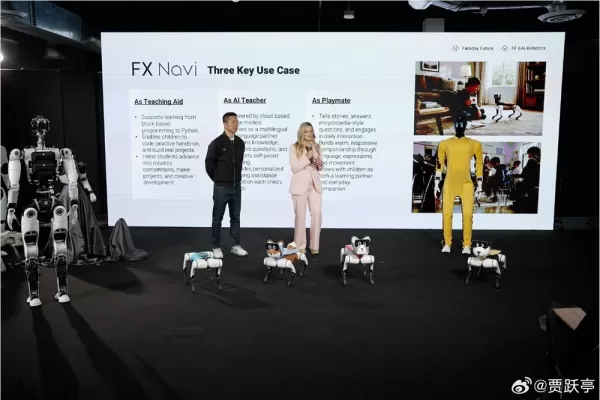
Jia Yueting, founder and global CEO of Faraday Future, said the company is accelerating its development as a pioneer, founder, and promoter of the global consumer robotics market. It is also collaborating with educational partners to build a robot education ecosystem that spans B2B educational institutions and C2C home learning environments.
The newly launched Futurist is described as the first U.S.-originated robot body product to fully support NVIDIA's Sonic full-body motion control system for full-size humanoid robots. The upcoming Ultra version will also feature the NVIDIA Jetson Thor high-performance chip, further enhancing its motion control and intelligent execution capabilities.
Meanwhile, the FX Navi is positioned as an entry-level quadruped EAI robot for the family and education markets. It comes with the EAI STEM curriculum system, covering learning, programming, and hands-on creation, aimed at helping teenagers transition from AI tool users to participants in robot development and creation.
Strategically, Faraday Future introduced the "One Brain, Multiple Forms" robot architecture, centered on a generalizable intelligent brain that integrates with various robot forms and differentiated EAI Agent and skill modules to enable capability adaptation across different scenarios. The company believes that compared to the industry's predominant focus on single general-purpose humanoid robots, the "One Brain, Multiple Forms" model is more conducive to large-scale deployment of robots in education, home services, and professional settings.
As competition in the humanoid robot industry continues to intensify, more companies are exploring the shift from individual robot capabilities to ecosystem platform capabilities. Faraday Future's release of a multi-form robot matrix and education ecosystem plan signals its intent to pursue new growth opportunities in the consumer robotics and smart education markets.
Related article
 Meta Removes AI Photo Editing Feature Following User Backlash
Meta, the social media giant, is once again embroiled in a public debate regarding the delicate balance between artificial intelligence and user privacy. According to TechCrunch, Meta’s Superintelligence Labs introduced a new AI image generator, Muse
DeepMind CEO Hassabis: I sleep six hours a day, usually feel energetic around 1 a.m.
Fortune recently featured an interview with Demis Hassabis, CEO of Google DeepMind, revealing his unconventional approach to rest and productivity. Hassabis disclosed that he sleeps very little, structuring his waking hours into two distinct work blo
OpenAI, Anthropic Vie for Market Share Despite Revenue Shortfalls
Despite recent reports suggesting OpenAI missed revenue targets, creating pressure on tech stocks this Tuesday, private AI lab investors remain resilient. Seasoned backers have confirmed they will not reduce investment despite negative media coverage
Related Special Topic Recommendations
Animation Creation
Meta Removes AI Photo Editing Feature Following User Backlash
Meta, the social media giant, is once again embroiled in a public debate regarding the delicate balance between artificial intelligence and user privacy. According to TechCrunch, Meta’s Superintelligence Labs introduced a new AI image generator, Muse
DeepMind CEO Hassabis: I sleep six hours a day, usually feel energetic around 1 a.m.
Fortune recently featured an interview with Demis Hassabis, CEO of Google DeepMind, revealing his unconventional approach to rest and productivity. Hassabis disclosed that he sleeps very little, structuring his waking hours into two distinct work blo
OpenAI, Anthropic Vie for Market Share Despite Revenue Shortfalls
Despite recent reports suggesting OpenAI missed revenue targets, creating pressure on tech stocks this Tuesday, private AI lab investors remain resilient. Seasoned backers have confirmed they will not reduce investment despite negative media coverage
Related Special Topic Recommendations
Animation Creation
 AI Scene Animation Tools for Social Media Content
2026 Latest Best Top-rated AI Scene Animation Tools for Social Media Content are curated here by XIX.AI. These powerful game-changing tools offer real-world tests and detailed free vs paid comparison, helping creators boost productivity significantly. Explore now to unlock your AI edge.
 9 tools
 xix.ai
Video creation
AI Short-Form Video Hook Generators for Reels, Shorts, and Product Launch Campaigns
xix.ai
Video creation
AI Short-Form Video Hook Generators for Reels, Shorts, and Product Launch Campaigns
2026 Latest Best AI Short-Form Video Hook Generators for Reels Shorts and Product Launch Campaigns! XIX.AI curates top-rated powerful game-changing tools that deliver must-try results through real-world tests. This weekly updated page offers free vs paid comparison rankings to help you find the perfect solution for boosting content creativity and productivity. Explore now to Unlock your AI edge!
11 tools
xix.ai
writing
AI Article Outline Tools for Long Form Writing
2026 Latest Best Top-Rated AI Article Outline Tools for Long Form Writing! This curated collection features powerful, game-changing tools that deliver accurate, structured outlines with real-world tests to boost writing efficiency significantly. XIX.AI is part of this elite selection. Get a free vs paid comparison to help you choose the perfect tool. Explore now and Unlock your AI edge!
9 tools
xix.ai
chatbot
Best AI Roleplay Chat Apps for Language Practice, Interview Prep, and Daily Fluency
2026 Latest Best Top-rated AI Roleplay Chat Apps for Language Practice, Interview Prep, and Daily Fluency! XIX.AI curates a powerful game-changing collection that offers free vs paid comparison, real-world tests, and updated rankings weekly. These must-try tools help you boost writing skills, overcome fluency challenges, and improve communication efficiency across all daily scenarios. Explore now to discover your perfect tool for language growth!
10 tools
xix.ai
Music composition
AI Stem Separation Tools for Remix Production, Sampling Prep, and Karaoke Masters
2026 Latest Best Top-rated AI Stem Separation Tools Curated for Remix Production, Sampling Prep, and Karaoke Masters. These powerful game-changing tools offer real-world tests to deliver precise audio isolation, boosting productivity significantly. XIX.AI provides a weekly updated free vs paid comparison guide to help you find the must-try solution that suits your needs. Explore now to unlock your AI edge.
8 tools
xix.ai
Data Analysis
AI SQL Copilots for Revenue Dashboards, Funnel Analysis, and Product Metrics
2026 Latest Best AI SQL Copilots Ranked Top-Rated! XIX.AI curates a powerful game-changing collection for weekly updated real-world tests. These must-try tools help you generate accurate revenue dashboards, analyze sales funnels, and track product metrics swiftly, boosting productivity massively. Explore now to Discover your perfect tool for data-driven decision making! 238 characters
9 tools
xix.ai

 Comments (0)
0/500
Comments (0)
0/500
On June 17, Faraday Future hosted the first part of the "All-Form FF EAI Robot World" launch event, where it unveiled four EAI robot products: the 2027 Futurist humanoid robot, the FXNavi quadruped robot, the FF MasterMini, and the FF Nova. The company also introduced its EAI education ecosystem strategy and the FF Robotics Partner Program (FF Robotics PAR).
Jia Yueting, founder and global CEO of Faraday Future, said the company is accelerating its development as a pioneer, founder, and promoter of the global consumer robotics market. It is also collaborating with educational partners to build a robot education ecosystem that spans B2B educational institutions and C2C home learning environments.
The newly launched Futurist is described as the first U.S.-originated robot body product to fully support NVIDIA's Sonic full-body motion control system for full-size humanoid robots. The upcoming Ultra version will also feature the NVIDIA Jetson Thor high-performance chip, further enhancing its motion control and intelligent execution capabilities.
Meanwhile, the FX Navi is positioned as an entry-level quadruped EAI robot for the family and education markets. It comes with the EAI STEM curriculum system, covering learning, programming, and hands-on creation, aimed at helping teenagers transition from AI tool users to participants in robot development and creation.
Strategically, Faraday Future introduced the "One Brain, Multiple Forms" robot architecture, centered on a generalizable intelligent brain that integrates with various robot forms and differentiated EAI Agent and skill modules to enable capability adaptation across different scenarios. The company believes that compared to the industry's predominant focus on single general-purpose humanoid robots, the "One Brain, Multiple Forms" model is more conducive to large-scale deployment of robots in education, home services, and professional settings.
As competition in the humanoid robot industry continues to intensify, more companies are exploring the shift from individual robot capabilities to ecosystem platform capabilities. Faraday Future's release of a multi-form robot matrix and education ecosystem plan signals its intent to pursue new growth opportunities in the consumer robotics and smart education markets.








 Meta Removes AI Photo Editing Feature Following User Backlash
Meta, the social media giant, is once again embroiled in a public debate regarding the delicate balance between artificial intelligence and user privacy. According to TechCrunch, Meta’s Superintelligence Labs introduced a new AI image generator, Muse
Meta Removes AI Photo Editing Feature Following User Backlash
Meta, the social media giant, is once again embroiled in a public debate regarding the delicate balance between artificial intelligence and user privacy. According to TechCrunch, Meta’s Superintelligence Labs introduced a new AI image generator, Muse
 DeepMind CEO Hassabis: I sleep six hours a day, usually feel energetic around 1 a.m.
Fortune recently featured an interview with Demis Hassabis, CEO of Google DeepMind, revealing his unconventional approach to rest and productivity. Hassabis disclosed that he sleeps very little, structuring his waking hours into two distinct work blo
DeepMind CEO Hassabis: I sleep six hours a day, usually feel energetic around 1 a.m.
Fortune recently featured an interview with Demis Hassabis, CEO of Google DeepMind, revealing his unconventional approach to rest and productivity. Hassabis disclosed that he sleeps very little, structuring his waking hours into two distinct work blo
 OpenAI, Anthropic Vie for Market Share Despite Revenue Shortfalls
Despite recent reports suggesting OpenAI missed revenue targets, creating pressure on tech stocks this Tuesday, private AI lab investors remain resilient. Seasoned backers have confirmed they will not reduce investment despite negative media coverage
OpenAI, Anthropic Vie for Market Share Despite Revenue Shortfalls
Despite recent reports suggesting OpenAI missed revenue targets, creating pressure on tech stocks this Tuesday, private AI lab investors remain resilient. Seasoned backers have confirmed they will not reduce investment despite negative media coverage

2026 Latest Best Top-rated AI Scene Animation Tools for Social Media Content are curated here by XIX.AI. These powerful game-changing tools offer real-world tests and detailed free vs paid comparison, helping creators boost productivity significantly. Explore now to unlock your AI edge.
9 tools
xix.ai

2026 Latest Best AI Short-Form Video Hook Generators for Reels Shorts and Product Launch Campaigns! XIX.AI curates top-rated powerful game-changing tools that deliver must-try results through real-world tests. This weekly updated page offers free vs paid comparison rankings to help you find the perfect solution for boosting content creativity and productivity. Explore now to Unlock your AI edge!
11 tools
xix.ai

2026 Latest Best Top-Rated AI Article Outline Tools for Long Form Writing! This curated collection features powerful, game-changing tools that deliver accurate, structured outlines with real-world tests to boost writing efficiency significantly. XIX.AI is part of this elite selection. Get a free vs paid comparison to help you choose the perfect tool. Explore now and Unlock your AI edge!
9 tools
xix.ai

2026 Latest Best Top-rated AI Roleplay Chat Apps for Language Practice, Interview Prep, and Daily Fluency! XIX.AI curates a powerful game-changing collection that offers free vs paid comparison, real-world tests, and updated rankings weekly. These must-try tools help you boost writing skills, overcome fluency challenges, and improve communication efficiency across all daily scenarios. Explore now to discover your perfect tool for language growth!
10 tools
xix.ai

2026 Latest Best Top-rated AI Stem Separation Tools Curated for Remix Production, Sampling Prep, and Karaoke Masters. These powerful game-changing tools offer real-world tests to deliver precise audio isolation, boosting productivity significantly. XIX.AI provides a weekly updated free vs paid comparison guide to help you find the must-try solution that suits your needs. Explore now to unlock your AI edge.
8 tools
xix.ai

2026 Latest Best AI SQL Copilots Ranked Top-Rated! XIX.AI curates a powerful game-changing collection for weekly updated real-world tests. These must-try tools help you generate accurate revenue dashboards, analyze sales funnels, and track product metrics swiftly, boosting productivity massively. Explore now to Discover your perfect tool for data-driven decision making! 238 characters
9 tools
xix.ai












