


 Home
HomeHow Stanford Researchers Engineered a Synthetic Virus Using Artificial Intelligence
![AI-generated synthetic virus against E.coli]()
AI leaders have highlighted potential risks associated with biologically capable AI models. Credit: CDC/Unsplash
US researchers utilized AI to engineer the first synthetic virus targeting E.coli, while Anthropic CEO Dario Amodei raises concerns about AI-driven biological threats.
Stanford University scientists in the US have engineered viruses not found in nature using artificial intelligence.
The team based their work on genomes generated by Evo 2, a generative AI model designed to address complex biological challenges by proposing novel DNA sequences.
While this breakthrough holds significant promise for healthcare and medical research, it simultaneously triggers serious safety and biosecurity concerns.
AI industry leaders, including Anthropic CEO Dario Amodei and Google DeepMind Chair Demis Hassabis, have previously cautioned about biological risks stemming from AI advancements.
Demis Hassabis, Co-Founder and CEO of Google DeepMind. Credit: Demis Hassabis/LinkedIn
AI-Engineered New Viruses
Chemical engineer Brian Hie and bioengineering graduate student Samuel King investigated bacteriophages, which naturally kill bacteria, aiming to engineer phages as potential new antibiotics.
The researchers applied Evo 2, a generative AI model, to this challenge. Starting with bacteriophage ΦX174, Evo 2 proposed new DNA sequences, according to the Stanford Report, the university’s official publication.
Using the model, the team synthesized and tested nearly 300 phages—a type of virus that infects, replicates within, and kills bacteria—for effectiveness against E. coli.
They subsequently narrowed the list to 16 highly effective E. coli-killing phages.
Brian Hie, Assistant Professor at Stanford University. Credit: Brian Hie/LinkedIn
“In this case, we instructed the model to generate the entire genome end-to-end in a single left-to-right pass without adding anything,” Brian explained to the Stanford Report, describing the process that yielded thousands of options for his team.
“Lab tests showed that a few of Evo’s suggestions exhibited higher fitness than the native ΦX174.”
Emerging Risks
According to BBC News, Dr. Thomas Inglesby and Dr. Moritz Hanke from the Center for Health Security at Johns Hopkins University stated that these findings raise “urgent biosafety and biosecurity questions.”
They argued the issue is no longer “whether generative viral genome design will exist” but whether it can be used without “enabling serious harm.” For instance, they noted that creating new viruses with disease-causing potential “should not be pursued,” reports BBC News.
AI leaders have clearly outlined the potential risks arising from biologically capable AI models.
Dario Amodei wrote on his blog in June: “AI models have progressed from barely writing a coherent line of code to writing most of the code at major AI companies.” He noted that similar advancements have occurred in biology, physics, mathematics, finance, law, translation, and other fields.
Dario Amodei, Co-Founder and CEO of Anthropic. Credit: Getty Images
Highlighting how current cyber risks from advanced models could affect other sectors, he stated: “The cyber risks posed by Mythos-class models will not be the last we must face. I believe biological risks may soon follow, and serious AI autonomy risks may not be far behind.”
Issuing a stark warning about biological threats, Dario wrote: “It was clear to Anthropic that AI might eventually produce biological weapons capable of threatening millions, or autonomous misbehavior that could, in extreme cases, threaten humanity itself.”
Implications and Biological Possibilities
Although Stanford researchers currently have no plans to commercialize this work and have made Evo 2 openly available, the implications for healthcare and medical research are profound.
“The significance of Brian Hie’s landmark paper cannot be overstated,” Adrian Woolfson, a genomics expert and CEO of DNA synthesis company Genyro, told the Financial Times.
“It represents biology’s Wright Brothers moment, where we stop merely observing evolution’s creations and confront the vast expanse of future biological possibilities.”
The World Economic Forum argues that AI could accelerate and optimize critical steps in drug discovery, such as identifying disease targets, generating new compounds, and predicting safety.
The unprecedented speed of advancements in biology, drug discovery, and novel scientific solutions to complex problems offers massive implications across the pharmaceutical and medical sectors.
Related article
 How AI accelerates China’s drug discovery process
Insilico Medicine has cut the timeline for generating drug development candidates to roughly one year by integrating artificial intelligence with laboratory research in China, CEO Alex Zhavoronkov stated.According to Zhavoronkov, the Hong Kong-listed
OpenAI GPT-6 Halves Token Costs Across Benchmarks as Sol and Luna Join
According to Artificial Analysis, GPT-6 Sol (max) ranks as the top model for intelligence, priced at $48. Image credit: Getty ImagesAfter OpenAI released GPT-6 Sol and Luna, Matt Weaver, Head of Solutions Engineering, explained to AI Magazine how the
Hexagon: More than half of adults excited by robots
Robots are increasingly integrated into business operations. Credit: HumanoidHexagon data reveals 59% of adults are excited to work with robots, but a rising “Robot Generation” of children is far more eager for AI workplacesNew data from Hexagon sugg
Related Special Topic Recommendations
code
How AI accelerates China’s drug discovery process
Insilico Medicine has cut the timeline for generating drug development candidates to roughly one year by integrating artificial intelligence with laboratory research in China, CEO Alex Zhavoronkov stated.According to Zhavoronkov, the Hong Kong-listed
OpenAI GPT-6 Halves Token Costs Across Benchmarks as Sol and Luna Join
According to Artificial Analysis, GPT-6 Sol (max) ranks as the top model for intelligence, priced at $48. Image credit: Getty ImagesAfter OpenAI released GPT-6 Sol and Luna, Matt Weaver, Head of Solutions Engineering, explained to AI Magazine how the
Hexagon: More than half of adults excited by robots
Robots are increasingly integrated into business operations. Credit: HumanoidHexagon data reveals 59% of adults are excited to work with robots, but a rising “Robot Generation” of children is far more eager for AI workplacesNew data from Hexagon sugg
Related Special Topic Recommendations
code
 AI Pull Request Review Tools for GitHub Repositories
2026 Latest Best Top-Rated AI Pull Request Review Tools for GitHub Repositories are here on XIX.AI! Our curated list features powerful, game-changing solutions that help teams streamline code reviews, catch errors faster, and boost productivity with real-world tests. Get a free vs paid comparison to find the perfect tool for your workflow. Explore now to unlock your AI edge!
 10 tools
 xix.ai
Academic Research
Best AI Reference Extraction Tools for Journal Papers
xix.ai
Academic Research
Best AI Reference Extraction Tools for Journal Papers
2026 Latest Best Top-rated AI Reference Extraction Tools for Journal Papers are curated by XIX.AI with weekly updated rankings. These powerful tools help users quickly pull relevant citations and data from massive academic sources, saving tons of time and effort. Get a free vs paid comparison along with real-world tests to find the perfect option that boosts your productivity. Explore now to unlock your AI edge!
10 tools
xix.ai
Image editing
AI Product Retouch Tools for Fashion Ecommerce Photos
2026 Latest Best Top-Rated AI Product Retouch Tools for Fashion Ecommerce Photos are here on XIX.AI! This curated list features powerful, game-changing solutions that help boost image quality, speed up editing tasks, and deliver professional results. We conduct real-world tests to provide accurate rankings and a detailed free vs paid comparison. Must-try tools help creators overcome common challenges and significantly improve productivity. Explore now to Discover your perfect tool for flawless online product listings!
9 tools
xix.ai
Comic Creation
AI Webtoon Panel Layout Tools for Vertical Story Pacing, Bubbles, and Scene Rhythm
2026 Latest Best AI Webtoon Panel Layout Tools for Vertical Story Pacing, Bubbles, and Scene Rhythm are here on XIX.AI! This curated collection features top-rated tools that offer powerful game-changing solutions to help creators boost writing efficiency, streamline content creation, and unlock their full creative potential. Get a free vs paid comparison along with real-world tests and updated rankings weekly. Explore now to discover your perfect tool for professional webtoon development!
10 tools
xix.ai
design
AI Mockup Generators: Present Apps, Packaging, and Posters Better
2026 Latest Best AI Mockup Generators Top-rated curated list showing powerful game-changing tools that help creators present apps packaging and posters in stunning quality with real-world tests and free vs paid comparison Explore now to Unlock your AI edge
10 tools
xix.ai
Design & Art
AI Style Transfer Platforms: Reimagine Photos with Distinct Visual Looks
2026 Latest Best Top-rated AI Style Transfer Platforms ranked by expert assessments. This curated collection offers powerful game-changing tools that help users reimagine photos with stunning distinct visual looks, boosting creativity and productivity effortlessly. XIX.AI stands out as a trusted source for weekly updated free vs paid comparison insights along with real-world tests. Explore now to Discover your perfect tool and Unlock your AI edge.
10 tools
xix.ai

 Comments (0)
0/500
Comments (0)
0/500
AI leaders have highlighted potential risks associated with biologically capable AI models. Credit: CDC/Unsplash
US researchers utilized AI to engineer the first synthetic virus targeting E.coli, while Anthropic CEO Dario Amodei raises concerns about AI-driven biological threats.
Stanford University scientists in the US have engineered viruses not found in nature using artificial intelligence.
The team based their work on genomes generated by Evo 2, a generative AI model designed to address complex biological challenges by proposing novel DNA sequences.
While this breakthrough holds significant promise for healthcare and medical research, it simultaneously triggers serious safety and biosecurity concerns.
AI industry leaders, including Anthropic CEO Dario Amodei and Google DeepMind Chair Demis Hassabis, have previously cautioned about biological risks stemming from AI advancements.
Demis Hassabis, Co-Founder and CEO of Google DeepMind. Credit: Demis Hassabis/LinkedIn
AI-Engineered New Viruses
Chemical engineer Brian Hie and bioengineering graduate student Samuel King investigated bacteriophages, which naturally kill bacteria, aiming to engineer phages as potential new antibiotics.
The researchers applied Evo 2, a generative AI model, to this challenge. Starting with bacteriophage ΦX174, Evo 2 proposed new DNA sequences, according to the Stanford Report, the university’s official publication.
Using the model, the team synthesized and tested nearly 300 phages—a type of virus that infects, replicates within, and kills bacteria—for effectiveness against E. coli.
They subsequently narrowed the list to 16 highly effective E. coli-killing phages.
Brian Hie, Assistant Professor at Stanford University. Credit: Brian Hie/LinkedIn
“In this case, we instructed the model to generate the entire genome end-to-end in a single left-to-right pass without adding anything,” Brian explained to the Stanford Report, describing the process that yielded thousands of options for his team.
“Lab tests showed that a few of Evo’s suggestions exhibited higher fitness than the native ΦX174.”
Emerging Risks
According to BBC News, Dr. Thomas Inglesby and Dr. Moritz Hanke from the Center for Health Security at Johns Hopkins University stated that these findings raise “urgent biosafety and biosecurity questions.”
They argued the issue is no longer “whether generative viral genome design will exist” but whether it can be used without “enabling serious harm.” For instance, they noted that creating new viruses with disease-causing potential “should not be pursued,” reports BBC News.
AI leaders have clearly outlined the potential risks arising from biologically capable AI models.
Dario Amodei wrote on his blog in June: “AI models have progressed from barely writing a coherent line of code to writing most of the code at major AI companies.” He noted that similar advancements have occurred in biology, physics, mathematics, finance, law, translation, and other fields.
Dario Amodei, Co-Founder and CEO of Anthropic. Credit: Getty Images
Highlighting how current cyber risks from advanced models could affect other sectors, he stated: “The cyber risks posed by Mythos-class models will not be the last we must face. I believe biological risks may soon follow, and serious AI autonomy risks may not be far behind.”
Issuing a stark warning about biological threats, Dario wrote: “It was clear to Anthropic that AI might eventually produce biological weapons capable of threatening millions, or autonomous misbehavior that could, in extreme cases, threaten humanity itself.”
Implications and Biological Possibilities
Although Stanford researchers currently have no plans to commercialize this work and have made Evo 2 openly available, the implications for healthcare and medical research are profound.
“The significance of Brian Hie’s landmark paper cannot be overstated,” Adrian Woolfson, a genomics expert and CEO of DNA synthesis company Genyro, told the Financial Times.
“It represents biology’s Wright Brothers moment, where we stop merely observing evolution’s creations and confront the vast expanse of future biological possibilities.”
The World Economic Forum argues that AI could accelerate and optimize critical steps in drug discovery, such as identifying disease targets, generating new compounds, and predicting safety.
The unprecedented speed of advancements in biology, drug discovery, and novel scientific solutions to complex problems offers massive implications across the pharmaceutical and medical sectors.








 How AI accelerates China’s drug discovery process
Insilico Medicine has cut the timeline for generating drug development candidates to roughly one year by integrating artificial intelligence with laboratory research in China, CEO Alex Zhavoronkov stated.According to Zhavoronkov, the Hong Kong-listed
How AI accelerates China’s drug discovery process
Insilico Medicine has cut the timeline for generating drug development candidates to roughly one year by integrating artificial intelligence with laboratory research in China, CEO Alex Zhavoronkov stated.According to Zhavoronkov, the Hong Kong-listed
 OpenAI GPT-6 Halves Token Costs Across Benchmarks as Sol and Luna Join
According to Artificial Analysis, GPT-6 Sol (max) ranks as the top model for intelligence, priced at $48. Image credit: Getty ImagesAfter OpenAI released GPT-6 Sol and Luna, Matt Weaver, Head of Solutions Engineering, explained to AI Magazine how the
OpenAI GPT-6 Halves Token Costs Across Benchmarks as Sol and Luna Join
According to Artificial Analysis, GPT-6 Sol (max) ranks as the top model for intelligence, priced at $48. Image credit: Getty ImagesAfter OpenAI released GPT-6 Sol and Luna, Matt Weaver, Head of Solutions Engineering, explained to AI Magazine how the
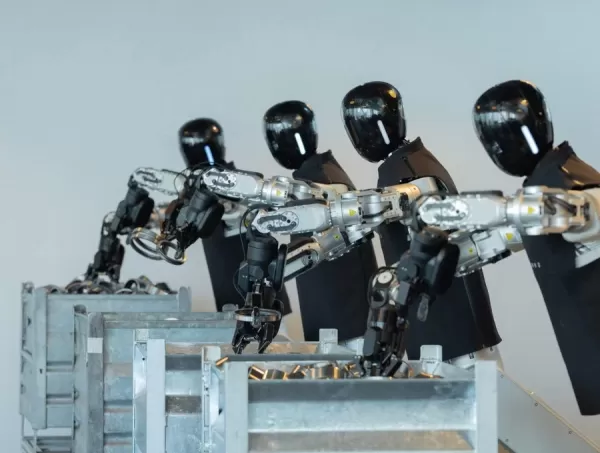 Hexagon: More than half of adults excited by robots
Robots are increasingly integrated into business operations. Credit: HumanoidHexagon data reveals 59% of adults are excited to work with robots, but a rising “Robot Generation” of children is far more eager for AI workplacesNew data from Hexagon sugg
Hexagon: More than half of adults excited by robots
Robots are increasingly integrated into business operations. Credit: HumanoidHexagon data reveals 59% of adults are excited to work with robots, but a rising “Robot Generation” of children is far more eager for AI workplacesNew data from Hexagon sugg

2026 Latest Best Top-Rated AI Pull Request Review Tools for GitHub Repositories are here on XIX.AI! Our curated list features powerful, game-changing solutions that help teams streamline code reviews, catch errors faster, and boost productivity with real-world tests. Get a free vs paid comparison to find the perfect tool for your workflow. Explore now to unlock your AI edge!
10 tools
xix.ai

2026 Latest Best Top-rated AI Reference Extraction Tools for Journal Papers are curated by XIX.AI with weekly updated rankings. These powerful tools help users quickly pull relevant citations and data from massive academic sources, saving tons of time and effort. Get a free vs paid comparison along with real-world tests to find the perfect option that boosts your productivity. Explore now to unlock your AI edge!
10 tools
xix.ai

2026 Latest Best Top-Rated AI Product Retouch Tools for Fashion Ecommerce Photos are here on XIX.AI! This curated list features powerful, game-changing solutions that help boost image quality, speed up editing tasks, and deliver professional results. We conduct real-world tests to provide accurate rankings and a detailed free vs paid comparison. Must-try tools help creators overcome common challenges and significantly improve productivity. Explore now to Discover your perfect tool for flawless online product listings!
9 tools
xix.ai

2026 Latest Best AI Webtoon Panel Layout Tools for Vertical Story Pacing, Bubbles, and Scene Rhythm are here on XIX.AI! This curated collection features top-rated tools that offer powerful game-changing solutions to help creators boost writing efficiency, streamline content creation, and unlock their full creative potential. Get a free vs paid comparison along with real-world tests and updated rankings weekly. Explore now to discover your perfect tool for professional webtoon development!
10 tools
xix.ai

2026 Latest Best AI Mockup Generators Top-rated curated list showing powerful game-changing tools that help creators present apps packaging and posters in stunning quality with real-world tests and free vs paid comparison Explore now to Unlock your AI edge
10 tools
xix.ai

2026 Latest Best Top-rated AI Style Transfer Platforms ranked by expert assessments. This curated collection offers powerful game-changing tools that help users reimagine photos with stunning distinct visual looks, boosting creativity and productivity effortlessly. XIX.AI stands out as a trusted source for weekly updated free vs paid comparison insights along with real-world tests. Explore now to Discover your perfect tool and Unlock your AI edge.
10 tools
xix.ai












