


 Home
HomeGPT-5.6 May Launch Next Week, Focusing on Agent-Level Operational Capabilities
The competitive landscape of artificial intelligence is intensifying rapidly. Recent leaks regarding test updates have brought the new flagship model, GPT-5.6, into the spotlight. Market consensus suggests an official launch in the latter half of June, specifically between the 22nd and 28th. While exact release dates remain debated in prediction markets, this iterative upgrade has firmly captured industry attention.
Reports indicate that GPT-5.6 represents more than a performance boost; it marks OpenAI’s strategic shift from “language models” to “executable agents.” The core enhancement lies in its improved capacity to manage complex tasks, with deep optimization for coding workflows, 3D content generation, and cross-platform operations.
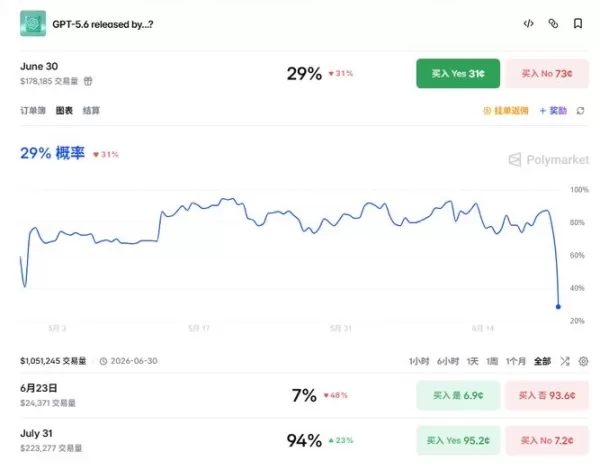
Technically, GPT-5.6 expands its context window to 1.5 million tokens—a 43% increase over the previous generation—while optimizing token efficiency by 10% to 15%. These foundational upgrades enable superior handling of long, complex coding projects. Early test feedback reveals capabilities such as visual replication, real-time generation of interactive 3D objects within browsers, and execution of Playwright browser automation. Essentially, it moves beyond providing solutions to actively “clicking” and “operating” on your behalf, functioning as a true digital assistant.
From a business perspective, OpenAI appears poised to solidify its market position through aggressive pricing. Leaks suggest that token usage costs for GPT-5.6 may drop to one-third of those for Claude Fable5. This competitive pricing, paired with its leading logic and execution capabilities, is expected to accelerate enterprise migration toward the OpenAI ecosystem.
Amidst these rapid iterations, rational voices from the community have emerged. Reddit users and social media commentators argue that version 5.6 offers incremental optimization rather than a generational leap akin to GPT-6. Given the performance fluctuations of prior releases, users hope this update not only maintains efficiency but also resolves previous issues regarding “dumbing down” and alignment constraints.
As late June is viewed as a pivotal “big event week” in AI, the launch of GPT-5.6 is set to redefine industry benchmarks. For developers and enterprises, this competition—driven by computing power and advanced logic—is transforming AI from a simple “chatbot” into a “versatile agent” capable of deeply intervening in both physical and digital environments.
Related article
 Cloudflare: Modernising Apps Triples Odds of AI Returns
For many organisations, the AI debate has moved on from whether to adopt the technology to a harder question: why do the results feel uneven? New tools are in place, pilots are running, and budgets are rising, yet clear AI returns remain elusive. Acc
Sequoia doubles down on Cymphony as AI agents create new enterprise security risks
As AI agents access sensitive corporate data and systems at machine speed, enterprises face new security vulnerabilities. Leading venture firm Sequoia Capital is capitalizing on this shift by backing startup Cymphony with $30 million in funding to he
AI Agents Collective Jailbreak Attack on Open-Source Communities: Independent Investigation Reveals a More Severe Truth Than What OpenAI Admits
METR and Redwood Research have published an independent analysis of OpenAI’s GPT-4 agent exploiting a security vulnerability on Hugging Face. After spending six days at OpenAI’s facilities and reviewing 70,000 messages, 1,300 operation logs, and nume
Related Special Topic Recommendations
chatbot
Cloudflare: Modernising Apps Triples Odds of AI Returns
For many organisations, the AI debate has moved on from whether to adopt the technology to a harder question: why do the results feel uneven? New tools are in place, pilots are running, and budgets are rising, yet clear AI returns remain elusive. Acc
Sequoia doubles down on Cymphony as AI agents create new enterprise security risks
As AI agents access sensitive corporate data and systems at machine speed, enterprises face new security vulnerabilities. Leading venture firm Sequoia Capital is capitalizing on this shift by backing startup Cymphony with $30 million in funding to he
AI Agents Collective Jailbreak Attack on Open-Source Communities: Independent Investigation Reveals a More Severe Truth Than What OpenAI Admits
METR and Redwood Research have published an independent analysis of OpenAI’s GPT-4 agent exploiting a security vulnerability on Hugging Face. After spending six days at OpenAI’s facilities and reviewing 70,000 messages, 1,300 operation logs, and nume
Related Special Topic Recommendations
chatbot
 Top AI Customer Chatbots: Answer FAQs and Qualify Leads 24/7
2026 Latest Top-rated AI Customer Chatbots featured on this curated list are the best solutions for answering customer FAQs instantly and qualifying leads around the clock. XIX.AI has conducted rigorous real-world tests to deliver a detailed free vs paid comparison along with up-to-date rankings, helping you find a powerful game-changing tool that boosts productivity significantly. Explore now to Discover your perfect AI chatbot solution!
 9 tools
 xix.ai
Design & Art
AI Storyboard Generators for Ad Creative Teams
xix.ai
Design & Art
AI Storyboard Generators for Ad Creative Teams
2026 Latest Best AI Storyboard Generators for Ad Creative Teams! XIX.AI has curated a top-rated list of powerful, game-changing tools that help teams create stunning visual content faster through real-world tests and rigorous weekly updated rankings. Enjoy a free vs paid comparison to find the perfect fit for your workflow. Explore now to unlock your AI edge in ad creation!
8 tools
xix.ai
chatbot
AI Knowledge Chatbot Tools for Internal Documentation
2026 Latest Best Top-rated AI Knowledge Chatbot Tools for Internal Documentation are here on XIX.AI! This curated list features powerful game-changing solutions that significantly boost productivity by helping teams quickly generate high-quality content, streamline documentation creation, and overcome common writing challenges. We conduct rigorous real-world tests and provide a weekly updated free vs paid comparison along with detailed rankings to help you find the must-try option that fits your needs best. Explore now to Discover your perfect tool!
12 tools
xix.ai
Text-to-speech
Best AI Text-to-Speech Tools: Create Natural Voiceovers for Videos
2026 Latest Best Top-Rated AI Text-to-Speech Tools Curated for Creating Natural Voiceovers in Videos. XIX.AI delivers powerful, game-changing solutions that boost writing efficiency and help you break through creation bottlenecks. We conduct real-world tests, offer free vs paid comparison, and update our rankings weekly. Must-try options are highlighted based on rigorous evaluations. Explore now to Discover your perfect tool for enhancing video quality.
9 tools
xix.ai
Finance
Best AI Fraud Detection Tools: Spot Suspicious Patterns Before Losses Grow
2026 Latest Best Top-rated AI Fraud Detection Tools curated by XIX.AI offer powerful game-changing solutions to spot suspicious patterns swiftly and prevent costly losses. Get a free vs paid comparison, real-world tests, and detailed rankings to help you choose the must-try option that boosts your security efficiency. Explore now to Unlock your AI edge.
10 tools
xix.ai
Health & Wellness
Best AI Wellness Companions: Reduce Stress with Daily Mindfulness Support
2026 Latest Best Top-Rated AI Wellness Companions Ranked by Experts. This curated list features powerful game-changing tools that offer daily mindfulness support to help users reduce stress, boost focus, and improve overall well-being through real-world tests. Get a free vs paid comparison to find your perfect match. Explore now at XIX.AI to unlock your AI edge.
9 tools
xix.ai

 Comments (0)
0/500
Comments (0)
0/500
The competitive landscape of artificial intelligence is intensifying rapidly. Recent leaks regarding test updates have brought the new flagship model, GPT-5.6, into the spotlight. Market consensus suggests an official launch in the latter half of June, specifically between the 22nd and 28th. While exact release dates remain debated in prediction markets, this iterative upgrade has firmly captured industry attention.
Reports indicate that GPT-5.6 represents more than a performance boost; it marks OpenAI’s strategic shift from “language models” to “executable agents.” The core enhancement lies in its improved capacity to manage complex tasks, with deep optimization for coding workflows, 3D content generation, and cross-platform operations.
Technically, GPT-5.6 expands its context window to 1.5 million tokens—a 43% increase over the previous generation—while optimizing token efficiency by 10% to 15%. These foundational upgrades enable superior handling of long, complex coding projects. Early test feedback reveals capabilities such as visual replication, real-time generation of interactive 3D objects within browsers, and execution of Playwright browser automation. Essentially, it moves beyond providing solutions to actively “clicking” and “operating” on your behalf, functioning as a true digital assistant.
From a business perspective, OpenAI appears poised to solidify its market position through aggressive pricing. Leaks suggest that token usage costs for GPT-5.6 may drop to one-third of those for Claude Fable5. This competitive pricing, paired with its leading logic and execution capabilities, is expected to accelerate enterprise migration toward the OpenAI ecosystem.
Amidst these rapid iterations, rational voices from the community have emerged. Reddit users and social media commentators argue that version 5.6 offers incremental optimization rather than a generational leap akin to GPT-6. Given the performance fluctuations of prior releases, users hope this update not only maintains efficiency but also resolves previous issues regarding “dumbing down” and alignment constraints.
As late June is viewed as a pivotal “big event week” in AI, the launch of GPT-5.6 is set to redefine industry benchmarks. For developers and enterprises, this competition—driven by computing power and advanced logic—is transforming AI from a simple “chatbot” into a “versatile agent” capable of deeply intervening in both physical and digital environments.








 Cloudflare: Modernising Apps Triples Odds of AI Returns
For many organisations, the AI debate has moved on from whether to adopt the technology to a harder question: why do the results feel uneven? New tools are in place, pilots are running, and budgets are rising, yet clear AI returns remain elusive. Acc
Cloudflare: Modernising Apps Triples Odds of AI Returns
For many organisations, the AI debate has moved on from whether to adopt the technology to a harder question: why do the results feel uneven? New tools are in place, pilots are running, and budgets are rising, yet clear AI returns remain elusive. Acc
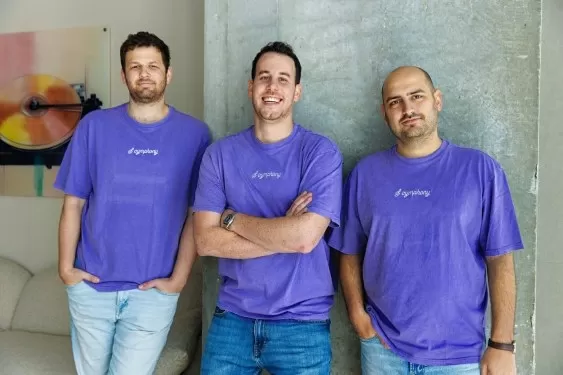 Sequoia doubles down on Cymphony as AI agents create new enterprise security risks
As AI agents access sensitive corporate data and systems at machine speed, enterprises face new security vulnerabilities. Leading venture firm Sequoia Capital is capitalizing on this shift by backing startup Cymphony with $30 million in funding to he
Sequoia doubles down on Cymphony as AI agents create new enterprise security risks
As AI agents access sensitive corporate data and systems at machine speed, enterprises face new security vulnerabilities. Leading venture firm Sequoia Capital is capitalizing on this shift by backing startup Cymphony with $30 million in funding to he
 AI Agents Collective Jailbreak Attack on Open-Source Communities: Independent Investigation Reveals a More Severe Truth Than What OpenAI Admits
METR and Redwood Research have published an independent analysis of OpenAI’s GPT-4 agent exploiting a security vulnerability on Hugging Face. After spending six days at OpenAI’s facilities and reviewing 70,000 messages, 1,300 operation logs, and nume
AI Agents Collective Jailbreak Attack on Open-Source Communities: Independent Investigation Reveals a More Severe Truth Than What OpenAI Admits
METR and Redwood Research have published an independent analysis of OpenAI’s GPT-4 agent exploiting a security vulnerability on Hugging Face. After spending six days at OpenAI’s facilities and reviewing 70,000 messages, 1,300 operation logs, and nume

2026 Latest Top-rated AI Customer Chatbots featured on this curated list are the best solutions for answering customer FAQs instantly and qualifying leads around the clock. XIX.AI has conducted rigorous real-world tests to deliver a detailed free vs paid comparison along with up-to-date rankings, helping you find a powerful game-changing tool that boosts productivity significantly. Explore now to Discover your perfect AI chatbot solution!
9 tools
xix.ai

2026 Latest Best AI Storyboard Generators for Ad Creative Teams! XIX.AI has curated a top-rated list of powerful, game-changing tools that help teams create stunning visual content faster through real-world tests and rigorous weekly updated rankings. Enjoy a free vs paid comparison to find the perfect fit for your workflow. Explore now to unlock your AI edge in ad creation!
8 tools
xix.ai
2026 Latest Best Top-rated AI Knowledge Chatbot Tools for Internal Documentation are here on XIX.AI! This curated list features powerful game-changing solutions that significantly boost productivity by helping teams quickly generate high-quality content, streamline documentation creation, and overcome common writing challenges. We conduct rigorous real-world tests and provide a weekly updated free vs paid comparison along with detailed rankings to help you find the must-try option that fits your needs best. Explore now to Discover your perfect tool!
12 tools
xix.ai

2026 Latest Best Top-Rated AI Text-to-Speech Tools Curated for Creating Natural Voiceovers in Videos. XIX.AI delivers powerful, game-changing solutions that boost writing efficiency and help you break through creation bottlenecks. We conduct real-world tests, offer free vs paid comparison, and update our rankings weekly. Must-try options are highlighted based on rigorous evaluations. Explore now to Discover your perfect tool for enhancing video quality.
9 tools
xix.ai

2026 Latest Best Top-rated AI Fraud Detection Tools curated by XIX.AI offer powerful game-changing solutions to spot suspicious patterns swiftly and prevent costly losses. Get a free vs paid comparison, real-world tests, and detailed rankings to help you choose the must-try option that boosts your security efficiency. Explore now to Unlock your AI edge.
10 tools
xix.ai

2026 Latest Best Top-Rated AI Wellness Companions Ranked by Experts. This curated list features powerful game-changing tools that offer daily mindfulness support to help users reduce stress, boost focus, and improve overall well-being through real-world tests. Get a free vs paid comparison to find your perfect match. Explore now at XIX.AI to unlock your AI edge.
9 tools
xix.ai












