


 Home
HomeGoogle Vids Introduces Feature Allowing Users to Star in Custom AI-Generated Videos
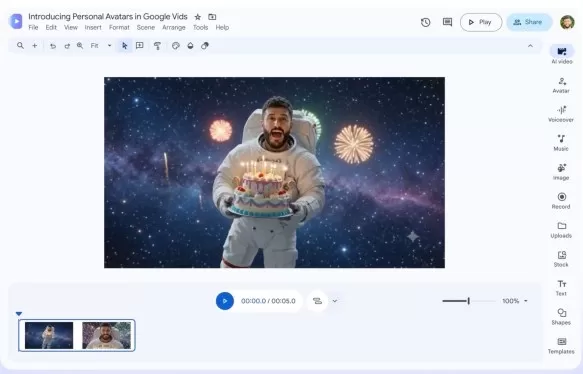
Although OpenAI’s Sora has been discontinued, Google believes there remains strong demand for a tool that enables users to appear as the main character in their own AI-generated videos. On Thursday, the company released an update to Google Vids that adds the capability to create a personalized digital avatar based on a user‑uploaded selfie and voice recording.
Furthermore, Google is integrating its multi‑modal AI model Gemini Omni into Vids. This integration allows users to craft videos by combining a written description with reference images they upload. Gemini Omni then synthesizes these inputs to produce the desired AI video. It can also be utilized to modify elements such as background changes, lighting adjustments, or the addition of visual effects to videos recorded on a smartphone.
In addition, Omni now supports step‑by‑step editing, giving users the option to make incremental changes to their videos rather than starting from scratch each time.
These updates transform Google Vids from its original purpose as an AI‑assisted tool for workplace presentations into a comprehensive video creation platform. By incorporating Vids into Google Workspace, the company signals its potential use for business applications such as internal updates and training materials. At the same time, the ability to create personalized avatars and perform conversational edits positions Vids as a direct competitor to other AI video startups and services like HeyGen, Synthesia, Captions, and D-ID.
Google specifies that the new AI avatars will be designed to resemble the account holder, linked to their Google account, and will include an invisible watermark generated by SynthID. This measure is intended to prevent the misuse of the tool to produce unusual AI videos featuring individuals such as Google CEO Sundar Pichai, a scenario that was possible with OpenAI’s Sora.
The company also states that access to personalized avatars is restricted to users located in specific regions who are at least 18 years old.
Related article
 Toyota’s $6.4bn robotics estimate puts physical AI in focus
Toyota Motor projects that rolling out automation across its manufacturing facilities, subsidiaries, and key suppliers may require approximately 400,000 robots and an annual expenditure of roughly 1 trillion yen ($6.4 billion) starting in 2028.Accord
Friend, the Lonely AI Wearable, Returns With a New Voice and a Much Bigger Price Tag
Two years ago, tech entrepreneur Avi Schiffmann introduced Friend, an AI-powered wearable device designed for conversation and daily text updates. The core concept was to leverage artificial intelligence to alleviate feelings of isolation. This week,
NY to Cap Power for 50M AI Data Centers
New York’s actions illustrate how governments globally might manage, tax, and regulate the physical footprint of the AI boom. Credit: Luca Bravo/UnsplashNew York Governor Kathy Hochul signs a historic executive order halting data centres, while state
Related Special Topic Recommendations
Productivity
Toyota’s $6.4bn robotics estimate puts physical AI in focus
Toyota Motor projects that rolling out automation across its manufacturing facilities, subsidiaries, and key suppliers may require approximately 400,000 robots and an annual expenditure of roughly 1 trillion yen ($6.4 billion) starting in 2028.Accord
Friend, the Lonely AI Wearable, Returns With a New Voice and a Much Bigger Price Tag
Two years ago, tech entrepreneur Avi Schiffmann introduced Friend, an AI-powered wearable device designed for conversation and daily text updates. The core concept was to leverage artificial intelligence to alleviate feelings of isolation. This week,
NY to Cap Power for 50M AI Data Centers
New York’s actions illustrate how governments globally might manage, tax, and regulate the physical footprint of the AI boom. Credit: Luca Bravo/UnsplashNew York Governor Kathy Hochul signs a historic executive order halting data centres, while state
Related Special Topic Recommendations
Productivity
 AI Task Planning Tools for Busy Professionals
2026 Latest Best Top-rated AI Task Planning Tools for Busy Professionals! XIX.AI has curated a powerful, game-changing collection of highly efficient tools that help users streamline workflows, boost productivity, and overcome daily scheduling challenges. Each option goes through rigorous real-world tests to ensure reliability. Get a free vs paid comparison and discover the perfect tool to unlock your AI edge. Explore now!
 15 tools
 xix.ai
chatbot
Top AI Customer Chatbots: Answer FAQs and Qualify Leads 24/7
xix.ai
chatbot
Top AI Customer Chatbots: Answer FAQs and Qualify Leads 24/7
2026 Latest Top-rated AI Customer Chatbots featured on this curated list are the best solutions for answering customer FAQs instantly and qualifying leads around the clock. XIX.AI has conducted rigorous real-world tests to deliver a detailed free vs paid comparison along with up-to-date rankings, helping you find a powerful game-changing tool that boosts productivity significantly. Explore now to Discover your perfect AI chatbot solution!
9 tools
xix.ai
Design & Art
AI Storyboard Generators for Ad Creative Teams
2026 Latest Best AI Storyboard Generators for Ad Creative Teams! XIX.AI has curated a top-rated list of powerful, game-changing tools that help teams create stunning visual content faster through real-world tests and rigorous weekly updated rankings. Enjoy a free vs paid comparison to find the perfect fit for your workflow. Explore now to unlock your AI edge in ad creation!
8 tools
xix.ai
chatbot
AI Knowledge Chatbot Tools for Internal Documentation
2026 Latest Best Top-rated AI Knowledge Chatbot Tools for Internal Documentation are here on XIX.AI! This curated list features powerful game-changing solutions that significantly boost productivity by helping teams quickly generate high-quality content, streamline documentation creation, and overcome common writing challenges. We conduct rigorous real-world tests and provide a weekly updated free vs paid comparison along with detailed rankings to help you find the must-try option that fits your needs best. Explore now to Discover your perfect tool!
12 tools
xix.ai
Text-to-speech
Best AI Text-to-Speech Tools: Create Natural Voiceovers for Videos
2026 Latest Best Top-Rated AI Text-to-Speech Tools Curated for Creating Natural Voiceovers in Videos. XIX.AI delivers powerful, game-changing solutions that boost writing efficiency and help you break through creation bottlenecks. We conduct real-world tests, offer free vs paid comparison, and update our rankings weekly. Must-try options are highlighted based on rigorous evaluations. Explore now to Discover your perfect tool for enhancing video quality.
9 tools
xix.ai
Finance
Best AI Fraud Detection Tools: Spot Suspicious Patterns Before Losses Grow
2026 Latest Best Top-rated AI Fraud Detection Tools curated by XIX.AI offer powerful game-changing solutions to spot suspicious patterns swiftly and prevent costly losses. Get a free vs paid comparison, real-world tests, and detailed rankings to help you choose the must-try option that boosts your security efficiency. Explore now to Unlock your AI edge.
10 tools
xix.ai

 Comments (0)
0/500
Comments (0)
0/500
Although OpenAI’s Sora has been discontinued, Google believes there remains strong demand for a tool that enables users to appear as the main character in their own AI-generated videos. On Thursday, the company released an update to Google Vids that adds the capability to create a personalized digital avatar based on a user‑uploaded selfie and voice recording.
Furthermore, Google is integrating its multi‑modal AI model Gemini Omni into Vids. This integration allows users to craft videos by combining a written description with reference images they upload. Gemini Omni then synthesizes these inputs to produce the desired AI video. It can also be utilized to modify elements such as background changes, lighting adjustments, or the addition of visual effects to videos recorded on a smartphone.
In addition, Omni now supports step‑by‑step editing, giving users the option to make incremental changes to their videos rather than starting from scratch each time.
These updates transform Google Vids from its original purpose as an AI‑assisted tool for workplace presentations into a comprehensive video creation platform. By incorporating Vids into Google Workspace, the company signals its potential use for business applications such as internal updates and training materials. At the same time, the ability to create personalized avatars and perform conversational edits positions Vids as a direct competitor to other AI video startups and services like HeyGen, Synthesia, Captions, and D-ID.
Google specifies that the new AI avatars will be designed to resemble the account holder, linked to their Google account, and will include an invisible watermark generated by SynthID. This measure is intended to prevent the misuse of the tool to produce unusual AI videos featuring individuals such as Google CEO Sundar Pichai, a scenario that was possible with OpenAI’s Sora.
The company also states that access to personalized avatars is restricted to users located in specific regions who are at least 18 years old.








 Toyota’s $6.4bn robotics estimate puts physical AI in focus
Toyota Motor projects that rolling out automation across its manufacturing facilities, subsidiaries, and key suppliers may require approximately 400,000 robots and an annual expenditure of roughly 1 trillion yen ($6.4 billion) starting in 2028.Accord
Toyota’s $6.4bn robotics estimate puts physical AI in focus
Toyota Motor projects that rolling out automation across its manufacturing facilities, subsidiaries, and key suppliers may require approximately 400,000 robots and an annual expenditure of roughly 1 trillion yen ($6.4 billion) starting in 2028.Accord
 Friend, the Lonely AI Wearable, Returns With a New Voice and a Much Bigger Price Tag
Two years ago, tech entrepreneur Avi Schiffmann introduced Friend, an AI-powered wearable device designed for conversation and daily text updates. The core concept was to leverage artificial intelligence to alleviate feelings of isolation. This week,
Friend, the Lonely AI Wearable, Returns With a New Voice and a Much Bigger Price Tag
Two years ago, tech entrepreneur Avi Schiffmann introduced Friend, an AI-powered wearable device designed for conversation and daily text updates. The core concept was to leverage artificial intelligence to alleviate feelings of isolation. This week,
 NY to Cap Power for 50M AI Data Centers
New York’s actions illustrate how governments globally might manage, tax, and regulate the physical footprint of the AI boom. Credit: Luca Bravo/UnsplashNew York Governor Kathy Hochul signs a historic executive order halting data centres, while state
NY to Cap Power for 50M AI Data Centers
New York’s actions illustrate how governments globally might manage, tax, and regulate the physical footprint of the AI boom. Credit: Luca Bravo/UnsplashNew York Governor Kathy Hochul signs a historic executive order halting data centres, while state

2026 Latest Best Top-rated AI Task Planning Tools for Busy Professionals! XIX.AI has curated a powerful, game-changing collection of highly efficient tools that help users streamline workflows, boost productivity, and overcome daily scheduling challenges. Each option goes through rigorous real-world tests to ensure reliability. Get a free vs paid comparison and discover the perfect tool to unlock your AI edge. Explore now!
15 tools
xix.ai

2026 Latest Top-rated AI Customer Chatbots featured on this curated list are the best solutions for answering customer FAQs instantly and qualifying leads around the clock. XIX.AI has conducted rigorous real-world tests to deliver a detailed free vs paid comparison along with up-to-date rankings, helping you find a powerful game-changing tool that boosts productivity significantly. Explore now to Discover your perfect AI chatbot solution!
9 tools
xix.ai

2026 Latest Best AI Storyboard Generators for Ad Creative Teams! XIX.AI has curated a top-rated list of powerful, game-changing tools that help teams create stunning visual content faster through real-world tests and rigorous weekly updated rankings. Enjoy a free vs paid comparison to find the perfect fit for your workflow. Explore now to unlock your AI edge in ad creation!
8 tools
xix.ai
2026 Latest Best Top-rated AI Knowledge Chatbot Tools for Internal Documentation are here on XIX.AI! This curated list features powerful game-changing solutions that significantly boost productivity by helping teams quickly generate high-quality content, streamline documentation creation, and overcome common writing challenges. We conduct rigorous real-world tests and provide a weekly updated free vs paid comparison along with detailed rankings to help you find the must-try option that fits your needs best. Explore now to Discover your perfect tool!
12 tools
xix.ai
2026 Latest Best Top-Rated AI Text-to-Speech Tools Curated for Creating Natural Voiceovers in Videos. XIX.AI delivers powerful, game-changing solutions that boost writing efficiency and help you break through creation bottlenecks. We conduct real-world tests, offer free vs paid comparison, and update our rankings weekly. Must-try options are highlighted based on rigorous evaluations. Explore now to Discover your perfect tool for enhancing video quality.
9 tools
xix.ai

2026 Latest Best Top-rated AI Fraud Detection Tools curated by XIX.AI offer powerful game-changing solutions to spot suspicious patterns swiftly and prevent costly losses. Get a free vs paid comparison, real-world tests, and detailed rankings to help you choose the must-try option that boosts your security efficiency. Explore now to Unlock your AI edge.
10 tools
xix.ai












