


 Home
HomeWhat is GFF3 Galaxy Tools? Complete genome annotation guide for 2025.
Working with genome annotation effectively demands tools that are both powerful and adaptable. The Generic Feature Format (GFF) and its newer version, GFF3, provide a consistent standard for annotating regions of a genome and their related information. The Galaxy GFF3 Tool Suite serves as a robust solution for handling, converting, and submitting this genomic data. This comprehensive set of tools, which includes Python scripts and a Conda/PyPi package, is built to simplify processes for developers and bioinformaticians, particularly those using the Galaxy framework. In this guide, we'll explore the GFF3 format, its uses, and the specific features of the Galaxy GFF3 Tool Suite.
Key Points
GFF3 is a nine-column, tab-delimited file format for annotating genomic features, comparable to the Genbank format.
The Galaxy GFF3 Tool Suite offers a collection of utilities for processing and converting GFF3 files.
This suite integrates directly with the Galaxy platform, streamlining bioinformatics processes.
It is available as both Python scripts and a Conda/PyPi package for developer convenience.
GFF3 is a core component of the Apollo Annotation Engine, used for visualizing genomic data.
The tool suite is built upon SeqFeature to minimize required code changes and improve compatibility.
Understanding the GFF3 Format
What is GFF3?
The Generic Feature Format (GFF), and specifically its third version GFF3, is an essential file type for marking and describing specific regions in a genome.
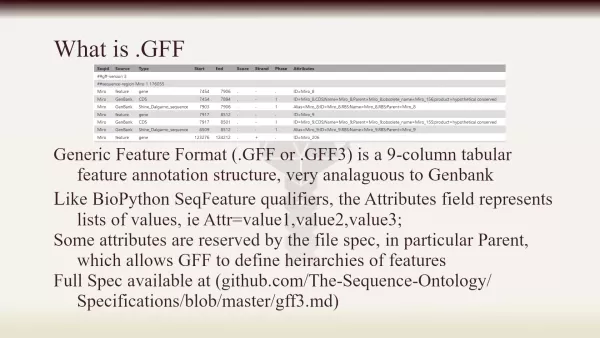
It uses a simple 9-column, tab-delimited structure, similar to the Genbank format, but includes additional elements to improve how features are described. This format makes storing and sharing genomic annotation data efficient and standardized.
Key characteristics of GFF3 include:
- Tabular Structure: Data is organized into nine columns, each describing a specific attribute of a genomic feature.
- Feature Qualifiers:The final column contains detailed annotations, similar to Genbank's qualifiers. A key reserved term here is 'Parent', which is used to define relationships and hierarchies between features.
- Attribute Field: Lists of values are stored in this field using a simple format, for example: Attr=value1,value2,value3.
The complete GFF3 specification is hosted on GitHub by The Sequence Ontology, where researchers can examine its details.
Key Differences from Genbank
Although GFF3 and Genbank are similar, knowing their differences is key to effective data management. The main distinction is the hierarchical structure GFF3 creates with its 'Parent' qualifier. This allows for a more organized and explicit representation of how features relate to each other. In Genbank, these relationships can be less clearly defined, sometimes relying on qualifiers that don't inherently show hierarchy. GFF3's approach ensures a standardized and clear method for defining these connections, which is vital for complex annotations.
Another difference is in sequence data handling. GFF3 files typically reference external sequence files rather than containing the sequence within the annotation file itself, which helps manage file sizes. Its attribute field also offers greater flexibility for adding custom data compared to Genbank.
Understanding these distinctions is crucial for leveraging the specific benefits of GFF3 in genome annotation projects.
Addressing BioPython Limitations
The Need for a New Package
A key reason for creating the Galaxy GFF3 Tool Suite was to work around limitations in BioPython's native handling of GFF3.
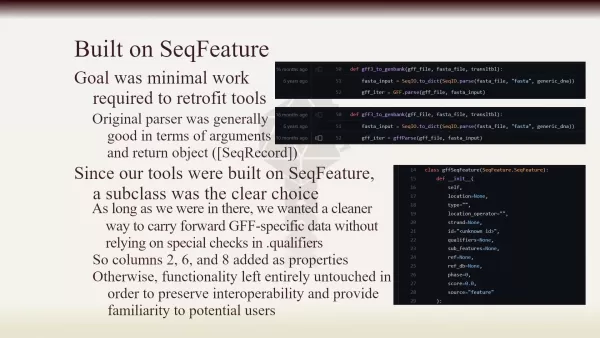
While BioPython is a valuable tool, its decision to deprecate sub-feature definitions for SeqFeatures presented a challenge for representing the hierarchical data common in GFF3 files.
To solve this, the CPT (Center for Phage Technology) created its own parsing solution with three main goals:
- Lightweight Package: To ensure smooth compatibility within the Galaxy ecosystem.
- Robust Error Logging: To provide better error checking and reporting during file parsing.
- Minimal Script Changes: To require as few modifications as possible to existing analysis scripts.
These goals were met by extending the existing SeqFeature class into a new GFF3SeqFeature class. This approach minimized changes and preserved the functionality users already relied on. Attributes like phase, score, and source were added directly as object properties, improving both code maintenance and data consistency.
Using the Galaxy GFF3 Tool Suite
Installing the CPT GFF Parser
The CPT GFF Parser is easy to install, ensuring smooth integration into your bioinformatics setup. Installation is supported via both pip and Conda, depending on your preferred package manager.
Using pip:
pip install CPT-GFFParser
Using Conda:
conda install -c ajc_atb cpt_gffparser
By offering both pip and Conda packages, the CPT GFF Parser guarantees broad compatibility and simple installation across different systems. This flexibility allows bioinformaticians to quickly add the parser to their existing toolkits, improving their ability to work with GFF3 data.
Steps to Implement Galaxy tools
While the CPT team provides a set of ready-to-use tools, you can also process other GFF3 files within Galaxy by following these general steps:
Install Galaxy: Ensure that Galaxy is installed and running on your system or server.
Access Tool Panel: Navigate to the Galaxy interface and confirm the tool panel is accessible.
Upload GFF3 File: Use the upload function to select and import your GFF3 file from your computer.
Run Analyses and other Bioinformatics Tools: Apply additional Galaxy tools to filter, analyze, or refine your annotation data.
Availability and Resources
Accessing the Tool Suite
The Galaxy GFF3 Tool Suite and the CPT GFF Parser are freely available for use and distribution. All components, including Python scripts, Conda packages, and documentation, can be accessed through the following channels:
- GitHub Repository: The source code and full documentation are hosted on GitHub under the TAMU-CPT organization.
- PyPi Package: The CPT GFF Parser is available on PyPi for straightforward pip installation.
- Conda Package: The parser is also available as a Conda package for easy integration into Conda-managed environments.
Making these resources openly available encourages collaboration and knowledge sharing in the bioinformatics community. The goal is to provide researchers and developers with the tools they need to advance their work in genome annotation.
Core Features of the Galaxy GFF3 Tool Suite
Key Capabilities
The Galaxy GFF3 Tool Suite provides a range of core features designed to improve genome annotation workflows. These features are tailored to meet the needs of bioinformaticians, developers, and researchers working with GFF3 files.
Some of the suite's core functions include:
- Format Conversion: Easily convert GFF3 files to and from other common formats, ensuring compatibility with various bioinformatics tools and databases.
- Error Handling: The suite includes detailed error logging to help identify and fix issues during file parsing and manipulation.
- Customization: Adapt the tools to suit specific project requirements, offering flexibility in data handling and analysis.
- Hierarchical Support: Full support for the Parent qualifier ensures the structured relationships between features are maintained.
The Galaxy GFF3 Tool Suite offers a comprehensive set of utilities that empower researchers to efficiently manage, analyze, and annotate genomic data.
Use Cases for the Galaxy GFF3 Tool Suite
Real-World Applications
The Galaxy GFF3 Tool Suite is used in various practical scenarios in bioinformatics. Its flexibility and integration capabilities make it a valuable resource for researchers, developers, and bioinformaticians.
Common use cases for implementing this suite include:
- Genome Annotation: Supporting precise annotation of genomic features for tasks like gene prediction, functional analysis, and comparative genomics.
- Apollo Integration: Connecting with the Apollo genome annotation editor to visualize and collaboratively edit annotations.
- Workflow Automation: Integrating seamlessly with the Galaxy platform to build automated pipelines for large-scale genomic analyses.
- Database Submissions: Facilitating the conversion of annotation data into formats required for submission to major public databases.
Frequently Asked Questions
What exactly is a GFF3 file?
GFF3 (Generic Feature Format Version 3) is a plain text file used to describe features and annotations on DNA, RNA, or protein sequences. It is widely used in bioinformatics for detailing gene structures, regulatory elements, and other genomic landmarks.
How does GFF3 differ from other annotation formats like Genbank?
While both formats serve a similar purpose, GFF3 emphasizes hierarchical relationships between features using the 'Parent' attribute, leading to more structured and organized annotations. Furthermore, GFF3 files typically reference external sequence files, whereas Genbank files often contain the sequence data within the same file.
What tools are included in the Galaxy GFF3 Tool Suite?
The Galaxy GFF3 Tool Suite includes utilities for reformatting, validating, annotating genes, repositioning features, and converting between file formats. It also features a GFF3 validator to ensure files comply with the official specification.
Is the Galaxy GFF3 Tool Suite difficult to use?
The Tool Suite, along with the CPT GFF parser, is designed for ease of use. A primary goal in developing the CPT GFF parser was to minimize the need to rework existing workflows while maintaining familiar functionality.
Related Questions
What are common challenges in genome annotation, and how can the GFF3 Tool Suite help address them?
Genome annotation involves a combination of computational and manual steps to identify and characterize functional elements in a genome. Researchers often face challenges such as: integrating data from different sources, managing data complexity, working with incomplete datasets, a lack of standardization, scaling analyses for large genomes, visualizing results, and computational resource limits. The GFF3 Tool Suite helps tackle many of these issues. By providing standardized functions and reducing complexity and manual effort, it enhances usability and the overall success of annotation projects.
Related article
 Stripe to Acquire OpenRouter as AI Model Routing Gains Momentum
Stripe has agreed to acquire OpenRouter, an AI model-routing platform that gives developers access to hundreds of models through a single interface. The deal adds model selection and routing to Stripe’s existing work around AI usage and token-based b
Former OpenAI Researcher Barrett Zoph Returns to Google to Support Gemini Development
Barret Zoph, who previously abruptly left and joined OpenAI due to a disagreement with Thinking Machines Lab CEO Miriam Mularati, has once again changed employers. Alphabet's Google announced that Zoph will return as Vice President of Research, bring
How Recursive Intelligence Raised $335M at $4B Valuation in 4 Months
The co-founders of startup Ricursive Intelligence seemed destined to be co-founders.Anna Goldie, CEO, and Azalia Mirhoseini, CTO, are so well-known in the AI community that they were among those AI engineers who “got those weird emails from Zuckerber
Related Special Topic Recommendations
Design & Art
Stripe to Acquire OpenRouter as AI Model Routing Gains Momentum
Stripe has agreed to acquire OpenRouter, an AI model-routing platform that gives developers access to hundreds of models through a single interface. The deal adds model selection and routing to Stripe’s existing work around AI usage and token-based b
Former OpenAI Researcher Barrett Zoph Returns to Google to Support Gemini Development
Barret Zoph, who previously abruptly left and joined OpenAI due to a disagreement with Thinking Machines Lab CEO Miriam Mularati, has once again changed employers. Alphabet's Google announced that Zoph will return as Vice President of Research, bring
How Recursive Intelligence Raised $335M at $4B Valuation in 4 Months
The co-founders of startup Ricursive Intelligence seemed destined to be co-founders.Anna Goldie, CEO, and Azalia Mirhoseini, CTO, are so well-known in the AI community that they were among those AI engineers who “got those weird emails from Zuckerber
Related Special Topic Recommendations
Design & Art
 Top AI Illustration Tools: Create Editorial Scenes and Cover Art Faster
2026 Latest Top-rated AI Illustration Tools: Our curated list features the best powerfully designed tools for creating stunning editorial scenes and eye-catching cover art quickly. Each option has gone through rigorous real-world tests, offering a free vs paid comparison to help you find the perfect match for your workflow. Try these must-try solutions today to unlock your AI edge and boost your creative productivity. Explore now at XIX.AI.
 10 tools
 xix.ai
Education and Learning
Top AI Tutors for Exam Prep: Practice Math, Science, and English
xix.ai
Education and Learning
Top AI Tutors for Exam Prep: Practice Math, Science, and English
2026 Latest Top-Rated Best AI Tutors for Exam Prep are here on XIX.AI! Our curated list features powerful game-changing tools that offer free vs paid comparison, real-world tests, and weekly updated rankings. They help boost your writing efficiency, simplify complex topic learning, and unlock your academic potential. Explore now to Discover your perfect exam prep tool and Start creating today to Unlock your AI edge!
10 tools
xix.ai
Finance
AI Budget Planning Tools for Personal Money Management
2026 Latest Best Top-Rated AI Budget Planning Tools for Personal Money Management are here on XIX.AI! This curated collection features powerful, game-changing solutions that help you conduct real-world tests, understand spending habits, and create personalized plans to boost productivity. Enjoy a free vs paid comparison along with detailed rankings. Must-try tools designed to simplify money management and unlock your AI edge. Explore now!
11 tools
xix.ai
Health & Wellness
AI Sleep Tracking Assistants: Improve Recovery with Better Bedtime Habits
2026 Latest Best Top-Rated AI Sleep Tracking Assistants curated for ultimate recovery. This fully updated weekly guide features powerful tools that deliver real-world tests, free vs paid comparison, and detailed rankings to help you find the must-try solution that boosts sleep quality and supports better bedtime habits. Explore now at XIX.AI to Unlock your AI edge.
10 tools
xix.ai
Data Analysis
AI SQL Copilots for Product and Revenue Analytics
2026 Latest Best Top-Rated AI SQL Copilots for Product and Revenue Analytics! XIX.AI has curated a powerful, game-changing collection of must-try tools that undergo real-world tests through weekly updated rankings. These tools help users boost productivity significantly by accelerating data analysis, streamlining complex queries, and generating accurate insights to drive smarter business decisions. Explore now to Discover your perfect tool for unlocking your AI edge!
14 tools
xix.ai
Education and Learning
Best AI Homework Helpers That Teach: Learn Concepts, Not Just Answers
2026 Latest Best Top-Rated AI Homework Helpers That Teach Core Concepts Not Just Answers Powerful Tools for Students Must-Try Curated List Weekly Updated Free vs Paid Comparison Real-World Tests Accurate Rankings to Help You Unlock Your Full Learning Potential Explore now to Discover your perfect tool for smarter studying.
10 tools
xix.ai

 Comments (1)
0/500
Comments (1)
0/500
![MarkLopez]()
Ça me semble hyper utile pour organiser les annotations génomiques, mais je me demande si ce format ne devient pas un peu trop complexe pour les débutants ? C'est comme si on avait besoin d'un manuel juste pour comprendre le manuel 😅. En tout cas, c'est cool de voir des outils comme Galaxy essayer de rendre ça plus accessible !
Working with genome annotation effectively demands tools that are both powerful and adaptable. The Generic Feature Format (GFF) and its newer version, GFF3, provide a consistent standard for annotating regions of a genome and their related information. The Galaxy GFF3 Tool Suite serves as a robust solution for handling, converting, and submitting this genomic data. This comprehensive set of tools, which includes Python scripts and a Conda/PyPi package, is built to simplify processes for developers and bioinformaticians, particularly those using the Galaxy framework. In this guide, we'll explore the GFF3 format, its uses, and the specific features of the Galaxy GFF3 Tool Suite.
Key Points
GFF3 is a nine-column, tab-delimited file format for annotating genomic features, comparable to the Genbank format.
The Galaxy GFF3 Tool Suite offers a collection of utilities for processing and converting GFF3 files.
This suite integrates directly with the Galaxy platform, streamlining bioinformatics processes.
It is available as both Python scripts and a Conda/PyPi package for developer convenience.
GFF3 is a core component of the Apollo Annotation Engine, used for visualizing genomic data.
The tool suite is built upon SeqFeature to minimize required code changes and improve compatibility.
Understanding the GFF3 Format
What is GFF3?
The Generic Feature Format (GFF), and specifically its third version GFF3, is an essential file type for marking and describing specific regions in a genome.
It uses a simple 9-column, tab-delimited structure, similar to the Genbank format, but includes additional elements to improve how features are described. This format makes storing and sharing genomic annotation data efficient and standardized.
Key characteristics of GFF3 include:
- Tabular Structure: Data is organized into nine columns, each describing a specific attribute of a genomic feature.
- Feature Qualifiers:The final column contains detailed annotations, similar to Genbank's qualifiers. A key reserved term here is 'Parent', which is used to define relationships and hierarchies between features.
- Attribute Field: Lists of values are stored in this field using a simple format, for example: Attr=value1,value2,value3.
The complete GFF3 specification is hosted on GitHub by The Sequence Ontology, where researchers can examine its details.
Key Differences from Genbank
Although GFF3 and Genbank are similar, knowing their differences is key to effective data management. The main distinction is the hierarchical structure GFF3 creates with its 'Parent' qualifier. This allows for a more organized and explicit representation of how features relate to each other. In Genbank, these relationships can be less clearly defined, sometimes relying on qualifiers that don't inherently show hierarchy. GFF3's approach ensures a standardized and clear method for defining these connections, which is vital for complex annotations.
Another difference is in sequence data handling. GFF3 files typically reference external sequence files rather than containing the sequence within the annotation file itself, which helps manage file sizes. Its attribute field also offers greater flexibility for adding custom data compared to Genbank.
Understanding these distinctions is crucial for leveraging the specific benefits of GFF3 in genome annotation projects.
Addressing BioPython Limitations
The Need for a New Package
A key reason for creating the Galaxy GFF3 Tool Suite was to work around limitations in BioPython's native handling of GFF3.
While BioPython is a valuable tool, its decision to deprecate sub-feature definitions for SeqFeatures presented a challenge for representing the hierarchical data common in GFF3 files.
To solve this, the CPT (Center for Phage Technology) created its own parsing solution with three main goals:
- Lightweight Package: To ensure smooth compatibility within the Galaxy ecosystem.
- Robust Error Logging: To provide better error checking and reporting during file parsing.
- Minimal Script Changes: To require as few modifications as possible to existing analysis scripts.
These goals were met by extending the existing SeqFeature class into a new GFF3SeqFeature class. This approach minimized changes and preserved the functionality users already relied on. Attributes like phase, score, and source were added directly as object properties, improving both code maintenance and data consistency.
Using the Galaxy GFF3 Tool Suite
Installing the CPT GFF Parser
The CPT GFF Parser is easy to install, ensuring smooth integration into your bioinformatics setup. Installation is supported via both pip and Conda, depending on your preferred package manager.
Using pip:
pip install CPT-GFFParser
Using Conda:
conda install -c ajc_atb cpt_gffparser
By offering both pip and Conda packages, the CPT GFF Parser guarantees broad compatibility and simple installation across different systems. This flexibility allows bioinformaticians to quickly add the parser to their existing toolkits, improving their ability to work with GFF3 data.
Steps to Implement Galaxy tools
While the CPT team provides a set of ready-to-use tools, you can also process other GFF3 files within Galaxy by following these general steps:
Install Galaxy: Ensure that Galaxy is installed and running on your system or server.
Access Tool Panel: Navigate to the Galaxy interface and confirm the tool panel is accessible.
Upload GFF3 File: Use the upload function to select and import your GFF3 file from your computer.
Run Analyses and other Bioinformatics Tools: Apply additional Galaxy tools to filter, analyze, or refine your annotation data.
Availability and Resources
Accessing the Tool Suite
The Galaxy GFF3 Tool Suite and the CPT GFF Parser are freely available for use and distribution. All components, including Python scripts, Conda packages, and documentation, can be accessed through the following channels:
- GitHub Repository: The source code and full documentation are hosted on GitHub under the TAMU-CPT organization.
- PyPi Package: The CPT GFF Parser is available on PyPi for straightforward pip installation.
- Conda Package: The parser is also available as a Conda package for easy integration into Conda-managed environments.
Making these resources openly available encourages collaboration and knowledge sharing in the bioinformatics community. The goal is to provide researchers and developers with the tools they need to advance their work in genome annotation.
Core Features of the Galaxy GFF3 Tool Suite
Key Capabilities
The Galaxy GFF3 Tool Suite provides a range of core features designed to improve genome annotation workflows. These features are tailored to meet the needs of bioinformaticians, developers, and researchers working with GFF3 files.
Some of the suite's core functions include:
- Format Conversion: Easily convert GFF3 files to and from other common formats, ensuring compatibility with various bioinformatics tools and databases.
- Error Handling: The suite includes detailed error logging to help identify and fix issues during file parsing and manipulation.
- Customization: Adapt the tools to suit specific project requirements, offering flexibility in data handling and analysis.
- Hierarchical Support: Full support for the Parent qualifier ensures the structured relationships between features are maintained.
The Galaxy GFF3 Tool Suite offers a comprehensive set of utilities that empower researchers to efficiently manage, analyze, and annotate genomic data.
Use Cases for the Galaxy GFF3 Tool Suite
Real-World Applications
The Galaxy GFF3 Tool Suite is used in various practical scenarios in bioinformatics. Its flexibility and integration capabilities make it a valuable resource for researchers, developers, and bioinformaticians.
Common use cases for implementing this suite include:
- Genome Annotation: Supporting precise annotation of genomic features for tasks like gene prediction, functional analysis, and comparative genomics.
- Apollo Integration: Connecting with the Apollo genome annotation editor to visualize and collaboratively edit annotations.
- Workflow Automation: Integrating seamlessly with the Galaxy platform to build automated pipelines for large-scale genomic analyses.
- Database Submissions: Facilitating the conversion of annotation data into formats required for submission to major public databases.
Frequently Asked Questions
What exactly is a GFF3 file?
GFF3 (Generic Feature Format Version 3) is a plain text file used to describe features and annotations on DNA, RNA, or protein sequences. It is widely used in bioinformatics for detailing gene structures, regulatory elements, and other genomic landmarks.
How does GFF3 differ from other annotation formats like Genbank?
While both formats serve a similar purpose, GFF3 emphasizes hierarchical relationships between features using the 'Parent' attribute, leading to more structured and organized annotations. Furthermore, GFF3 files typically reference external sequence files, whereas Genbank files often contain the sequence data within the same file.
What tools are included in the Galaxy GFF3 Tool Suite?
The Galaxy GFF3 Tool Suite includes utilities for reformatting, validating, annotating genes, repositioning features, and converting between file formats. It also features a GFF3 validator to ensure files comply with the official specification.
Is the Galaxy GFF3 Tool Suite difficult to use?
The Tool Suite, along with the CPT GFF parser, is designed for ease of use. A primary goal in developing the CPT GFF parser was to minimize the need to rework existing workflows while maintaining familiar functionality.
Related Questions
What are common challenges in genome annotation, and how can the GFF3 Tool Suite help address them?
Genome annotation involves a combination of computational and manual steps to identify and characterize functional elements in a genome. Researchers often face challenges such as: integrating data from different sources, managing data complexity, working with incomplete datasets, a lack of standardization, scaling analyses for large genomes, visualizing results, and computational resource limits. The GFF3 Tool Suite helps tackle many of these issues. By providing standardized functions and reducing complexity and manual effort, it enhances usability and the overall success of annotation projects.








 Stripe to Acquire OpenRouter as AI Model Routing Gains Momentum
Stripe has agreed to acquire OpenRouter, an AI model-routing platform that gives developers access to hundreds of models through a single interface. The deal adds model selection and routing to Stripe’s existing work around AI usage and token-based b
Stripe to Acquire OpenRouter as AI Model Routing Gains Momentum
Stripe has agreed to acquire OpenRouter, an AI model-routing platform that gives developers access to hundreds of models through a single interface. The deal adds model selection and routing to Stripe’s existing work around AI usage and token-based b
 Former OpenAI Researcher Barrett Zoph Returns to Google to Support Gemini Development
Barret Zoph, who previously abruptly left and joined OpenAI due to a disagreement with Thinking Machines Lab CEO Miriam Mularati, has once again changed employers. Alphabet's Google announced that Zoph will return as Vice President of Research, bring
Former OpenAI Researcher Barrett Zoph Returns to Google to Support Gemini Development
Barret Zoph, who previously abruptly left and joined OpenAI due to a disagreement with Thinking Machines Lab CEO Miriam Mularati, has once again changed employers. Alphabet's Google announced that Zoph will return as Vice President of Research, bring
 How Recursive Intelligence Raised $335M at $4B Valuation in 4 Months
The co-founders of startup Ricursive Intelligence seemed destined to be co-founders.Anna Goldie, CEO, and Azalia Mirhoseini, CTO, are so well-known in the AI community that they were among those AI engineers who “got those weird emails from Zuckerber
How Recursive Intelligence Raised $335M at $4B Valuation in 4 Months
The co-founders of startup Ricursive Intelligence seemed destined to be co-founders.Anna Goldie, CEO, and Azalia Mirhoseini, CTO, are so well-known in the AI community that they were among those AI engineers who “got those weird emails from Zuckerber
2026 Latest Top-rated AI Illustration Tools: Our curated list features the best powerfully designed tools for creating stunning editorial scenes and eye-catching cover art quickly. Each option has gone through rigorous real-world tests, offering a free vs paid comparison to help you find the perfect match for your workflow. Try these must-try solutions today to unlock your AI edge and boost your creative productivity. Explore now at XIX.AI.
10 tools
xix.ai

2026 Latest Top-Rated Best AI Tutors for Exam Prep are here on XIX.AI! Our curated list features powerful game-changing tools that offer free vs paid comparison, real-world tests, and weekly updated rankings. They help boost your writing efficiency, simplify complex topic learning, and unlock your academic potential. Explore now to Discover your perfect exam prep tool and Start creating today to Unlock your AI edge!
10 tools
xix.ai

2026 Latest Best Top-Rated AI Budget Planning Tools for Personal Money Management are here on XIX.AI! This curated collection features powerful, game-changing solutions that help you conduct real-world tests, understand spending habits, and create personalized plans to boost productivity. Enjoy a free vs paid comparison along with detailed rankings. Must-try tools designed to simplify money management and unlock your AI edge. Explore now!
11 tools
xix.ai

2026 Latest Best Top-Rated AI Sleep Tracking Assistants curated for ultimate recovery. This fully updated weekly guide features powerful tools that deliver real-world tests, free vs paid comparison, and detailed rankings to help you find the must-try solution that boosts sleep quality and supports better bedtime habits. Explore now at XIX.AI to Unlock your AI edge.
10 tools
xix.ai
2026 Latest Best Top-Rated AI SQL Copilots for Product and Revenue Analytics! XIX.AI has curated a powerful, game-changing collection of must-try tools that undergo real-world tests through weekly updated rankings. These tools help users boost productivity significantly by accelerating data analysis, streamlining complex queries, and generating accurate insights to drive smarter business decisions. Explore now to Discover your perfect tool for unlocking your AI edge!
14 tools
xix.ai

2026 Latest Best Top-Rated AI Homework Helpers That Teach Core Concepts Not Just Answers Powerful Tools for Students Must-Try Curated List Weekly Updated Free vs Paid Comparison Real-World Tests Accurate Rankings to Help You Unlock Your Full Learning Potential Explore now to Discover your perfect tool for smarter studying.
10 tools
xix.ai

Ça me semble hyper utile pour organiser les annotations génomiques, mais je me demande si ce format ne devient pas un peu trop complexe pour les débutants ? C'est comme si on avait besoin d'un manuel juste pour comprendre le manuel 😅. En tout cas, c'est cool de voir des outils comme Galaxy essayer de rendre ça plus accessible !












