


 Home
Google’s Gemini 2.5 Flash Emerges as an Affordable AI Powerhouse
Google continues to lead innovation in artificial intelligence, with its latest Gemini 2.5 Flash model generating significant interest. This release focuses not only on performance but also on accessibility, offering a low-latency, cost-efficient AI solution suitable for diverse applications—from high-volume real-time interactions to generative AI tasks. Here's an exploration of why this model represents a transformative development for developers and businesses.
Key Points
Gemini 2.5 Flash emphasizes cost-efficiency, bringing advanced AI capabilities within reach for more users.
It performs exceptionally well in high-volume, real-time use cases such as chatbots and data analytics, as well as generative AI applications.
The model extends the sophisticated reasoning features of the Gemini 2.5 series.
It aims to deliver performance on par with larger models, but with greater speed and affordability.
Two separate pricing tiers are available for 'thinking' and 'non-thinking' modes, providing adaptable usage options.
Understanding Gemini 2.5 Flash: A Cost-Effective AI Model
What is Gemini 2.5 Flash?
Gemini 2.5 Flash is the newest addition to Google's Gemini AI model family, designed as a versatile 'workhorse' model.
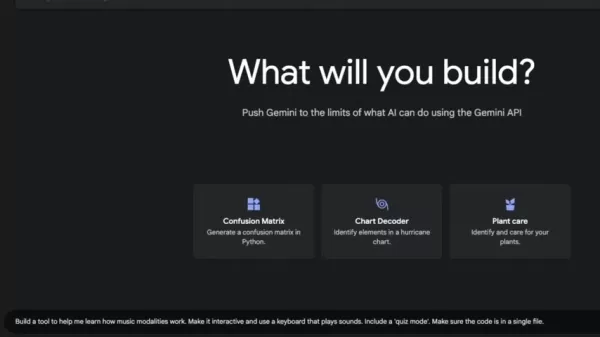
It emphasizes affordability and minimal delay while maintaining robust performance. Ideal for high-volume, real-time applications, it is well-suited for chatbots, analytics dashboards, and interactive tools. A notable strength is its support for agentic workflows, indicating Google's vision for the model in autonomous, dynamic systems. In essence, Gemini 2.5 Flash aims not to lead in every performance metric, but to serve as a practical, accessible AI solution for diverse scenarios.
The Power of Pricing: Understanding the Tiers
A key differentiator for Gemini 2.5 Flash is its innovative pricing model.
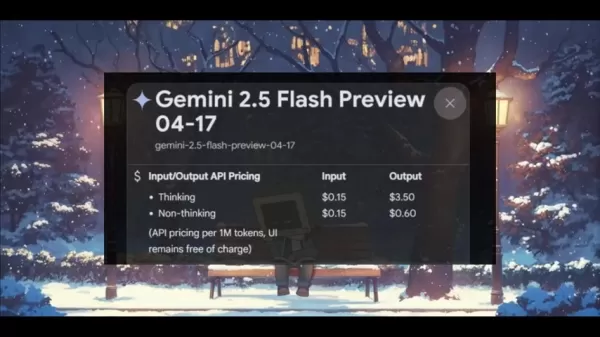
Google offers two distinct tiers: a 'thinking' mode for complex reasoning tasks, priced at $0.15 per million input tokens and $3.50 per million output tokens, and a 'non-thinking' mode for simpler tasks, priced at $0.15 per million input tokens and $0.60 per million output tokens. This tiered system enables developers to align costs with application requirements, resulting in considerable savings, particularly for data-intensive tasks that don't demand intensive reasoning for every operation.
Applications and Potential: Where Gemini 2.5 Flash Shines
The economical nature of Gemini 2.5 Flash makes it appealing for numerous applications.
Key areas where this model stands out include:
- Chatbots: Enabling interactive customer service experiences at a manageable cost.
- Analytics Dashboards: Delivering real-time insights and data visualizations from large datasets affordably.
- Generative AI: Efficiently producing dynamic content and completing creative tasks.
- Agentic Workflows: Automating operations within sophisticated, self-directed systems.
Comparing Gemini 2.5 Flash to Other AI Models
Benchmarking Gemini 2.5 Flash Performance
Benchmark tests compare Gemini 2.5 Flash with models like OpenAI's O4-mini, Claude 3.7 Sonnet, Grok 3 Beta, and DeepSeek R1. Gemini 2.5 Flash is priced at $0.15 per million input tokens and $0.60 per million output tokens, with its 'reasoning' mode priced at $3.50.
A Comparison of AI Models
Gemini 2.5 Flash stands out by balancing affordability with capable performance across various tasks. While larger models might excel in specific areas, Gemini 2.5 Flash provides a cost-efficient alternative for many applications. Its competitive pricing is set to influence a new wave of AI services and software.
Below is a performance overview of Gemini 2.5 Flash compared to other leading models:
Benchmark Gemini 2.5 Flash Gemini 2.0 Flash OpenAI o4-mini Claude Sonnet 3.7 Grok 3 Beta DeepSeek R1 Input Price ($ / 1M tokens) $0.15 $0.10 $1.10 $3.00 $3.00 $0.55 Output Price ($ / 1M tokens) $0.60 $0.40 $4.40 $15.00 $15.00 $2.19 Reasoning (Humanity's Last Exam) 12.1% 5.1% 14.3% 8.9% 8.6% 8.6% Science (GPOA Diamond) 78.3% 60.1% 81.4% 78.2% 80.2% 71.5% Mathematics (Aime 2025) 78.0% 27.5% 92.7% 49.5% 77.3% 70.0% Mathematics (AIME 2024) 88.0% 32.0% 93.4% 61.3% 83.9% 79.8% Code Generation (LiveCodeBench) 63.5% 34.5% 70.6% 70.6% 70.6% 64.3%
Getting Started with Gemini 2.5 Flash
Accessing Gemini 2.5 Flash in Google AI Studio
To start using Gemini 2.5 Flash, visit Google AI Studio.
You'll find Gemini 2.5 Flash listed in the model selection dropdown. There, you can choose between 'thinking' and 'non-thinking' modes to match your task requirements. Google AI Studio also provides adjustable settings such as temperature control, structured output customization, code execution, and Google Search grounding.
Code Execution Demonstrations
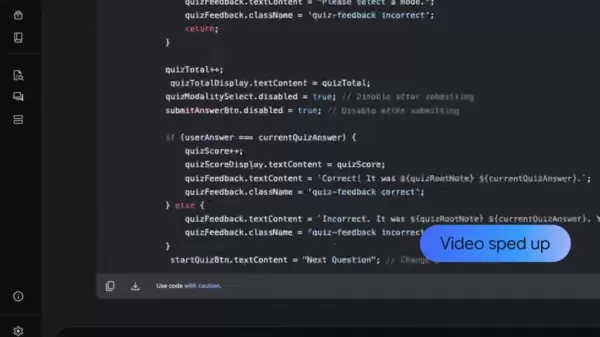
The demonstration includes several benchmarks run through direct prompts to the Google AI assistant, which successfully generated, output, and rendered code using the new model. Examples include:
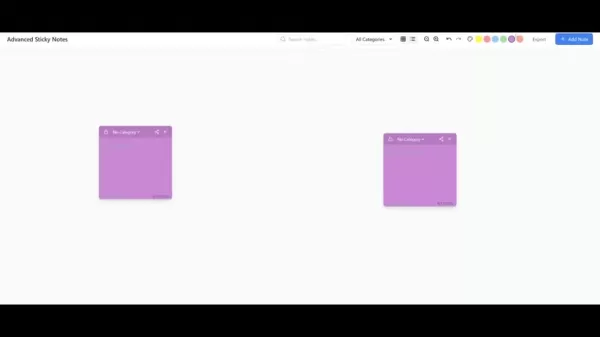
- A Sticky Notes App: The AI rapidly created a fully functional, visually appealing front-end for note management.
- Conway's Game of Life: The AI received a prompt to develop a Python simulation of this classic cellular automaton.
Gemini 2.5 Flash Pricing Details
Cost-Effective and Scalable Pricing
Gemini 2.5 Flash features an attractive pricing model with 'Thinking' and 'Non-Thinking' options.
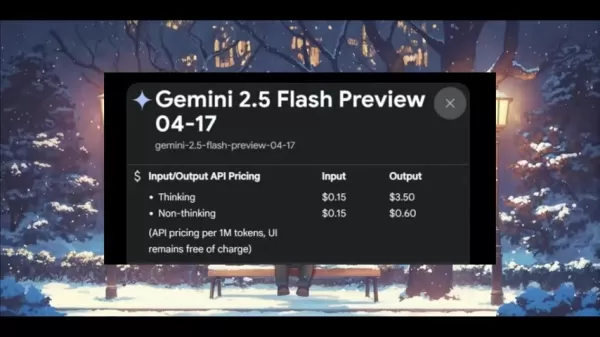
'Thinking' tasks cost $0.15 per million input tokens and $3.50 per million output tokens, while 'Non-Thinking' mode reduces output costs to $0.60 per million tokens. This positions Gemini 2.5 Flash as a budget-friendly AI solution. Additionally, rate limits have been increased to 500 requests daily for developer testing.
Weighing the Pros and Cons of Gemini 2.5 Flash
Pros
Highly cost-effective
Excels in high-volume, real-time applications
Builds upon the reasoning capabilities of the Gemini 2.5 series
Offers flexible pricing tiers
Cons
May not outperform larger models in all benchmarks
Performance varies with workload, which can be both a limitation and an advantage
Limited to 500 requests on the free tier
Ideal Use Cases for Gemini 2.5 Flash
High-Volume, Real-Time Applications
Gemini 2.5 Flash is particularly effective for applications requiring fast responses and high throughput. Its low latency and economical pricing make it ideal for handling numerous concurrent users or large data streams.
Chatbots and Conversational AI
This model offers a budget-friendly approach to building interactive and engaging chatbot experiences, enabling scalable customer service and support solutions.
Workflow Automation
Gemini's speed and efficiency make it a compelling option for automating routine tasks, helping businesses streamline operations, reduce manual work, and boost productivity.
Frequently Asked Questions about Gemini 2.5 Flash
What are the key advantages of using Gemini 2.5 Flash?
Gemini 2.5 Flash combines cost-efficiency, low latency, and solid performance, especially for high-volume, real-time applications. Its flexible pricing allows developers to manage AI expenses effectively.
What kind of applications is Gemini 2.5 Flash best suited for?
This model is ideal for chatbots, analytics dashboards, agentic workflows, and other applications that need quick responses and efficient handling of large datasets.
How does the pricing work for Gemini 2.5 Flash?
Gemini 2.5 Flash offers two pricing tiers: a 'thinking' mode for complex reasoning and a 'non-thinking' mode for simpler tasks, each with separate input and output token rates. Google AI Studio also includes adjustable settings like temperature control, structured output, code execution, and Google Search grounding.
Related Questions
How does Gemini 2.5 Flash compare to other AI models like Gemini 2.5 Pro or OpenAI's offerings?
Gemini 2.5 Flash is positioned as a cost-effective alternative that delivers quality comparable to larger models, but with greater speed and lower cost. While it may not lead in every benchmark, its pricing makes it appealing for many practical uses.
What are the limitations of Gemini 2.5 Flash?
The model may not be the best choice for tasks requiring peak accuracy or advanced reasoning. Developers should evaluate their application's specific needs when selecting between Gemini 2.5 Flash and other models. Always review user agreements and codes of conduct to ensure optimal use.
How can I stay up-to-date on the latest AI news and developments, including updates to the Gemini family of models?
Subscribe to industry newsletters, follow AI research organizations and experts on social media, and check Google AI's official site regularly for news and updates. The field of AI is advancing rapidly, offering exciting opportunities for involvement.
Related article
 Stripe to Acquire OpenRouter as AI Model Routing Gains Momentum
Stripe has agreed to acquire OpenRouter, an AI model-routing platform that gives developers access to hundreds of models through a single interface. The deal adds model selection and routing to Stripe’s existing work around AI usage and token-based b
Former OpenAI Researcher Barrett Zoph Returns to Google to Support Gemini Development
Barret Zoph, who previously abruptly left and joined OpenAI due to a disagreement with Thinking Machines Lab CEO Miriam Mularati, has once again changed employers. Alphabet's Google announced that Zoph will return as Vice President of Research, bring
How Recursive Intelligence Raised $335M at $4B Valuation in 4 Months
The co-founders of startup Ricursive Intelligence seemed destined to be co-founders.Anna Goldie, CEO, and Azalia Mirhoseini, CTO, are so well-known in the AI community that they were among those AI engineers who “got those weird emails from Zuckerber
Related Special Topic Recommendations
Design & Art
 Top AI Illustration Tools: Create Editorial Scenes and Cover Art Faster
2026 Latest Top-rated AI Illustration Tools: Our curated list features the best powerfully designed tools for creating stunning editorial scenes and eye-catching cover art quickly. Each option has gone through rigorous real-world tests, offering a free vs paid comparison to help you find the perfect match for your workflow. Try these must-try solutions today to unlock your AI edge and boost your creative productivity. Explore now at XIX.AI.
 10 tools
 xix.ai
Education and Learning
Top AI Tutors for Exam Prep: Practice Math, Science, and English
2026 Latest Top-Rated Best AI Tutors for Exam Prep are here on XIX.AI! Our curated list features powerful game-changing tools that offer free vs paid comparison, real-world tests, and weekly updated rankings. They help boost your writing efficiency, simplify complex topic learning, and unlock your academic potential. Explore now to Discover your perfect exam prep tool and Start creating today to Unlock your AI edge!
10 tools
xix.ai
Finance
AI Budget Planning Tools for Personal Money Management
2026 Latest Best Top-Rated AI Budget Planning Tools for Personal Money Management are here on XIX.AI! This curated collection features powerful, game-changing solutions that help you conduct real-world tests, understand spending habits, and create personalized plans to boost productivity. Enjoy a free vs paid comparison along with detailed rankings. Must-try tools designed to simplify money management and unlock your AI edge. Explore now!
11 tools
xix.ai
Health & Wellness
AI Sleep Tracking Assistants: Improve Recovery with Better Bedtime Habits
2026 Latest Best Top-Rated AI Sleep Tracking Assistants curated for ultimate recovery. This fully updated weekly guide features powerful tools that deliver real-world tests, free vs paid comparison, and detailed rankings to help you find the must-try solution that boosts sleep quality and supports better bedtime habits. Explore now at XIX.AI to Unlock your AI edge.
10 tools
xix.ai
Data Analysis
AI SQL Copilots for Product and Revenue Analytics
2026 Latest Best Top-Rated AI SQL Copilots for Product and Revenue Analytics! XIX.AI has curated a powerful, game-changing collection of must-try tools that undergo real-world tests through weekly updated rankings. These tools help users boost productivity significantly by accelerating data analysis, streamlining complex queries, and generating accurate insights to drive smarter business decisions. Explore now to Discover your perfect tool for unlocking your AI edge!
14 tools
xix.ai
Education and Learning
Best AI Homework Helpers That Teach: Learn Concepts, Not Just Answers
2026 Latest Best Top-Rated AI Homework Helpers That Teach Core Concepts Not Just Answers Powerful Tools for Students Must-Try Curated List Weekly Updated Free vs Paid Comparison Real-World Tests Accurate Rankings to Help You Unlock Your Full Learning Potential Explore now to Discover your perfect tool for smarter studying.
10 tools
xix.ai

 Comments (3)
0/500
![NicholasAdams]()
Finally, an AI model that doesn't break the bank! Gemini 2.5 Flash looks like a game-changer for developers who need speed without the premium price tag. Google is really pushing the boundaries here, making high-end AI accessible to more people. Can't wait to test its latency myself!
![AndrewAllen]()
C'est impressionnant de voir Google rendre l'IA aussi abordable ! 😮 Mais est-ce que cette accessibilité va accélérer l'adoption ou simplement créer plus de dépendance envers leurs écosystèmes ? J'aimerais savoir comment ça se compare aux modèles open-source.
![NicholasLewis]()
Finalmente um modelo mais barato! Fico feliz de ver grandes empresas priorizando acessibilidade, não apenas PURE performance. Ainda sim, será que isso de fato abre portas para desenvolvedores independentes, ou é apenas uma jogada para dominar ainda mais o mercado? Só espero que eles continuem melhorando a privacidade também.😅
Google continues to lead innovation in artificial intelligence, with its latest Gemini 2.5 Flash model generating significant interest. This release focuses not only on performance but also on accessibility, offering a low-latency, cost-efficient AI solution suitable for diverse applications—from high-volume real-time interactions to generative AI tasks. Here's an exploration of why this model represents a transformative development for developers and businesses.
Key Points
Gemini 2.5 Flash emphasizes cost-efficiency, bringing advanced AI capabilities within reach for more users.
It performs exceptionally well in high-volume, real-time use cases such as chatbots and data analytics, as well as generative AI applications.
The model extends the sophisticated reasoning features of the Gemini 2.5 series.
It aims to deliver performance on par with larger models, but with greater speed and affordability.
Two separate pricing tiers are available for 'thinking' and 'non-thinking' modes, providing adaptable usage options.
Understanding Gemini 2.5 Flash: A Cost-Effective AI Model
What is Gemini 2.5 Flash?
Gemini 2.5 Flash is the newest addition to Google's Gemini AI model family, designed as a versatile 'workhorse' model.
It emphasizes affordability and minimal delay while maintaining robust performance. Ideal for high-volume, real-time applications, it is well-suited for chatbots, analytics dashboards, and interactive tools. A notable strength is its support for agentic workflows, indicating Google's vision for the model in autonomous, dynamic systems. In essence, Gemini 2.5 Flash aims not to lead in every performance metric, but to serve as a practical, accessible AI solution for diverse scenarios.
The Power of Pricing: Understanding the Tiers
A key differentiator for Gemini 2.5 Flash is its innovative pricing model.
Google offers two distinct tiers: a 'thinking' mode for complex reasoning tasks, priced at $0.15 per million input tokens and $3.50 per million output tokens, and a 'non-thinking' mode for simpler tasks, priced at $0.15 per million input tokens and $0.60 per million output tokens. This tiered system enables developers to align costs with application requirements, resulting in considerable savings, particularly for data-intensive tasks that don't demand intensive reasoning for every operation.
Applications and Potential: Where Gemini 2.5 Flash Shines
The economical nature of Gemini 2.5 Flash makes it appealing for numerous applications.
Key areas where this model stands out include:
- Chatbots: Enabling interactive customer service experiences at a manageable cost.
- Analytics Dashboards: Delivering real-time insights and data visualizations from large datasets affordably.
- Generative AI: Efficiently producing dynamic content and completing creative tasks.
- Agentic Workflows: Automating operations within sophisticated, self-directed systems.
Comparing Gemini 2.5 Flash to Other AI Models
Benchmarking Gemini 2.5 Flash Performance
Benchmark tests compare Gemini 2.5 Flash with models like OpenAI's O4-mini, Claude 3.7 Sonnet, Grok 3 Beta, and DeepSeek R1. Gemini 2.5 Flash is priced at $0.15 per million input tokens and $0.60 per million output tokens, with its 'reasoning' mode priced at $3.50.
A Comparison of AI Models
Gemini 2.5 Flash stands out by balancing affordability with capable performance across various tasks. While larger models might excel in specific areas, Gemini 2.5 Flash provides a cost-efficient alternative for many applications. Its competitive pricing is set to influence a new wave of AI services and software.
Below is a performance overview of Gemini 2.5 Flash compared to other leading models:
| Benchmark | Gemini 2.5 Flash | Gemini 2.0 Flash | OpenAI o4-mini | Claude Sonnet 3.7 | Grok 3 Beta | DeepSeek R1 |
|---|---|---|---|---|---|---|
| Input Price ($ / 1M tokens) | $0.15 | $0.10 | $1.10 | $3.00 | $3.00 | $0.55 |
| Output Price ($ / 1M tokens) | $0.60 | $0.40 | $4.40 | $15.00 | $15.00 | $2.19 |
| Reasoning (Humanity's Last Exam) | 12.1% | 5.1% | 14.3% | 8.9% | 8.6% | 8.6% |
| Science (GPOA Diamond) | 78.3% | 60.1% | 81.4% | 78.2% | 80.2% | 71.5% |
| Mathematics (Aime 2025) | 78.0% | 27.5% | 92.7% | 49.5% | 77.3% | 70.0% |
| Mathematics (AIME 2024) | 88.0% | 32.0% | 93.4% | 61.3% | 83.9% | 79.8% |
| Code Generation (LiveCodeBench) | 63.5% | 34.5% | 70.6% | 70.6% | 70.6% | 64.3% |
Getting Started with Gemini 2.5 Flash
Accessing Gemini 2.5 Flash in Google AI Studio
To start using Gemini 2.5 Flash, visit Google AI Studio.
You'll find Gemini 2.5 Flash listed in the model selection dropdown. There, you can choose between 'thinking' and 'non-thinking' modes to match your task requirements. Google AI Studio also provides adjustable settings such as temperature control, structured output customization, code execution, and Google Search grounding.
Code Execution Demonstrations
The demonstration includes several benchmarks run through direct prompts to the Google AI assistant, which successfully generated, output, and rendered code using the new model. Examples include:
- A Sticky Notes App: The AI rapidly created a fully functional, visually appealing front-end for note management.
- Conway's Game of Life: The AI received a prompt to develop a Python simulation of this classic cellular automaton.
Gemini 2.5 Flash Pricing Details
Cost-Effective and Scalable Pricing
Gemini 2.5 Flash features an attractive pricing model with 'Thinking' and 'Non-Thinking' options.
'Thinking' tasks cost $0.15 per million input tokens and $3.50 per million output tokens, while 'Non-Thinking' mode reduces output costs to $0.60 per million tokens. This positions Gemini 2.5 Flash as a budget-friendly AI solution. Additionally, rate limits have been increased to 500 requests daily for developer testing.
Weighing the Pros and Cons of Gemini 2.5 Flash
Pros
Highly cost-effective
Excels in high-volume, real-time applications
Builds upon the reasoning capabilities of the Gemini 2.5 series
Offers flexible pricing tiers
Cons
May not outperform larger models in all benchmarks
Performance varies with workload, which can be both a limitation and an advantage
Limited to 500 requests on the free tier
Ideal Use Cases for Gemini 2.5 Flash
High-Volume, Real-Time Applications
Gemini 2.5 Flash is particularly effective for applications requiring fast responses and high throughput. Its low latency and economical pricing make it ideal for handling numerous concurrent users or large data streams.
Chatbots and Conversational AI
This model offers a budget-friendly approach to building interactive and engaging chatbot experiences, enabling scalable customer service and support solutions.
Workflow Automation
Gemini's speed and efficiency make it a compelling option for automating routine tasks, helping businesses streamline operations, reduce manual work, and boost productivity.
Frequently Asked Questions about Gemini 2.5 Flash
What are the key advantages of using Gemini 2.5 Flash?
Gemini 2.5 Flash combines cost-efficiency, low latency, and solid performance, especially for high-volume, real-time applications. Its flexible pricing allows developers to manage AI expenses effectively.
What kind of applications is Gemini 2.5 Flash best suited for?
This model is ideal for chatbots, analytics dashboards, agentic workflows, and other applications that need quick responses and efficient handling of large datasets.
How does the pricing work for Gemini 2.5 Flash?
Gemini 2.5 Flash offers two pricing tiers: a 'thinking' mode for complex reasoning and a 'non-thinking' mode for simpler tasks, each with separate input and output token rates. Google AI Studio also includes adjustable settings like temperature control, structured output, code execution, and Google Search grounding.
Related Questions
How does Gemini 2.5 Flash compare to other AI models like Gemini 2.5 Pro or OpenAI's offerings?
Gemini 2.5 Flash is positioned as a cost-effective alternative that delivers quality comparable to larger models, but with greater speed and lower cost. While it may not lead in every benchmark, its pricing makes it appealing for many practical uses.
What are the limitations of Gemini 2.5 Flash?
The model may not be the best choice for tasks requiring peak accuracy or advanced reasoning. Developers should evaluate their application's specific needs when selecting between Gemini 2.5 Flash and other models. Always review user agreements and codes of conduct to ensure optimal use.
How can I stay up-to-date on the latest AI news and developments, including updates to the Gemini family of models?
Subscribe to industry newsletters, follow AI research organizations and experts on social media, and check Google AI's official site regularly for news and updates. The field of AI is advancing rapidly, offering exciting opportunities for involvement.








 Stripe to Acquire OpenRouter as AI Model Routing Gains Momentum
Stripe has agreed to acquire OpenRouter, an AI model-routing platform that gives developers access to hundreds of models through a single interface. The deal adds model selection and routing to Stripe’s existing work around AI usage and token-based b
 Former OpenAI Researcher Barrett Zoph Returns to Google to Support Gemini Development
Barret Zoph, who previously abruptly left and joined OpenAI due to a disagreement with Thinking Machines Lab CEO Miriam Mularati, has once again changed employers. Alphabet's Google announced that Zoph will return as Vice President of Research, bring
 How Recursive Intelligence Raised $335M at $4B Valuation in 4 Months
The co-founders of startup Ricursive Intelligence seemed destined to be co-founders.Anna Goldie, CEO, and Azalia Mirhoseini, CTO, are so well-known in the AI community that they were among those AI engineers who “got those weird emails from Zuckerber

2026 Latest Top-rated AI Illustration Tools: Our curated list features the best powerfully designed tools for creating stunning editorial scenes and eye-catching cover art quickly. Each option has gone through rigorous real-world tests, offering a free vs paid comparison to help you find the perfect match for your workflow. Try these must-try solutions today to unlock your AI edge and boost your creative productivity. Explore now at XIX.AI.
10 tools
xix.ai

2026 Latest Top-Rated Best AI Tutors for Exam Prep are here on XIX.AI! Our curated list features powerful game-changing tools that offer free vs paid comparison, real-world tests, and weekly updated rankings. They help boost your writing efficiency, simplify complex topic learning, and unlock your academic potential. Explore now to Discover your perfect exam prep tool and Start creating today to Unlock your AI edge!
10 tools
xix.ai

2026 Latest Best Top-Rated AI Budget Planning Tools for Personal Money Management are here on XIX.AI! This curated collection features powerful, game-changing solutions that help you conduct real-world tests, understand spending habits, and create personalized plans to boost productivity. Enjoy a free vs paid comparison along with detailed rankings. Must-try tools designed to simplify money management and unlock your AI edge. Explore now!
11 tools
xix.ai

2026 Latest Best Top-Rated AI Sleep Tracking Assistants curated for ultimate recovery. This fully updated weekly guide features powerful tools that deliver real-world tests, free vs paid comparison, and detailed rankings to help you find the must-try solution that boosts sleep quality and supports better bedtime habits. Explore now at XIX.AI to Unlock your AI edge.
10 tools
xix.ai

2026 Latest Best Top-Rated AI SQL Copilots for Product and Revenue Analytics! XIX.AI has curated a powerful, game-changing collection of must-try tools that undergo real-world tests through weekly updated rankings. These tools help users boost productivity significantly by accelerating data analysis, streamlining complex queries, and generating accurate insights to drive smarter business decisions. Explore now to Discover your perfect tool for unlocking your AI edge!
14 tools
xix.ai

2026 Latest Best Top-Rated AI Homework Helpers That Teach Core Concepts Not Just Answers Powerful Tools for Students Must-Try Curated List Weekly Updated Free vs Paid Comparison Real-World Tests Accurate Rankings to Help You Unlock Your Full Learning Potential Explore now to Discover your perfect tool for smarter studying.
10 tools
xix.ai

Finally, an AI model that doesn't break the bank! Gemini 2.5 Flash looks like a game-changer for developers who need speed without the premium price tag. Google is really pushing the boundaries here, making high-end AI accessible to more people. Can't wait to test its latency myself!
C'est impressionnant de voir Google rendre l'IA aussi abordable ! 😮 Mais est-ce que cette accessibilité va accélérer l'adoption ou simplement créer plus de dépendance envers leurs écosystèmes ? J'aimerais savoir comment ça se compare aux modèles open-source.
Finalmente um modelo mais barato! Fico feliz de ver grandes empresas priorizando acessibilidade, não apenas PURE performance. Ainda sim, será que isso de fato abre portas para desenvolvedores independentes, ou é apenas uma jogada para dominar ainda mais o mercado? Só espero que eles continuem melhorando a privacidade também.😅












